
The Ads You Get — What Gives Them the Right to Know You?
An explainer on personalized customer journeys: how real-time data and AI tools like Adobe Target, Salesforce Einstein, and Braze tailor touchpoints, plus a fact-check of a tool listicle and three questions for vetting personalization tools.
A while back, I came across a listicle: "The Top 10 AI Tools for Creating Personalized Customer Journeys."
Personalized customer journeys. Sounds like abstract tech jargon. But it has been quietly taking care of you, every single day.
Here's an example. Last night, on an e-commerce site, you spent three minutes looking at a pair of running shoes. You didn't buy. This morning you open your inbox, and there it is: a "running shoes, 30% off" email. You pick up your phone, and it's in your push notifications too. And when you finally contact customer service with a question, the person on the other end already knows you were agonizing over whether the shoes run small.
That whole process? That is a personalized customer journey.
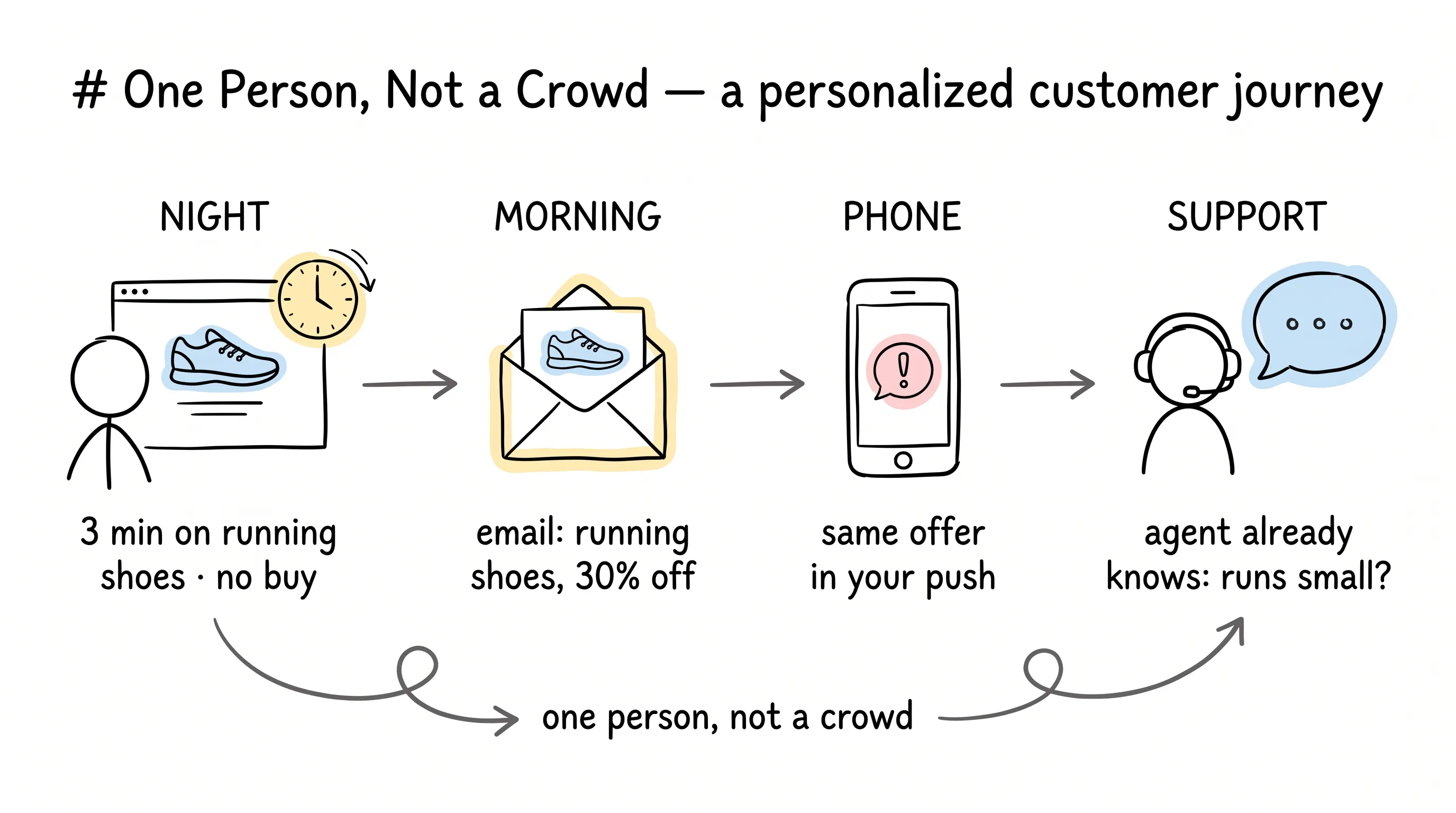
So what exactly is a personalized customer journey?
Simply put: it treats you as one person, not a crowd. What you clicked, how long you lingered on which page, what you bought — the system remembers all of it. Then, at every touchpoint, it shows you something different from what everyone else sees.
Marketing in the past couldn't do that. Old-school marketing was broadcasting: one piece of content, sent to ten thousand people, all identical.
Now it can. How? Real-time data, plus AI.
In this article, I'll spend half the time on that — and the other half on something more interesting: I did some fact-checking on that list, and I found problems.
First, What Kind of Players Can Actually Deliver One-to-One?
Of the tools on the list that I could verify and match to real products, I sorted them into three types.
Type one: the platform-level players. The classic examples are Adobe Target and Salesforce Einstein.
What Adobe Target does is make your website, your app, and your emails show each visitor something different. It feeds on real-time behavioral data, combined with predictive analytics, to decide what to show a given person at this very moment. Its A/B testing is rock-solid: two versions run side by side, the data speaks, and the winner takes over.
Salesforce Einstein is different. It doesn't live in the marketing department. It lives inside the CRM.
What's a CRM? It's the notebook a company keeps on "everything that has ever happened between me and each customer." Einstein puts AI inside that notebook: it predicts what a customer will want next, and even automates data entry and report generation. Your team can also build their own dashboards, watch the metrics move, and adjust strategy on the fly.
One handles the front line — what gets shown. The other handles the back office — what gets decided. Put these two together, and you basically have the chassis of personalized marketing.
Type two: the outreach players. The classic example is Braze.
Braze handles email, app push notifications, SMS, in-app messages — the things that land directly on your phone. It runs data in real time, slices audiences in real time, and orchestrates across channels. The benefit is immediate: the push notification and the email you receive say the same thing. No mixed signals.
Type three: the specialists.
Take Mutiny. It does website personalization for B2B companies only. B2B has a quirk: few visitors, but every visitor is expensive. Mutiny can identify, in real time, which company is visiting and what role that person holds, then dynamically swap the content — even running the A/B tests automatically. No need to keep a tech team around for it.
Take Omneky. It handles ad creative. Using machine learning, it generates ad assets in bulk, throws them at various channels to test, and automatically kills off the ones with poor numbers. A designer used to produce three images a day, picking versions by gut feel; now you can test hundreds a day and let the market vote.
Then there's Aidbase. It started out as AI customer support, and is now leaning into personalized journeys too: support no longer sits waiting for users to ask — it reaches out proactively, with context, based on behavioral data. Plus, it's not hard to hook into your systems, and the interface is friendly to support teams.
Now, the Interesting Part
The top six on the list: I could find real products, case studies, and customers for every one of them.
The back half of the list has four tools whose names I won't mention. I searched and searched: no official website, no customer stories, no evidence of any kind that they exist.
Either they're too new, or they've been renamed, or…
they simply don't exist.
I don't know which it is. But it got me thinking.
Think about it: a marketer, short on time and short on budget, works through a list one tool at a time. At the end, four of them are phantoms. What that person loses may be more than a bit of trial-and-error time. Worse: next time, they won't even trust the recommendations that are actually credible.
So on choosing tools, my view comes down to one sentence: a list is a catalog, not a conclusion.
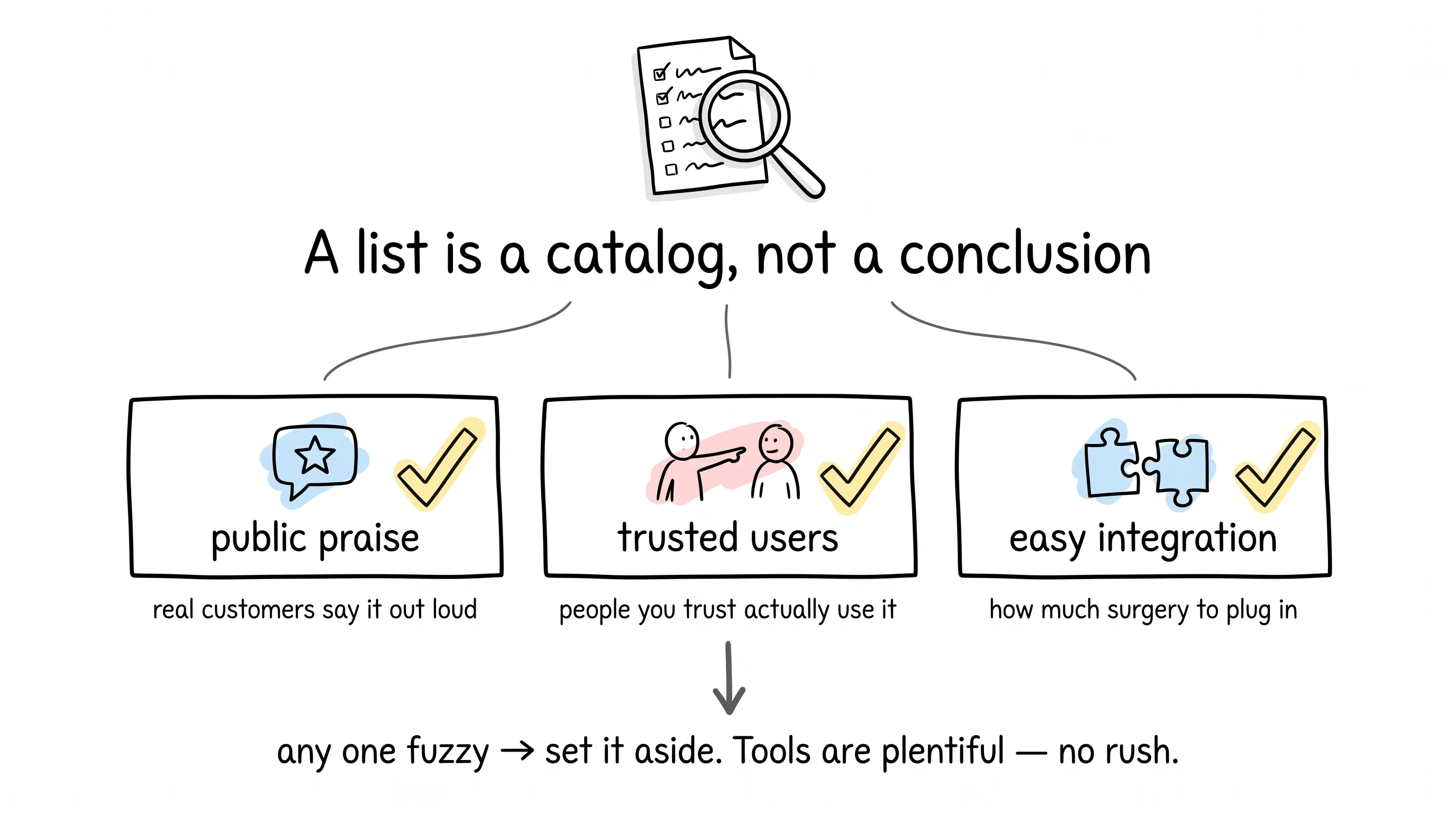
How do you verify? Check three things: whether real customers have praised it in public; whether people you trust are actually using it; and how much surgery it takes to plug into your existing systems.
If any one of the three is fuzzy, set it aside for now. Tools are plentiful. There's no rush.
How to Choose? I Compressed It into Three Questions
That list laid out six criteria — real-time data processing, predictive analytics, integration difficulty, multichannel, scalability, ease of use. All valid, but too long. I've compressed them into three questions:
One: Is it real-time? The user just clicked "close page," and your system takes three seconds to catch up — too late. With personalization, one step slow is basically the same as not doing it at all.
Two: Does it plug into your existing systems? Your CRM lives in Salesforce, but you picked a personalization tool that can't connect to it. Your data lies stranded on two isolated islands — you've paid good money for an empty shell.
Three: Will your own people actually use it? However powerful the tool, if your ops folks spend two weeks and still can't get the hang of it, it ends up gathering dust on a purchase order.
When in doubt, run a trial: pour in a batch of your own real data and let it run. Data doesn't lie. Demo videos do.
Finally, Back to That Pair of Running Shoes
Think about personalization deeply enough, and it turns out to be remarkably simple: someone carefully remembers your preferences, and hands you exactly what you need, exactly when you need it.
Done well, you feel understood.
Done badly, you feel tracked.
Where's the line? It's whether your recommendation truly comes from "I get you," or merely from "I hold your data." The former is thoughtfulness. The latter is bombardment.
Tools — Adobe, Braze, whatever — are just means of doing it faster. If you haven't figured out whether you truly understand your customers, buying a more expensive tool will only make you annoying, faster.
May every touchpoint land as thoughtfulness — not interruption.
Continue reading
Related articles

Cross-Border Business: Time to Upgrade Your AI Toolbox
A learn article explaining how AI tools help cross-border e-commerce sellers clear five hurdles: language, regulation, logistics, payments, and fraud. It outlines a five-compartment toolbox, a five-step adoption path, and metrics such as conversion rate and CLV, while cautioning against over-reliance on AI.

AI Is Taking Over the Dirty Work of Social Media Marketing, One Task at a Time
This learn article outlines four social media marketing tasks AI can handle — audience analytics, content drafting and design, ad targeting and creative testing, and spam moderation — and cautions that taste, judgment, and data security remain human responsibilities.

AI Is Already This Good — Why Is Your Social Media Marketing Still Pure Manpower?
An overview of 18 AI tools for social media marketing, organized into six categories covering audience research, content creation, scheduling, comment and DM handling, ad management, and visual production, plus notes on personalization, prediction, and emerging trends.