
The 11 Hours AI Saved — Where Did They Go?
A learn article discussing how marketers spend the time AI saves, and why reallocating it from output to judgment can shift teams from efficiency gains to growth. It cites survey figures on budgets, training gaps, and governance.
A while back, I had dinner with a friend who is a marketing director.
He's been in great form lately, and he spent the whole dinner singing AI's praises. Since his team started using it, he said, every person saves an average of 11 hours a week — a day and a half, free, every week.
So I asked him: what do you do with all that saved time?
He stopped for a second.
Then he thought about it and said: more content, I guess. We used to publish three pieces a week. Now we can do seven.
I didn't have anything to say to that. But on the way home, I couldn't stop turning it over.
The Efficiency Is Real
Let's get one thing straight: the efficiency gains from AI are not hype.
I went through the recent batch of industry surveys: nearly 90% of marketers are already working with AI, and 68% of sales and marketing professionals use it every single day.
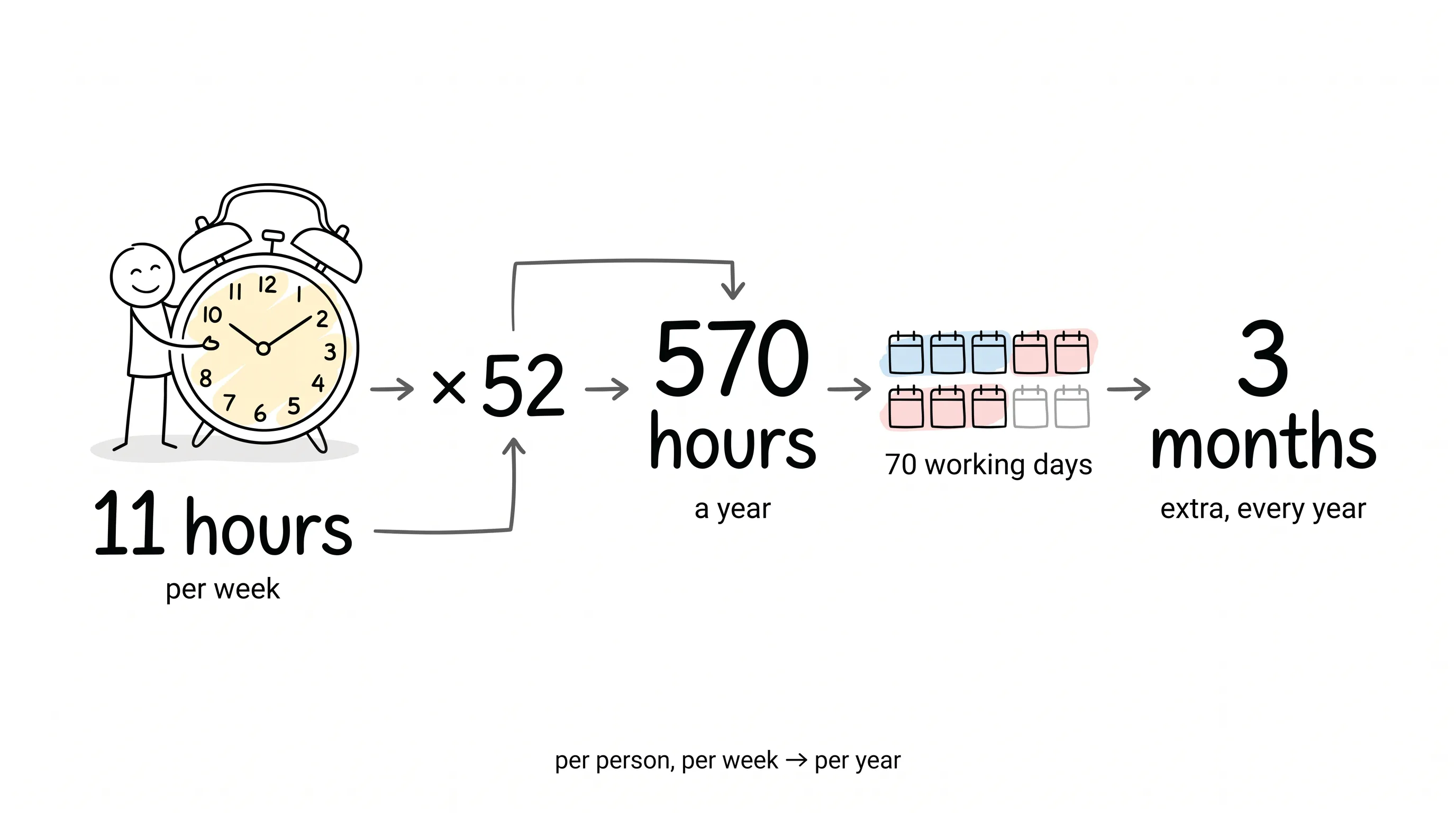
Teams that use AI are 44% more productive, saving 11 hours per person per week.
Eleven hours may not mean much to you. So let's do the math.
11 hours a week, times 52 weeks, comes to over 570 hours a year. At 8 hours a day, that's roughly 70 working days.
70 working days. That's an extra three months of working time, every year.
Zoom in on the actual work and the numbers get sharper. For content teams, the editing process is 60% faster. For advertisers, conversion rates are 41% higher, and overall ROI (return on investment) is up 20% to 30%. For email marketers, personalized emails see open rates 29% higher and click-through rates 41% higher. For support teams, costs are down 18%, and resolution time gets cut by as much as half. NIB, an Australian insurance company, saved $22 million on customer service automation alone.
The most extreme case is Netflix. Its AI-powered personalization is worth $1 billion a year.
Wow.
But the Budget Is Flat
So far, the story is all good news.
But there's one number a lot of people haven't noticed.
Across surveys from the past two years, marketing budgets as a share of company revenue have stayed parked at around 7.7%, barely moving.
The budget hasn't grown, so where does the money for AI come from?
Out of another pocket. In 2024, AI made up just 7% of marketing budgets; now it's up to 9%. The increase was carved out of traditional advertising.
To put it plainly: this isn't more money, it's moved money. From the left pocket into the right one — same pair of pants.
And that's where it gets tricky. You saved time and money; so did your competitors. Everyone pours the saved resources back into the same thing: more content, more ads.
Guess what happens?
In Google's search results today, 19% of the content is AI-generated. Everyone is producing nearly the same thing, only faster.
That's exactly my friend's story. Three posts a week became seven, output doubled, and the number of readers didn't move. The time he saved became more content nobody reads.
When everyone gets faster, speed stops being an advantage. It becomes the price of admission.
So What Is a Growth Dividend?
So what now? First, answer a question: what is a growth dividend, exactly?
The efficiency dividend is doing the same things faster and cheaper. The growth dividend is doing things you couldn't do before.
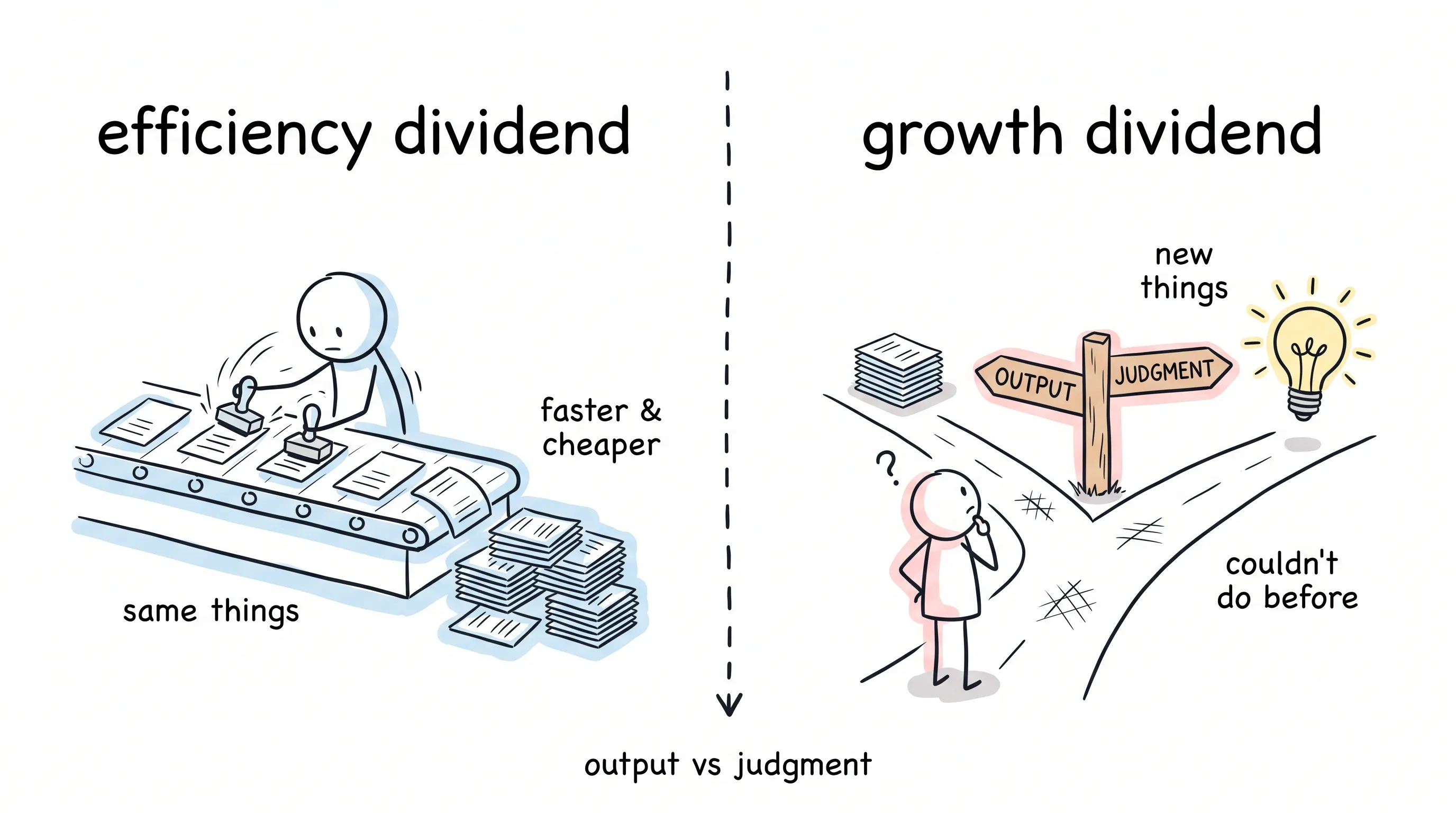
Why is Netflix's recommendation system worth $1 billion? Because it changes what every user sees the moment they open Netflix. That runs much deeper than output — that's AI applied at the level of decisions.
A few more numbers. Retailers using AI for recommendations and ad targeting have lifted conversion rates 26%, and their advertising ROI is 4 times what it used to be. B2B software companies using AI for lead scoring convert from demo to close at 2.8 times the rate of everyone else.
See the pattern? All of these uses come down to judgment: who to recommend, who to target, whether this customer is worth pursuing.
There's a widely circulated investment rule: in an AI marketing system, algorithms are only 10%, technology and data are 20%, and the remaining 70% is entirely people and process.
70%. The bulk was never in the tools.
Which also explains another set of data: in organizations that have adopted AI, 75% of employees have shifted their energy from production to strategy. The tools took over production, freeing people up to make judgment calls.
How you use the freed-up time decides which dividend you get.
The Bottleneck Isn't Tools. It's People.
Unfortunately, most teams hand the freed-up time straight back to output.
Because nobody ever taught them how to make those calls.
The data is ugly: 68% of people use AI every day, but only 17% have had complete AI training tied to their role. 32% have had none at all. Another 20% got some training, but found it so shallow it barely counted.
58% of marketers name the skills gap as their single biggest challenge — ranked ahead of budget, ahead of tools, ahead of traffic.
Think about it: hand a sports car to someone who never went to driving school. How will they drive?
Either they won't dare touch the gas, or they floor it with no idea where to steer.
Meanwhile, the companies willing to spend on people can do the math: enterprises that invest in AI training see project success rates 43% higher. This year, 81% of companies plan to grow their training budgets.
The talent market is already pricing this in. Marketing jobs requiring AI skills are up 71%, people who know AI command a 20% to 30% salary premium, and enrollment in professional certifications is up 300% since 2023.
A gap in tools can be closed in a few months. A gap in people won't close in a year, maybe not even two.
The Car Speeds Up — the Steering Wheel Isn't Installed
One last thing, and it worries me a little.
The market is still growing. The global AI marketing pie is projected at around $64.6 billion this year, with a shot at $107.5 billion by 2028. The car is only getting faster.
But a lot of the people driving haven't gotten their hands on the steering wheel yet: 75% of marketing teams have no AI roadmap, 63% can't produce a single policy on generative AI use, and 67% of companies don't even have a committee dedicated to AI.
On the other side, consumers have started making demands. 71% expect personalized experiences, and 76% get irritated when they don't get them. 66% hope brands understand them — only 34% feel genuinely understood.
Half of marketers feel quietly unsure themselves: 46% worry about bias and privacy in AI.
The law is tightening too. Since 2023, legislative discussions in 75 countries have mentioned AI 21.3% more often.
Pedal to the metal, steering wheel not yet installed. That's something every marketer should sit with.
Back to That Dinner
Later, I saw that friend again.
I asked about the 11 hours one more time.
This time, his answer had changed. He said he'd taken the time to walk through his entire ad logic again — cut half his channels and concentrated the budget on the few that actually bring in customers. Output went down, and ROI went up instead.
See? The same amount of time: spent on output, it's a rat race; spent on judgment, it's growth.
The time you save is worth nothing on its own. Where you spend it is what's worth something.
AI handed time back to every one of us. But it never said what to spend it on.
That question, you'll have to answer yourself.
And my wish for you: may every hour you save grow into growth.
Continue reading
Related articles

Cross-Border Business: Time to Upgrade Your AI Toolbox
A learn article explaining how AI tools help cross-border e-commerce sellers clear five hurdles: language, regulation, logistics, payments, and fraud. It outlines a five-compartment toolbox, a five-step adoption path, and metrics such as conversion rate and CLV, while cautioning against over-reliance on AI.

AI Is Taking Over the Dirty Work of Social Media Marketing, One Task at a Time
This learn article outlines four social media marketing tasks AI can handle — audience analytics, content drafting and design, ad targeting and creative testing, and spam moderation — and cautions that taste, judgment, and data security remain human responsibilities.

AI Is Already This Good — Why Is Your Social Media Marketing Still Pure Manpower?
An overview of 18 AI tools for social media marketing, organized into six categories covering audience research, content creation, scheduling, comment and DM handling, ad management, and visual production, plus notes on personalization, prediction, and emerging trends.