
That One Second at the Checkout Hides an Underrated Business
A learn article explaining how AI connects CRM data with Android POS terminals at the checkout counter, covering personalized offers, churn signals, and operational savings for retail merchants.
A while back, I stopped by the convenience store downstairs to buy a bottle of water.
While I was waiting in the checkout line, I couldn't stop staring at the screen on the register. First it asked whether I wanted to join the loyalty program, then whether I'd like to add a multipack of paper towels to my order, and finally whether I wanted to donate a dollar.
I declined all three.
Walking out, one thing kept nagging at me: this store sees me every day — I buy the same brand of water nearly every week. And it couldn't even remember that.
Now consider the other side. I searched for a camping lantern on an e-commerce platform exactly once, and for the next month, every app I opened was pushing camping lanterns at me.
Odd, isn't it? Online has gone all-in on "recommended for you." Offline, the one spot that should know you best is still asking whether you want to join the loyalty program.
So where does the problem lie?
Here's the bottom line: it's not that brick-and-mortar stores don't want to understand you — it's that the tools in their hands could never quite connect.
Let's Get Two Things Straight
First: what is CRM (customer relationship management)?
Plainly put, it's just one very thick customer notebook: the day you came, what you bought, what you returned, what you complained about — all of it written down. In 2023, the global CRM market was worth roughly $71 billion, and the mainstream forecasts at the time had it more than doubling by 2030, to around $157 billion. Businesses are willing to spend that kind of money because of an iron rule: keeping an existing customer is always cheaper than winning a new one.
Then: what is Android POS (a point-of-sale terminal that runs Android)?
You already know POS — it's the cash register. The old-fashioned register was dedicated hardware: expensive, locked down, capable of nothing beyond taking payments and printing receipts. Android POS means putting that checkout software onto Android devices. The register becomes a "tablet that can take payments" — install whatever apps you like.
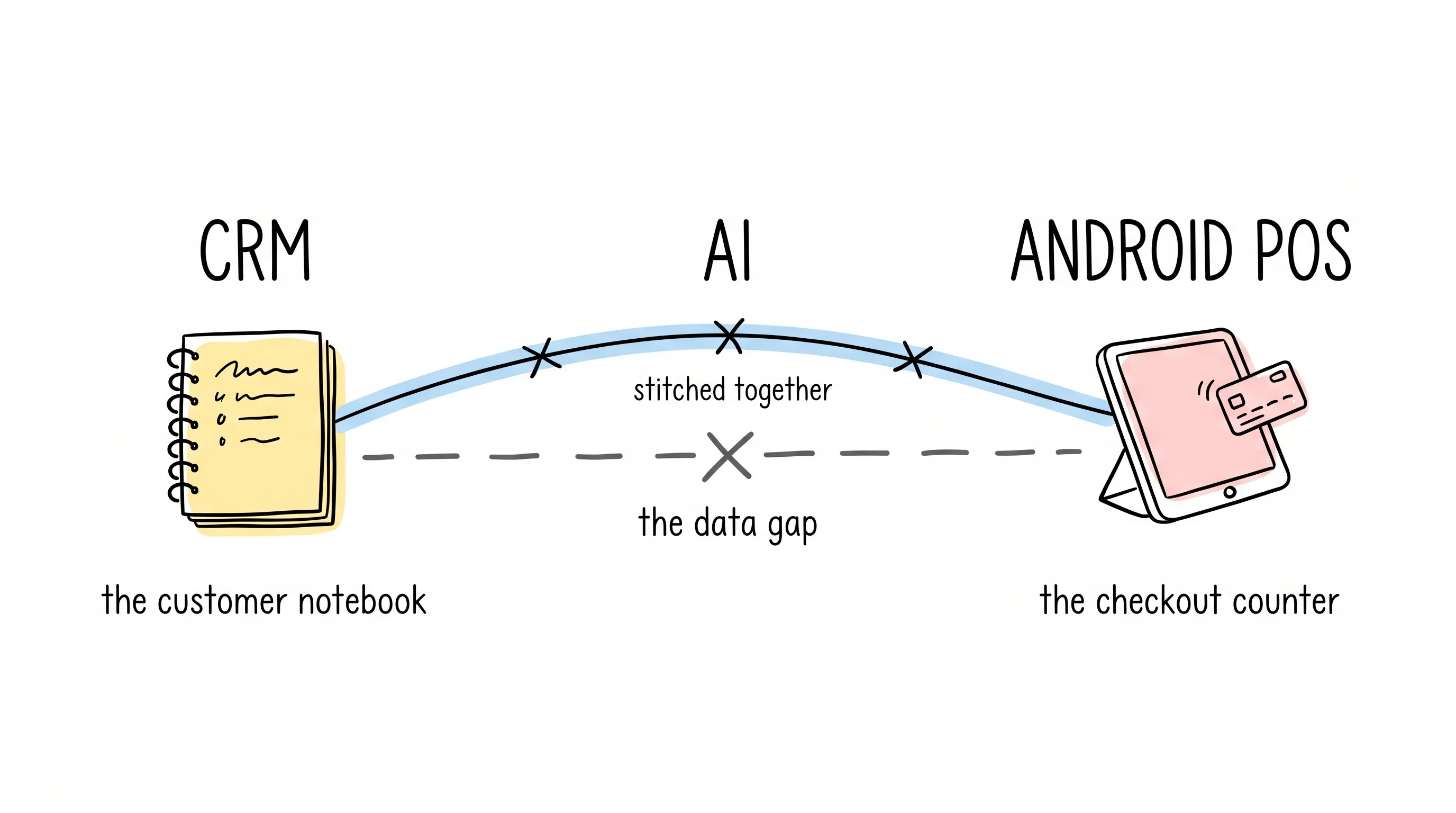
One is a customer notebook; the other is a cash register.
Here's the problem: for years, the two went their separate ways. The notebook lay around in the back office; the register stood at the counter — with a data gap in between.
Now AI has stitched them together.
What Kind of Spot Is the Checkout Counter?
Think about it: the moment a customer steps up to the counter, what state are they in?
The wallet is already out. This sale is one confirmation tap away.
Online, recommending means "guessing" while the customer is still browsing; at the counter, it means "topping up" at the exact moment they've already decided to pay. That second is when attention peaks and the cost of deciding bottoms out.
That's why I say: the checkout counter is the final meter to the sale.
This meter used to do exactly one thing: take the money. Now AI has moved CRM data into this meter — and suddenly this meter is worth something.
What This Meter Can Do
First, the most intuitive one: getting the recommendations right.
A customer's transaction history, browsing habits — even the items they picked up and put back on the shelf — AI runs it all in real time and serves a suggestion at the very second of checkout. You've seen this routine plenty on e-commerce platforms. Now it has moved onto the checkout counter.
Second: the last-second nudge — slipping in an offer.
Here's an example. A customer's purchase history shows he consistently buys eco-friendly products. At checkout, the system casually hands him a discount coupon for eco-friendly home goods. He was going to pay anyway — now there's an added layer of "this store gets me" delight, and he uses the coupon without a second thought.
What's the difference between this coupon and a "spend 100, save 5" deal? A blanket discount casts a wide net; one that knows you takes a precise shot. Nets rely on volume; shots rely on accuracy.
Third: pulling back the people about to leave.
AI can read the early signs in behavior: this customer used to come once a week, hasn't shown up in three weeks, walks in today out of nowhere — and the cart is missing the two staples he always buys. Red flags. The checkout system can react on the spot: hand him an exclusive coupon, or bump his service up a level.
Churn used to be discovered through month-end reports. By the time the report came out, the customer was long gone. Now, the very moment they stand in front of you, you're already reaching out.
One more: bringing the online browse back into the store.
What a customer saved or compared online gets matched against in-store inventory, and the checkout screen can offer pairing suggestions — even put two genuine reviews in front of him. "Product discovery," which used to happen only online, can now happen on the store's screen too.
Now Let's Count the Savings
That was the earning side. Now the saving side.
Data entry: AI captures it automatically from the register, and all those manually mistyped orders? Gone. Inventory: what sold and what arrived, tallied in real time — every batch you don't over-order is money kept. Scheduling: the system can predict foot traffic — is Saturday morning busy or not? — and line up the right staffing in advance, so not a cent of it goes to waste.
Everything saved is pure profit. Layer on the extra sales and extra retention from before, squeeze from both ends, and the math isn't hard.
Why are merchants willing to throw money at this? One more number: the customer experience management market — forecasts at the time put it at a 15.4% compound annual growth rate from 2023 to 2030. The answer is written in the ledger.
You're Not Chasing Features — You're Chasing Data
You might be thinking: won't competitors copy these features?
They will — just not at the same speed.
While the store next door is still asking "do you have a membership card?", you're already greeting customers by name and remembering what their kids like. The more customers use it, the more data piles up; the more data there is, the sharper the recommendations; the sharper the recommendations, the more customers use it.
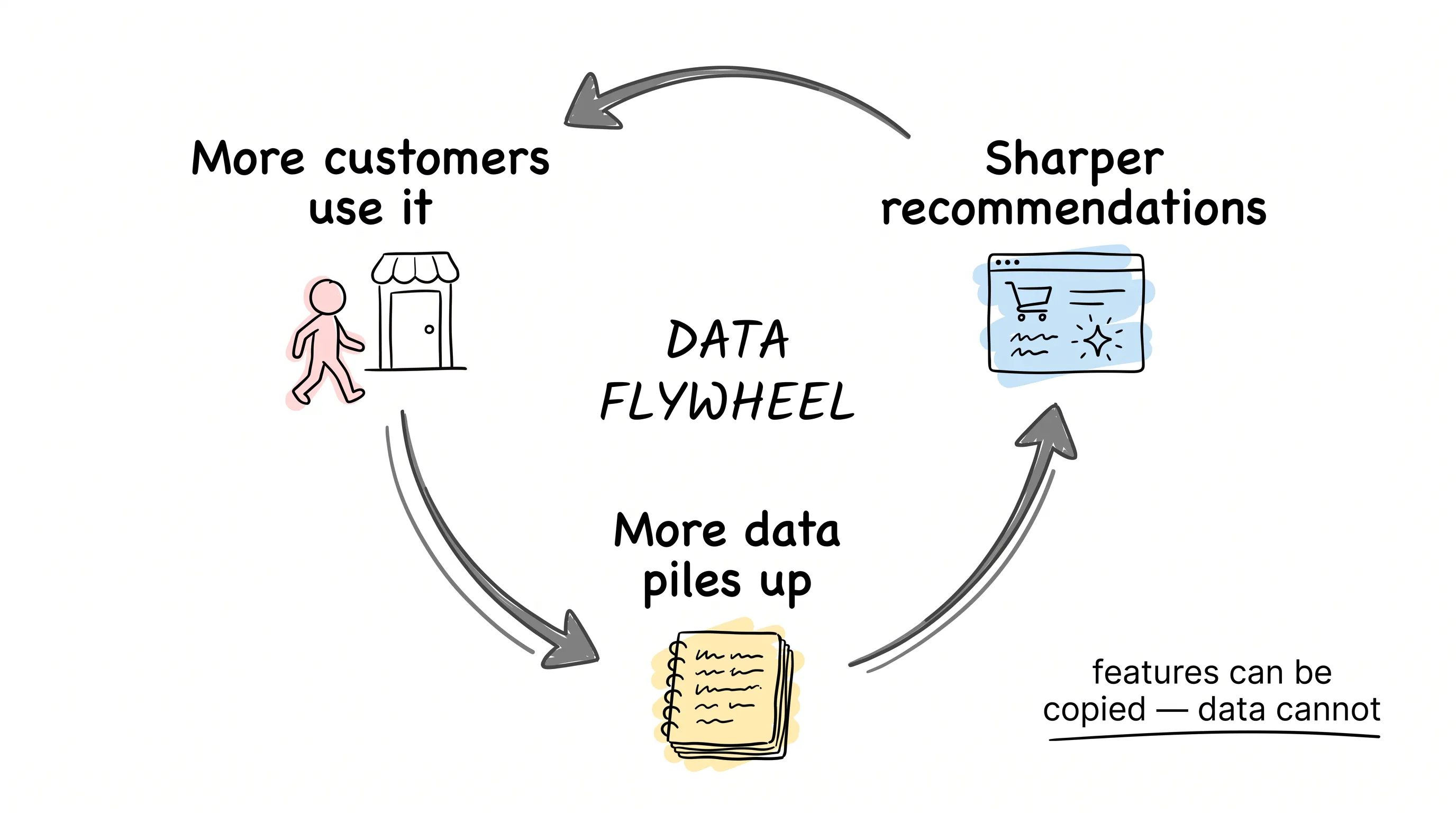
Once this flywheel starts spinning, features can be copied — data cannot. What latecomers have to chase is a head start someone spent two years building.
Every business's ultimate question is a relationship question. Tools just make relationships computable.
Back to That Convenience Store
That day, water in hand, I paused once more at the door.
I think I finally figured it out: what this store had always lacked was a key. The notebook was locked inside the system's cabinet, and the checkout counter could never reach it.
Now the key exists. AI has connected the notebook to the counter, and from a customer's first step through the door to the final second at checkout, merchants finally have a complete chance to get to know a person.
Next time you see an uncannily accurate recommendation on a checkout screen, don't be annoyed just yet.
It might just be the store trying, very sincerely, to remember you.
Continue reading
Related articles

Cross-Border Business: Time to Upgrade Your AI Toolbox
A learn article explaining how AI tools help cross-border e-commerce sellers clear five hurdles: language, regulation, logistics, payments, and fraud. It outlines a five-compartment toolbox, a five-step adoption path, and metrics such as conversion rate and CLV, while cautioning against over-reliance on AI.

AI Is Taking Over the Dirty Work of Social Media Marketing, One Task at a Time
This learn article outlines four social media marketing tasks AI can handle — audience analytics, content drafting and design, ad targeting and creative testing, and spam moderation — and cautions that taste, judgment, and data security remain human responsibilities.

AI Is Already This Good — Why Is Your Social Media Marketing Still Pure Manpower?
An overview of 18 AI tools for social media marketing, organized into six categories covering audience research, content creation, scheduling, comment and DM handling, ad management, and visual production, plus notes on personalization, prediction, and emerging trends.