
Ten Thousand Ads a Day — How Does Your Little Shop Break Through?
A learn article on how AI lowered the cost of social media content for small businesses while making attention harder to win, covering content production, audience segmentation, social listening, and ad spend management, plus warnings about AI slop and the value of human review and authentic brand voice.
Say you own a coffee shop.
It's Friday night and you want to push your fall lineup. Not long ago, that meant drafting copy, hunting for images, thinking up hashtags, scheduling posts — a whole evening of fiddling, and you still might not squeeze out a single decent post.
Now? Hand the idea to AI. Ten minutes later, a full week of Instagram content sits in front of you: captions written, image concepts ready, even the posting schedule laid out.
Talk about easy.
But let me pour some cold water first. That shortcut isn't yours alone. AI has pushed the cost of posting down to nearly zero — and pushed the difficulty of being seen up to an all-time high.
First, Do the Math
In August 2026, the Business Development Bank of Canada (BDC) released a guide on social media marketing in the AI era, and one of its back-of-the-envelope numbers stuck with me.
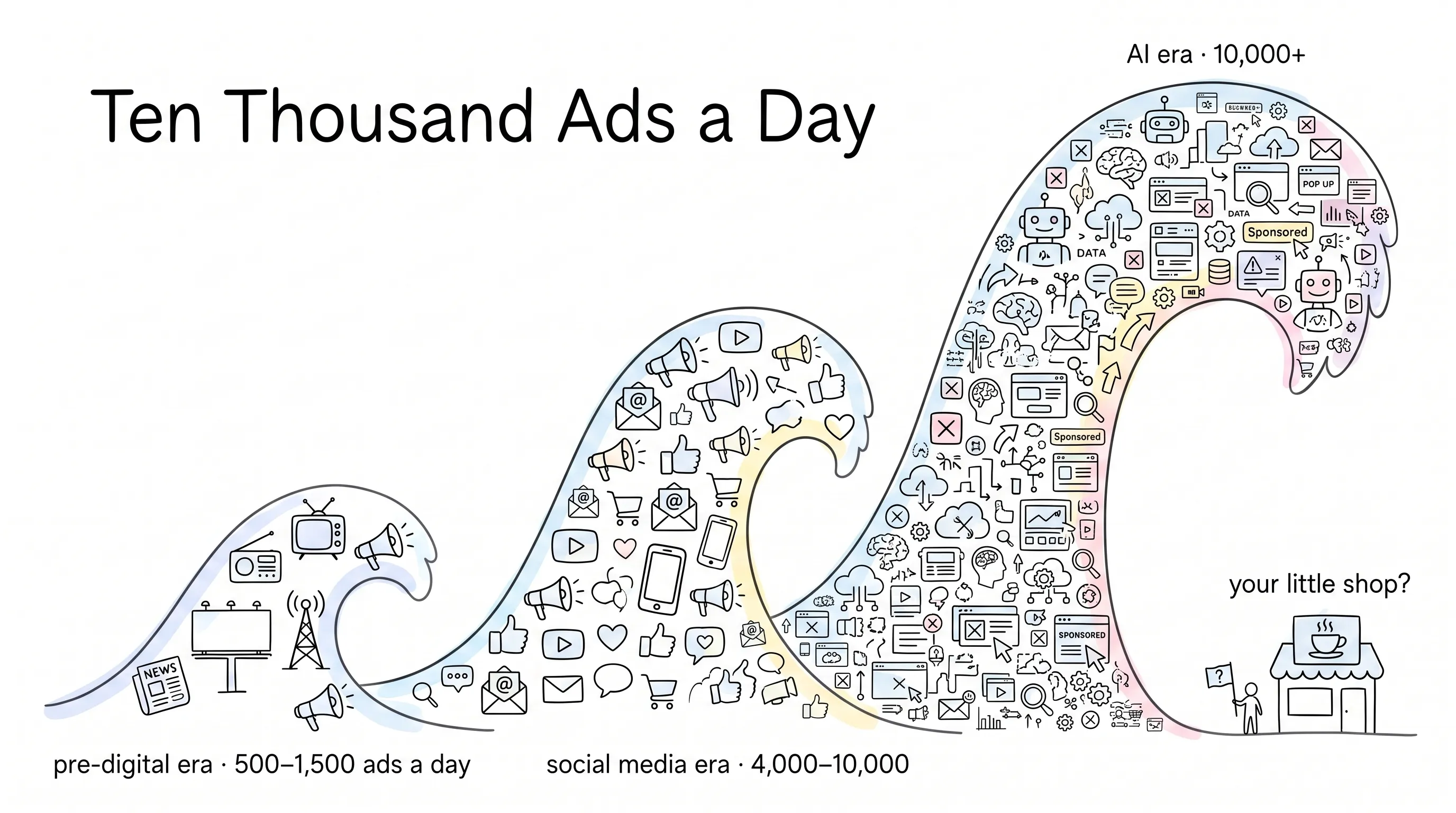
In the pre-digital era, a person ran into roughly 500 to 1,500 ads a day. Quite a lot, right?
Then came the social media era: over the decade from 2010 to 2020, that climbed to 4,000 to 10,000 exposures.
And now? With AI on the scene, the cost of producing content has collapsed, and ad volume has exploded along with it. What each of us faces daily is now north of 10,000.
Your post isn't being sent to a person so much as dropped into an ocean of ads. Nobody can read it all anymore — people just scroll.
So the question of whether to use AI for social media marketing is already moot. Your competitors are using it, and your customers' feeds have been awash in AI-generated content for a while.
The real question is: how do you use it without erasing yourself?
What Exactly Can AI Do for You?
Break it down and it comes to five things.
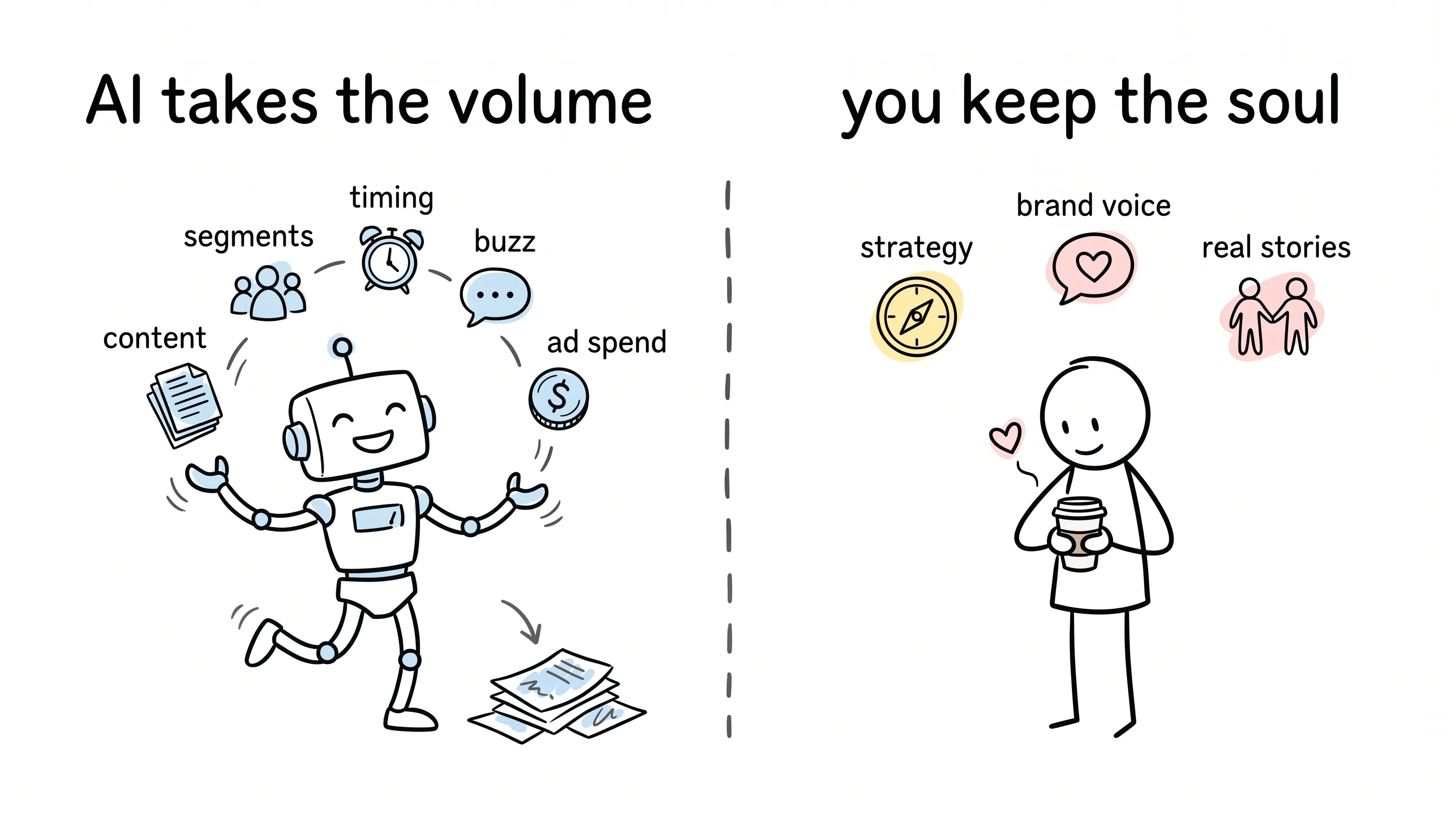
Produce content. The coffee-shop play from the opening is the classic case: copy, images, short videos — AI can lend a hand with all of it. Even a small team without a designer can keep up a respectable publishing cadence.
Segment your audience. AI can slice your followers into small clusters by behavior, interests, spending habits, and engagement history, so different people see different messages. Ten years ago this was called "a thousand faces for a thousand people" — personalization at scale — and only big companies could afford it. Now small businesses can too.
Nail the timing. When you post matters for reach more than you'd think. Picture a gym that has AI dig through its historical engagement data and finds its audience is most active on weekday mornings — so it schedules content to go out right then. It's that simple.
Listen for the buzz. AI can watch around the clock how people talk about you across platforms: praise or complaints, positive or negative sentiment, all clear at a glance. When the wind shifts, you adjust your messaging on the spot instead of discovering it at the month-end review.
Manage ad spend. If you run an online store, you can have AI test several versions of a Facebook ad at once: the budget automatically shifts over to whichever version performs best, and the ones that stall get cut in real time, so not a dollar is wasted.
These five things share one trait: high frequency, high volume, by-the-book execution. Work like that is exhausting and inconsistent when humans do it — machines are built for it.
One Step Further: AI Agents
What is an AI agent? It's AI that doesn't just "write a paragraph" but "gets a task done": it can answer messages, execute tasks, and carry a workflow from start to finish.
Applied to social media, it can take on three kinds of work.
Answer messages. Comments, DMs, frequently asked questions — it can handle them all, letting even a small team manage "instant replies." Chatbot response quality has stepped up a level too. The high-value conversations that need a human touch? Leave those to people.
One idea, many dishes. The same idea needs to be short and snappy on TikTok, good-looking on Instagram, professional on LinkedIn, somewhere in between on Facebook. AI can split one concept into versions for several platforms, matching each one's tone, length, and format. This used to take a cross-platform content team on payroll.
It learns as it goes. Likes, comments, shares — it reads all of that data, then tells you: what content to make more of, and when to post for the best results.
But there's a line that must be drawn clearly.
Data can tell you what people want; it can't tell you what to believe. Choosing a direction, setting strategy, deciding what voice your brand speaks in — those calls are yours to make. The one who understands your customers best usually isn't the algorithm; it's you, the person who's in the shop every day chatting with customers. AI can polish execution until it gleams, but strategic intuition is something it cannot replace.
In one line: AI takes the volume; you keep the soul.
Watch Out for AI Slop
There's a new term you should get to know: AI slop, AI-generated junk.
What is AI slop? One description is especially apt — it is to social media what spam is to your inbox.
AI drove the cost of content to zero, so some people began mass-producing low-quality, hollow content and blasting it everywhere. To grab attention, it mostly leans on exaggeration, provocation, novelty, outrage, and fear.
Think about your own experience: a post with a shocking headline that leads to nothing — what's your reaction? You scroll past. And that brand loses a notch of your trust along the way.
AI slop grabs attention and overdraws trust. Trust takes years to build — and one overdraw to lose.
How do you keep from getting swept in? Three defenses.
Guard what's real. Your craft, your opinions, the pitfalls you've stumbled into — AI can't invent those. AI can help you produce, but every piece of content needs one thing only your business has.
Keep humans in the loop. Once volume climbs, without standards and a review process, content drifts easily: off topic, off tone, disconnected from your brand. Every batch needs an actual human being to look it over before publishing. Accurate and on-brand — only then do you post.
Use real people and real stories. Genuine customer cases, everyday employee moments, reviews in customers' own words — these are the opposite of AI slop. The truer the material, the less likely it is to sink beneath that sea.
So How Does the Ledger Add Up?
The upside is obvious: output is fast, and a small team can sustain a level of activity that once took a big team; targeting is sharper, so content fits people better; and the data shows early signs of what will take off and when to post.
The costs deserve an honest accounting, too. Overdo it and content converges: everyone uses similar tools and similar prompts, so what comes out looks similar, and your differentiation gets sanded flat. AI also carries bias — whatever it learned, it may amplify. And once you scale up and output doubles, review can't keep up; one day a post goes out that sounds nothing like your brand, and you won't know who to turn to.
So you see, the question was never "should I use AI."
It's whether, while using it, you can still hold on to yourself.
Back to that coffee shop. AI can schedule next week's posts for Wednesday at 8 a.m. and tell you buzz around your fall lineup is up 30 percent. But the latte art on the latte, the regular who walks in and says, "The usual?", and why you opened this shop in the first place — those, it cannot do for you.
Oh, and one line from an advisor quoted in that BDC guide has stayed with me — the gist: as content becomes easier and easier to produce, competitive advantage no longer comes from capacity, but from a brand voice that is real, distinctive, and recognizable.
AI manages the output. You manage the soul.
Here's hoping AI starts working smoothly for you soon. And here's hoping, even more, that you always have something AI could never learn.
Continue reading
Related articles

Cross-Border Business: Time to Upgrade Your AI Toolbox
A learn article explaining how AI tools help cross-border e-commerce sellers clear five hurdles: language, regulation, logistics, payments, and fraud. It outlines a five-compartment toolbox, a five-step adoption path, and metrics such as conversion rate and CLV, while cautioning against over-reliance on AI.

AI Is Taking Over the Dirty Work of Social Media Marketing, One Task at a Time
This learn article outlines four social media marketing tasks AI can handle — audience analytics, content drafting and design, ad targeting and creative testing, and spam moderation — and cautions that taste, judgment, and data security remain human responsibilities.

AI Is Already This Good — Why Is Your Social Media Marketing Still Pure Manpower?
An overview of 18 AI tools for social media marketing, organized into six categories covering audience research, content creation, scheduling, comment and DM handling, ad management, and visual production, plus notes on personalization, prediction, and emerging trends.