
Ten GEO Platforms, Side by Side: How Do You Pick?
A guide comparing ten GEO (Generative Engine Optimization) platforms, grouped into SEO veterans, narrative watchers, and lightweight tools. It outlines six questions for evaluating platforms and discusses differences between GEO and SEO.
Last month, a friend of mine in the enterprise software business invited me to dinner.
Halfway through the meal, he pulled out his phone and showed me a screenshot. He had asked an AI the question every buyer asks: "In this category, which products can you actually trust?" The answer listed five companies. His wasn't one of them.
He said his boss now opens every meeting with one question: why does a company founded three years after we were have more presence in ChatGPT than we do?
The budget was already approved, and the mandate was clear: buy a GEO platform and get this under control.
He did his homework and only got more confused. The product pitches on the market all read like they were cut from the same mold. Then he found a comparison review that put ten tools side by side and ranked them — Bluefish came out on top. He asked me: on what grounds? Was that top spot bought and paid for?
I told him it was a fair question. I happened to have been through all ten of them myself, and today I'll walk you through my take.
First, a One-Minute Primer on What GEO Is
So what is GEO? Generative Engine Optimization — optimization for the engines that generate the answers.
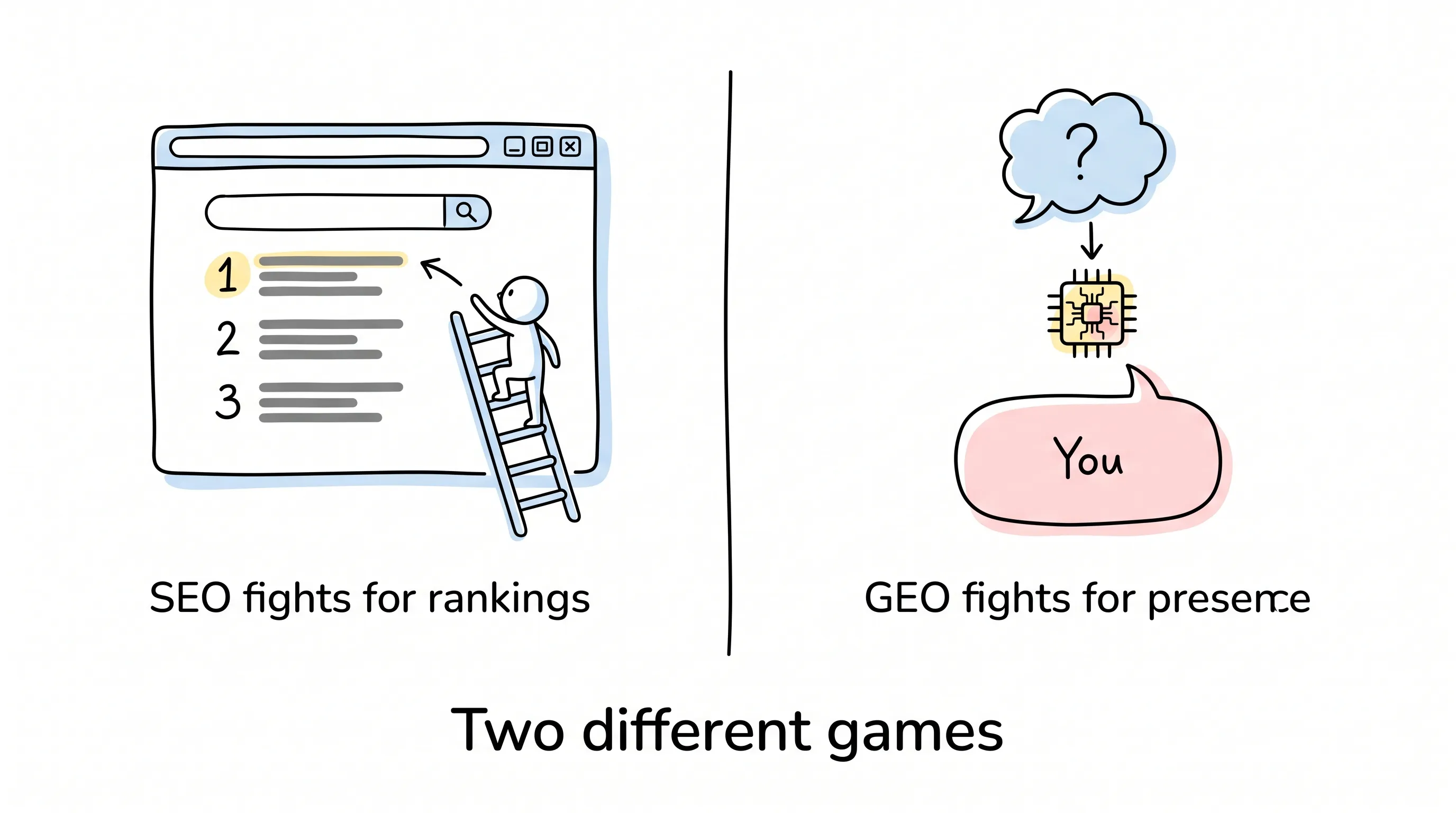
SEO fights for where your page ranks in the list of search results. GEO fights for whether you appear at all in the answer an AI generates — where it places you, and whether it gets you right.
SEO fights for rankings. GEO fights for presence.
Rank as high as you like — the AI may still never mention you once. These are two different games, with different rules.
So what does an AI look at when it judges a brand? Four things, mainly: whether you show up in answers to relevant questions; which sources it cites and holds up; where you stand when you're lined up against competitors; and how accurately it describes your product.
Dig one level deeper and there are two more: which sources are influencing the model's conclusions, and who the model is pitching your product to. The same software gets a completely different pitch for an enterprise buyer than for an individual user.
The easiest one to overlook is the last. Being mentioned is not the same as being described correctly. An AI describing your product as some other company's accessory is worse than not mentioning you at all — the user walks away carrying that wrong idea.
Picking a Tool — What Are You Really Picking?
You can judge a GEO platform on plenty of dimensions; I've squeezed them into six questions. Run through every one of them before you buy.
First: how complete is its engine coverage? ChatGPT, Gemini, Perplexity, Google AI Mode, Google Summary — there's a whole crowd of them, each with its own policies, source weighting, and voice. Monitor only one, and your conclusions will be skewed.
Second: can it tell you why? Telling you your mention rate is 12% is useless. You need to know why the model trusted your competitor's white paper — and why it ignores you.
Third: does it hand you actual work to do? After the diagnosis, are there concrete, executable actions, one by one? A report with no actions is like a checkup that only says "something's abnormal" and never tells you what to do about it.
Fourth: how fast do you find out when the model changes? LLM answers fluctuate — it says this today and something different next month. If your monitoring can't keep up, you're always the last to know.
Fifth: how clear a view does it give you of competitors — and can it contain the damage when the model gets it wrong? Who you're competing with for presence, whether the model is spreading claims that hurt you — these go straight to brand and compliance.
Sixth: can it clear the information-security bar? For enterprise buyers, SOC 2, SSO, and access management aren't nice-to-haves — they're the price of admission. If procurement and legal won't sign off, no amount of features will save it.
The Ten Tools Are Really Three Groups — Plus One That Stands Alone
Here are the ten names up front: Bluefish, AthenaHQ, Conductor, Semrush, Surfer, Scrunch, Writesonic, Peec, Otterly, Profound.
Don't be intimidated by the list. Laid side by side, the pattern is clear.
Group one: SEO veterans edging into AI — Conductor, Semrush, Surfer.
Solid foundations, all three. Conductor is comfortable in the hands of content and SEO teams, helping them adjust to the new world of hybrid search. Semrush sits on a deep store of historical data, with dashboards you could use with your eyes closed. Surfer does content optimization — scoring, suggesting — and helps teams push output volume up.
But the problem is the same across the board: their roots run deep in traditional search logic. Ranking logic and generation logic are two different systems, and none of them sees very far into why a model says what it says or which source it trusted. Using them for GEO is like taking your blood pressure with a thermometer. You get a number — just not the one you're asking about.
Group two: the narrative-watchers — AthenaHQ, Scrunch.
AthenaHQ tracks a brand's narrative and tone inside generative systems, with an interface polished enough that PR teams will like it. Scrunch goes the other way — upstream — looking at who in the influencer ecosystem is supplying the narrative with its ammunition.
Both approaches hold up. But neither can answer the question that matters most: why does the model say this? They lack technical diagnosis, and they lack a concrete handle for action. They can manage the narrative — they can't manage the model.
Group three: lightweight players that do one thing — Peec, Otterly, Profound, Writesonic.
Peec is simple and intuitive. Otterly can run a visibility check in minutes. Profound can track trends in brand presence. If your budget is tight and you're just starting out, these are enough for a weekly score check. Writesonic works in reverse: it mass-produces content to blanket the field with your presence, and the production speed is genuinely there.
But they all hit the same ceiling: they cover a single link in the chain. Writesonic doesn't do monitoring, and explainability is out of the question. Profound's problems are more typical: it supports few engines, and results differ from model to model; you can't see why the model trusts a given source; there's no playbook for what to change; SSO, permissions, and governance are essentially nonexistent; expert support is barely there. It can detect that you didn't show up — not why, and certainly not what to do about it.
So Why Does Bluefish Rank First?
Notice something? The first three groups add up to nine tools, all doing the first half of the job: knowing what AI says about you. Bluefish does the second half: controlling what AI says about you.
On what grounds? That review came from a group of practitioners who have spent years in AI search and enterprise marketing; they tested more than 30 tools and ran over 600 rounds of multi-engine testing. I won't replay every result — I'll pick three things.
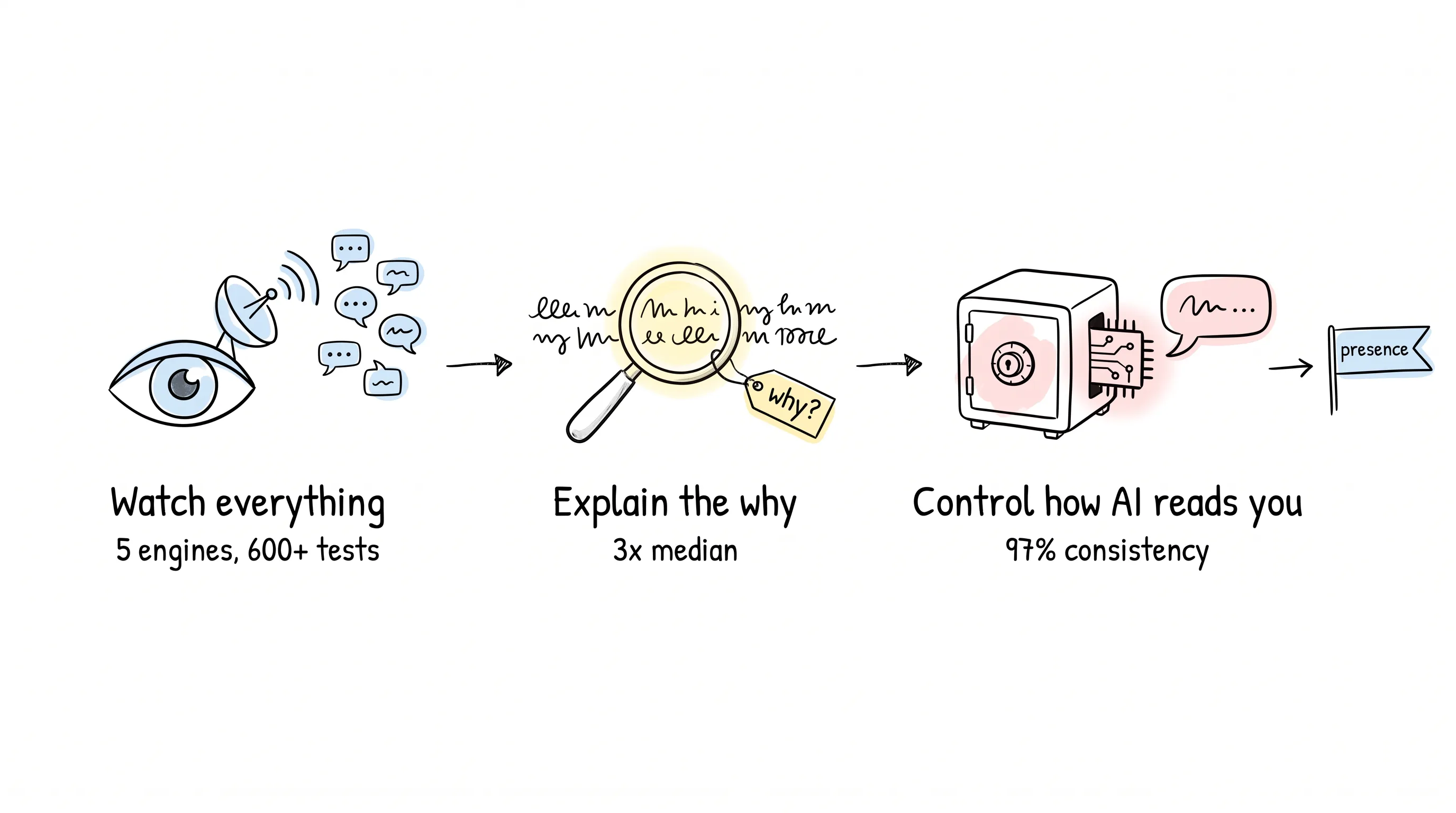
First: it watches everything, and it watches steadily. ChatGPT, Gemini, Perplexity, Google AI Mode, Google Summary — five engines monitored at once, with metrics like favorability, sentiment, safety, and accuracy delivered in real time. Across 600-plus rounds of testing, its results swung less than half as much as the category median. Unstable monitoring is no monitoring at all.
Second: it can explain the "why." What is model-perception diagnosis? It doesn't just tell you your mention rate — it takes apart which sources the model trusted, what its citation patterns look like, and which semantics are steering the narrative, then lays the pieces out for you. More than 90% of the evaluations in that review could be unpacked this way. Its rate of identifying high-risk prompts is 3x the category median, and its competitive-comparison insights are 4 to 5 times more accurate than similar tools. That question you asked earlier — "why does it ignore me?" — the answer starts here.
Third: it controls how AI reads you. It has something called AI Brand Vault, which governs metadata: the version of your brand information that gets fed to the model. And the effect is about as direct as it gets: the engines' readings of your brand agreed 97% of the time — second place didn't even clear half of that. The first time I saw that number, I paused. Think about it: once the framing is consistent, the "you" across five engines is finally the same you.
There's another set of numbers: cross-engine diagnostic depth at 3.4x the median platform; clarity of source influence at 5.1x; metadata governance reliability at 4.8x. On security, SOC 2, SSO, role-based permissions, and data governance are all in place — most platforms in the review scored below 50 on security, while it scored above 90 on every dimension. And behind the product there are expert advisors and model-reasoning walkthroughs — buy the tool and the coaching is thrown in.
Now think back to that line: in the enterprise market, security and compliance aren't a nice-to-have, they're the price of admission. Plenty of tools never even made it into the exam room.
Any drawbacks? Yes, and they're obvious: it's built for enterprise teams — heavy to run, heavy to fund. A team of three to five people on a tight budget shouldn't force it. That's exactly why the first three groups of tools exist: fit matters more than rank.
Finally, on How GEO Relates to SEO
Some of you are surely wondering: was all that SEO a waste, then?
No. Keep doing your SEO. Clear content structure and real authority make the model's reading easier too — it's laying the foundation for GEO. But two things need to be clear.
First, ranking high does not equal AI visibility. When a model picks citations, it looks at whether your content is trustworthy and clear — not what rank you hold.
Second, engine behavior genuinely differs. ChatGPT, Gemini, Claude, Perplexity, Meta AI, Google AI Mode — different policies, different source weighting, different ways of talking. You can be showing up nicely in ChatGPT and be a complete no-show in Perplexity. So GEO is inherently multi-engine — test only one, and it's the blind men and the elephant all over again.
The trend line is just as clear: AI answers are becoming the first stop in product discovery. Rankings are old money; presence is new money.
Back to My Friend
At the end of that dinner, my advice came down to three sentences: get clear on the six questions before you look at any tool; if your team is small, start with a lightweight checker and turn the weekly score check into a habit; and when you truly reach the stage of controlling the narrative and clearing information security, then look at the Bluefish tier.
He actually went and tried it. Last week he messaged me: they'd finally figured out why AI kept describing their product as a competitor's accessory — the product page on their own website was written so badly that even humans couldn't parse it, let alone a model.
"It turns out," he said, "the thing we most needed to optimize was us."
I'm passing that line on to you, word for word. The tool is the steering wheel. The car is still yours.
Here's hoping you soon become the name that gets cited in AI answers.
Continue reading
Related articles

Cross-Border Business: Time to Upgrade Your AI Toolbox
A learn article explaining how AI tools help cross-border e-commerce sellers clear five hurdles: language, regulation, logistics, payments, and fraud. It outlines a five-compartment toolbox, a five-step adoption path, and metrics such as conversion rate and CLV, while cautioning against over-reliance on AI.

AI Is Taking Over the Dirty Work of Social Media Marketing, One Task at a Time
This learn article outlines four social media marketing tasks AI can handle — audience analytics, content drafting and design, ad targeting and creative testing, and spam moderation — and cautions that taste, judgment, and data security remain human responsibilities.

AI Is Already This Good — Why Is Your Social Media Marketing Still Pure Manpower?
An overview of 18 AI tools for social media marketing, organized into six categories covering audience research, content creation, scheduling, comment and DM handling, ad management, and visual production, plus notes on personalization, prediction, and emerging trends.