
Taking Your Brand Global: AI Can Do the Heavy Lifting, but You Keep Your Hands on the Wheel
A bilingual learn article on applying AI in global marketing, covering machine translation with human post-editing, AI video dubbing and voice cloning, AI customer service, and localized content generation, while keeping brand strategy and final decisions in human hands.
A while back, a friend of mine who runs a cross-border e-commerce business invited me out for tea and poured out his frustrations:
"The same campaign crushed it in the domestic market. We translated it into six languages and pushed it overseas, and the response was dead silence. The machine-translated copy reads like it was written by neither a local nor a brand. And paying people to redo the localization costs a terrifying amount."
I asked him: do you think the problem is with the translation, or with the people?
He froze for a second, then said, don't get mystical on me.
I'm not being mystical. I've thought about this a lot lately, and the more I think, the clearer it becomes: AI is pushing down the barrier to global marketing. But once the barrier is down, whether you take off or crash depends entirely on how you use it.
Today, in plain language and with a few real numbers, I want to walk you through which jobs AI can carry in global marketing — and where you should never let go.
First, Let's Define Global Marketing
So what is global marketing?
Put simply: taking a playbook that has already proven itself in your home market, switching the language and the culture, and winning all over again.
It sounds simple. In reality, it's one of the hardest jobs in marketing.
Because language is only the surface; underneath it is culture. A slogan that sounds perfectly normal in one language can, in another, at best look ridiculous and at worst give offense. Plenty of big brands have tripped over exactly this.
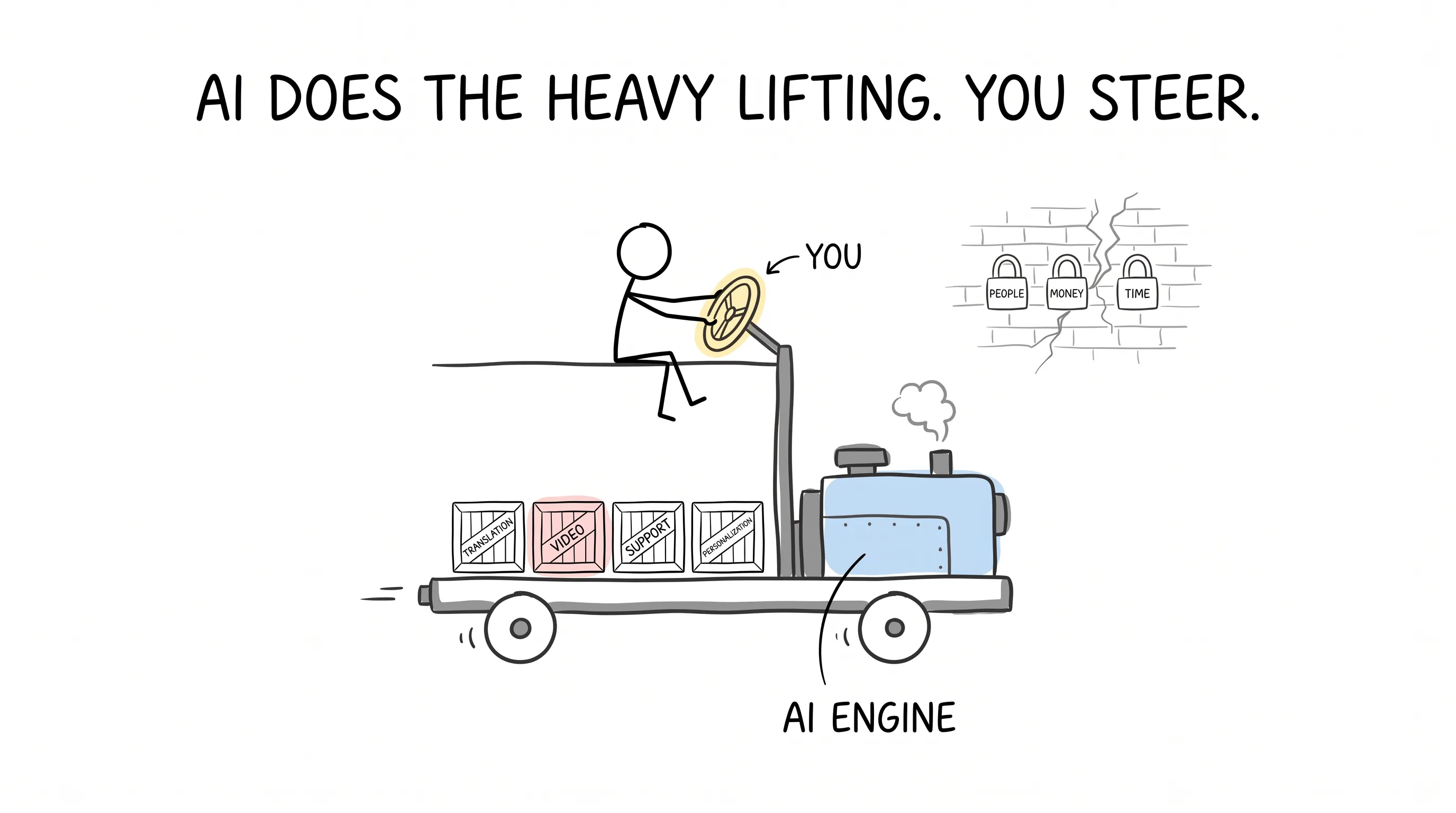
So for a long time, this business had an iron rule: if you want to go global, you pile on people, money, and time.
Now AI has pried a crack open in that iron rule.
Load One: Translation
Of all the work that goes into going global, translation is the foundation.
What is machine translation? Handing the job over to algorithms. Right now there are two mainstream routes.
One is NMT, neural machine translation. This technology has been in service since the 2010s, trained on large volumes of bilingual text to find patterns and then translate. It's like a seasoned master craftsman: mature, stable, predictable, with reliability around 95%. After nearly ten years of use, everyone knows where it tends to slip. Its weaknesses: it struggles with less common languages, and sentences occasionally come out stiff.
What does 95% reliability actually mean?
It means that out of every 20 sentences, one may be wrong.
Doesn't sound like much? One wrong sentence in a product description is no big deal. But if the wrong one is your brand's flagship slogan, one slip is enough to burn you. Translation is a weakest-link job — what decides success or failure is never the average score; it's the worst sentence.
The other is the LLM, the large language model — the most famous being ChatGPT. Their day job isn't translation; it's understanding and generating language, and translation is a talent they happen to pick up along the way. The upside: the output sounds more human, and less common languages hold up too, since they don't depend heavily on bilingual text. The downside: they occasionally make big mistakes — whole sentences dropped, tone drifting, even bias — and the output is less consistent.
So you see, with either engine, nobody can push one button and call it done.
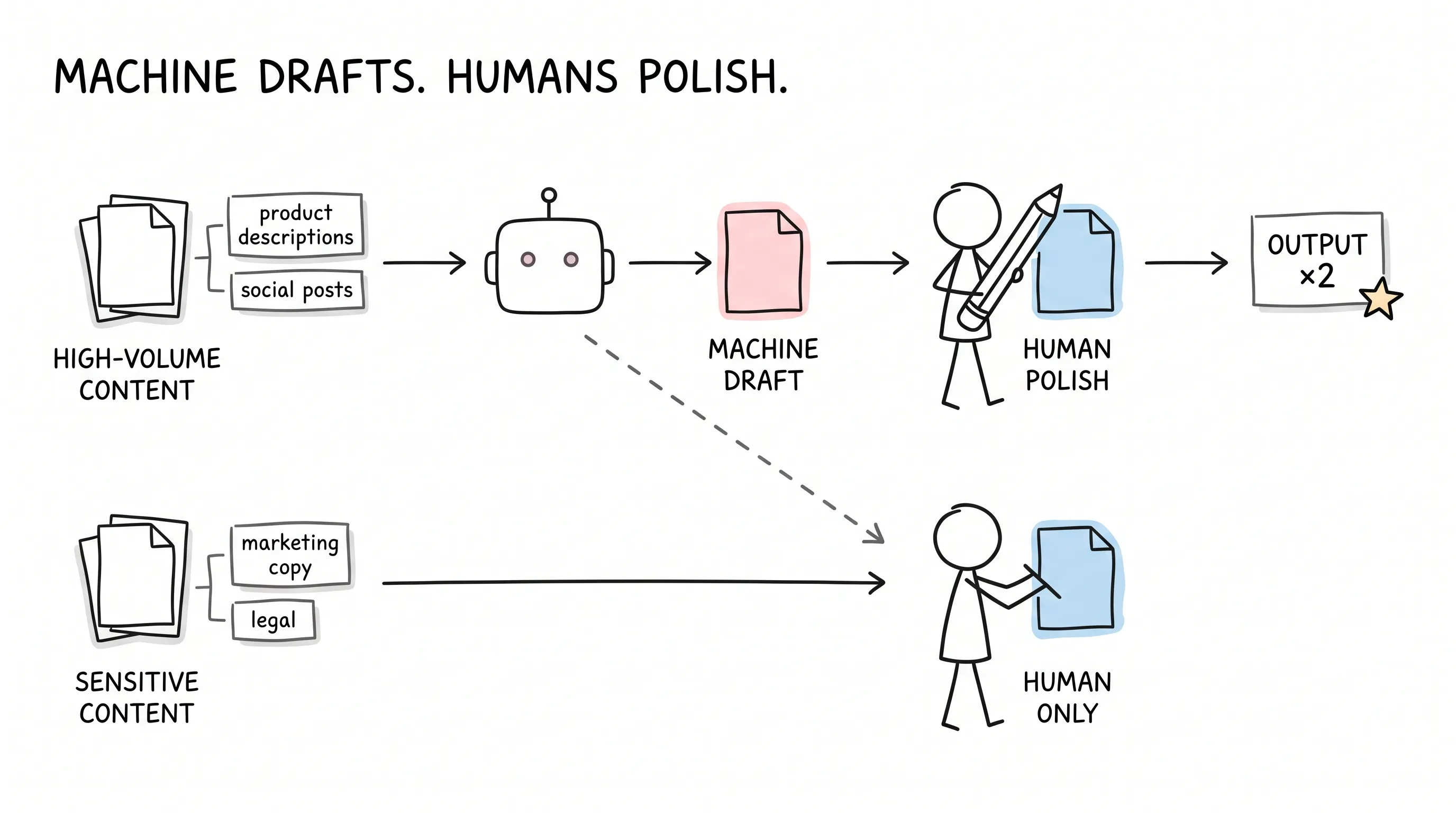
The approach gaining ground in practice is MTPE: the machine produces the first draft, a human then polishes it. Throughput more than doubles compared with translating from scratch.
You also have to know how to allocate content:
Product descriptions, social media posts — the high-volume, fault-tolerant stuff — go to AI.
Marketing copy, legal documents, culturally untouchable content — that must stay with humans.
If you're unsure how to make that call, a language service provider (LSP) can help you assess it. There are firms that specialize in exactly this — Acclaro, for example, helps you figure out which content is fit for AI translation and which you shouldn't touch with it at all. A conversation before you start is well worth it.
AI does the heavy lifting; humans steer.
Load Two: Video
What eats the most manpower in global marketing?
Video.
HubSpot ran a survey: 61% of companies said the biggest headache in video production is time and bandwidth; 44% pointed to not enough team capacity. And the moment you need to cover multiple countries and languages at once, both numbers get harder, several times over.
AI offers several solutions here:
For dubbed audio that matches the lips, there's ADR technology: the machine analyzes the actor's lip movements and fits the translated speech back in, seamless.
For keeping the same voice, there's voice cloning: record a voice actor once, and they keep speaking across a dozen-plus languages.
For a full assembly line, there's the NMT-plus-speech-synthesis combo: the machine translates the script, the machine generates the speech, and even lip sync and pacing are worked out for you.
And there's all-in-one AI dubbing software, where translation, voice selection, and lip-sync adjustment are all automated.
Wow.
One case stuck with me. In 2022, with Shah Rukh Khan's own authorization, Cadbury cloned the Bollywood superstar's voice and likeness. And then? Local shop owners just filled in their store's name and generated a video of the superstar "personally" selling for their shop.
What does that mean?
In the past, a superstar endorsement reached only the big channels. After cloning, every street-corner shop had its own dedicated ad. One endorsement multiplied into thousands.
That's leverage.
Load Three: Customer Service
A customer sends an inquiry at 3 a.m. Who picks it up?
AI does.
AI customer service is one of the most mature applications today. It understands natural language, never takes a day off, handles dozens of conversations at once, and speaks whatever language the customer speaks.
IKEA built an AI assistant called Billie. Product questions, purchase advice, even basic design consultations — it handles them all, running nonstop across time zones. Since launch, Billie has resolved 47% of customer inquiries.
Forty-seven percent — nearly half the questions, resolved before a human ever got involved.
And IKEA's call-center staff?
Not laid off. They were retrained as design consultants, moving on to higher-value work like one-on-one consultations.
See? When AI is used right, people are pushed upward, not out the door.
Load Four: Personalization and Local Content
Now for the most imaginative part.
The essence of marketing is the right people hearing the right message. Applied globally, that means 100 markets, 100 versions of the message. It used to take local teams building each one by hand. Now AI can knock out the better part of that for you.
Coca-Cola's play: using AI tools plus a massive 3D asset library to rapidly generate multilingual, localized ad creative. Fast — and on-brand across 100-plus markets.
L'Oréal's play: with 37 beauty brands under its roof, brute-force localization could never keep up. They use generative AI to produce local content at scale in each language — the brand's voice stays the same, while every sentence aims straight at the local market.
That's where generative AI shines: it writes fast and still holds the brand's "tone of voice." One brand personality, expressed across different languages and cultures. That's the hardest part.
But all of this rests on one precondition: the data has to be clean.
AI personalization runs on user data. Before you use it: strip out personal information, get users' consent, and follow local data-protection law. That sounds like boilerplate. It isn't. User trust is an advance payment — every mistake you make draws down the balance.
Where This Is Heading
My take: AI will keep getting better at handling cultural differences, and cross-language communication will keep getting more natural. But no matter how far the technology goes, the answer to "what does the brand actually want to say" will always have to come from a person.
The engine keeps getting stronger, but the steering wheel stays in human hands for the long haul.
A few days later I asked my friend: so, did you bring in AI?
He said yes — machine translation plus human polishing, and output doubled on the spot.
I said good — and next, try the video and customer service plays.
And here's wishing your brand gets the words exactly right in every market — and always sounds like you.
Continue reading
Related articles

Cross-Border Business: Time to Upgrade Your AI Toolbox
A learn article explaining how AI tools help cross-border e-commerce sellers clear five hurdles: language, regulation, logistics, payments, and fraud. It outlines a five-compartment toolbox, a five-step adoption path, and metrics such as conversion rate and CLV, while cautioning against over-reliance on AI.

AI Is Taking Over the Dirty Work of Social Media Marketing, One Task at a Time
This learn article outlines four social media marketing tasks AI can handle — audience analytics, content drafting and design, ad targeting and creative testing, and spam moderation — and cautions that taste, judgment, and data security remain human responsibilities.

AI Is Already This Good — Why Is Your Social Media Marketing Still Pure Manpower?
An overview of 18 AI tools for social media marketing, organized into six categories covering audience research, content creation, scheduling, comment and DM handling, ad management, and visual production, plus notes on personalization, prediction, and emerging trends.