
Stuffing AI into Old Processes Is the Most Expensive Waste of the Year
A bilingual learn article arguing that bolting AI agents onto unchanged marketing processes wastes budget, and outlining a rebuilt process with five agent roles plus a three-step adoption path.
A while back, an old friend in marketing invited me out for tea. He'd barely sat down before the complaints started pouring out.
Last year, his company went on a spending spree and bought every AI tool on the market that had a name.
I asked: how did that work out?
He gave a bitter smile: "We bought plenty of tools — and got busier. Before, people did the work. Now people wait on the AI while it works."
None of this surprised me.
Because he'd made a classic mistake: he hadn't moved the process an inch — then treated AI as a bolt-on and stuffed it into the old steps, one after another.
Stuffing AI into old processes is the most expensive waste of the year.
The AI You're Talking About May Already Be "Old AI"
First, a concept. What exactly is an AI agent?
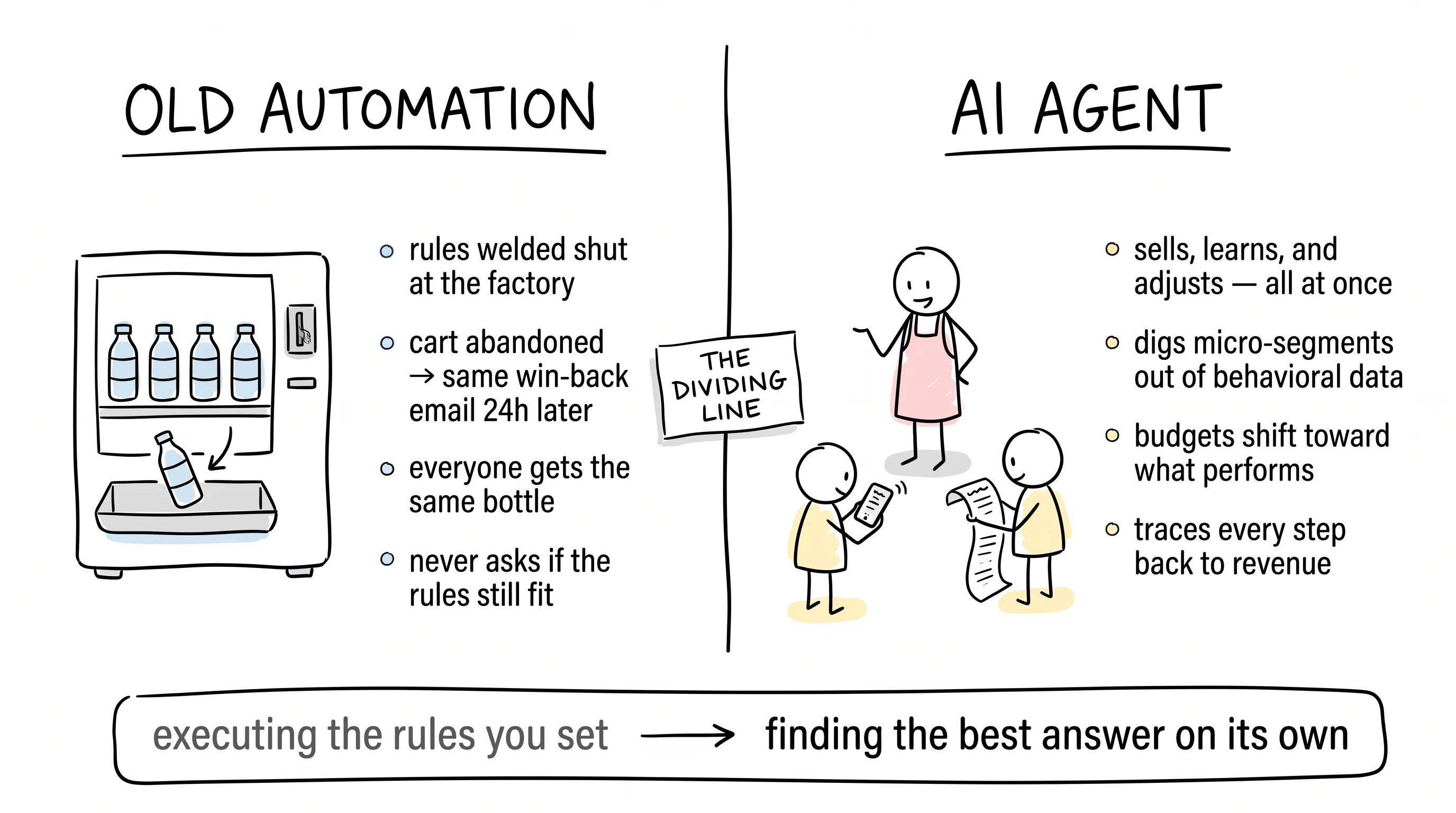
Picture traditional marketing automation as a vending machine. Its rules were welded shut at the factory: coin in, product out. A customer abandons a cart, and a win-back email goes out 24 hours later. Whoever pays, they get the same bottle of water. Whether those rules still fit? The machine never asks.
An agent is different. It's more like the shop assistant who has worked your floor for ten years.
He greets the Tuesday-morning customer who scrolls videos differently from the Friday-afternoon customer who loves a long read. He sells, learns, and adjusts — all at the same time.
For instance, an agent digs micro-segments out of mountains of behavioral data — audiences your hands could never find. It can tell which customer is close to closing, and what content to hand over right now. Budgets shift in real time across channels, with more money sliding toward whatever performs. And when a touch actually produces an order, it traces every step back to revenue and shows you the math, instead of just counting the last click (the last ad or email a customer touches before buying).
Yes — from "executing the rules you set" to "finding the best answer on its own": that one step is the dividing line in AI marketing over the past two years.
How fast? Gartner predicts that by the end of 2026, 40% of enterprise applications will have task-oriented AI agents built in. Look further out: by 2028, at least 15% of day-to-day work decisions will be made by AI on its own, no human sign-off required.
Stop and think about that for a second. This isn't adding a feature to software. This is filling your company with digital employees who never sleep.
Why Is This Non-Negotiable? Let's Do the Math
So why is every company rushing to adopt? One quick piece of math makes it clear.
On one side, demand for personalized content is exploding. On the other, marketing budgets lie flat, parked at about 7.7% of company revenue, year after year.
Demand goes up. Money doesn't. Who fills the gap?
Either quality shrinks, or the team burns out, or technology fills the gap.
The companies that pulled ahead chose the third.
The Real Dividing Line Is the Process
Now, a number that stings.
Right now, 62% of organizations are piloting agents. But only about a third have actually rolled them out company-wide.
Why do so many pilot, and so few pull it off?
Because most companies installed agents into their old processes. Approvals still take the same route; the division of labor looks the same. AI walked in the door, then got its hands tied by the old house rules.
Now think: what happens when a broken process pairs up with an AI that never gets tired?
It takes everything that's broken and copies it into every step — faster. It fails sooner, fails faster, and fails in perfect unison.
So the order matters. Tear the process down and rebuild it first. Make AI a native of the new process. Only then does it become worth anything.
AI doesn't pick its process. Give it a good one and it grows wings. Give it a bad one and it crashes faster.
What Does a Rebuilt Process Look Like?
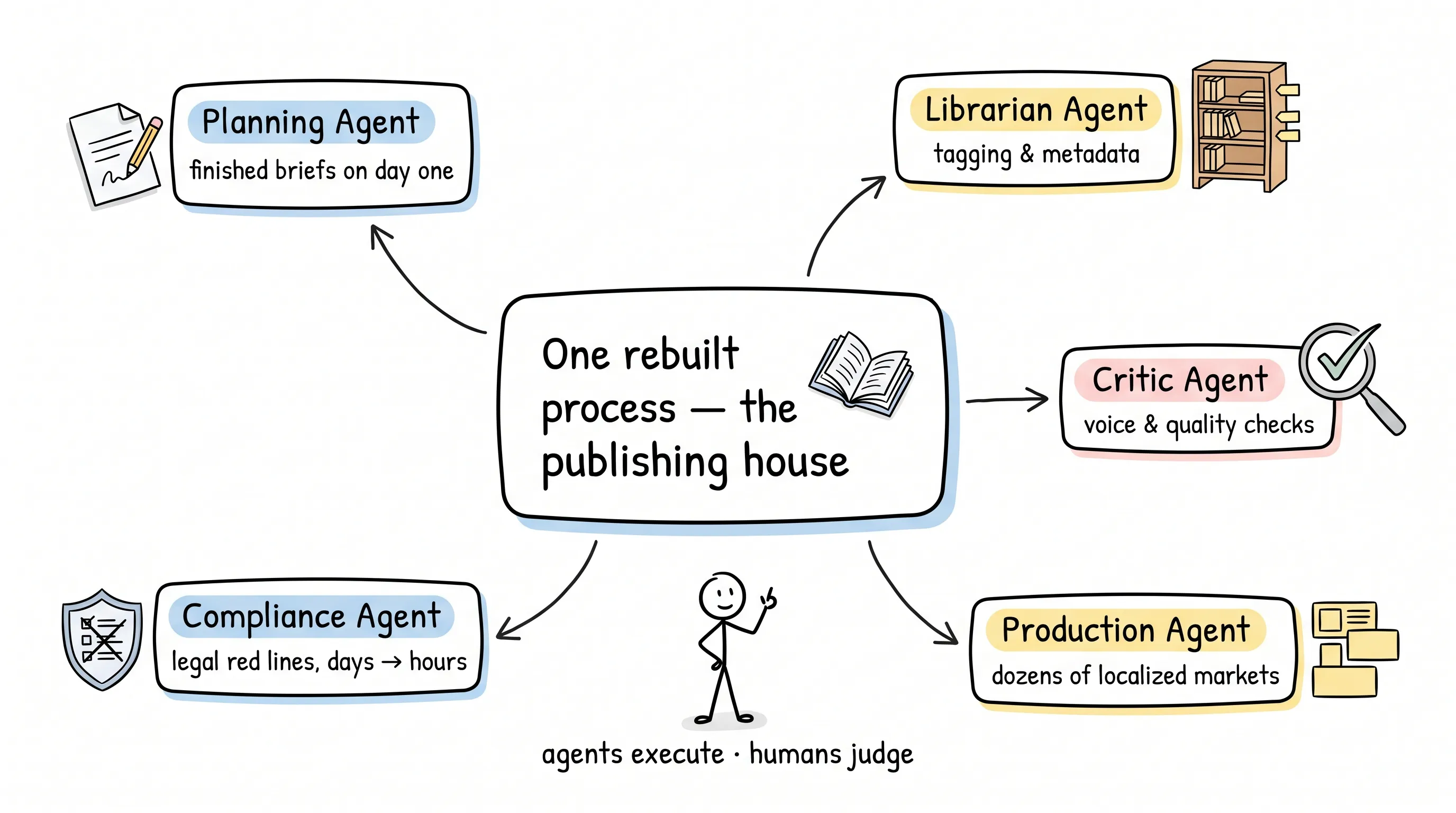
Picture a marketing team as a publishing house.
The five most draining jobs used to be: writing the plans, minding the asset library, catching flaws, chasing legal sign-off, and doing localization.
Now, each of the five has a digital employee.
The Planning Agent takes historical data, audience preferences, and business goals, and turns out finished briefs — then automatically splits one master brief into versions for every region and channel. Just getting everyone aligned on direction used to eat up weeks. Now creative teams pick up their assignments on day one.
The Librarian Agent runs the asset library. Tagging, indexing, and completing metadata are the most soul-grinding chores in digital asset management. It does them — and the more the team uses it, the sharper it gets. Assets get found fast, so reuse naturally climbs.
The Critic Agent checks voice, tone, and quality standards before anything ships. Problems caught on the production line cost the least.
The Compliance Agent is a lifesaver for regulated industries like finance and healthcare. Brand guidelines, legal red lines, industry clauses — it checks each one against approved messaging libraries, line by line. A manual review round used to take days. Now, hours.
The Production Agent handles output at scale. One master asset becomes localized versions for dozens of markets — resizing, translation, local labels — it handles all of it. The parts that call for cultural tact stay with people.
By the way, none of this is a slide-deck daydream. Aprimo, a veteran vendor in digital asset management (DAM), put agents like these into production back in 2023 — a full two years before most people started saying "Year of the Agent" in every other sentence.
Ready to Start? Where Do You Begin?
Three steps.
Step one: lay the groundwork. Agents have to eat, and their food is data. Connect your customer data. Align identities. Otherwise your agents eat half-cooked rice every day, and no amount of cleverness helps.
Step two: tear the process down and rebuild it. Map the process as it stands. Mark where people genuinely add value, and where they're only passing parcels along. After the rebuild, automation is the default; human review is the exception.
Step three: set the rules. Which decisions AI can make on its own, which require a human signature, and whom it escalates to when it meets something new — write it all down in black and white. Then move people up the ladder: agents execute; humans judge, create, and guard quality. And feed real results back to the agents — that's how they keep getting stronger.
One more thing: inside step two sits the highest-leverage starting point — let agents take over tagging and metadata in your asset library first. Fastest results, most visible returns.
Finally, the Big Ledger
Enterprises expect an average return of 171% on their agentic AI investments. US companies are more aggressive: 192%. Early results back that up: AI deployments return roughly three times what traditional automation does.
McKinsey did bigger math: customer operations, marketing and sales, software engineering, and R&D — four functions worth $2.6 trillion to $4.4 trillion in potential value every year.
Marketing alone: companies that adopted AI see productivity gains worth roughly 5% to 15% of marketing spend. Annualized, that's about $463 billion.
One case I especially like: a company took its broad, blunt audiences and split them into 150 personalized segments. Campaign response rates rose 40%, and media costs fell 25%.
But — notice this but. A 2025 survey on agentic AI found 79% of organizations already using it. The ones seeing transformational returns? Only those that rebuilt their processes.
Excess returns never grow on tools. They grow in processes.
Looking ahead, this only accelerates. Multi-agent collaboration becomes the standard — a single agent is an employee; a team of agents is a team. The settings console fades away — you tell the AI what you want in plain words, and it gets it. And once third-party cookies are gone, teams that know how to mine gold from first-party data will leave the ones who can't further and further behind.
A few days ago, I ran into my tea-drinking friend again.
This time, they didn't buy new tools. They tore their content process down to the studs and rebuilt it: agents run execution, people make the judgment calls. He told me that these days, he actually leaves work in time to pick up his kids.
I said: That's good. Really good.
Look at it now: same budget, same set of tools. Change the process, and it's a different company entirely.
Here's wishing you the same: hand the repetitive work to digital employees soon — and spend the time you save on the things only humans can do.
Continue reading
Related articles

Cross-Border Business: Time to Upgrade Your AI Toolbox
A learn article explaining how AI tools help cross-border e-commerce sellers clear five hurdles: language, regulation, logistics, payments, and fraud. It outlines a five-compartment toolbox, a five-step adoption path, and metrics such as conversion rate and CLV, while cautioning against over-reliance on AI.

AI Is Taking Over the Dirty Work of Social Media Marketing, One Task at a Time
This learn article outlines four social media marketing tasks AI can handle — audience analytics, content drafting and design, ad targeting and creative testing, and spam moderation — and cautions that taste, judgment, and data security remain human responsibilities.

AI Is Already This Good — Why Is Your Social Media Marketing Still Pure Manpower?
An overview of 18 AI tools for social media marketing, organized into six categories covering audience research, content creation, scheduling, comment and DM handling, ad management, and visual production, plus notes on personalization, prediction, and emerging trends.