
Stop Sending Everyone the Same Coupon
AI is rebuilding personalized marketing: swap blanket coupons for targeted promotions, use generative AI to say something different to every customer, and build the data-to-measurement foundation that turns messages from noise into reminders.
A few days ago, my phone got two promotional texts within the same hour.
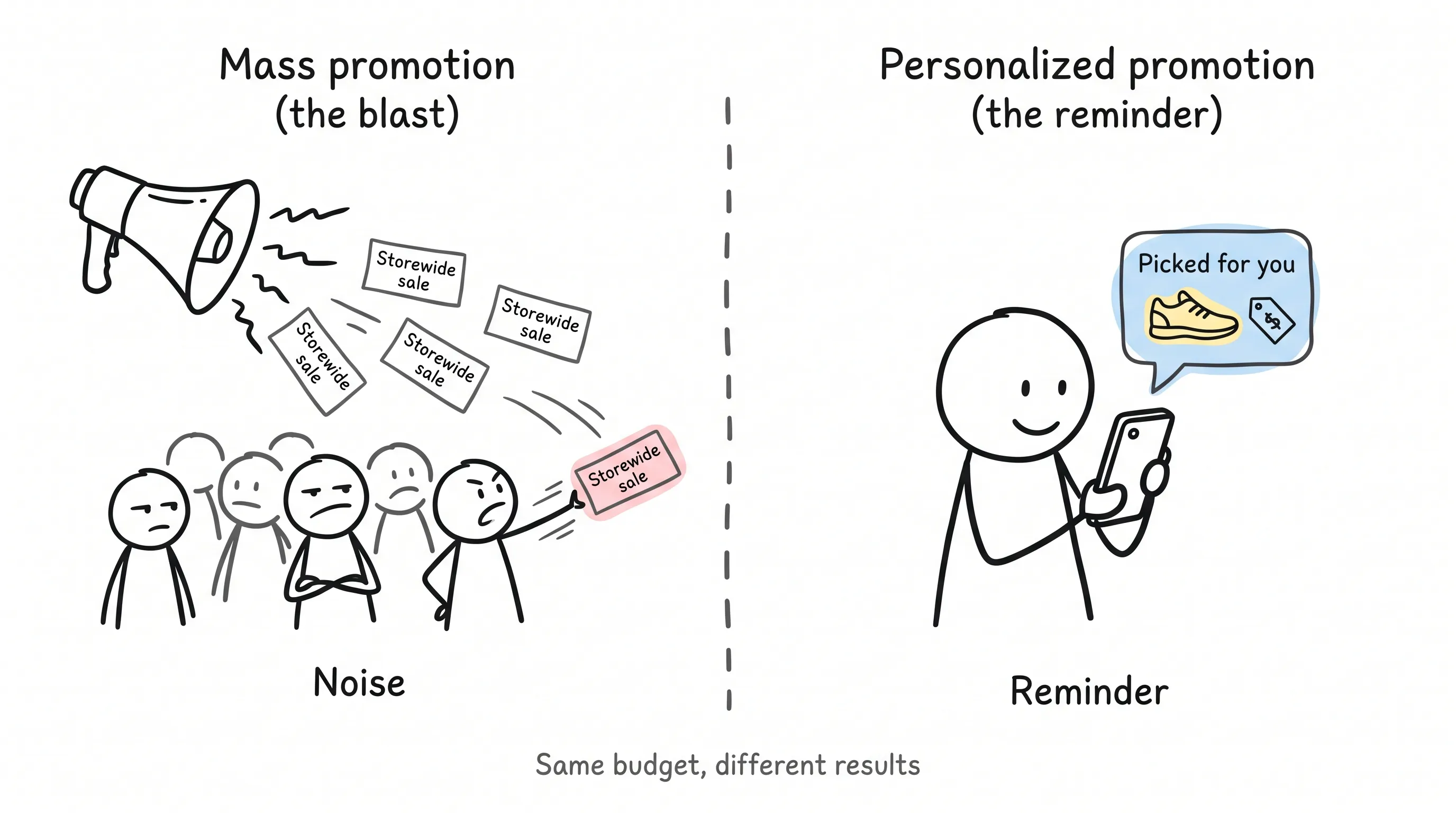
The first: "¥30 off every ¥300 storewide — tap here to enter the sale."
The second: "Those running shoes you looked at last week just dropped to 20% off — only the last batch left."
Guess which one I opened?
The second. The first one, I swiped away after the first few words.
Strange? Not at all. Both were promotions, but one felt like spam and the other like a reminder.
Behind these two texts hides an old business that AI is rebuilding from the ground up: personalized marketing.
What Is Personalization?
What is personalization, exactly?
Put simply, it means saying the right thing, to the right person, at the right time.
Sounds simple. But think about who stands in front of a retailer: thousands, even hundreds of millions of individuals. They speak different languages, come from different cultures, carry different-sized wallets, and buy things for wildly different reasons: some will stake out a sale in the middle of the night to save five yuan; others specifically pick the expensive option — "Pricy, but zero hassle."
Want to speak to that many people, one by one, right to their hearts? Humans can't do it. And in the past, nobody really could.
So what did everyone do instead? Flood irrigation. Every holiday, storewide 50% off, one text blasted to ten million people. Simple, blunt, and it sort of worked. But the price: only about one in ten would actually be moved by that coupon. The other nine received pure harassment.
Worse yet, consumers got spoiled a long time ago.
A 2021 McKinsey survey found that 71% of consumers expect brands to deliver interactions tailored specifically to them, and 76% feel frustrated when brands don't.
Note that word: expect. Personalization is no longer a bonus. It is the default.
If your marketing can't personalize, every message you send is noise.
Move One: Swap Flood Irrigation for Precision Drip
So how do you actually do it? McKinsey points to two paths. The first: targeted promotions.
What are targeted promotions?
Stop blasting coupons at random. Segment first, then send.
For example, split users into groups like these:
There's the group that is extremely price-sensitive — no discount, and they turn around and walk to your competitor. Give them deeper discounts. Earning a little less beats losing the order.
There's the group that clearly favors certain categories — only mother-and-baby products, only sneakers. Push along the lines of what they already love.
There's the group that habitually claims coupons in the app and finds email annoying. Reach them in the app.
And there's the group that hasn't bought in a long time. Don't drag them back; going by their past purchase frequency, offer them an easy way back in.
Then there are the members. Members are the people who raised their hands and said, "I'm willing to be served personally by you." How deep their discount goes depends on their membership tier.
Behind all these tactics is the same underlying capability: using data to calculate who is most likely to be moved by which kind of offer. The industry calls it "promotion propensity." It sounds arcane, but it's really just running a calculation for each person: if this coupon is sent to them, what's the probability they'll use it?
Is it worth all this trouble? McKinsey's research offered a set of numbers: 65% of consumers cite targeted promotions as an important reason to complete a purchase. Companies that do targeted promotions right can lift sales by one to two percentage points and improve profit margins by one to three percentage points.
One to three percentage points — sounds trivial, right?
Do the math. Retail is a notoriously thin-margin business; a net margin of 5% is considered quite good. Improving profit margins by one to three points is equivalent to conjuring 20%, even 60%, more profit out of thin air.
In a thin-margin industry, a few points are the line between life and death.
Mass promotions buy exposure. Targeted promotions buy responses.
A North American Retailer's Experiment
Has anyone actually made this work? Yes.
A long-established North American retailer used to run the standard "calendar-based promotions": the moment a holiday arrived, a storewide sale where everyone got the same discount; on ordinary days, small tiered discounts by membership level.
Then it committed to a transformation toward data-driven personalized promotions.
First, build models. Based on each user's historical purchase behavior, calculate the probability that they will actually bite on an offer. Then move in small, fast steps — one two-week sprint after another, with A/B tests running nonstop: this coupon to this batch of people, that coupon to that batch, crunch the data, review the results, iterate.
As the tests ran on, they discovered something counterintuitive: users were worn out by the barrage of coupons.
Their response was unexpected: send less. Cut a portion of the promotions and make the experience simpler.
The result? In three months, the annualized profit margin of the initial tests rose by about 3%.
Sending fewer coupons made more money instead. Because good personalization isn't just "sending accurately" — it also includes "knowing when not to send."
Move Two: Let AI Speak for You — Something Different for Every Person
The second path is bolder: using generative AI for content.
What does "generative AI for content" mean?
The targeted promotions just described solve "who gets the offer, and how deep." But once the offer lands in front of a user, there still needs to be a line spoken to them. That line used to be written by your copywriters, word by word. Want to write one hundred million lines for one hundred million people? Impossible. So the only option was one line, blasted to everyone.
Generative AI crushed the cost of doing this. Tailoring content for niche audiences used to be too expensive to attempt; now AI can quickly and cheaply mass-generate different tones, different images, and different copy for different audiences.
That said, let me pour a bucket of cold water here.
Plenty of brands are indeed piloting this. But how are most of them piloting it? By hand. Today they use one tool to write a few lines, tomorrow they switch to another tool to make a few images — one isolated experiment at a time. No automation, no integration into their systems, and often no one going back to evaluate which pieces performed well.
It's like buying an excavator and then digging with a shovel.
The real play is to wire people, processes, and platforms into one line: automated content production, smooth cross-team collaboration, promotions and content seamlessly joined. McKinsey has observed that teams that get this running smoothly produce content 50 times faster than by hand.
50 times. Let that sink in.
Of course, AI-generated content can go off the rails. Bias, toxicity, confidently delivered nonsense — any of it can surface. So the guardrails must stand in front: content must be human-reviewed and verified, and it has to meet the company's standards and tone.
One European telecom company offered a beautiful demonstration. They installed a "next-best-action" engine: multiple machine learning models predict, for a given user, the probability of accepting a given action and how much that acceptance is worth, then rank everything by priority. How finely were the actions broken down? Roughly 2,000 of them, tested one text message at a time.
Then generative AI stepped up to write the copy: by age, gender, and data usage, different people received different messages. The company's core selling points, woven in with the offer details, read like they were written for you alone. The guardrails were in place too: length, tone, privacy — all locked down tight.
After a few months, users who received the personalized messages had engagement rates 10% higher than those who didn't.
Ten percent more action from a text. On the strength of that ten percent, the telecom decided to roll this playbook out across more channels.
Move Three: The Foundation. Without It, the First Two Moves Are Castles in the Air
At this point, you might be thinking: it's just coupons plus copywriting — I could pilot it tomorrow.
Not so fast. The first two moves both grow out of the same foundation.
As early as 2019, McKinsey proposed a technical framework for personalized marketing called "4D": data, decisions, design, distribution. Now they've added a fifth: measurement.
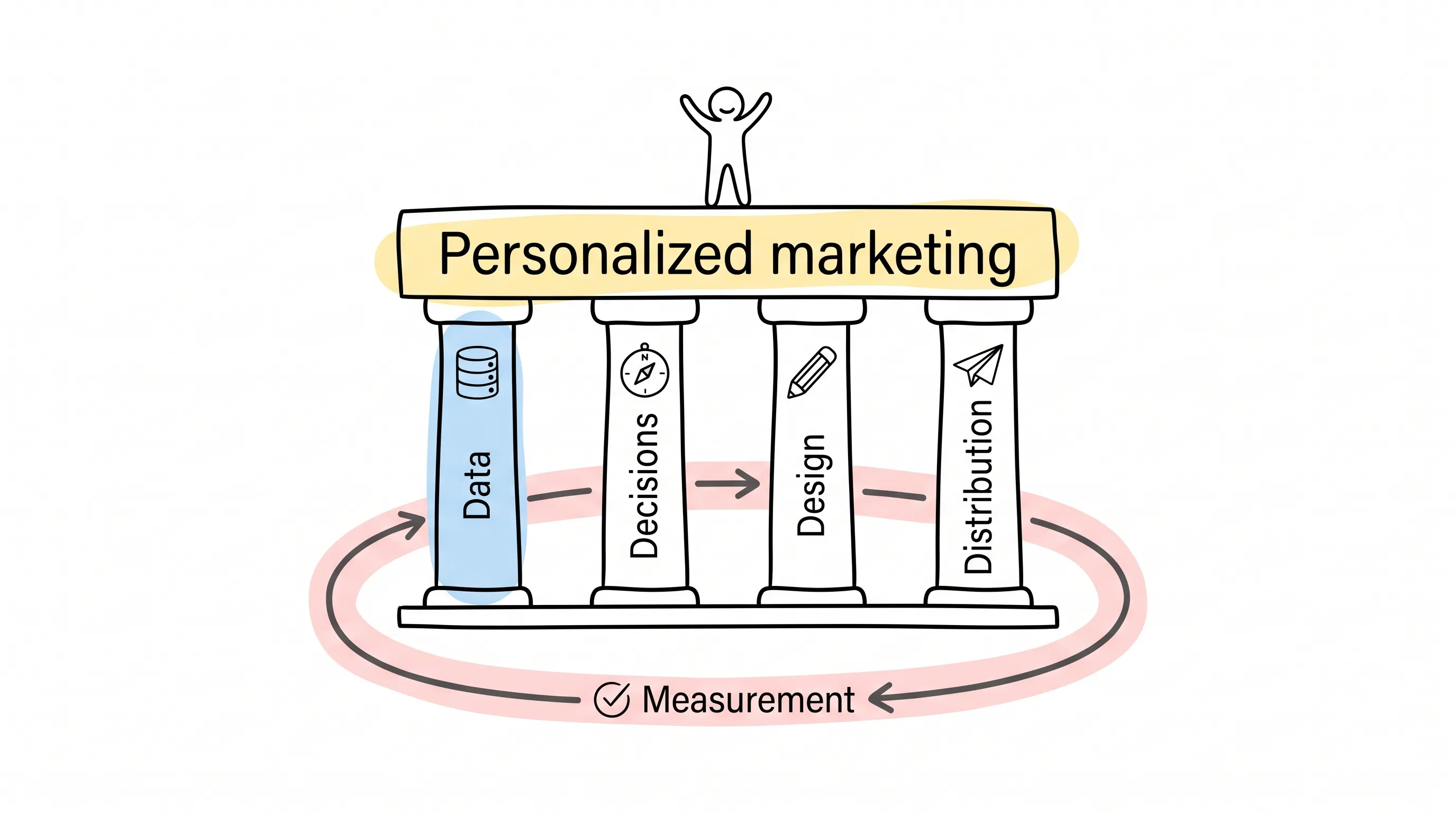
What is data? Don't just store transaction records. What promotions went out and who used them; what content was pushed and who clicked; a unified tagging system; the feature store supporting machine learning; the prompt library and vector databases for large models. All of it must be there. Data is the foundation. If the foundation is shaky, every building above it is rented.
What are decisions? A suite of AI models runs four calculations: Will this person place an order because of this coupon? How much true incrementality did this promotion bring? Will they click this piece of content? Which type of content works best on which kind of person? Once the calculations are done, hand them to a decision engine to rank: at this moment, what should this person see?
What is design? Two systems, each governing one thing. One governs offers: generation, deployment, redemption — one standard across all channels. One governs content: creation, versioning, storage — all assets go into the same asset library, ready to grab and use whenever needed. Whatever you do, don't let every channel keep its own copy; that's where the disaster begins.
What is distribution? A user browses the app, wanders into a mini program (a lightweight app running inside a super-app like WeChat), then turns around and receives a text — the path sprawls across a pile of channels. To deliver "real-time personalization," the system must be able to process a user's behavioral signals in an instant, then immediately decide: at this moment, at which touchpoint, push which piece of content.
What is measurement? A closed loop. All channels' data converges in one place, incrementality tests become routine, metric definitions get unified. The dashboards that come out of it: executives watch revenue and profit; ops teams track every single campaign. Every cent spent gets chased down and asked one question: was it worth it?
Is this whole apparatus heavy? Heavy.
One large North American retailer famous for deep discounts, to pull this off, wired its point-of-sale systems fully into its marketing tech stack, built models to study the intersections between products and users, put together cross-department teams, and shut down most of its storewide mega-sales. Within a year, pricing optimization produced $400 million in value, and targeted promotions supercharged by generative AI added another $150 million.
$400 million, plus $150 million. Impressive. That's the return on the foundation.
So Where Do You Start?
If you want in, where do you start? Four steps.
First, draw the map: where would targeted promotions and personalized content create the most value?
Next, find the "lifetime value events" you most want to drive: which actions best show that a user intends to stay with you for the long haul?
Then give your tech a health check: list every tool you're missing.
Finally, rewire processes and organization: how talent, data, technology, analytics, and marketing collaborate — reorganize all of it around personalization.
Of these four steps, the hardest part isn't really the technology. It's execution.
Anyone can buy the tools; anyone can build the models. What actually separates the winners is how far platform integration has gone and how well-drilled the team has become.
Finally, Back to Those Two Texts
Now look again at the two texts from the beginning.
"¥30 off every ¥300 storewide," versus "the running shoes you had your eye on just dropped in price." The difference, on the surface, is copy; underneath, it's systems: one sender has no idea who you are, the other knows what you've been thinking about since last week.
Same budget. Some send reminders; others send noise.
Those who never master personalization will watch their room to survive get eaten away, bit by bit, by those who do.
For users, good marketing comes down to three words: "You get me." Bad marketing is also three words: "Ugh, this again."
Here's wishing that every message you send lands as "exactly what I needed" — not "casually swiped away."
Continue reading
Related articles

Cross-Border Business: Time to Upgrade Your AI Toolbox
A learn article explaining how AI tools help cross-border e-commerce sellers clear five hurdles: language, regulation, logistics, payments, and fraud. It outlines a five-compartment toolbox, a five-step adoption path, and metrics such as conversion rate and CLV, while cautioning against over-reliance on AI.

AI Is Taking Over the Dirty Work of Social Media Marketing, One Task at a Time
This learn article outlines four social media marketing tasks AI can handle — audience analytics, content drafting and design, ad targeting and creative testing, and spam moderation — and cautions that taste, judgment, and data security remain human responsibilities.

AI Is Already This Good — Why Is Your Social Media Marketing Still Pure Manpower?
An overview of 18 AI tools for social media marketing, organized into six categories covering audience research, content creation, scheduling, comment and DM handling, ad management, and visual production, plus notes on personalization, prediction, and emerging trends.