
Stop Chasing Rankings. What You Want Is a Spot on AI's Citation List
A learn article explaining how AI answers now cite only a few sources and how GEO (generative engine optimization) works differently from traditional SEO. It covers measurement, content structuring, authority building, and quarterly review practices for AI visibility.
A few days ago, a friend of mine who runs an enterprise software company called me, and he sounded anxious.
He said their company ranks No. 1 on Google — nearly ten years of SEO, keywords locked down tight. But last week, the procurement lead at a major client told him: when we evaluate vendors now, we don't open Google at all — we just ask ChatGPT.
They asked around, and the AI recommended three vendors.
Theirs wasn't one of them.
He asked me: what's going on here? We're still on page one.
I told him: buddy, the times have changed. Your ranking was built for search engines to see. But your customers have stopped searching — they're asking AI.
1. Search Has Changed: From 10 Shelf Slots to 2 Spots
Let's start from the beginning.
What is traditional SEO? You do a pile of keyword optimization so your page ranks a bit higher on Google's results page. At its core, it's fighting for shelf space. Google gives you 10 blue links per page, and you fight for one of those spots.
So what is GEO? GEO — Generative Engine Optimization. Put simply: optimizing your content until AI engines like ChatGPT, Gemini, and Perplexity are willing to cite it.
These are two games with completely different rules.
Think about it: Google is a shopping mall, and what you're fighting for is shelf space. AI is a butler. When the master asks it a question, it rummages through the book pile, picks out only two or three names, and reports back.
And there's data to back this up. Profound, a company that monitors AI visibility, has run the numbers: on average, a single LLM answer cites only 2 to 7 domains.
10 shelf slots became 2 spots.
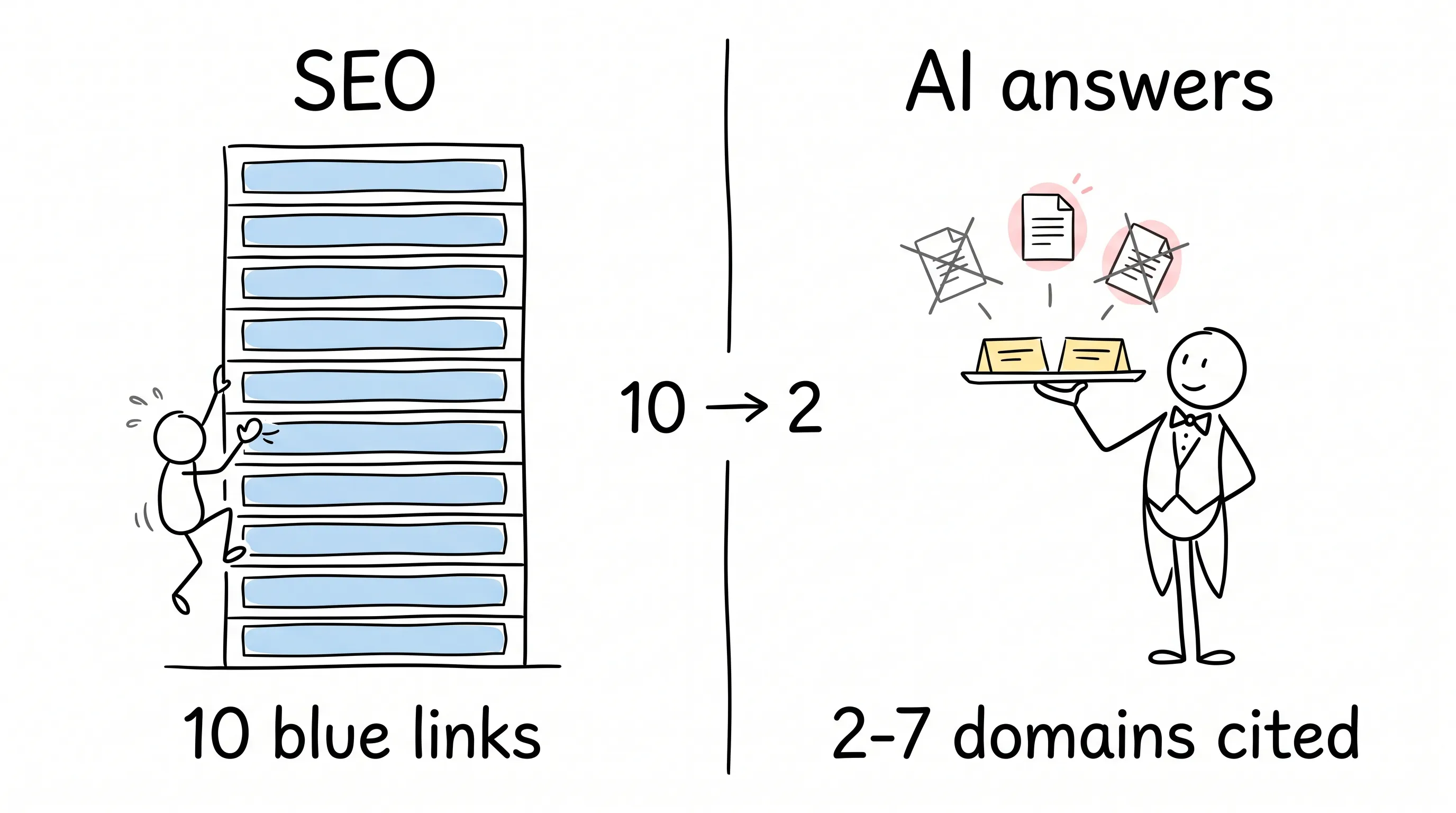
What does that mean? It means that in AI search, the second tier might as well not exist. Backlink counts no longer decide anything either — what AI recognizes is citation authority: whoever gets cited more by high-authority sources is the one it trusts.
How big is this? In 2025, more than 1 billion questions a day were already going to ChatGPT. 71% of people in the US already use AI search to research what to buy and which brands to trust. Forrester's survey shows that 89% of B2B buyers use generative AI to dig up information on their own throughout the procurement process. Adobe also found that the bigger and more complex the purchase, the more people are willing to ask AI first — that share has reached 87%.
Some agencies even predict that by October 2030, ChatGPT's traffic will surpass Google's. Will that prediction land? I don't know. But there's almost no doubt about the direction.
By the way, don't get hung up on terminology. Some in this industry call it GEO, some call it AEO (Answer Engine Optimization); Profound itself prefers AEO. The name doesn't matter; what matters is the one thing behind it: getting AI to mention you in front of your customers.
2. What Makes AI Cite You?
So how does AI actually decide whom to cite?
Think of AI as a student taking an open-book exam.
When the question arrives, it goes to the books first. The jargon term is RAG — retrieval-augmented generation: pull material off the web in real time, feed it to the model, generate an answer. And once it's done with the books, it trusts only three kinds of content: relevant to the question, fresh enough, and authoritative enough.
An old friend from the SEO era — E-E-A-T (Experience, Expertise, Authoritativeness, Trustworthiness) — is still hard currency in this exam. Whoever publishes content with transparent authors, reliable sources, and steady updates is far more likely to catch AI's eye.
Profound itself is the proof: their in-depth guide on AEO has been cited more than 9,000 times in total across the major models.
Impressive, right? Here's the point:
AI doesn't collect opinions. It only collects sources it dares to cite.
Now flip it around: what's the cost of doing nothing? Let me play it out for you.
Six months from now, a customer asks AI "who's the strongest player in our industry" — and AI rattles off your competitor's name. Worse: AI does mention you, but the "you" it describes is a hallucination — the features are wrong, the reputation is skewed. Your brand narrative gets casually rewritten by someone else, and you never even get a chance to defend yourself.
This window won't stay open long. Waiting passively only makes the price go up.
3. The Foundation: Get Clear, Take Stock, Hear the Truth
So where do you start?
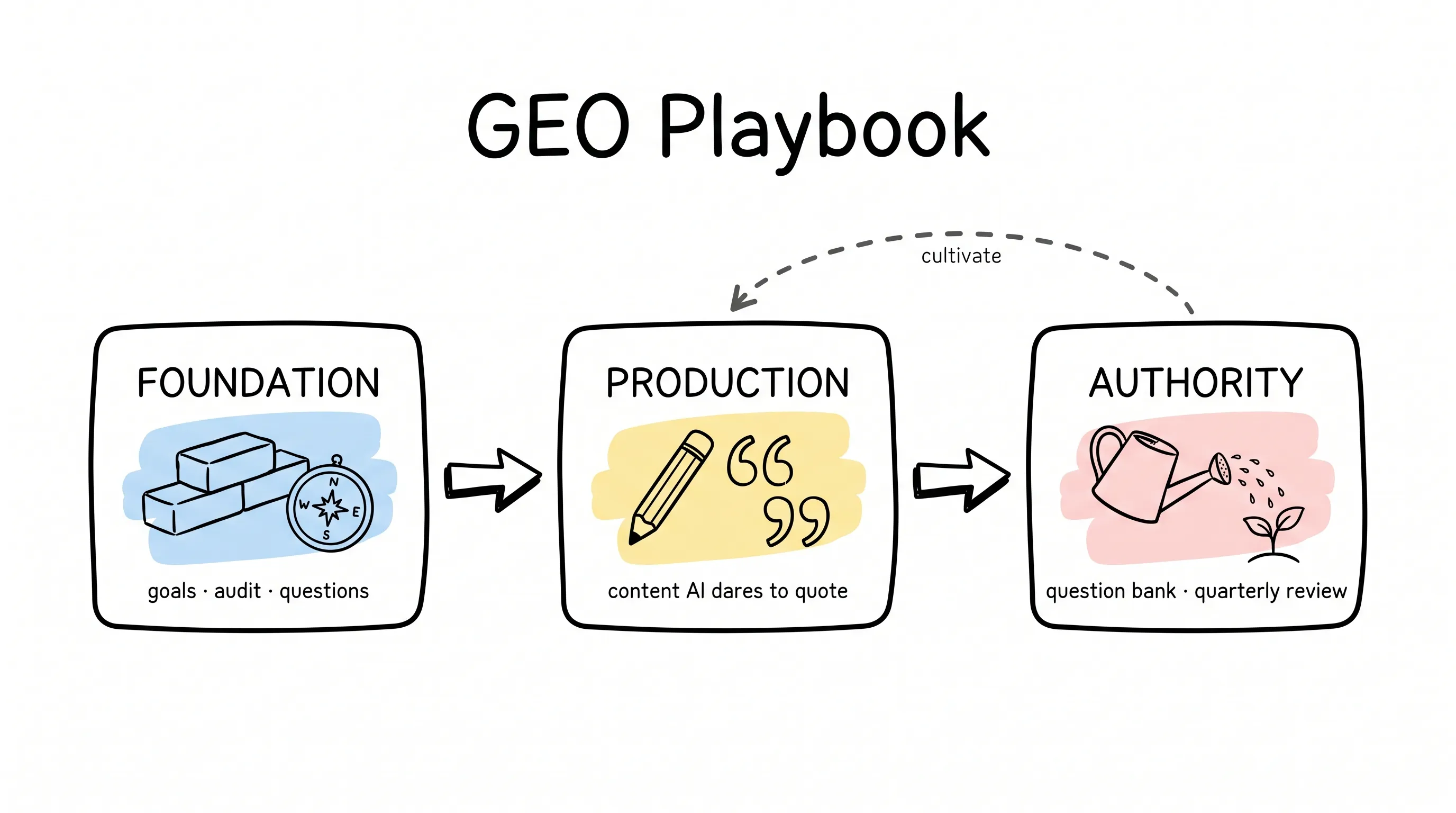
I've seen too many companies open with "how do we get ChatGPT to mention us." Wrong order. To build a house, pour the foundation first. That foundation is three things.
First: get clear on what you actually want.
AI visibility isn't the goal. Money is. Decide first: what is AI supposed to bring you — leads, revenue, or sign-ups? Tie AI visibility to business metrics, and only then does this effort stand on solid ground.
Here's a dumb-looking method that's worth a fortune: add one question to your lead forms and signup forms — "How did you hear about us?" That single question opens a window, and through it you'll see whether AI is actually bringing you customers.
Reference targets could look like this: AI-attributed leads growing 20% a year; brand visibility score cracking the industry's top three; positive sentiment when AI mentions you staying at or above 90%.
Second: take stock.
If you don't know what AI is saying about you right now, you can't improve anything. Use a monitoring tool (like Profound's Answer Engine Insights) to give yourself a checkup: your visibility score, your share of voice, whether the sentiment is praise or criticism, and whether AI is making things up about your product.
Working out without reading your checkup report — the harder you train, the worse you get hurt.
Third: listen to the real questions.
What customers ask AI is the exam you should be optimizing for. Where do you find those questions? In sales call recordings, in the mouths of longtime customers, in Reddit discussions.
Lay the questions out along the buying journey: at the awareness stage, customers ask "what is GEO"; at the comparison stage, "which enterprise GEO tools are best"; at the decision stage, straight to "how do I book a quote and a demo." There's your funnel map — lay your content down along it.
And if collecting them yourself feels too slow, there's another way. Profound's Conversation Explorer uses a dataset of tens of millions of real user questions (updated weekly) to estimate how hot any given question runs in AI search.
Foundation done — now you can build.
4. Production: Make Your Content Something AI Dares to Quote
Next comes production. The core is one sentence:
Make it so AI understands you at a glance — and dares to quote you.
How? Five moves.
Move one: make your content "easy to quote." Open with a TL;DR, structure the body as bullet lists, add structured markup like FAQPage and HowTo, and use tables wherever a table fits. Produce plenty of comparison pieces: "the 10 best tools in the XX industry," "Option A or Option B — how to choose." When AI assembles answers, this is the structure it loves to pull from.
Move two: get the technical foundation solid. HTTPS site-wide, mobile load times squeezed under 1.8 seconds, structured data coverage maxed out. And keep watch on AI crawlers: whether they've visited your site, what they crawled, when they stopped coming — all of it has to be visible (Profound's Agent Analytics exists for exactly this). If you can, also publish an LLMs.txt file — think of it as slipping a cheat sheet to the AI crawlers.
Here's a trap that's remarkably easy to step into: most AI crawlers don't execute JavaScript. Writing your whole menu on glass looks pretty — but crawlers only read the little blackboard at the door. Put your critical content, honestly and plainly, into the base web code.
Move three: cultivate citation authority. Publish original research, industry white papers, expert viewpoints — and set yourself a hard target: at least 20 citations from high-authority domains each quarter. This is hard. It takes real data and genuine expertise. But that difficulty is precisely what makes it a moat. The easy things, everyone does — why would AI cite you for those?
Move four: shore up trust signals. Write clear author bios, label your sources plainly, and get review-type structured data in place. Then clean house on a schedule: delete or refresh old content that's outdated or low quality. HubSpot just did this recently, and it worked well.
Move five: keep the multimedia assets coming. Charts, infographics, videos with transcripts — and write proper alt tags on every image. The more multimodal AI engines become, the more valuable these assets are.
Some people worry: will doing GEO hurt traditional SEO?
Quite the opposite. Structured markup and authoritative content are bonus points for traditional SEO too. Both sides rise together.
5. Building Authority: AI's Trust Has to Be Grown
The last step — and the easiest one to overlook: this is not a one-shot deal. It has to be cultivated.
How do you cultivate it? Two things.
First, build your own question bank. For every core business topic, prepare 20 to 30 real questions, run them every day, and log what the AI answers. What you're watching for isn't a screenshot from any single day — it's the longitudinal curve: is your visibility climbing, or sliding?
Models turn over every three months, and so does the way customers phrase things. So every 90 days, refresh the question bank and your content.
Second, review every quarter. Watch four numbers: visibility score, citation count, sentiment index, share of voice. Pull your competitors into the comparison — that's the only way the numbers mean anything. And report the results to management, so the whole company can see what this is worth.
Then there's people and money. A well-run GEO team is usually built from four roles: an SEO lead who owns strategy and execution, a content strategist who owns the question bank and the material, a data analyst who owns measurement and reporting, and a marketing lead who owns the budget — and, along the way, locks down company-wide support.
How much budget? For a mid-sized company, roughly $75,000 to $150,000 a year — call it half a million to just over a million RMB — covering tools, content, and analytics. Big companies go harder still: starting at $250,000.
Expensive? Depends what you compare it against. Against one budget line — or against a channel that's quietly closing.
Rollout pacing matters too. Start with the three engines with the most traffic: ChatGPT, Google AI Mode, and Perplexity. Once those are working, extend to Claude and Microsoft Copilot. Don't get greedy — win your home field first.
Beyond that, AI answers will keep getting more personalized, more multimodal, wired into more real-time data. When that day comes, whoever keeps their content fresh keeps getting cited.
Writing to this point, I keep thinking of that phone call.
He really did follow the playbook. Started by taking stock, built up the question bank, cleaned out the old content. Last month he messaged me: AI has started mentioning them. Not in the top three yet — but that curve is heading up.
That's today's search game: no more 10 shelf slots. Only 2 spots left.
The era of fighting for shelf space is over. What you need to do is get onto AI's citation list.
Here's my wish for you: may you be the name that gets mentioned in AI's answers.
Continue reading
Related articles

Cross-Border Business: Time to Upgrade Your AI Toolbox
A learn article explaining how AI tools help cross-border e-commerce sellers clear five hurdles: language, regulation, logistics, payments, and fraud. It outlines a five-compartment toolbox, a five-step adoption path, and metrics such as conversion rate and CLV, while cautioning against over-reliance on AI.

AI Is Taking Over the Dirty Work of Social Media Marketing, One Task at a Time
This learn article outlines four social media marketing tasks AI can handle — audience analytics, content drafting and design, ad targeting and creative testing, and spam moderation — and cautions that taste, judgment, and data security remain human responsibilities.

AI Is Already This Good — Why Is Your Social Media Marketing Still Pure Manpower?
An overview of 18 AI tools for social media marketing, organized into six categories covering audience research, content creation, scheduling, comment and DM handling, ad management, and visual production, plus notes on personalization, prediction, and emerging trends.