
Stop Asking Consumers: It's Time for a New Scoreboard in Brand Marketing
An essay on replacing survey-based brand measurement with AI analysis of real consumer behavior across search, social, reviews, and AI conversations, covering mental availability, perception, and commercial premium, plus AI recommendations as a new observation surface.
Marketing has fought a long war: the brand camp against the performance camp.
Performance brings in money fast. A landing page, a few tidy reviews, a handful of good-looking images — a product can pop up overnight, with money pouring in like water. Brand builders watch with envy, but they know in their hearts: long-term revenue still depends on a name that carries weight.
A few years back, the industry went through a "performance branding" fad — hoping to hit two birds with one bullet. How did that turn out? Too much force, pleasing neither side. It was New Coke all over again.
But here's what everyone already understands: brand governs long-term survival, performance governs this quarter's cash, and you can't escape either one. The real argument was never about that. It was about something else:
On the brand side of the ledger, what gives you the right to judge whether the money was well spent?
For decades, the answer has been: surveys, and the whole family of brand metrics derived from surveys.
That scoreboard is due for a replacement.
Let me tell you three stories first
Story one. A customer says he only supports local shops and has no use for giants. Open his purchase history and you'll find Amazon boxes stacked to the ceiling.
Story two. A frequent flyer tells a friend she picks airlines purely on service and comfort. The next day, booking a flight, she opens… a fare-comparison site. Price has become the only deciding factor.
Story three. Ask a friend why he likes Apple, and he'll deliver a flawless answer: it's easy to use, it protects privacy, the ecosystem. What he can't articulate is how much of it is social image, how much is ten years of habit, how much is familiarity hammered in by decades of advertising.
Three stories, one lesson:
Humans are unreliable narrators of their own behavior.
The answer from your mouth and the answer from your wallet often read like they come from two different people.
Yet brand measurement in our industry has spent decades building its foundation on "asking people."
What exactly is a brand outcome?
Let's define the terms. When we measure a brand, we look at three things: awareness, equity, and valuation.
What is awareness? When consumers think of a category, do they think of you? Here's a quick test: when I say "sneakers," which brands come out of your mouth? Is Nike on your list?
What is equity? One layer deeper. The same shoe, with the word Nike on the side, sells for meaningfully more. That name alone carries a premium.
What is valuation? Converting that intangible asset into a single dollar figure.
Awareness, equity, valuation. Sounds scientific enough. But how are those scores actually produced?
Asking people, for decades
The industry has always relied on measurement giants like Kantar, Ipsos, and NielsenIQ. They hold millions of data points, run sophisticated models, and refurbish their collection pipelines year after year.
But peel these intricate machines back, layer by layer, and what is the input sitting at the very bottom?
Asking people.
Assemble a panel, ask them how they feel about your brand, and their answers become your brand's score.
The foundation is people exactly like the ones in those stories.
This is no fault of the measurement firms. Decades ago, this was genuinely the only way. Real human behavior was too complex to analyze piece by piece, so it got compressed into a questionnaire.
The problem: between "marketing happens" and "a score gets printed," how many layers are stacked in between? Let me walk you through it:
Marketing happens. The consumer experiences the marketing. Their impression of the brand shifts, or doesn't. A researcher asks the consumer. The consumer strains to recall and put it into words. A model converts the answers into metrics.
Six whole layers.
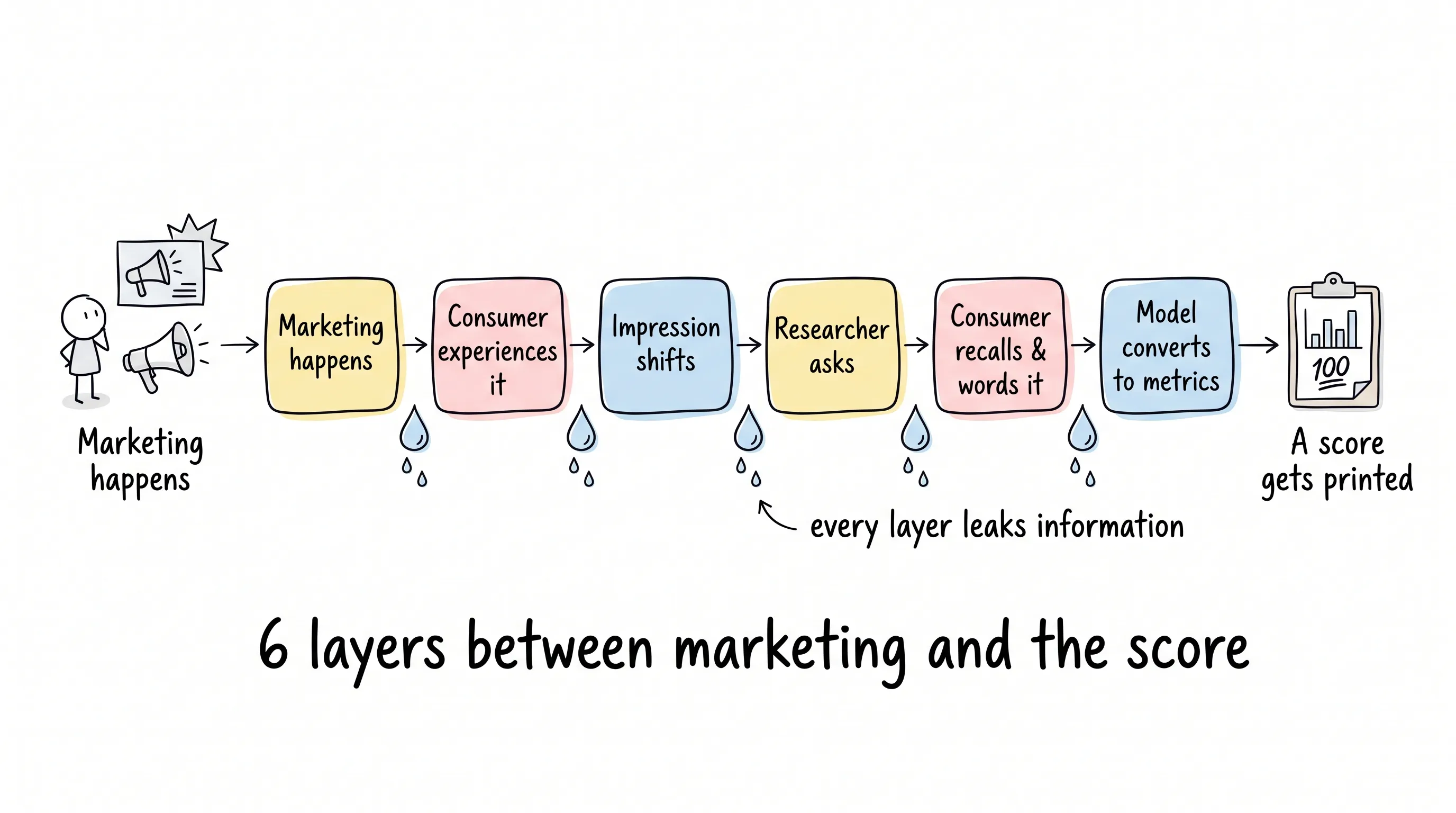
Every layer leaks information. A questionnaire squeezes a person's complete, vivid, contradictory lived experience into one checkbox.
There was no alternative. Now there is.
Why is it only possible now?
Because of AI.
It wasn't for lack of will — the computation was unaffordable and the volume unmanageable. What a person types into a search engine, says on social media, buys on e-commerce pages, asks in AI conversations — these behaviors are massive, scattered, and unstructured. Human analysis: impossible. Traditional tools: can't chew through it.
AI models happen to be built for exactly this: swallowing massive, wildly varied information and reading out its meaning, at a cost low enough to run every day, continuously. Survey-based brand metrics can now be upgraded to behavior-based brand metrics.
Over the past few months, we've been building exactly this for clients. The model rests on three pillars.
Pillar one: mental availability. Do consumers know you? Can they call you to mind? Look at their searches, their browsing, and how they prompt in AI. Someone actively researching and shopping carries the answer in their behavior: did you make their shortlist?
Pillar two: perception. What kind of brand do consumers think you are? Look at what people actually say on social media and in e-commerce reviews. Each one is understood individually, placed in context, and analyzed continuously as a stream — not spot-checked once a year.
Pillar three: commercial premium. How much more can your brand dare to charge than others? Look at pricing elasticity: how much more expensive can you be while still holding onto critical sales volume? That is the pricing power a brand earns. Even the stock price can be weighed on this scale — investors voting with real money on the brand's durability.
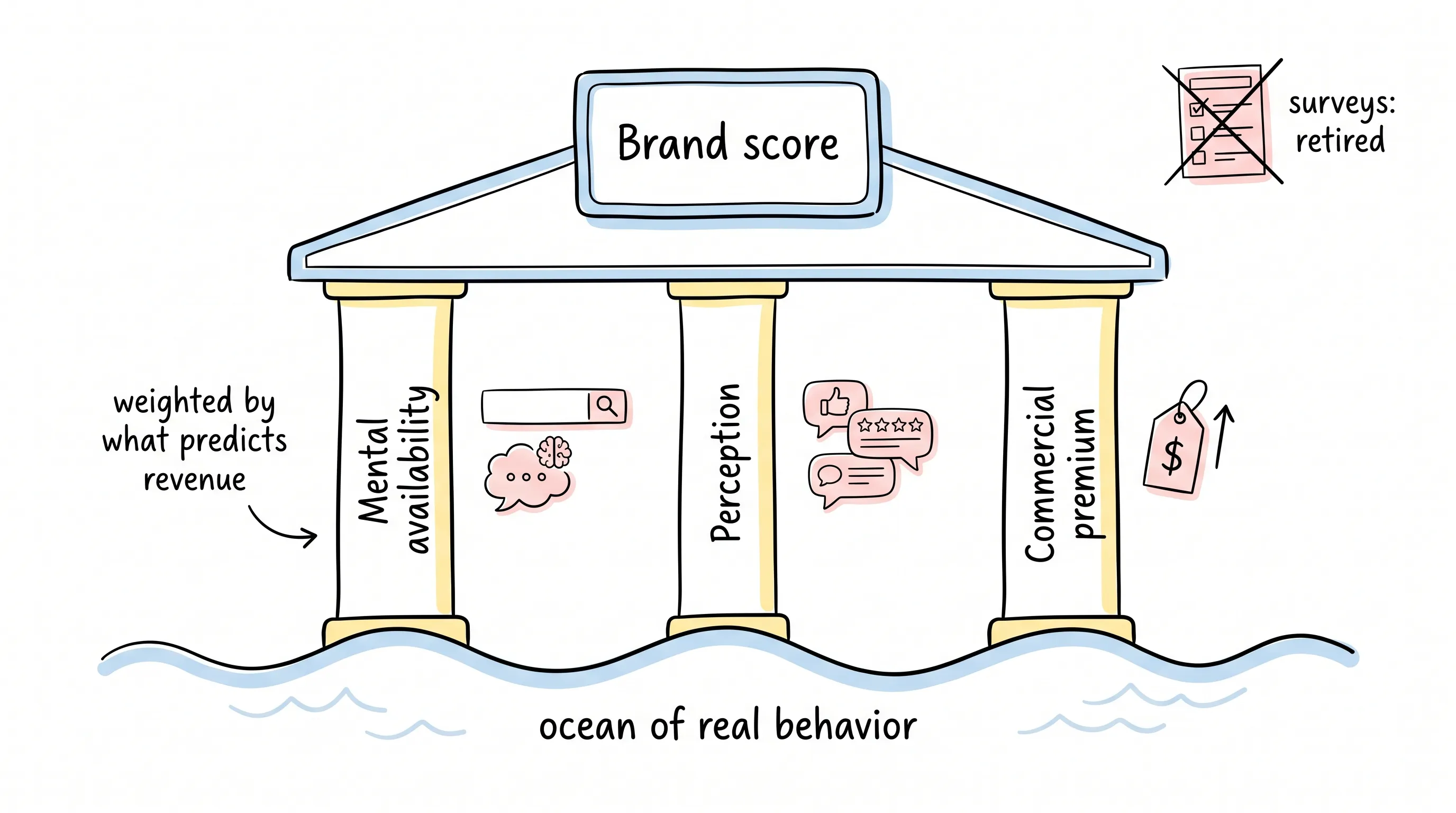
And these signals don't fight alone. They benchmark against competitors and roll into indices, so you don't misread the entire category's rising tide as your own doing. Then each pillar is weighted by how well it predicts revenue outcomes. The three pillars are not equal. Whoever predicts the business gets the louder voice.
One more thing deserves its own mention: AI recommendations are themselves a new observation surface. A user asking an AI to recommend a product may never name any brand. But whoever the AI recommends in its answer tells you who ranks high in the AI's "mind." Once shopping agents place orders on people's behalf, whoever the AI remembers is who gets bought.
Does this thing actually work?
A true story.
A client of ours, despite real internal resistance, made their first heavy investment in a brand campaign. Under the old approach, brand-lift research would take nearly a month after launch before the first results appeared.
With the new model, no waiting. Share of search is moving, perception is moving, brand resonance is growing — near real-time, visible every day.
What does that mean? It means brand budgets can be defended faster, teams can make decisions before results harden, and there's still time to steer the direction back on course. The final research report shifts from "the first time we learn the answer" to a verification check.
Waiting a month blind and watching a dashboard every day are two entirely different ways to manage.
So are surveys still useful?
Yes. I'm not here to write off surveys entirely.
Surveys accomplished something remarkable: they turned something extremely hard to observe into structured data. And we always knew they never perfectly represented brand equity. But they were the best that era could do.
Now the constraint has changed. Before, we could only define brand equity by "the data we could collect." From here on, we can define it by "the data understanding it truly requires."
For decades, brand measurement had exactly one source of truth: asking people. Now, it can be an entire ocean of behavior.
Remember those three stories? The customer who claimed to support local shops, the traveler who swore by service and comfort, the Apple user who couldn't articulate all his reasons. They weren't lying. They were just incomplete. Before, we had to treat "incomplete answers" as the truth. Now, we can watch what they do.
Here's hoping the next time you spend money on your brand, you don't have to guess — you can see.
Continue reading
Related articles

Cross-Border Business: Time to Upgrade Your AI Toolbox
A learn article explaining how AI tools help cross-border e-commerce sellers clear five hurdles: language, regulation, logistics, payments, and fraud. It outlines a five-compartment toolbox, a five-step adoption path, and metrics such as conversion rate and CLV, while cautioning against over-reliance on AI.

AI Is Taking Over the Dirty Work of Social Media Marketing, One Task at a Time
This learn article outlines four social media marketing tasks AI can handle — audience analytics, content drafting and design, ad targeting and creative testing, and spam moderation — and cautions that taste, judgment, and data security remain human responsibilities.

AI Is Already This Good — Why Is Your Social Media Marketing Still Pure Manpower?
An overview of 18 AI tools for social media marketing, organized into six categories covering audience research, content creation, scheduling, comment and DM handling, ad management, and visual production, plus notes on personalization, prediction, and emerging trends.