
Stop Arguing About Whether AI Works. Let Me Show You Some Real Books
A learn article reviewing public AI deployment cases across healthcare, legal, insurance, retail, and e-commerce, summarizing reported time and cost results while urging readers to check metric definitions, investment, and survivorship bias.
The other day, a friend of mine who runs an enterprise-services business sent me a message: "Run, this AI thing—is it real money, or just the emperor's new clothes?"
I didn't answer him directly. A question like this can't be settled by debate. There's only one way to settle it—old-fashioned, but it works.
Look at the books.
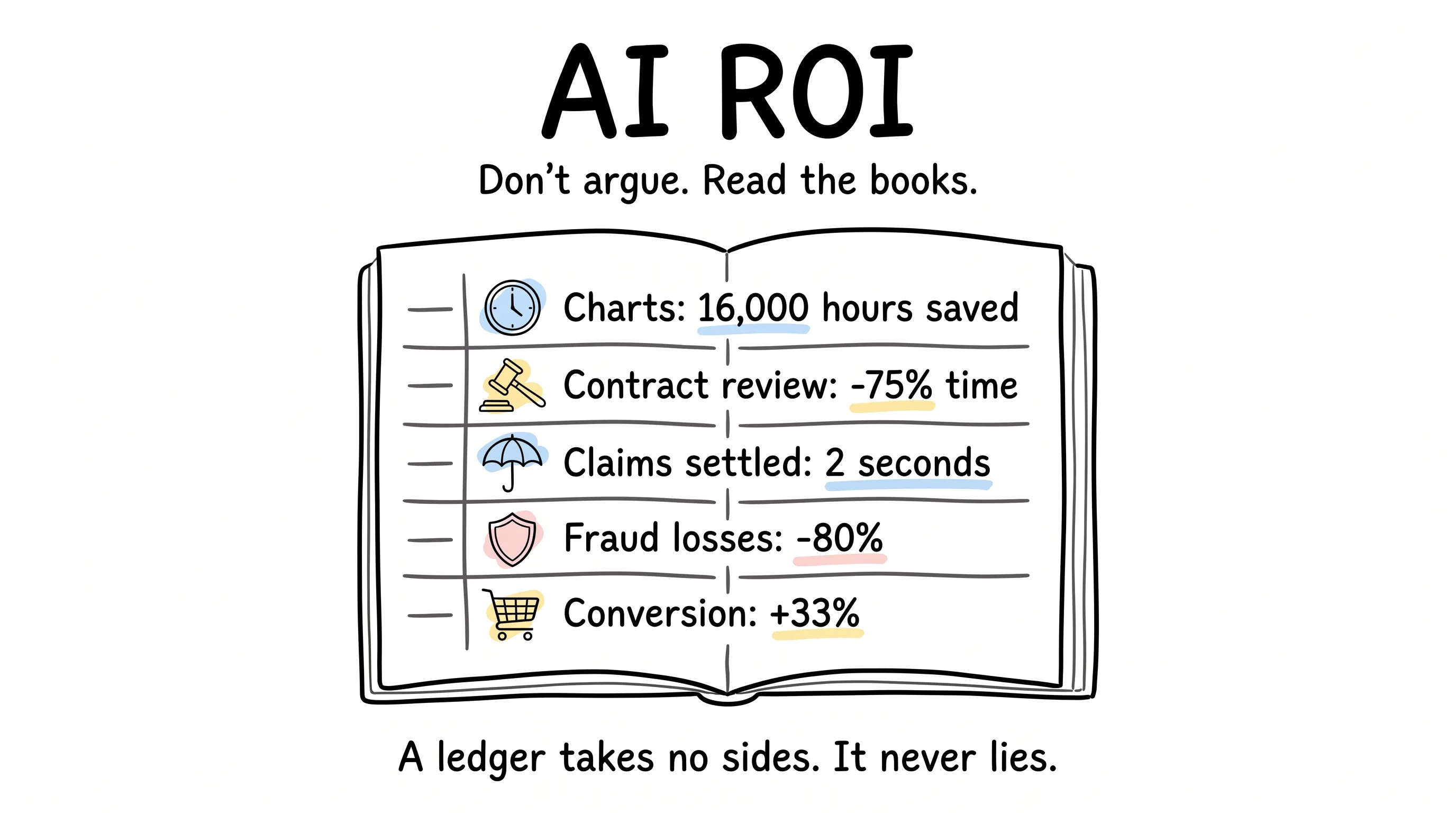
A ledger takes no sides, but it never lies.
Recently I went through a batch of public AI deployment cases, all with the numbers laid out in the open: earnings calls, company press releases, vendor reports. Every single one is a company operating under its own name. Hospitals, law firms, car dealerships, insurance companies, restaurants, accounting firms—all of them there.
I've picked the entries that stuck with me most. Let me walk you through them.
First, the Ledger of Time Saved
What does real ROI look like? It's when someone dares to open up the time-and-cost books for you to see.
Start with hospitals. Kaiser Permanente, the American healthcare group serving more than 12 million members, deployed "ambient AI": the doctor sees patients as usual, the AI listens alongside, and quietly finishes writing the chart.
The pilot started at one hospital in October 2023, then spread to 40 hospitals, with more than 7,000 physicians using it. How much did it save? 16,000 hours.
16,000 hours may not register. So let me do the math for you: at 2,000 working hours per physician per year, that's eight full-time doctors appearing out of thin air. No salaries paid, no resignations—and they write charts faster than humans do.
Here's the interesting part: Kaiser Permanente itself says this was their fastest technology deployment in more than 20 years. Why so fast? Because the AI didn't ask doctors to change a single habit. It simply took the paperwork out of their hands.
How fast a technology gets adopted never depends on how advanced the technology is. It depends on how much you ask users to change.
Dentistry has its own entries. PDS Health, a group covering more than 1,100 dental offices, rolled AI imaging diagnostics out across every location within 12 months, analyzing 120 million clinical findings in total.
Heartland Dental goes further: 39 states, more than 1,750 practices. AI imaging caught 46% more lesions and lifted diagnostic accuracy by 13%. Dentists used to read films on experience alone—and every cavity missed was a landmine planted.
Now the law firms. A&O Shearman, a global firm spanning 43 jurisdictions, put Harvey, the legal AI, in front of all 4,000-plus employees. Each person saves 2 to 3 hours a week.
Doesn't sound like much? 4,000 people, at 2.5 hours a week over 50 weeks a year, comes to nearly 500,000 hours.
Another firm, Wilson Sonsini, took a different path: it built its own platform and let the AI work as a junior associate reviewing contracts. Review time dropped 75%, and on one category of its own contracts, accuracy reached 95%. Piloted in Q4 2023, fully live by May 2024.
In law, time is the product. When contract review drops from 4 hours to 1, the 3 hours saved are profit.
One more number from the hospitals. Mayo Clinic uses AI to read electrocardiograms, with a 95% detection rate; a kidney-function assessment that used to take 45 minutes now returns results in seconds.
KPMG, one of the Big Four accounting firms, hasn't been idle either, rolling its own audit platform, Clara, out to more than 100 countries and cutting document-review volume in half.
Next, the Ledger Where the Money Moves Directly
Time saved pays off only indirectly. A few companies took the knife straight to revenue and costs.
Start with car dealerships. Lithia Motors, a large American auto dealership group listed on the NYSE, used AI for identity verification and fraud detection. In 6 months, fraud losses fell 80%, and fraudulent transactions dropped 65%.
Fraud used to be something you couldn't prevent and simply had to accept. Now 80% of it is cut straight off the books. That's pure profit.
Turn to insurance. Lemonade, an AI-native insurance company, was built on an AI company's architecture from the day it was founded in 2015. Its claims settle in 2 seconds; 55% of claims run fully automated, never touched by human hands.
A traditional insurer takes days, even weeks, to process one claim. Between 2 seconds and 2 weeks lies an entire industry's worth of old process. When I saw that number, only three words came to mind: this is unreal.
And restaurants. Sweetgreen, the American fast-casual chain, has been installing a robot kitchen called Infinite Kitchen in its stores. The stores that have it run a 31% restaurant-level margin, and employee turnover is down 45%.
Notice this detail: what the robot kitchen replaced were the repetitive motions—chopping, plating, portioning. The employees who remain do the work of dealing with guests. When the work stops being repetitive, people stop leaving.
Insurance has a veteran too. Allstate's ALLIE system drafts 50,000 claim messages a day, and email drafting time is down 70%. The fiercer number is the one that comes next: billing-related inquiries fell 45%.
Why did inquiries fall? Because the claim letters made sense on the first read. Most of the trouble on customer-service calls is written by letters that weren't clear the first time.
E-commerce has two entries as well. Wayfair, the home-goods e-commerce company, used Google's Gemini model for personalized recommendations, and conversion rose 33%. The rollout came in phases across 2024 to 2025, and even its 14,000 employees were all issued generative-AI licenses.
Redfin used conversational AI to help people find homes, launching last November; listing views roughly doubled, and requests to tour a home rose 47%. Merchants on Shopify who used the platform's AI personalization tools saw quarterly sales rise 20% and cart abandonment fall by 10 to 20 percent.
The Most Interesting Entries Are the Counterintuitive Ones
By now you may be thinking: these are all big-company stories. What do they have to do with me?
Hold on. Here are two small ones.
First, a dealership in Illinois called Crystal Lake. It signed up for a month-to-month AI tool for customer follow-up and appointment booking, with results inside 30 days. In 6 months, $2 million in gross sales was credited to the AI, and the booking rate rose 27%.
Big companies use big platforms; small companies use monthly subscriptions. The biggest difference between this AI wave and every technology wave before it is that small companies can afford it for the first time.
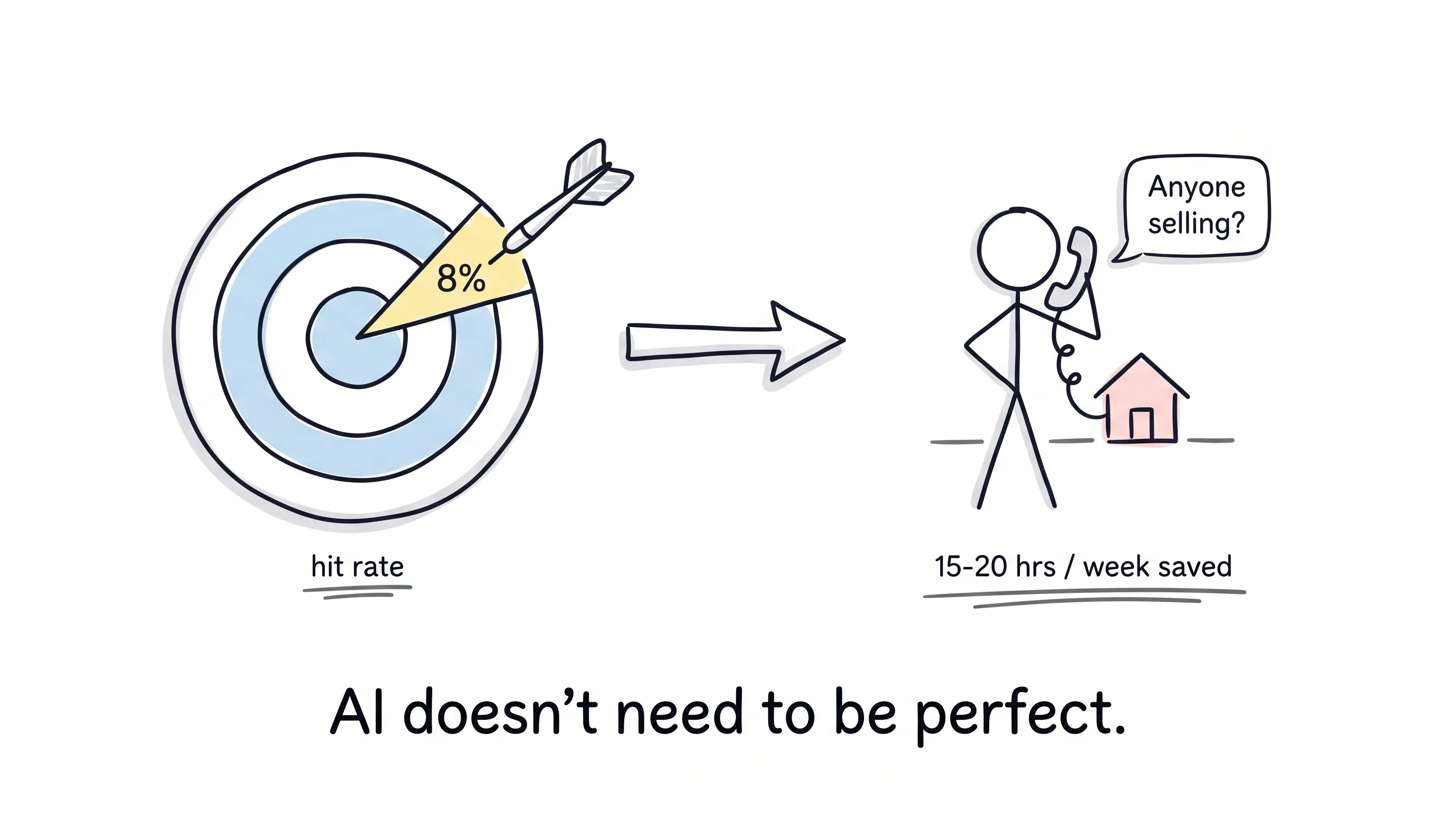
The second one is even more counterintuitive. Compass, a large American residential brokerage, built its agents a prediction feature for "who might be about to sell their home." The feature launched in June 2020. What's its hit rate? Roughly 8%.
8%. You might laugh: what terrible aim.
But look at it from another angle. Without that 8%, agents are shooting 100% blind, phoning homeowners one by one. With it, agents save 15 to 20 hours a week and go after only the houses with real odds.
AI doesn't need to be perfect. It just needs to be a little better than what you're doing now—and consistent.
One more number, about speed. Aspen Dental, a chain of more than 1,100 dental offices, deployed an AI diagnostics system with a 6-week sprint, covering the whole country by February 2026. After the rollout, treatment acceptance rose 12%.
6 weeks, 1,100 stores. In the past, putting one information system into a chain was measured in years.
But Everything Has a Flip Side
Having said all this, don't rush to copy anyone's playbook just yet.
These numbers share a common birthplace: most come from press releases, earnings calls, and vendor reports. Who published them? Either the benefiting company itself, or the vendor selling it the tool. Both sides have plenty of incentive to make the numbers look good.
So when I read these ledgers, I keep a scale in my head, and I apply three discounts.
First, check how the metric is defined. A number like "99% order accuracy"—you have to ask: does that mean all orders, or only the orders the system itself deemed valid? Change the definition and every number changes.
Second, check the investment. RSM US, the fifth-largest accounting firm in the United States, announced in June 2025 that it would invest $1 billion in AI over the three years from 2025 to 2028. Compass's prediction platform has received more than $1.5 billion in cumulative investment. Returns don't fall from the sky; they're paid for first, in real money. What you see is the return; what you don't see is the investment.
Third, check the denominator. The ones that make the press releases are the ones that worked; for the projects that didn't, nobody holds a press conference. So the case list you're seeing is, by nature, a survivorship list.
So my advice has never been to copy any particular company, but to copy the idea: go back into your own business, find the step that eats the most time, carries the least value, and grinds people down the hardest—and let AI gnaw at it.
Kaiser gnawed at writing charts, Lemonade at claims, Wendy's at drive-thru ordering. Its AI ordering system takes 86% of orders with no human intervention, valid-order accuracy is close to 99%, and every order comes 22 seconds faster.
In every case, the gnawing landed on the most time-consuming link in the chain.
Finally
In the end, here's the line I sent back to my friend: whether AI is useful is not a matter of opinion. It's a matter of arithmetic.
The return on AI isn't in the concept. It's in the books.
The numbers are all there, laid out in the open. You don't have to believe me—go flip through them yourself.
And here's to finding, sooner rather than later, the step in your own books that most deserves to be gnawed away.
Continue reading
Related articles

Cross-Border Business: Time to Upgrade Your AI Toolbox
A learn article explaining how AI tools help cross-border e-commerce sellers clear five hurdles: language, regulation, logistics, payments, and fraud. It outlines a five-compartment toolbox, a five-step adoption path, and metrics such as conversion rate and CLV, while cautioning against over-reliance on AI.

AI Is Taking Over the Dirty Work of Social Media Marketing, One Task at a Time
This learn article outlines four social media marketing tasks AI can handle — audience analytics, content drafting and design, ad targeting and creative testing, and spam moderation — and cautions that taste, judgment, and data security remain human responsibilities.

AI Is Already This Good — Why Is Your Social Media Marketing Still Pure Manpower?
An overview of 18 AI tools for social media marketing, organized into six categories covering audience research, content creation, scheduling, comment and DM handling, ad management, and visual production, plus notes on personalization, prediction, and emerging trends.