
Still Ranking, but the Traffic Is Gone: What GEO, AEO, and SEO Are Really About
An explainer on why rankings can persist while search clicks decline, and how GEO, AEO, and SEO work as complementary layers. It covers citation-friendly content, structured data, and platform-specific practices for AI-era visibility.
A few days ago, an old friend who has spent nearly a decade in SEO invited me out for tea.
He sat down, and the first thing out of his mouth was: "Boss, am I about to lose my job?"
I asked what was wrong.
His site's keywords, he said, were still sitting solidly in Google's top three. But the clicks in his analytics dashboard had dropped by more than half.
The rankings held. The people left.
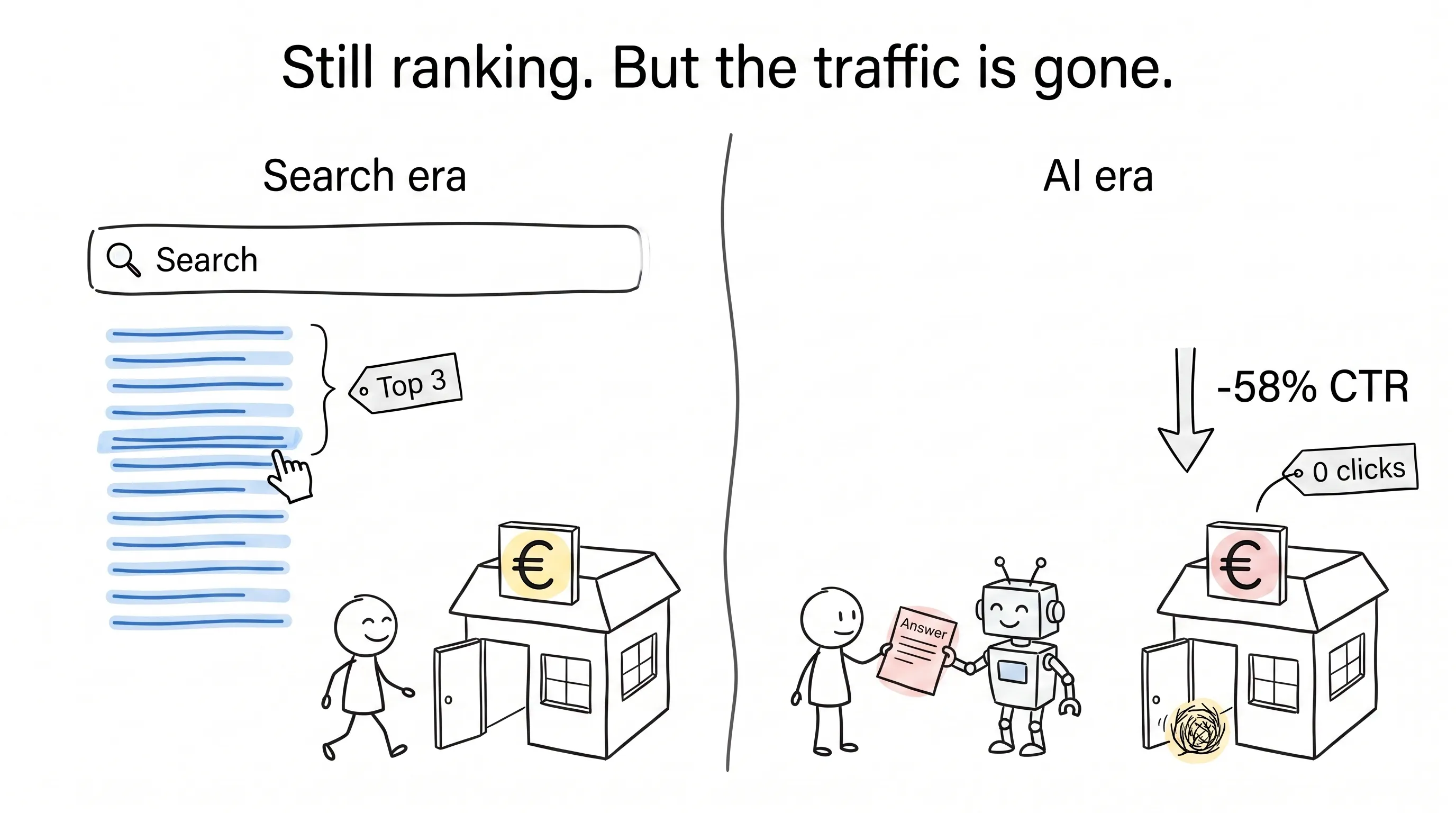
Later I did some digging and found he wasn't alone. Ahrefs has run the numbers: the content at the very top of Google has seen its click-through rate fall 58%. Brutal. Keep in mind, back in 2025 that figure was only 34.5%.
Why? Because people have stopped clicking links.
First, What Exactly Happened
Think about it: these days, when you run into a problem, is your first move to open a search engine, or to just ask an AI?
For a lot of people, the answer is now the latter.
Here are the numbers. ChatGPT handles 2.5 billion prompts a day, and 65% of them are, at their core, searches. You used to search Google for "how to relieve lower back pain." Now you just ask ChatGPT.
You ask, and the answer is right there on the page. No clicking. No going anywhere.
This is what's called "zero-click search." The search is still happening — the clicks are gone.
And here's the sting: even when an AI does attach links, almost nobody follows them. Click-through rates from ChatGPT run 96% lower than Google's.
For companies that live off search traffic, it looks like this: the mall is still open, but customers ask the security guard a question at the entrance, turn around, and go home. The store? They never set foot inside.
But don't panic. Not yet.
SEO isn't dead. It has simply gone from a one-man show to the first act of a trilogy. The other two acts are called GEO and AEO.
So where do you start? With the most critical one: GEO.
What Is GEO?
GEO — Generative Engine Optimization.
Put plainly: getting AI to cite you when it answers questions.
You might ask: how does an AI decide whom to cite?
Picture ChatGPT as an extremely scrupulous librarian. Ask him a question and he won't just make something up — he'll dash into the stacks, flip through dozens of books, distill them into one answer for you, and then, before handing it over, note exactly which books he drew from.
Which books does he reach for first? Two kinds: the ones he can understand at a glance, and the ones with a trustworthy provenance.
What GEO does, then, is turn your website into that kind of book. Three things, specifically.
First, bring evidence. AI has an almost superstitious faith in data. Write "our method works well," and it turns and walks away. Write "we tested 1,200 cases and lifted conversion by 23%," and it cites you on the spot. Original research, verifiable statistics, third-party reports — in an AI's eyes, these are hard currency.
Second, build clean structure. Schema markup (structured data labels that tell machines what your page contains), clear heading hierarchies, tables, charts — don't skimp on the busywork. An AI is a machine, and machines read structured content with the least effort. The more clearly you organize things, the more confident the AI feels when it cites you.
Third, show who you are. Who wrote this? What are their credentials? Where did the data come from? Whom did they cite? These transparency signals decide whether an AI dares to trust you. An AI worries about citing the wrong source and damaging its own reputation, too.
All of this has already been turned into a product. Jasper, a company that builds content-marketing tools, has shipped a complete GEO playbook: it scores your content for GEO, finds the gaps that keep AI from citing you, and then generates citation-friendly content by the rules. When the tools are already out, what does that tell you? This is no longer a concept — it's a serious business.
What Is AEO?
AEO — Answer Engine Optimization.
What's an answer engine? Google's AI Overviews, Bing Copilot, Perplexity's instant answers — the features that carry the answer straight to you.
If GEO is about getting cited when the AI writes the essay, AEO is about getting copied when the AI checks its cheat sheet.
Search engines no longer hand you ten blue links. The answer is written right at the top of the results page. Where does that answer come from? It's excerpted from the content the engine considers most reliable.
So the core of AEO comes down to one question: is your content easy to pick?
Answer first. Whatever the user asks, the first sentence answers it. No buildup, no "In today's rapidly evolving landscape."
Make the format easy to pick. FAQs, lists, tables, short paragraphs. Answer engines pick through content the way people pick strawberries — the berries that come off one at a time are the easiest to take. Write a dense, airtight essay, and the engine has no choice but to skip you.
Keep the language plain. Less jargon, fewer detours. The AI serves your words to the user as-is — the more your writing resembles a clean, ready-made "model answer," the more likely it gets carried off.
So Is SEO Useless?
Useless? Hardly. Quite the opposite.
One number is fascinating: roughly 40% of Google's AI Overviews cite content that already ranks in the top 10 of organic search, and about 70% cite content in the top 100.
In plain terms: when AI copies homework, it still copies from the top student's paper first.
The rankings, authority, and backlinks you've spent ten years accumulating still work — only the way you use them has changed. The three of them stack like the floors of one three-story building.
SEO is the foundation: it gives you a base to stand on in traditional search. AEO is the storefront: it makes you visible at the top of the results page and inside AI's instant answers. GEO is your word of mouth: it gets models like ChatGPT and Gemini to mention you of their own accord when they compose answers.
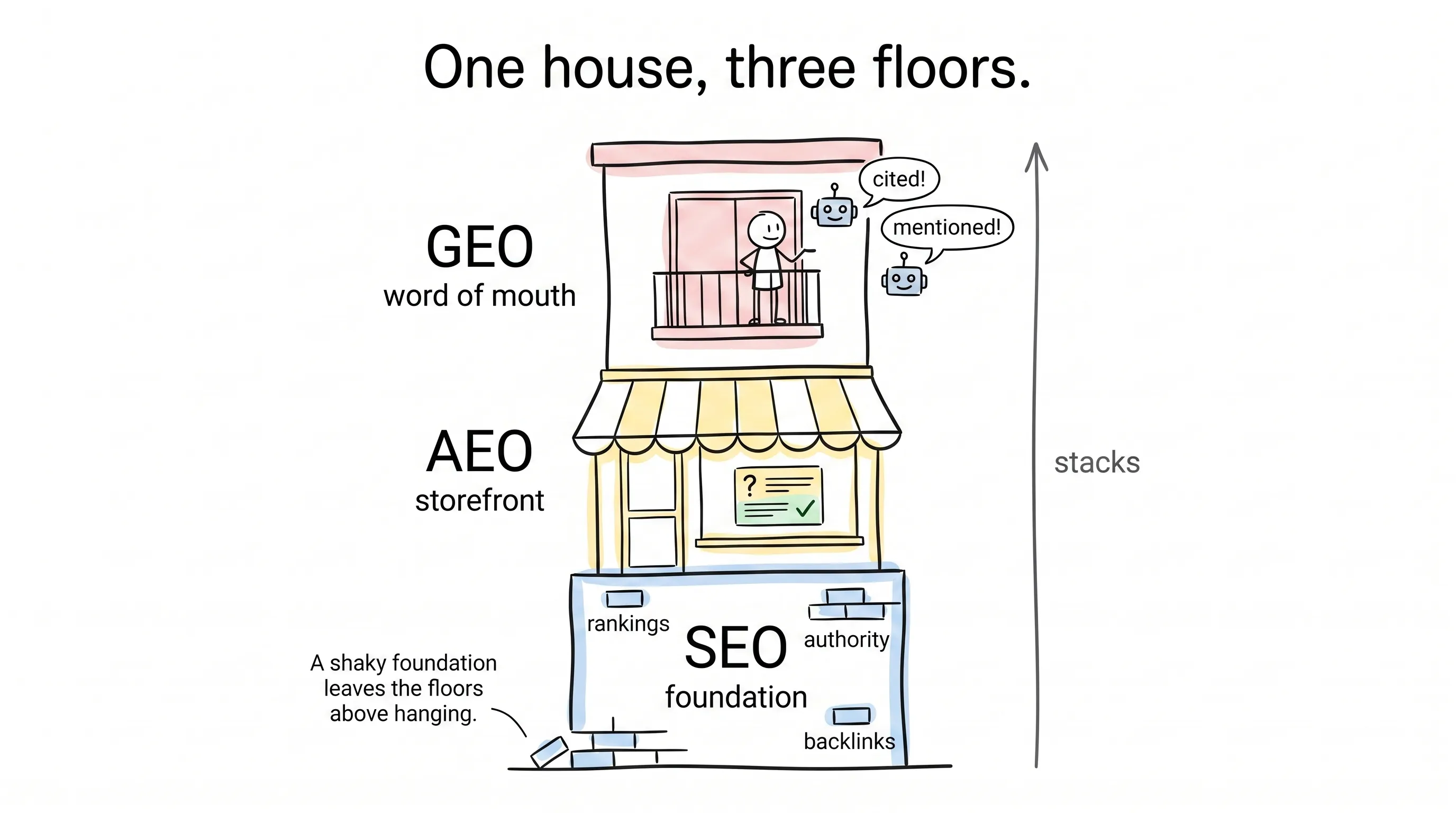
A shaky foundation leaves the two floors above hanging in midair. But pour a foundation and never build the home, and it's just as wasted.
How Do You Actually Do It?
Where to start? I break it into three steps.
Step one: establish authority.
Every claim needs evidence behind it: your own research, industry reports, verifiable data — bring them out when they count. Go to communities like Reddit and Quora and put real effort into the discussion around your brand; AI loves to eavesdrop on the neighborhood chatter there. Sign your articles honestly, spell out the author's professional background, and cite your sources.
And here's the plainest, most overlooked rule of all: refresh old content on a regular schedule. Ahrefs also found that ChatGPT is the model most likely to cite fresh pages. Don't let your content gather dust.
Step two: build the structure.
Write headings the way users actually ask. If users ask "What's the difference between GEO and SEO?", your subheading should say, honestly, "What's the difference between GEO and SEO." In every paragraph, the first sentence gives the answer; the expansion comes after. More FAQs, more tables, more short paragraphs. Add Schema markup wherever it belongs — FAQPage, HowTo, Product — don't be put off by the tedium. The tooling has caught up here too: Jasper's FAQ Schema generation workflow, for instance, runs question-and-answer creation, AEO optimization, and JSON-LD markup in one pipeline.
Step three: serve each platform to its own taste.
Different AIs have different palates.
ChatGPT loves lifting ready-made structures — your lists, your FAQs, often carried off untouched. Perplexity always brings citations, so the harder your original data and authoritative backing, the better you fare. Google's AI Overviews favor content with FAQ/HowTo markup, short definitions, and images. Bing Copilot loves to synthesize — step-by-step guides and comparison content suit it best. Claude prefers longer, more coherent paragraphs with solid argumentation.
And there's one variable that keeps getting ignored: social platforms.
YouTube, Reddit, and LinkedIn are the three platforms AI cites most often. And each model has its own preferences: ChatGPT frequently cites Reddit and Wikipedia, Perplexity leans on Reddit, LinkedIn, and G2, and Google often fishes content out of Facebook and Yelp.
Think about it: much of what AI "knows" was fed to it by these platforms. How people talk about you on Reddit almost directly determines how an AI introduces you.
Word of mouth, in the AI era, has become an asset you can manage in earnest.
Is It Worth It?
Some will ask: rework the content, build the structure — is it worth it?
Run the numbers.
Semrush's report: visitors coming from LLMs convert at 4.4 times the rate of traditional search traffic.
Why? Think about it. Someone searching on Google is still in the "browsing" stage. Someone asking ChatGPT has already entered the "doing" stage — what they want is a definite recommendation, a definite plan. A visitor arriving with that intent is one step away from paying.
So how do you measure whether you're doing it well? Stop staring at rankings. Watch these instead: whether AI answers cite you or mention you, how many visitors arrive from AI platforms, and how those visitors convert.
And this game has only just begun. Enter now and you hold the best position on the board; wait until the landscape settles and you'll be trading real money for time.
The front door to traffic has already moved. Your job is to move with it — and live right next door.
Back to My Friend
By the time that pot of tea was finished, I asked him: so what are you going to do?
He said he'd hold his rankings for now. Then he'd go back and do three things: add data and sources to his core pages; build out FAQs and Schema; and assign someone to answer industry questions on Reddit, properly and consistently.
I told him: that's exactly right.
In the search-engine era, you fought to squeeze into ten blue links. In the AI-search era, you fight to become the one answer that gets cited.
Here's wishing you an early move into AI's citation list.
Continue reading
Related articles

Cross-Border Business: Time to Upgrade Your AI Toolbox
A learn article explaining how AI tools help cross-border e-commerce sellers clear five hurdles: language, regulation, logistics, payments, and fraud. It outlines a five-compartment toolbox, a five-step adoption path, and metrics such as conversion rate and CLV, while cautioning against over-reliance on AI.

AI Is Taking Over the Dirty Work of Social Media Marketing, One Task at a Time
This learn article outlines four social media marketing tasks AI can handle — audience analytics, content drafting and design, ad targeting and creative testing, and spam moderation — and cautions that taste, judgment, and data security remain human responsibilities.

AI Is Already This Good — Why Is Your Social Media Marketing Still Pure Manpower?
An overview of 18 AI tools for social media marketing, organized into six categories covering audience research, content creation, scheduling, comment and DM handling, ad management, and visual production, plus notes on personalization, prediction, and emerging trends.