
Still Ranked, but No Clicks: Let's Talk About GEO, the New Course on the Syllabus
A learn article on zero-click search and GEO (Generative Engine Optimization): why a No.1 ranking can still lose clicks to AI Overviews, how to make content citable by AI engines, and how to track AI Share of Voice while correcting AI errors.
A few days ago, an old friend who has done SEO for a decade or so invited me out for tea. Halfway through, he told me something that had sent a chill down his spine.
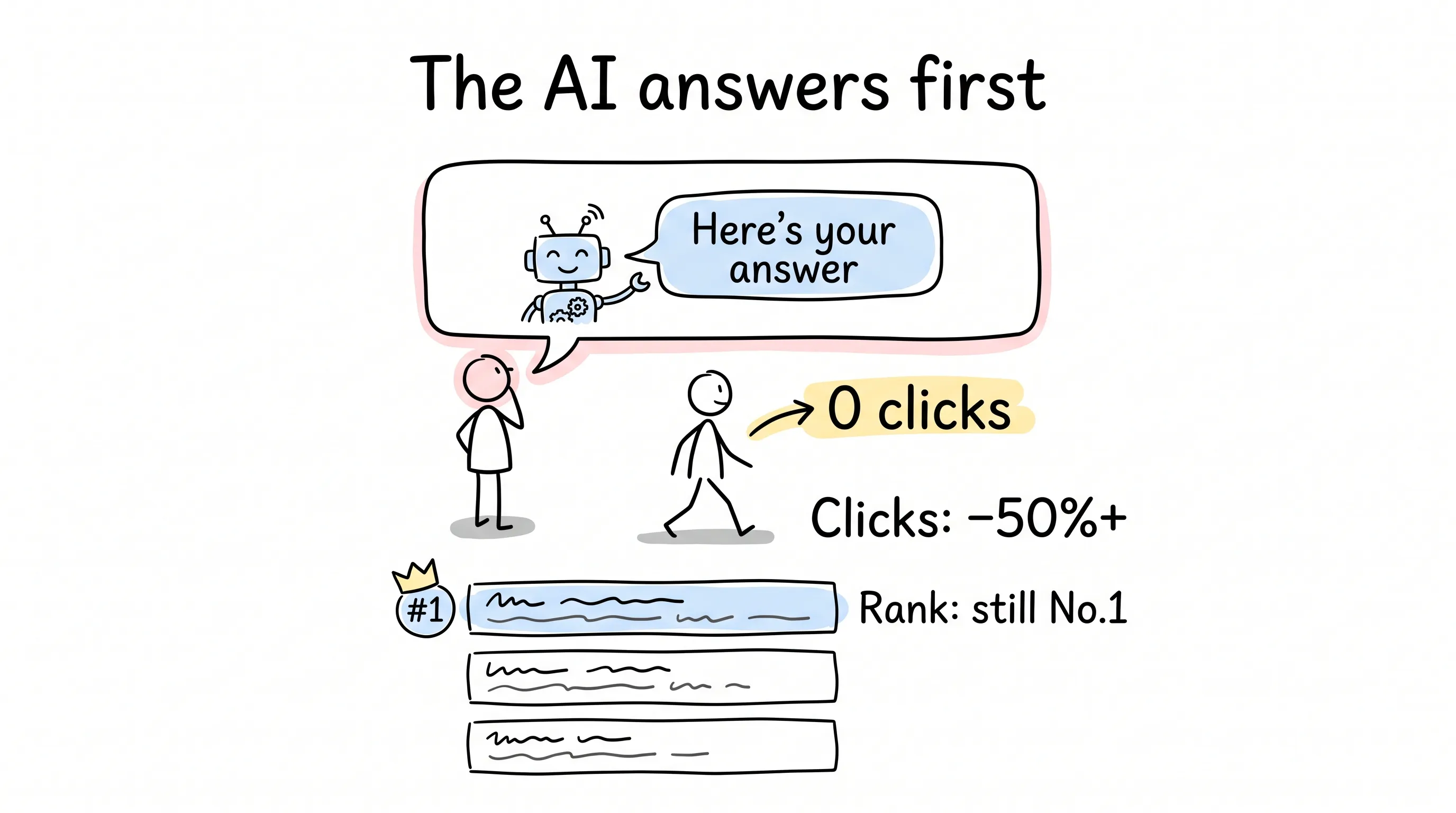
His company had a keyword that had ranked No. 1 on Google for years. The ranking hadn't moved an inch; the traffic had dropped by more than half.
Only when he dug into the analytics did he see it: when users searched that keyword, a Google AI Overview now sat at the very top of the page. The AI had gotten there first and finished telling the whole story. Users read the answer and never scrolled down — never clicked that little blue link of his.
My first reaction: this isn't a problem for your company alone. The entire search business is having its foundation swapped out.
What is zero-click search?
Zero-click means exactly what it says: users search, then click none of the results.
So where did they go? The answer was served straight to them by the AI. One earlier study found that 69% of searches already end with zero clicks. Search, read, leave — the links never get touched.
Here's an even wilder number. By early 2026, searches involving AI had grown 1,757% year over year.
Unbelievable. One year.
Put the two numbers side by side and the picture is clear: the end point of search is shifting from "handing users a results page" to "handing users an answer."
Used to be, everyone fought over rankings. Rankings decided who got seen.
Now, the AI synthesizes the answer for the user first. The first screen a user sees is no longer your page — it's the AI's words.
Even No. 1 isn't safe
If there's one thing I want SEO teams to take to heart, it's this: treating ranking and being cited as the same thing is the most expensive misunderstanding of our era.
One report put a number on it: the moment an AI Overview appears at the top of the page, your click-through rate drops 58% — even if you rank first.
Sit with that for a second. The top spot used to be a money printer. Now the AI has done your job ahead of you — read the ten web pages for the user and condensed them into three sentences. Users got what they came for, so naturally they stopped coming.
So the real question has changed. It used to be: how do I rank first? Now it's: when the AI assembles its answer, will it include you?
What is GEO?
GEO — Generative Engine Optimization — studies exactly this: how to get AI platforms like ChatGPT, Gemini, and Perplexity to mention you, cite you, and recommend you in their answers.
Note the key phrase here: being cited.
Sitting next to it is another term, AEO — Answer Engine Optimization — which is about shaping your content into answers that can be lifted out directly. GEO is the bigger umbrella: it covers how your brand gets mentioned, cited, and recommended inside generative engines. Plenty of growth-stage brands run all three courses at once — SEO, AEO, and GEO.
Why would an AI cite you?
Think about it in reverse and it clicks. For the AI to cite you, it has to be able to lift a clean, specific, credible sentence straight off your page and into its answer.
Same product, two ways of writing it, two very different fates.
One: a 3,000-word essay with the key conclusion buried in the middle of paragraph five, slathered in "industry-leading" and "outstanding experience." The AI reads it and shakes its head — not a line worth quoting.
The other: one paragraph that states who you are, what you sell, and what it costs — every claim checking out against the facts — plus a tidy set of structured data. The AI lifts it and goes.
Underneath this sits a simple mechanism: before answering, the AI goes out to gather source material first, then organizes what it collected into the answer. The trade jargon for this is Retrieval-Augmented Generation (RAG). The structured data (schema) you hand it works like a business card: it tells the AI who you are, what you sell, and why you're trustworthy. Only when the card is clear does it dare speak on your behalf. Schema used to be about earning that polished snippet in search results. Now it's also about whether the AI recognizes — and vouches for — you.
By the way, something called llms.txt has popped up recently — essentially a site index written specifically for AI crawlers, telling them which parts of your site are worth reading. The standard is still evolving; worth watching, but don't count on a single silver bullet to save the day.
Rankings test whether people are willing to click you. Being cited tests whether machines dare to quote you.
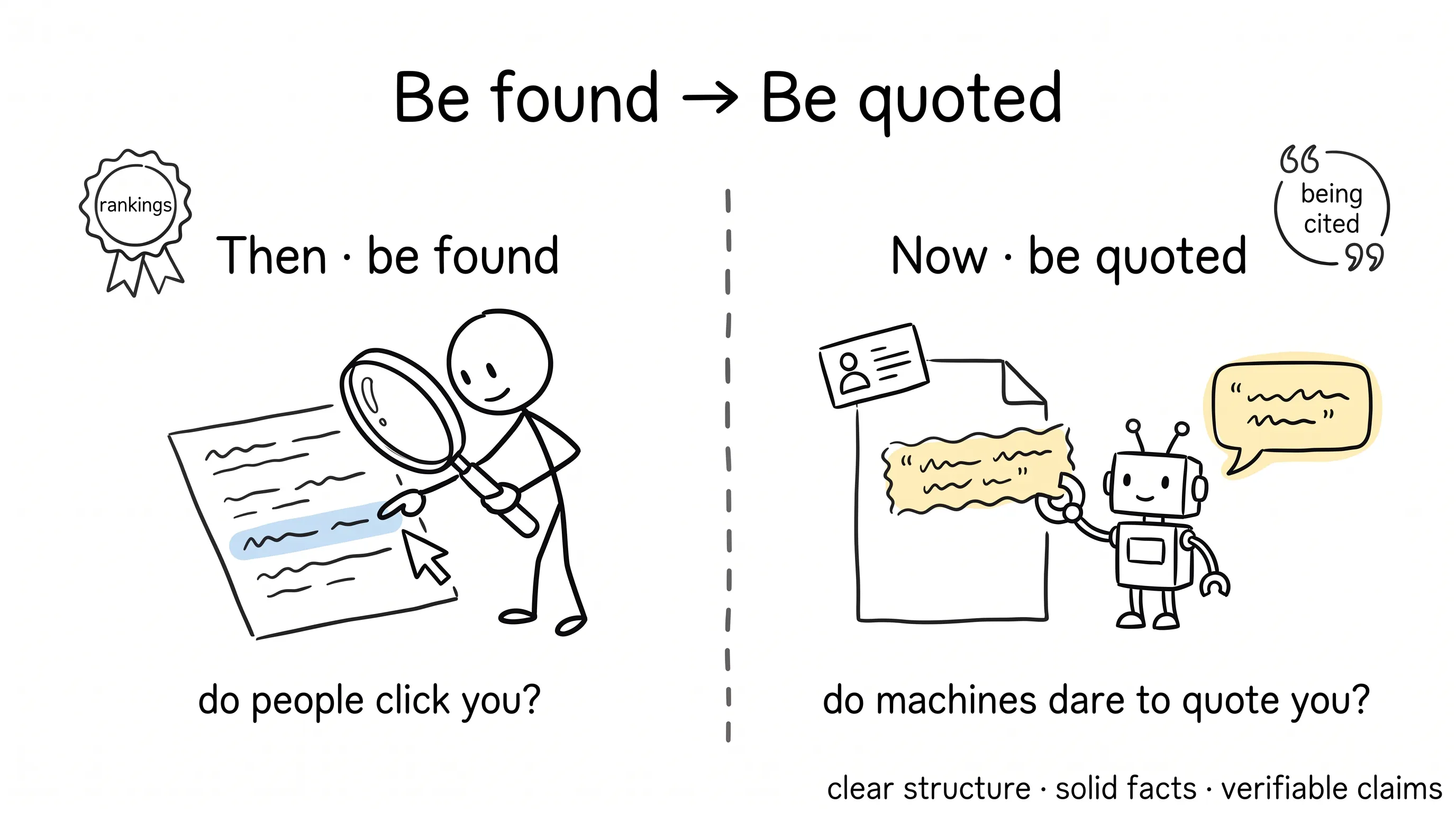
Whether machines dare to quote you comes down to three things: clear structure, solid facts, verifiable claims. The good news: none of the three fights with SEO. Write your content clearly and accurately, and Google is just as happy. So GEO isn't a rebuild from scratch — it's a second floor on the same foundation.
Once you're cited, how do you keep score?
At this point someone's bound to ask: how do you measure this? You can't run on gut feel.
There is one metric that comes close to a North Star: AI Share of Voice.
What is AI Share of Voice? Within your category, of all the answers AI generates, the share that mentions your brand.
Say the AI gets asked a hundred times and mentions you sixty of those times — your share of voice is 60%. The biggest difference from ranking: a ranking only tells you which position you hold; share of voice tells you how big a cut of the AI business you're actually getting.
How do you measure it? The public AI platforms can be asked directly. Some providers do it the plain way: every day they run batches of prompts on public engines like ChatGPT, Gemini, Perplexity, Claude, and Copilot, simulating the questions real users would ask, then count who gets mentioned in each answer — and whether it's praise or criticism. When each engine refreshes its data pool is a black box to the outside world, so the only way is to keep running the checks, day after day. Of course, this monitoring covers public engines only; models deployed inside a company's own walls are beyond anyone's reach from the outside.
And along the way, you can do something even more important: catch errors.
I call it "hallucination patrol." Sometimes the AI gets your price wrong, mixes up your features, or pins someone else's achievements on you. Worse, once users take a wrong answer as gospel, it keeps spreading through other answers.
So watching whether the AI mentions you isn't enough. You also have to watch whether it gets you right when it does. Spot an error, correct it immediately — before users lock in the wrong first impression.
What happens if you do nothing?
Let's run the numbers.
One survey found that 47% of brands don't even have an AI search strategy yet.
Meanwhile, the early movers already have data in hand: traffic from AI converts 4.4 times better than traditional organic search.
4.4x — why such a huge gap?
Picture the two kinds of visitors. One is a passerby who clicks a page on a whim. The other is a customer who just asked the AI "which solution fits me?" and was referred over by the AI. The second one arrives carrying a question, arriving with intent — one foot already through your door.
The sources have narrowed. The intent has thickened.
47% of your competitors are still standing still, and a 4.4x conversion dividend is sitting on the table. That math isn't hard to do.
My view is blunt: keep doing SEO. But SEO alone is no longer enough. The extra required course is called GEO, and half the class hasn't enrolled yet. For anyone who moves first, that's an opportunity sitting in plain sight.
Back to that friend
And he did act. He rebuilt his site around the few sentences most worth quoting, completed his structured data, and set up monitoring to check each week what the various AIs were saying about him — and whether they were getting it right.
Last week we had tea again, and he said something that stuck with me:
"We used to compete to be found. Now we compete to be quoted."
May you start early — and be quoted by this new world that much sooner.
Continue reading
Related articles

Cross-Border Business: Time to Upgrade Your AI Toolbox
A learn article explaining how AI tools help cross-border e-commerce sellers clear five hurdles: language, regulation, logistics, payments, and fraud. It outlines a five-compartment toolbox, a five-step adoption path, and metrics such as conversion rate and CLV, while cautioning against over-reliance on AI.

AI Is Taking Over the Dirty Work of Social Media Marketing, One Task at a Time
This learn article outlines four social media marketing tasks AI can handle — audience analytics, content drafting and design, ad targeting and creative testing, and spam moderation — and cautions that taste, judgment, and data security remain human responsibilities.

AI Is Already This Good — Why Is Your Social Media Marketing Still Pure Manpower?
An overview of 18 AI tools for social media marketing, organized into six categories covering audience research, content creation, scheduling, comment and DM handling, ad management, and visual production, plus notes on personalization, prediction, and emerging trends.