
Still Guessing at Topics? Instagram's Search Bar Is Hiding Ready-Made Answers
A guide on using Instagram's search bar as a content research method, plus a roundup of recent AI ad tools from TikTok, Reddit, Snap, X, and YouTube.
A few days ago, a friend who runs a content business invited me out for coffee. The first thing she said when we sat down: coming up with topics is brutal. Every day she opens a blank document, stares at the cursor, and her mind goes blank.
I asked her: so how do you pick your topics?
Her answer: vibes. When inspiration shows up, she writes. When it doesn't, she scrolls her phone.
I laughed, couldn't help myself, and walked her through a trick I'd picked up recently. By the time I finished, she had her phone out, trying it on the spot.
Today I'm passing that trick on to you. While we're at it, we'll dig into TikTok's bigger play, plus a few recent things from around the industry you should know about.
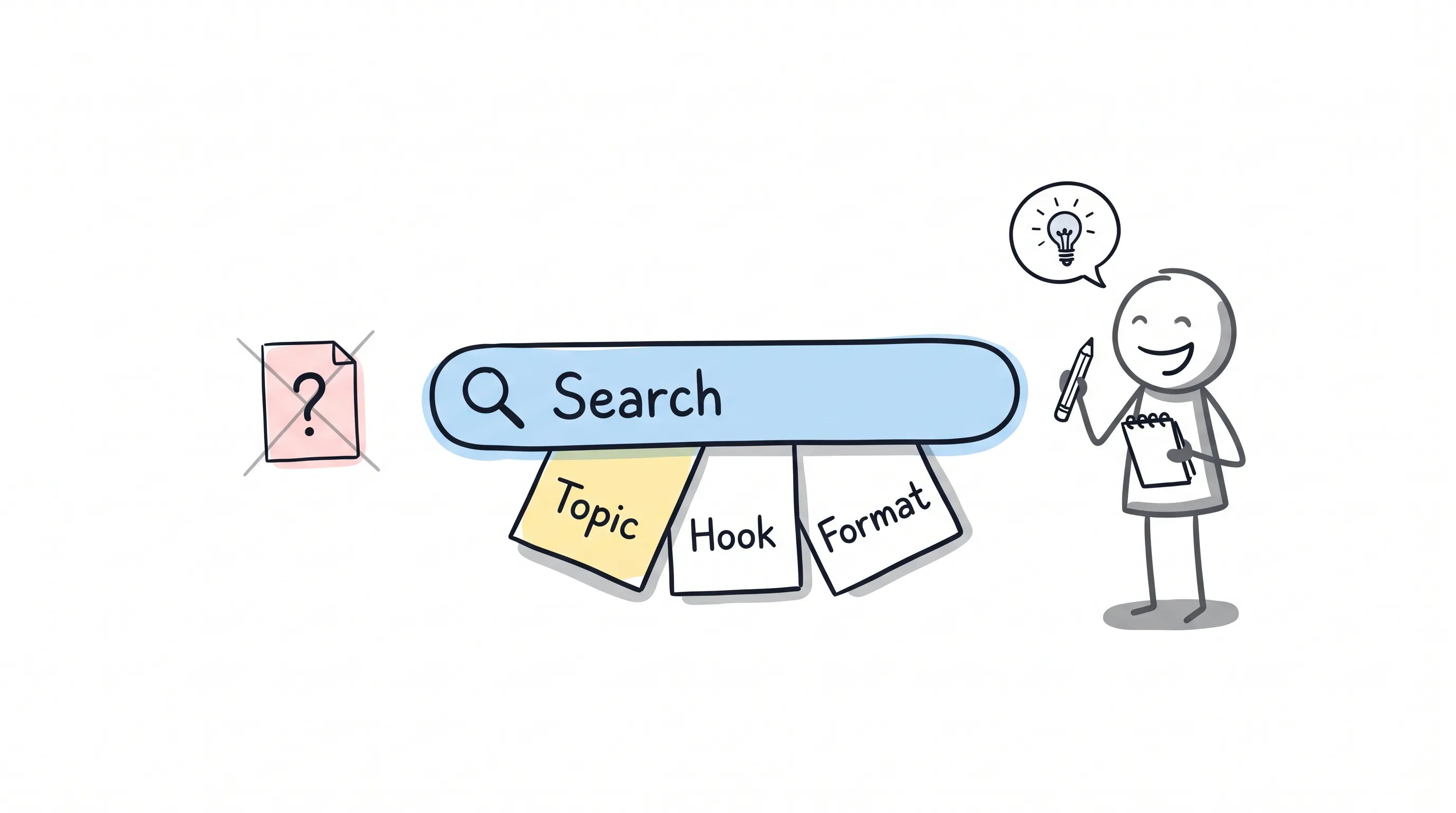
Treat Instagram's Search Bar as a Research Tool
Content people spend all day studying the algorithm. What most of them miss is that the algorithm is quietly handing you answers every single day.
And where does it hand them to you? Instagram's search bar.
Think about it: whatever users search for is what the platform pushes to the top. And sitting at the very front is the content the platform has already validated and that performs best. In other words, the topics you haven't filmed yet — the answers are already sitting in the search bar.
How do you actually do it? Four steps.
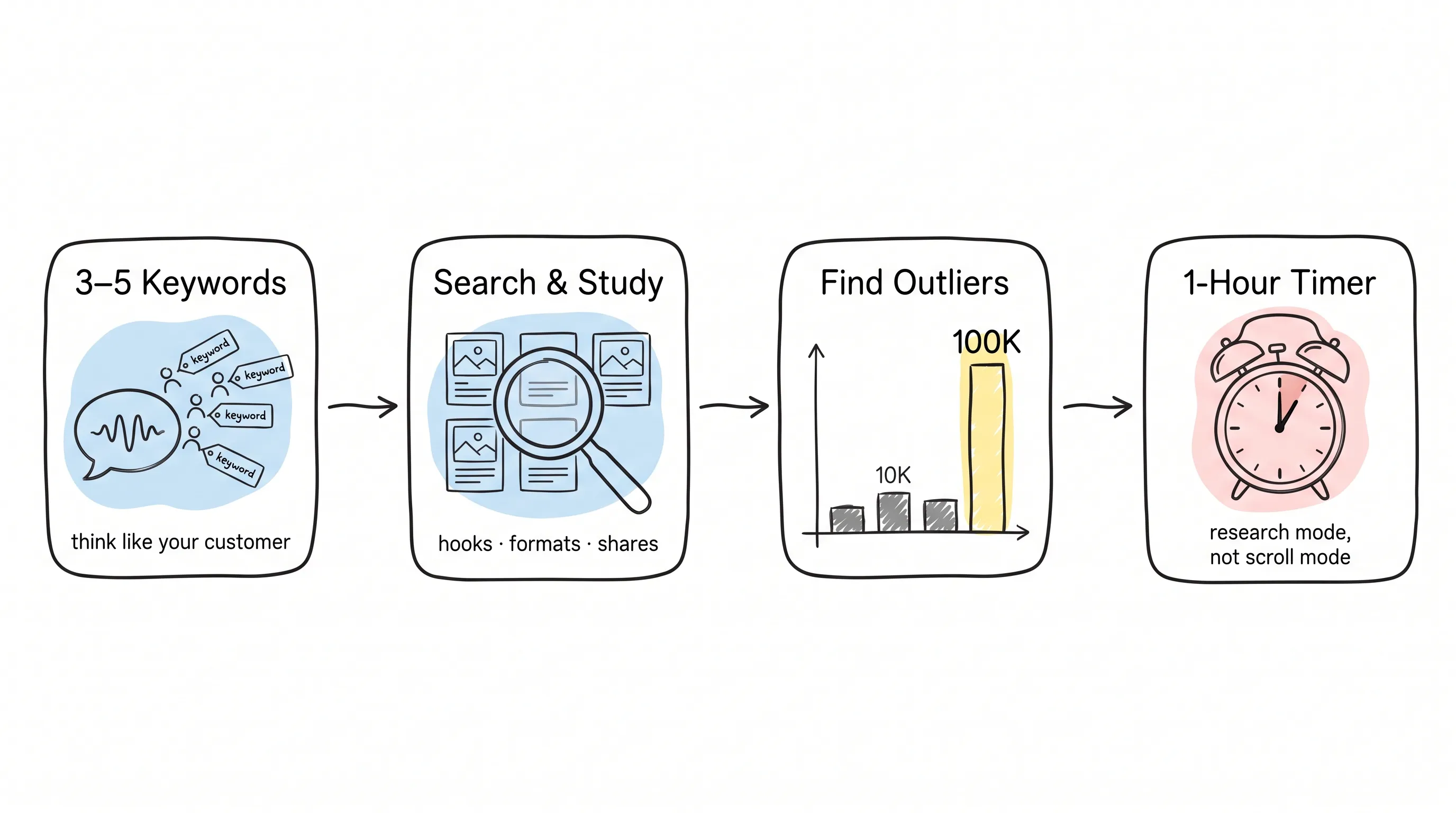
Step one: list three to five keywords. One caveat — think like your customer, not like your industry. What does that mean? A web designer's clients are never searching for "technical SEO." They're searching "how do I get my website to rank on Google." Ask yourself: what would my target user actually type into that search bar?
Step two: type each keyword in, one at a time, then switch to the Reels or Posts tab. What pops up are the hottest, freshest posts for that term. Pay attention to a few things: how the opener holds people (the hook), what the format is (talking-head video, big on-screen captions, a carousel, or plain B-roll), and what topic it covers. And keep an eye on share counts. Shares are the strongest signal you'll get: the content was so good someone hit the share button and sent it to a friend. That's worth far more than likes.
Step three: hunt for outliers. What's an outlier? An account usually pulls 10,000 views per video. Then one day, one video rockets to 100,000. Go figure out what that video does differently from everything else the account posts. The topic? The hook? The format? That 100K video is the answer key, straight from the algorithm's own mouth.
Step four: set an alarm — one hour — and stop when it goes off. This sounds like the easiest step. It's actually the hardest. Because somewhere along the way, "researching" turns into scrolling. Remember: research mode, not scroll mode. When you spot a hook, a format, or a topic you can use, write it down on the spot, and ask yourself: how does this become mine?
Oh, and one advanced move. Feed the profiles of five competitor accounts into Claude and have it analyze them against your own content. The goal is specific — find two things: the patterns they do well that you can borrow, and the gaps they've never touched that you can own.
This method was shared by a content marketer named Michelle Gifford. Her advice: run this exercise once a week, then use what you find to set three to five content pillars for yourself — the handful of topic directions you return to again and again. Don't drift all over the map.
In plain terms: it's swapping gut-feel guesses for reading the answer key.
TikTok's Play: Let AI Run Your Ads
Now, TikTok. Recently they rolled out a string of AI tools in one go, and every one of them points the same direction: tearing down the barrier to running ads as fast as they can.
How far does the demolition go?
Used to be, running TikTok ads meant going through Ads Manager first — an interface that, to a beginner, looks like an airplane cockpit. A wall of buttons, no clue where to start. Not anymore. TikTok now lets you connect your ad account directly to the AI tools you already use. Want to launch a campaign, pull a report, or talk through how you'd run your ads? Just ask, like chatting with a colleague who knows the ropes. For a lot of small business owners, the wall standing between them and ad buying just came down.
The second move is even more aggressive. TikTok released a set of downloadable AI skills that, once installed, do the media buyer's job for you: mining your data for the patterns behind top-performing creative, and working out how your budget should be split. Melissa Laurie, founder of Oysterly Media, has gone through these tools, and her advice is to start with one of them in particular — because with it, most of an ad concept is already built for you.
The third move is the most tangible: Creative Studio got an upgrade. Feed in your brand guidelines, and it combines them with trends currently taking off on the platform to generate video ads that are ready to tweak and run. From what Melissa has observed, AI-generated creative is paying off especially fast for certain types of ads.
But the Ads That Still Work Best Are the Roughest Ones
At this point you might be thinking AI-generated ads are about to take over TikTok.
Quite the opposite.
Melissa has worked with plenty of big-brand clients, and for those clients her team uses the kind of native-looking video with barely any polish on it, paired with a fixed opening framework. Why? Because TikTok users' thumbs move fast, and what stops them is something that looks like a friend shot it on a whim. Polish, sometimes, is exactly what makes people swipe away.
She also called out a very common mistake: the video hasn't even gotten to the point yet, and viewers are already gone. Those first few seconds are worth obsessing over.
So what is AI actually for? My take: AI handles efficiency; humans handle authenticity. The soul of an ad still has to come from real people.
One more thing. Small businesses that could never afford ads can now get in the game. When the barrier disappears, competition shows up. And when that happens, what you're competing on is still the content itself.
Before You Go: A Few More Things Worth Knowing
Those were the two big storylines. There are a few smaller moves in the industry lately — here they are, platform by platform. How much each one matters is yours to weigh.
Instagram is laying down rules for AI content: if your account posts AI-generated people, you have to attach an "AI-generated" label; skip the label and your reach gets throttled. Label things honestly and your distribution won't be affected; if you get flagged by mistake, you can appeal through Account Status. One detail worth noting: making content with AI tools and using AI to fake an identity are two different things — the platform only cares about the latter. It's a fine line, and they've drawn it with care.
Reddit added a new option for advertisers: 15-second "deep views." Built for ads that need a little more time to make their point — automated bidding, you pay per deep view, global beta, and you can run it head-to-head against the existing 6-second view goal. Same company: Max, its automated campaign tool, is now fully rolled out too — targeting, creative, placements, and budget all automated, plus new asset groups so a single campaign can handle multiple products and multiple sets of creative. Reddit also opened up its Advertising API, with Smartly already integrated. Official line: advertisers in the beta are seeing lower acquisition costs and more conversions. Take official numbers with a grain of salt, but the direction is real: platforms are racing to make ad buying as hands-off as possible for you.
Snap did the honest, unglamorous thing: Unified Attribution is now live worldwide for app advertisers using AppsFlyer or Adjust. It puts Snapchat's own performance data and your MMP's (mobile measurement partner) conversion data in one place, and you can even use the MMP's real-time signals for optimization. Cross-channel attribution, without bouncing back and forth between two systems anymore.
TikTok's comment section just got livelier: voice comments up to 60 seconds, up to 9 photos in a single comment, plus Live Photos; creators can run polls under their videos, with up to 5 options. Polls and Live Photos are live worldwide now; voice comments and photo carousels will roll out over the coming month. The comment section is turning from a text box into a little town square.
X switched creators to a new payout rail: content monetization payouts and subscription revenue share in the US will now run through X Money. Existing users migrate automatically; new users need to activate it under the Money tab first, or the next payout won't land.
YouTube is quietly testing two things. One is affiliate shopping: the products tagged in your video stay the same, but the platform may automatically route the sale to a better-matched local retailer to see if performance improves. Videos with the "paid product placement" toggle switched on are excluded from this test. The other is live "react" streams: more creators can now host their own reaction stream on top of someone else's livestream and monetize it independently; the original stream doesn't lose out either — concurrent viewers, public plays, and watch time driven by the react stream all get credited to the original. It's on by default; if you'd rather not be the stream someone reacts to, you can turn it off before going live.
A while later, my friend messaged me on WeChat. She said she went back that day and dug in for an hour, filled half a page of notes. Her words: turns out half of what I scroll past every day is answers other people have already validated — I just never stopped long enough to look.
Topics, ad buying — the tools will keep piling up. But what you can fish out of that search bar comes down, in the end, to what you're willing to ask.
Here's to your next hit post hiding in the keyword you haven't searched yet.
Continue reading
Related articles

Cross-Border Business: Time to Upgrade Your AI Toolbox
A learn article explaining how AI tools help cross-border e-commerce sellers clear five hurdles: language, regulation, logistics, payments, and fraud. It outlines a five-compartment toolbox, a five-step adoption path, and metrics such as conversion rate and CLV, while cautioning against over-reliance on AI.

AI Is Taking Over the Dirty Work of Social Media Marketing, One Task at a Time
This learn article outlines four social media marketing tasks AI can handle — audience analytics, content drafting and design, ad targeting and creative testing, and spam moderation — and cautions that taste, judgment, and data security remain human responsibilities.

AI Is Already This Good — Why Is Your Social Media Marketing Still Pure Manpower?
An overview of 18 AI tools for social media marketing, organized into six categories covering audience research, content creation, scheduling, comment and DM handling, ad management, and visual production, plus notes on personalization, prediction, and emerging trends.