
Someone Made 7 Predictions About AI in Marketing. Two Years Later, I Settled Every Account.
A learn article revisits seven 2024 predictions about AI in content marketing and checks each one, covering lower content creation barriers, AI's effect on search traffic, AR/VR adoption, chatbots, mobile, and the changing role of marketers.
A few nights ago I was racing a deadline and needed to check a set of figures.
Out of habit, I opened ChatGPT.
Only after I finished writing did it hit me: that night, I never once touched a search engine.
Then I remembered a small story a friend told me. His son was doing homework, hit a word he didn't know, and blurted out "ask AI" — never "search for it."
Have you noticed? Our habits for getting information are being rewritten.
And someone scripted that rewrite a long time ago.
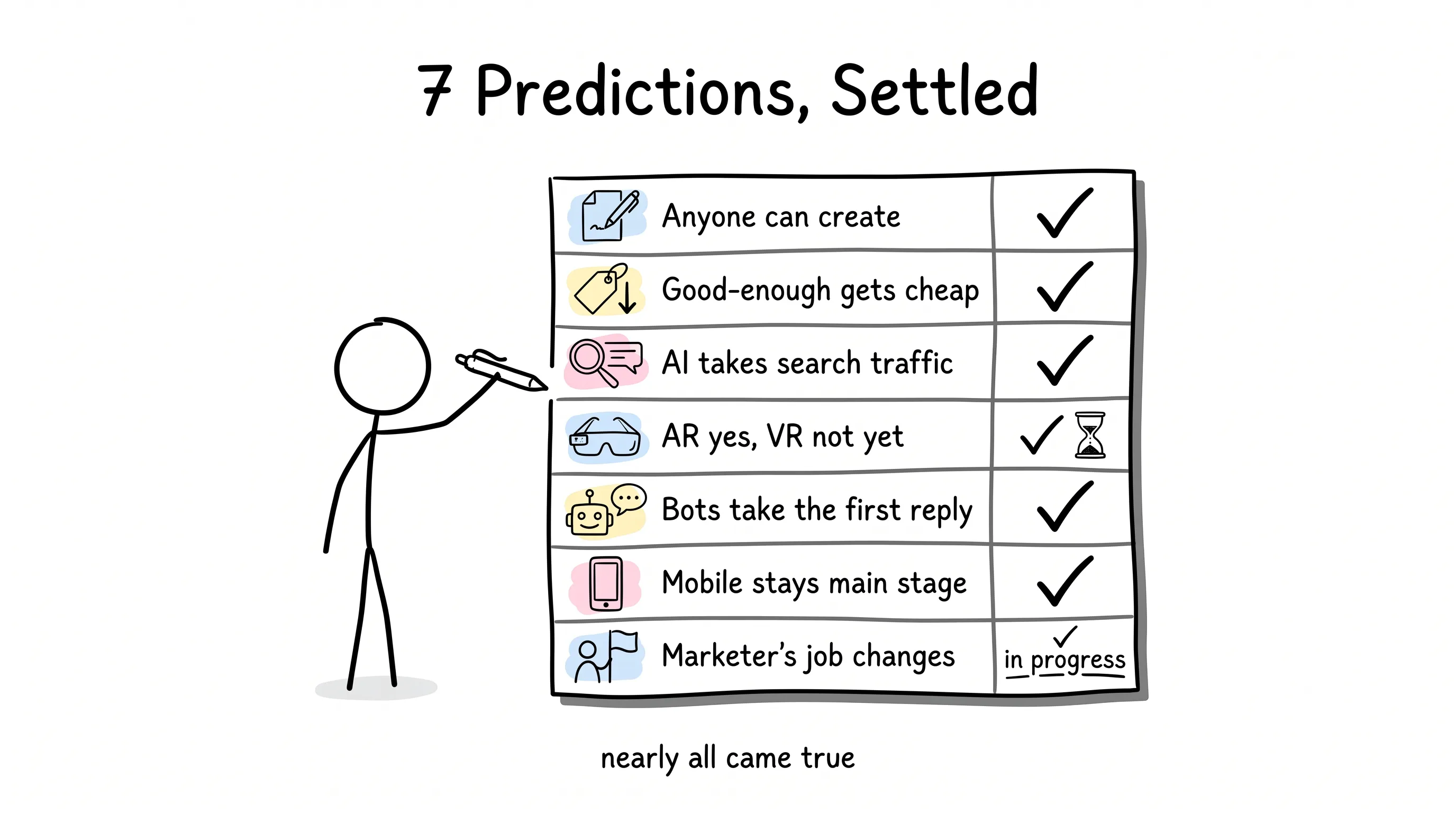
In 2024, someone rattled off 7 predictions for what AI would do to content marketing.
Two years on, I dug those 7 out and settled the accounts one by one.
Here's the verdict up front: nearly all of them came true. A few landed even harder than predicted.
Before We Settle the Accounts, Look at the Soil
For predictions to come true, the soil has to be there first.
What is "content intelligence"?
Simply put: let the machine read through oceans of content data first, then tell you what content people will actually watch, when to post it, and who to send it to.
Things that used to be gut calls now have data backing them.
One step further is generative AI. Writing blog posts, posting on social, refreshing website copy, drafting emails — it can lend a hand with all of it. And the time your team saves can go to work that actually takes brains.
What is hyper-personalization?
You search for cat litter on Amazon, click on a product, and the page instantly serves up a "frequently bought together" row.
It never asked you why you're buying cat litter. It figured that out on its own.
The right information, at the right time, to the right person. It sounds that simple. It's that hard.
Then there's predictive analytics. Data from the past could only tell you what happened yesterday; today's AI takes a shot at tomorrow. How much stock to hold, where to throw the budget, what to change about the product — there's math you can run for all of it now.
Customer experience is changing even more directly.
It's midnight and you have a question. Who do you turn to?
A customer service bot. It doesn't sleep, it replies in seconds, and it knows who you are and what you've bought. Dollar Shave Club handed the whole job of answering user questions over to AI.
And don't forget voice. Siri, Alexa, Google Assistant — people are starting to "speak" their needs instead of "typing" them. Spoken, in full sentences, like a chat. If your content doesn't change along with that, you won't be there when users start talking.
The flashiest is AR. Buying furniture? "Place" it in your own living room first. Buying lipstick? "Try" the shade on your face first. Want to travel? "Wander" through the sights from your living room. Coca-Cola Zero even ran a campaign: you "grab" a virtual bottle of Coke in front of a giant digital screen, walk into a nearby Tesco store, and redeem it for a real one.
Good grief. Now that's "what you see is what you get" — literally.
Soil laid out. Time to settle the accounts for real.
Prediction 1: Anyone Can Create Content Now
Underneath this prediction runs an entry bar that keeps dropping.
Blogs challenged traditional media. Self-publishing shook up the book business. Podcasts bypassed the radio. YouTube handed the studio over to every ordinary person.
How? Tools kept getting cheaper — good gear and good software became affordable for ordinary people. Channels kept getting more direct — no more begging the media gatekeepers; you could reach readers straight from social media. And people had grown tired of assembly-line content, and started craving small voices with personality.
Two years on, that bar is still dropping. AI swung another hammer: you used to have to write, shoot, and edit. Now you only need to know how to "make the ask."
For the first time, individuals and small teams can go toe-to-toe with the big institutions.
Came true. And then some.
Prediction 2: Content That's "Good Enough" Keeps Getting Cheaper
AI-written content is everywhere. The volume is huge, the quality is rising too, and it keeps iterating on itself, writing more and more like a human.
What does that mean?
It means "passing grade" content will depreciate in an instant. When a machine can churn out 100 passable pieces a minute, your "passable" is worth nothing.
Only two kinds of content will still be left standing: content with real insight, or content with real experience.
Of the 7, this one hits marketers the hardest.
Prediction 3: AI Will Steal a Chunk of Search Traffic
Remember that late night at the beginning?
I opened ChatGPT, not a search engine. That's this prediction in miniature.
Users go straight to AI for the answer and stop flipping through results pages. No results page, no click on your link. ChatGPT and Gemini are both siphoning that traffic away.
Sites that live off organic traffic felt the chill first.
But this is not "SEO is dead."
What died is the old playbook: stuffing content with keywords and sitting back waiting for users to click in. What survives is the new playbook: don't bet on a single channel, and make content that can stand up to being cited and paraphrased by AI.
Came true. And it's still deepening.
Prediction 4: AR and VR Will Enter Marketing
This account has to be split in two.
AR has truly arrived. Virtual makeup try-ons, furniture placement, big-screen interactions — the playbooks keep multiplying, all it takes is a phone, and the barrier is low enough.
VR is half a beat behind. Headset adoption hasn't kept up with the forecast's optimism.
So the ledger splits down the middle: AR came true; VR is still on its way.
Prediction 5: Bots Will Take Over the Opening Line
Customer service bots are online 24/7, reply in seconds, and recommend products while they're at it.
Social media bots keep their eyes on every single mention of a brand, automatically replying to comments and logging sentiment.
Human time gets freed up for strategy, for creative work.
Think about it: post a complaint online today, and nine times out of ten, the first reply you get is from a bot. And most likely, you never even noticed.
Came true.
Prediction 6: Mobile Is Still the Main Battlefield
AI keeps reading mobile behavior in finer detail.
Think about that picture: you walk past a coffee shop, your phone goes "ding" — your favorite latte is on discount today.
How did it know? Location data, cross-checked with your purchase history.
This one didn't just come true. It's already routine.
Prediction 7: The Marketer's Job Is Going to Change
AI has taken over the mechanical parts: crunching the data, writing first drafts, segmenting and tagging users.
People free up their hands for the parts worth more: setting strategy, coming up with ideas, building relationships.
In 2024, O'Reilly ran a survey: 67% of marketing teams were already using AI, and another 26% were on their way.
Looking at it again today, those numbers have only gone up.
And there's one thing machines can't do: take responsibility for outcomes. Where the money goes, what can be said, what can't be touched — these judgments need a human to make the final call.
So if you're worried about being replaced by AI, what you're probably worried about isn't AI. It's that you're standing still, doing only the work AI can do too.
This one is coming true. Present progressive — and counting.
A Few Parting Words
Settle all 7 accounts, and they point at the same thing:
What AI takes away is the part of the work that's "just execution." The identity of "marketer" — that, it cannot take away.
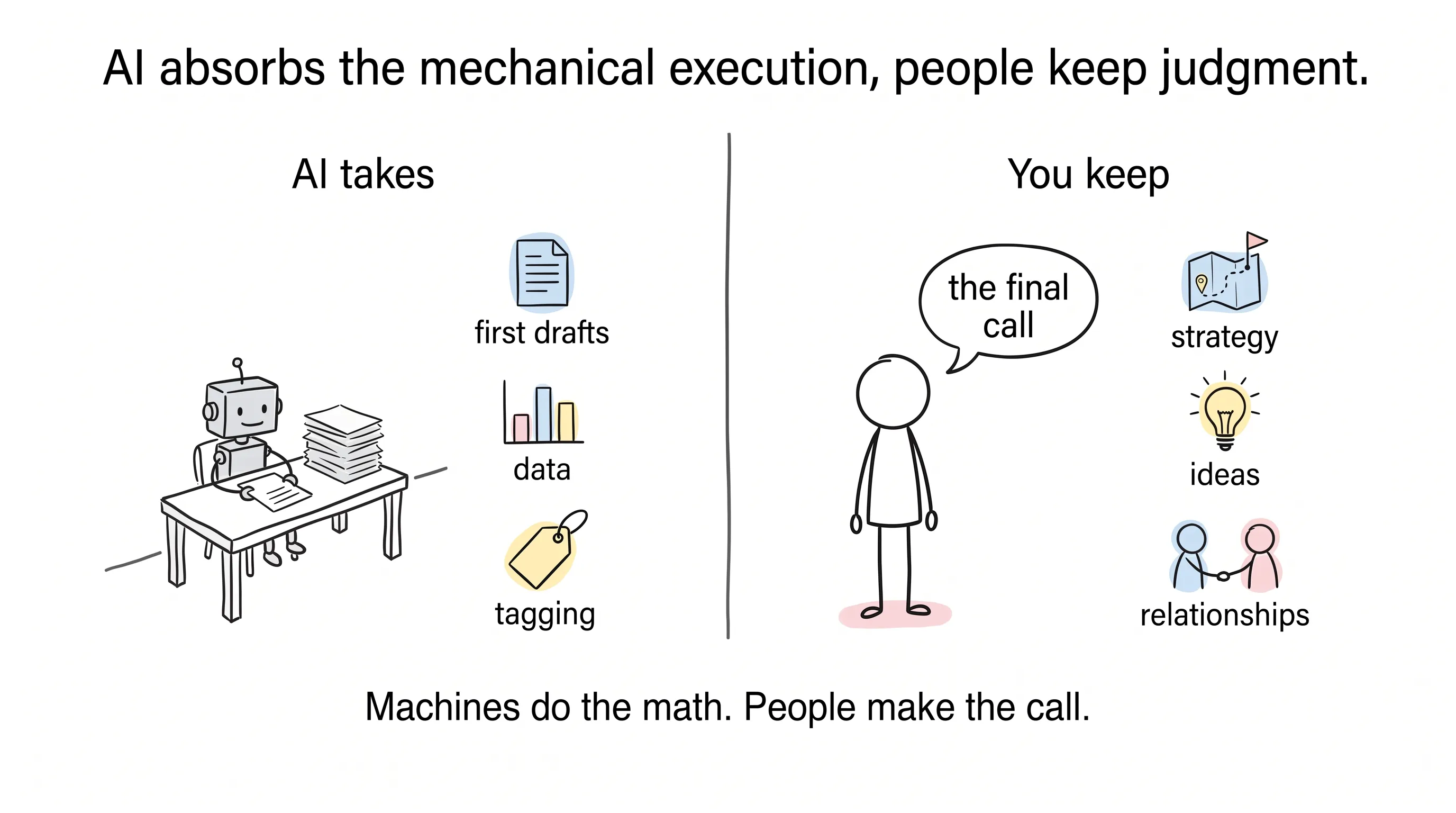
Machines do the math; people make the call. Machines do the volume; people do the part that's a little bit different.
That night, I didn't open a search engine.
Two years ago, that was a prediction.
Today, it's something you and I do without thinking.
Change never arrives with a marching band. It just quietly swaps out your habits some night.
Here's to being the one who makes the predictions.
Not the one they're about.
Continue reading
Related articles

Cross-Border Business: Time to Upgrade Your AI Toolbox
A learn article explaining how AI tools help cross-border e-commerce sellers clear five hurdles: language, regulation, logistics, payments, and fraud. It outlines a five-compartment toolbox, a five-step adoption path, and metrics such as conversion rate and CLV, while cautioning against over-reliance on AI.

AI Is Taking Over the Dirty Work of Social Media Marketing, One Task at a Time
This learn article outlines four social media marketing tasks AI can handle — audience analytics, content drafting and design, ad targeting and creative testing, and spam moderation — and cautions that taste, judgment, and data security remain human responsibilities.

AI Is Already This Good — Why Is Your Social Media Marketing Still Pure Manpower?
An overview of 18 AI tools for social media marketing, organized into six categories covering audience research, content creation, scheduling, comment and DM handling, ad management, and visual production, plus notes on personalization, prediction, and emerging trends.