
So Your Product "Showed Up" in an AI Answer? Don't Celebrate Yet
The article explains three ways products can appear in AI answers — organic recommendations, AI shopping product cards, and ad placements — and outlines a three-step review workflow, describing Dageno's approach and its stated limits on sales attribution.
A while back, my friend Lao Chen took me out for coffee.
Lao Chen has spent five years in cross-border office accessories; his flagship product is a multi-port docking station, sold to remote workers overseas. The moment I sat down, he couldn't hold it in: "Bro, we made it into AI! Last week I asked ChatGPT to recommend a few docking stations for cross-border remote work — and we were in the answer!"
I was genuinely happy for him. But once the congratulations were done, I asked one question: how exactly did your product "show up" there?
He froze. What do you mean, "how"? It showed up — isn't that the end of the story?
No. It's not.
Today, this is precisely the thing cross-border teams can least afford to ignore.
What Does "Showing Up" Actually Mean? There Are Three Kinds
When I got back, I dug deep into a product called Dageno. It's an AI shopping and ad intelligence tool built for cross-border e-commerce, DTC, and product teams, and one entire page is devoted to a single idea: there are actually three ways a product can show up in an AI answer.
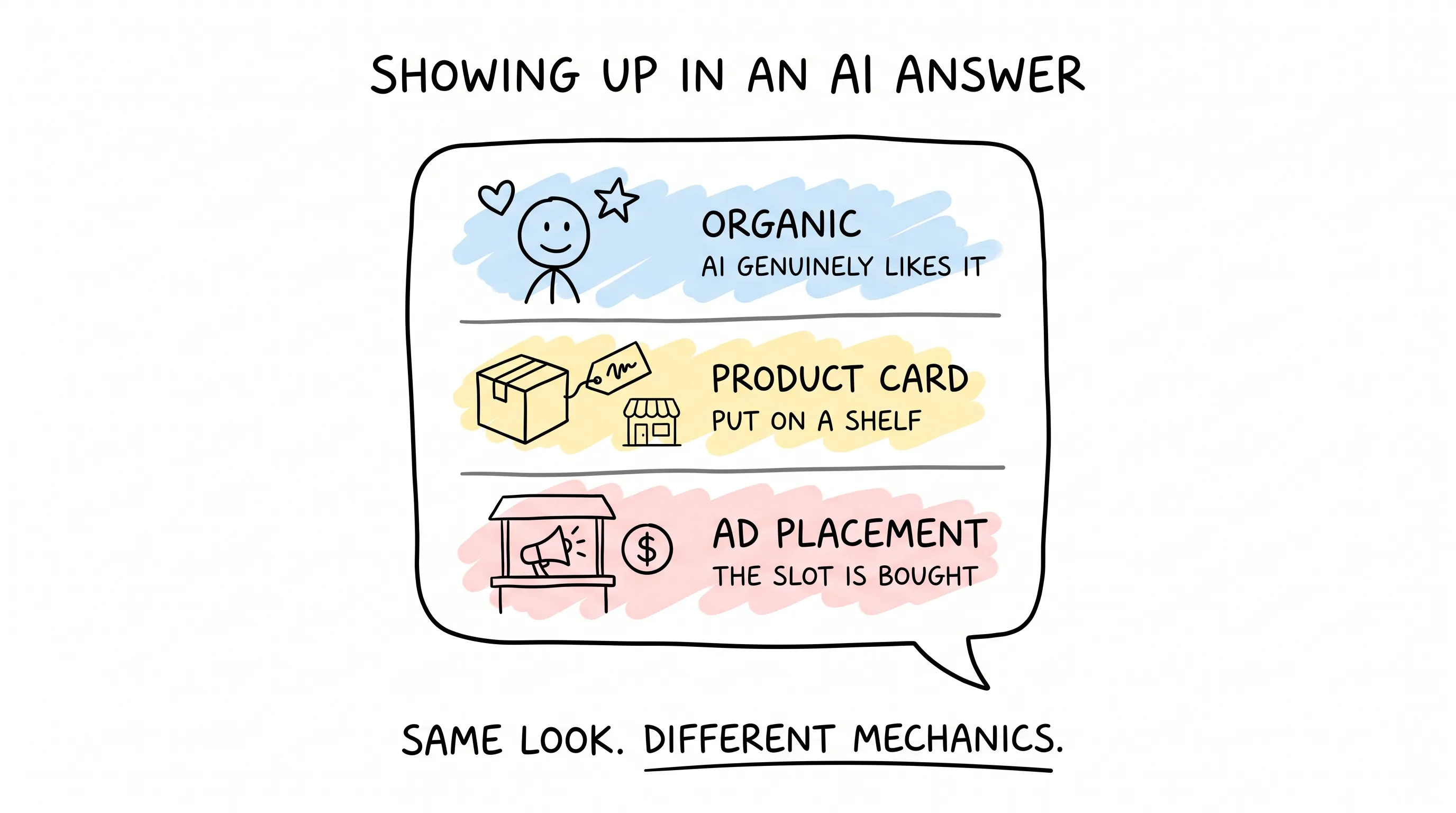
The first is organic recommendation. The AI genuinely thinks your product is good and brings up your brand and product on its own. That's consumers recognizing you.
The second is the AI Shopping product card. Hanging inside the answer is a card: product, price, merchant, cited sources. You've been put on a shelf.
The third is the AI ad placement. A paid slot. The position is bought, the intent is engineered, and standing next to you may well be a competitor's pitch.
The tricky part is that these three ways of showing up look almost identical. To a user scrolling past, each one just reads as "oh, this product."
But.
They look the same. The mechanics are completely different.
Think about it: on traditional e-commerce platforms, nobody conflates organic search rankings, product detail pages, and paid placements. So how come in AI, so many teams mush all three into one "composite score" — and pop the champagne when the score is high?
Organic recommendations, product cards, and ad placements are three different production mechanisms. A single composite score can't tell you which kind of showing up you actually got.
Lumping Them Together Means Seeing Nothing
The first cost of lumping them together: you can't see the gaps.
What's a gap? The brand is present, but the product is absent. At Lao Chen's company, the AI did indeed mention the brand. But push one level deeper: which specific product? At what price? Through which channel can you buy it? Where do the reviews come from? None of that was in the answer.
It made it into the answer, but never into the cart.
The second cost: you can't see the AI-ads opportunity clearly. AI ads are new, and the placements and playbooks keep changing. Before putting money in, you need to be clear on three things: What does the ad placement look like? What purchase intent is it capturing? What are competitors saying?
Pour your budget in before you've seen all that, and you're driving with your eyes closed.
How Dageno Does It: Separate First, Then Fix the Books
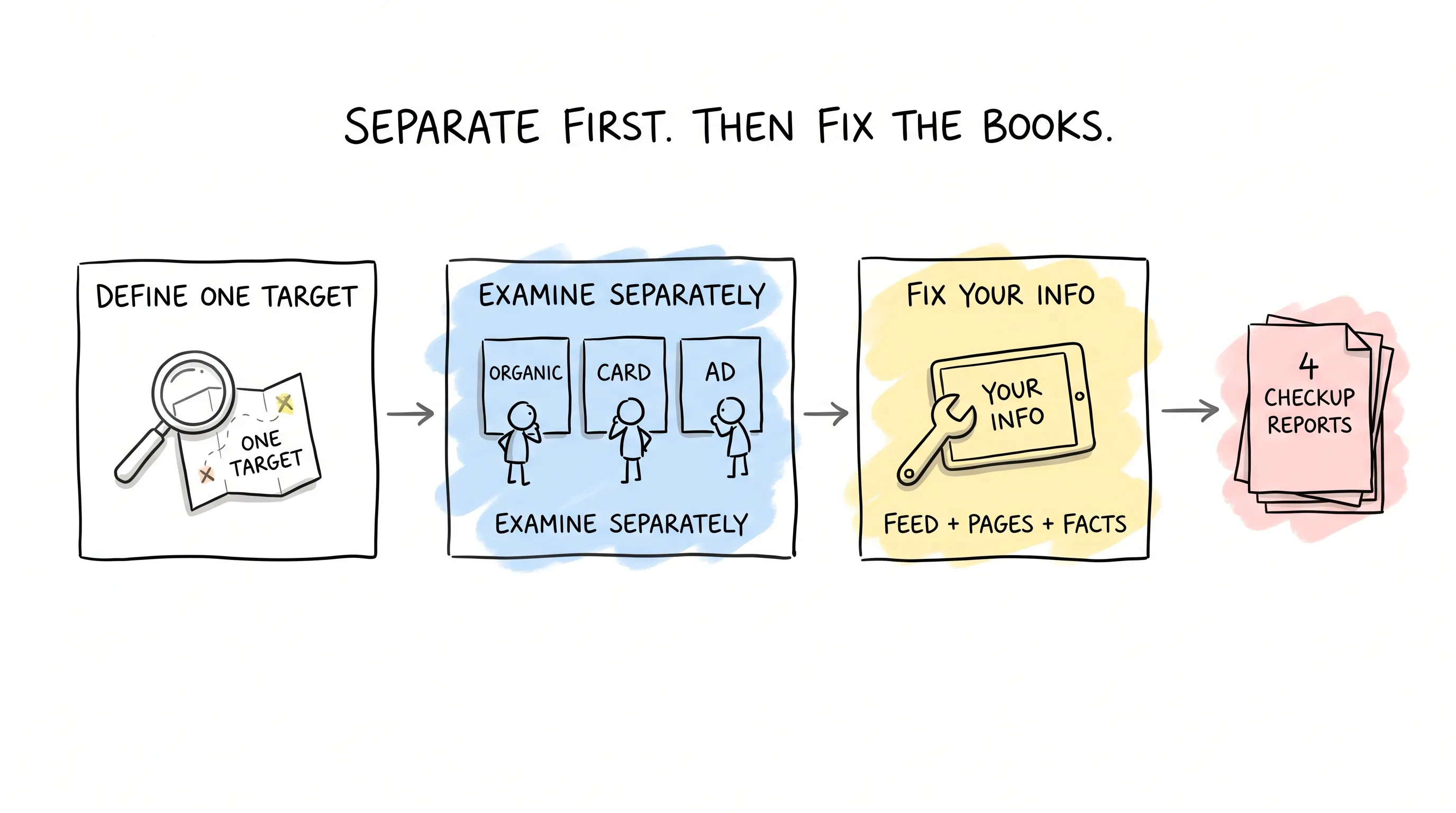
So what do you actually do? I've distilled Dageno's approach into three steps.
Step one: define one specific observation target. What is your product scope? Which overseas markets are you going after? Which competitors should your brand be measured against? Without clear definitions, everything downstream is muddled bookkeeping.
Step two: examine the three kinds of evidence separately. Organic recommendations, product cards, ad placements — review them layer by layer, on their own, with no layer pretending to be another.
Step three: go back and fix your own information. First get right the materials AI reads — product facts, product feed, landing pages, channel information — then add third-party evidence on top.
Run all three steps and you'll be holding four things: a baseline of product visibility, a map of gaps in demand and attributes, your channels and citation sources, and a competitive read on AI ads.
In plain terms: four checkup reports.
The Foundation: Running the Numbers on the Data
None of this works on talk; it runs on data. I took a look at Dageno's data foundation:
More than 500 million ad data records, covering ads, advertisers, and placements in ChatGPT and Google AI.
More than 100 million product data records — products, prices, reviews, merchants, and citations from AI shopping scenarios.
Market data spanning more than 12,000 market categories.
And under the hood run more than 10 mainstream AI models: ChatGPT, Gemini, Google AI Overview, Perplexity, Grok, and more.
Volume alone isn't enough. Every AI answer, citation, search, product, and ad signal that Dageno records is tagged with its market, model, region, and time.
What is responsible data? Data where every record can answer: observed where, by which model, in which region, at what time.
Data without scope is noise.
It Knows Where Its Limits Are
This next part is what I respect most.
Can Dageno attribute performance inside AI directly to sales? It says so itself, flat-out: no.
What it can measure is the signals of products, brands, sources, and ads inside AI scenarios. Sales impact has to be cross-validated against official business data — GSC (Google Search Console), GA4 (Google Analytics 4), CRM, your e-commerce platform.
It refuses false precision.
On the ad-observation side, it currently supports two: ChatGPT Ads and Google AI Overview Ads. Which regions, which formats, and how much ground it can cover — that depends on the actual availability of the ads themselves and on project configuration.
Even here, it won't give you a guarantee.
Set that against the marketing copy out there promising "one-click attribution, effortless growth," and this kind of honesty is worth real money.
Who It's For
So what kind of team fits?
It draws its own boundary clearly: cross-border e-commerce, DTC, consumer tech, and multi-brand product teams that already have overseas standalone sites, product feeds, retail channels, or content assets. Your business has to have something AI can "see" in the first place — that's what gives observation a handle.
The fit also varies by market type.
Cross-border e-commerce and DTC: a strong fit. The core move is watching product cards, channels, reviews, attributes, and purchase scenarios.
Consumer electronics and smart hardware: also a strong fit. The core move is comparing specs, compatibility, review sources, and the consideration set in users' heads.
Multi-brand retail and product portfolios: a good fit. The core move is setting priorities by market, category, SKU, and channel.
Back to That Cup of Coffee
Back to Lao Chen.
When the coffee was done, I gave him exactly one piece of advice: don't celebrate yet. First answer one specific question: in the overseas market you're focused on, what does your product look like in organic recommendations, in product cards, and in ad placements?
There's a line on Dageno's website that I wrote down: start from one specific overseas-market question. Get clear on your market, your audience, the data you have, and how much your team can take on — then decide whether to use the free data, the product workspace, or a partnership model.
See it clearly first. Then you're ready to strike.
Here's hoping Lao Chen's docking stations soon go from "being mentioned" to "being bought."
Continue reading
Related articles

Cross-Border Business: Time to Upgrade Your AI Toolbox
A learn article explaining how AI tools help cross-border e-commerce sellers clear five hurdles: language, regulation, logistics, payments, and fraud. It outlines a five-compartment toolbox, a five-step adoption path, and metrics such as conversion rate and CLV, while cautioning against over-reliance on AI.

AI Is Taking Over the Dirty Work of Social Media Marketing, One Task at a Time
This learn article outlines four social media marketing tasks AI can handle — audience analytics, content drafting and design, ad targeting and creative testing, and spam moderation — and cautions that taste, judgment, and data security remain human responsibilities.

AI Is Already This Good — Why Is Your Social Media Marketing Still Pure Manpower?
An overview of 18 AI tools for social media marketing, organized into six categories covering audience research, content creation, scheduling, comment and DM handling, ad management, and visual production, plus notes on personalization, prediction, and emerging trends.