
So How Do You Actually Run an AI Marketing Campaign? Let Me Tell You a Few Stories First
A story-driven guide to running AI marketing campaigns: six campaign types illustrated with cases like Heinz, Nutella, Cadbury, Netflix, Dove, Nike, and Kalshi, plus three starting steps, tool suggestions by use case, and trends such as contextual targeting and predictive spend.
A while back, a friend of mine who runs a brand invited me to dinner.
Halfway through the meal, the venting started. His budget had barely moved, yet the growth his boss wanted had doubled. Ad channels kept getting more expensive, and a single round of A/B testing was enough to swallow a whole quarter.
He asked me: "Tell me — how am I supposed to fight this battle?"
I said, don't rush. Let me tell you a few stories first. Then you can decide how to line up your battle plan for next year.
First, a Few Numbers. Then the Stories.
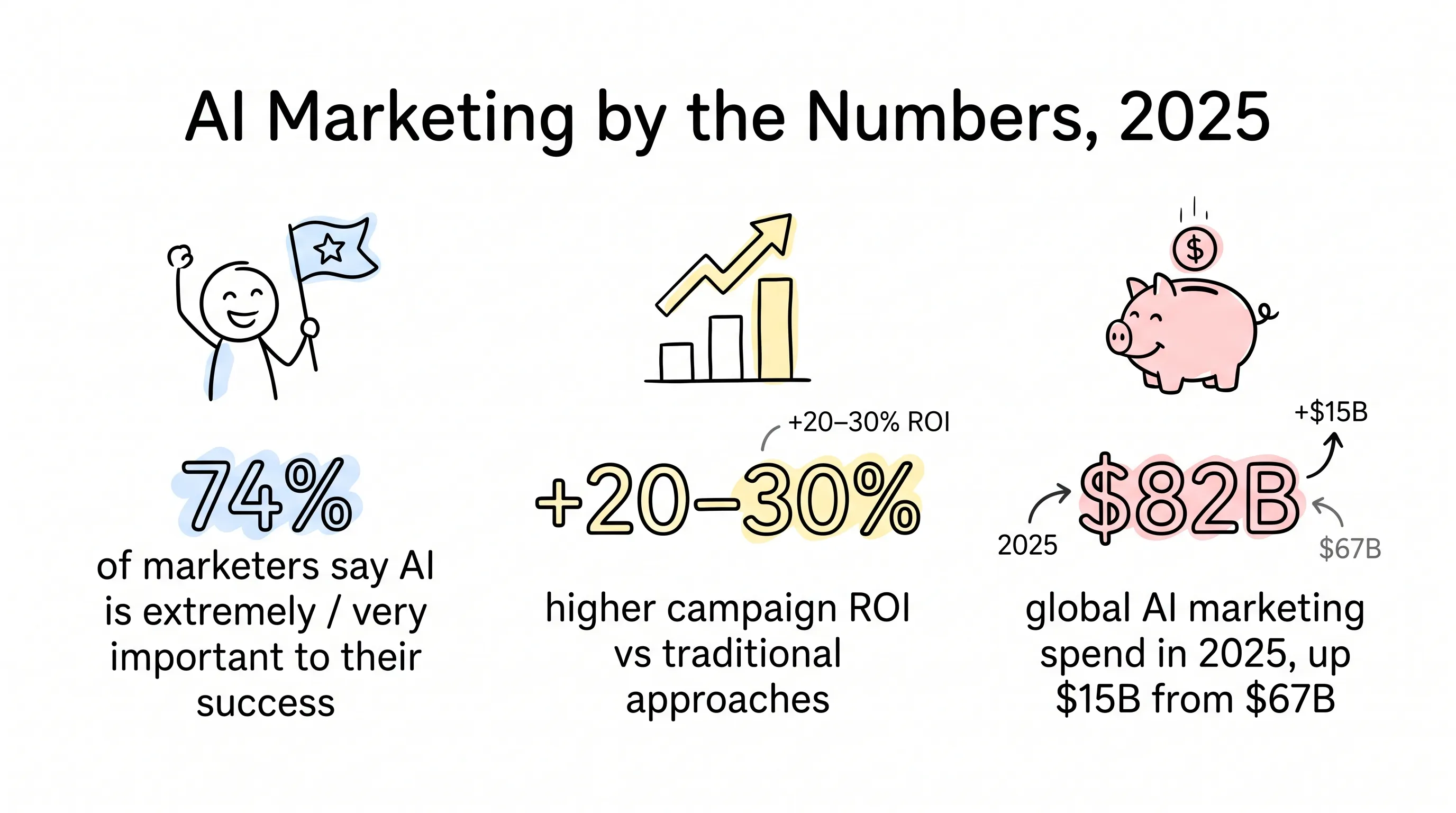
A 2025 survey found that 74% of marketers consider AI "extremely important" or "very important" to their marketing success over the coming year — up 8 percentage points from the year before. Companies using AI in their marketing report campaign ROIs generally 20% to 30% higher than traditional approaches. And global spending on AI marketing technology hit $82 billion in 2025, up from $67 billion the year before.
An extra $15 billion in a single year. Money doesn't lie.
But.
Not every campaign with "AI" stamped on it deserves to be called an AI marketing campaign. You used ChatGPT to write a headline and declared that you've "embraced AI"? That's not an AI campaign. That's a new label slapped on an old method.
So what counts as a real AI marketing campaign? Three tests, as I see it.
First, machine learning is genuinely doing the work: predicting placements, filtering content, optimizing creative. Second, the AI makes its own decisions: it adjusts the ad buying itself, rather than reciting a script a human wrote. Third, the AI directly produces creative assets: the copy, the imagery, the video — it wrote them.
Miss all three, and it doesn't count.
Alright, the bar is set. Now for the stories. I've sorted the cases I've watched over the past few years into groups, and I'll take them one group at a time.
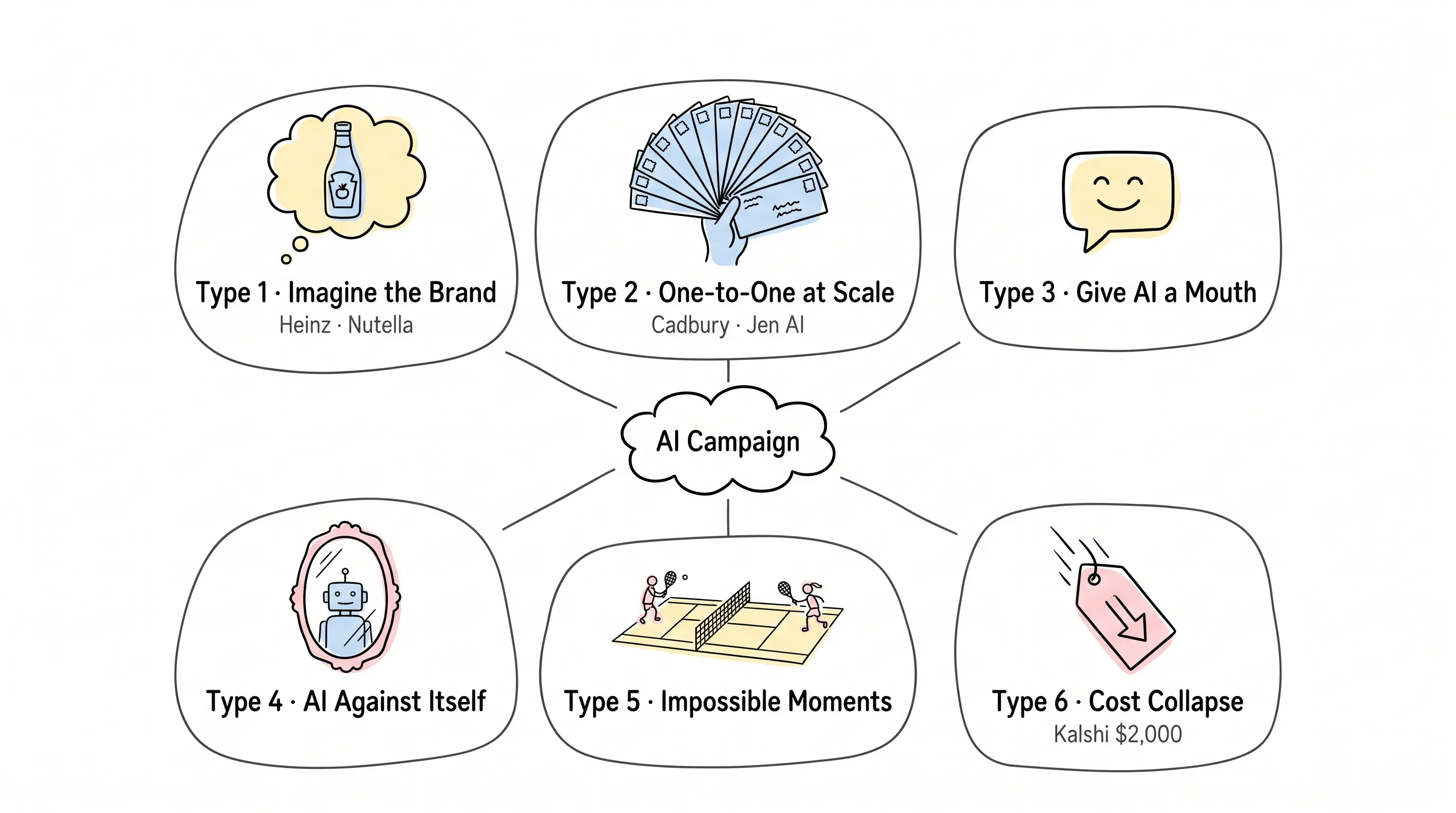
Type 1: Let the Machine Imagine Your Brand for the Whole World
The first story belongs to ketchup.
Heinz wanted to know one thing: what does ketchup look like inside a machine's imagination? It fed a batch of abstract prompts into DALL-E 2 — "ketchup diving underwater," "ketchup in outer space," that kind of thing.
And the result?
No matter how it was prompted, what came out was Heinz's iconic glass bottle, every single time. The reason isn't complicated: in the internet's image libraries that trained the model, images of ketchup are drowning in Heinz bottles.
Brilliant. It's the hardest proof of "share of mind" I know of. Market share can be inflated; a machine's imagination can't. What is a brand? A brand is a category that not even a machine can imagine without you.
The second story belongs to chocolate spread.
Nutella used an algorithm to generate 7 million jars — 7 million labels, every single one different, no two alike. All of them sold out.
Think about it: this used to be flat-out impossible. Personalization was a craft — a human drawing each one by hand: expensive, slow, impossible to scale. Then the algorithm showed up, and personalization became an assembly line: 7 million "one-of-a-kinds," an afternoon's worth of design capacity.
Type 2: One-to-One at Scale — From Slogan to Production Capacity
During India's festive season, Cadbury teamed up with Ogilvy India and Wavemaker Mumbai to do something nobody had done before: recruit Bollywood superstar Shah Rukh Khan to record ads for countless small local stores.
Could a superstar record that many ads? Impossible. So the machine stepped in. AI-generated video meant that in every ad, the superstar named that specific store and its location, and the ad went to the people around it. For the first time, the corner shop had "a big star recording an ad just for me." Business picked up at those small stores — and the case itself took home a D&AD Graphite Pencil and a spot on the Cannes shortlist.
Cruise line Virgin Voyages walked the same path. With VMLY&R and the AI studio Deeplocal, it built something called Jen AI: as early as the summer of 2023, Jennifer Lopez was no longer running one ad for everyone — she was recording a personalized boarding invitation for every potential guest.
Lingerie brand Cosabella went even more direct. It let the AI platform Albert AI take over the imagery and copy for its Facebook ads; in the first month, return on ad spend (ROAS) shot past 500%.
Yum! Brands (parent of KFC, Pizza Hut, and Taco Bell) applied this machinery at an even finer grain: reinforcement learning running email. When to send, what offer to send, who to send it to — the machine learns by itself, and the more it learns, the sharper it gets. Repeat purchases went up; churn went down.
Marketing used to have only two ways to live: one-size-fits-all, chasing efficiency through scale — or one-size-fits-one, chasing premium through intimacy. Pick one. Not anymore. Personalization is no longer a luxury. It's production capacity.
Oh, and the meditation app Calm belongs in this camp too: with a recommendation engine running on Amazon's cloud, it reads your sleep patterns and the time of day, then serves you the meditation you should be hearing. Saving users from straining over a massive content library is a business in itself.
Type 3: Give AI a Mouth
After Stranger Things aired, Netflix built a chatbot called El Bot and put it on Messenger. Fans could chat with characters "from the show," hunt for Easter eggs, solve puzzles, and grab exclusive previews. It rolled out across 24 countries with an 88% user retention rate.
Eighty-eight percent. My God. How many brands' campaign pages are forgotten by the next morning?
Sephora's virtual try-on is another such mouth. 3D face tracking lets you try thousands of lipsticks and eyeshadows on your phone, while a chatbot helps you match shades and make picks — and somewhere in the trying, you buy. The tool has been used more than 200 million times, and paired with in-app campaigns in Southeast Asia, engagement rose 28%.
Notice what these two cases share: users get so absorbed in playing that they forget they're looking at an ad. The sign that your marketing truly lands is when people stop treating it as an ad.
Type 4: Turning AI Against Itself
Everything so far used AI as a tool. These two stories use AI as a mirror.
Dove (the Unilever brand) did something counterintuitive. While other beauty brands rushed to generate flawless models with generative AI, Dove used AI to expose AI: it fed the industry's favorite "beauty" prompts into image models and showed the public, exactly as they came out, the bias and distortion in the results. Amplified on social media with digital content built in Nvidia Omniverse, the campaign earned 3.5 billion impressions, and 52% of buyers of its limited-edition line were first-time Dove customers.
Using technology's own bias to argue for the value of the real. Full marks from me.
The World Wildlife Fund (WWF) pushed #WorldWithoutNature even harder: each year, a group of brands removes the animal from its logo for a day, and creators use AI to paint "a world without wildlife." Those hollow images, sitting there — no one can look at them and feel nothing. FoodPanda, Earth Hour, and other brands joined in.
AI didn't save a penny here. But it lodged a worldview in people's hearts.
Type 5: Resurrecting Impossible Moments
After Serena Williams announced her retirement, Nike and AKQA made a film. Using machine learning to analyze footage from her entire career, they trained two models: Serena at 17, playing Serena at 35.
Across the net, the two Serenas really played.
1.7 million people watched that match. Organic views beat Nike's previous record by 1,082%, and it took the Grand Prix for Digital Craft at the Cannes Lions International Festival of Creativity. Without AI, this simply could not be made: you can't actually put two Serenas on the same court, and you can't rewind time.
H&M took the adjacent step. In 2025, it created "digital twins" (AI-generated likenesses) of 30 real models, shared across ads, e-commerce product pages, and social content, saving round after round of photo shoots. And it was done decently: the models kept the rights to their own likeness, and their pay wasn't cut by a cent.
Save everything technology can save; hold the line where it can't. That's what knowing how to use technology looks like.
Type 6: The Collapse of the Cost Structure
The last story is the one I most wanted to tell you.
Kalshi, a financial trading platform regulated by the U.S. Commodity Futures Trading Commission, ran a 30-second ad during the 2025 NBA Finals.
What did it cost to make?
$2,000.
The visuals were generated with Google Veo, with Gemini and ChatGPT as assistants, and the whole thing was executed single-handedly by one AI filmmaker, PJ Accetturo. Twenty million viewers saw it, and it was called "the first AI ad to make it to prime time."
Do the math. A traditional 30-second, big-game-caliber ad — production plus placement — starts in the hundreds of thousands to millions of dollars. Getting into the Finals for $2,000 isn't saving money. That's a barrier collapsing. When production costs drop from the millions to the thousands, small teams and giant brands sharing the same prime-time slot is only a matter of time.
McDonald's recently brought AI into the product itself. With Leo Burnett Thailand, it first asked ChatGPT: what is the perfect fried chicken experience? Then it turned the AI's answer directly into a product, McFried Chicken. AI is no longer just advising on "how to say it" — it has started calling the shots on "what the product should be."
And of course, there's a cautionary tale about overplaying it. Mint Mobile founder and actor Ryan Reynolds had ChatGPT write an ad script in 2023; the result was absurd beyond belief, and viewers described it as "kind of creepy." The spot never actually ran — pure conversation fodder. See, you can use AI to spark buzz, but don't treat it as your formal weapon. Know where the line is.
Want to Try? Where Do You Start?
Stories done. Your turn. Three steps.
-
Pick one entry point. Don't get greedy. For copy, look at Jasper, Writer, ChatGPT. For ad buying, look at Albert AI, Pattern89. For customer journeys, look at Dynamic Yield, Salesforce Einstein. For design, look at Midjourney, DALL-E, Adobe Firefly. Start on monthly plans; talk annual only after the ROI shows up. Don't lock yourself in on day one.
-
Feed it clean data. CRM records, purchase history, behavioral trails, engagement data from past campaigns — all of it counts. Dirty data, dirty predictions. Garbage in, garbage out — in front of AI, that saying holds double.
-
Launch is just the beginning. Watch the metrics weekly, adjust inputs and swap creative variants based on the data, and keep the model learning. Click-through rate, customer acquisition cost, and ROAS — these three numbers will tell you where you're headed.
How small can a team be and still play? Small teams lean on off-the-shelf tools: content generation plus email automation gets you started for around $50 a month. Mid-size companies add omnichannel orchestration and predictive analytics. Large enterprises build their own models and their own machine learning teams.
Which New Cards Are on Next Year's Table?
Looking ahead, three cards are worth watching.
First card: contextual and emotional targeting. Ads stop asking only "who is watching" and start asking "what emotion is this moment." Netflix's ad suite, launched in 2025, embeds ads into the mood of a show: you've just watched a character sit down to dinner, and a food-delivery ad appears. Platforms like Roku and Amazon's cloud are matching ads by emotion and topic as well.
Second card: predictive spend. Machine learning models now forecast campaign performance before launch, and marketers expect 80 to 90 percent confidence. Aim first, then fire.
Third card is a warning. McKinsey has run the numbers: hyper-personalization (individualized messaging at massive scale) can lift ROAS by as much as 25%, but the guardrails of privacy and ethics must go up first. Keep the legal line in view too: steer clear of copyright landmines with generated images and music; lock contracts down tight before using a celebrity's face or voice; cage user data inside compliance regimes like GDPR and CCPA; and disclose purely AI-generated content when disclosure is due. Audiences and regulators are both watching.
Back to That Dinner
After dinner broke up, I sent that friend a message. The gist was this:
Don't rush to buy tools. First get clear on one thing: what's the one thing humans can't do that you want AI to do for you?
Heinz got the machine to draw its own share of mind. Dove made technology reveal its own bias. Nike put two Serenas on opposite sides of the net. Kalshi stood on the Finals stage for $2,000. None of them was buying efficiency. What they bought was: what used to be impossible.
What AI changes isn't some step in the marketing process.
It's the cost structure of marketing. And when the cost structure shifts, every play changes with it.
May your brand be the one the machine draws, and draws alone, when it imagines ketchup.
Continue reading
Related articles

Cross-Border Business: Time to Upgrade Your AI Toolbox
A learn article explaining how AI tools help cross-border e-commerce sellers clear five hurdles: language, regulation, logistics, payments, and fraud. It outlines a five-compartment toolbox, a five-step adoption path, and metrics such as conversion rate and CLV, while cautioning against over-reliance on AI.

AI Is Taking Over the Dirty Work of Social Media Marketing, One Task at a Time
This learn article outlines four social media marketing tasks AI can handle — audience analytics, content drafting and design, ad targeting and creative testing, and spam moderation — and cautions that taste, judgment, and data security remain human responsibilities.

AI Is Already This Good — Why Is Your Social Media Marketing Still Pure Manpower?
An overview of 18 AI tools for social media marketing, organized into six categories covering audience research, content creation, scheduling, comment and DM handling, ad management, and visual production, plus notes on personalization, prediction, and emerging trends.