
Six People Sign the Deal — and You're Only Emailing One of Them
This learn article explains B2B personalization: enterprise purchases involve multiple decision-makers, so it recommends tiering accounts by value, using intent data to spot in-market accounts, and tailoring content to roles such as CFO and IT. It cites research and vendor examples such as ZoomInfo.
A few days ago, a friend who works in enterprise software showed me his team's latest showpiece: a "personalized email."
The greeting read, "Dear {Name} of {Company}." The body? Same template, not a single word changed, blasted to twenty thousand customers.
"See?" he said. "We do personalization."
"What you've done," I told him, "is called mail merge."
He pushed back. Everyone in the industry does it this way, he said.
Fine. Then let's get serious today about one question: what is real B2B personalization? By the end, you'll see that done well, every dollar of it can be traced to a return. Done badly, it's just spraying your budget into the trash.
What Is B2B Personalization?
What is personalization? On the small end, it's getting the name right in an email. On the big end, it's knowing who the customer is, what they're wrestling with right now, and what they should look at next — before they say a word.
Get all of that right, and you're doing personalization.
But B2B personalization is a completely different animal from what you feel shopping on Taobao, China's largest online marketplace.
Taobao-style personalization targets one person. B2B personalization targets a group of people.
Think about it: when a company buys your product, who makes the call? Not one person. Gartner has the data: an enterprise purchase decision is made, on average, by six people together.
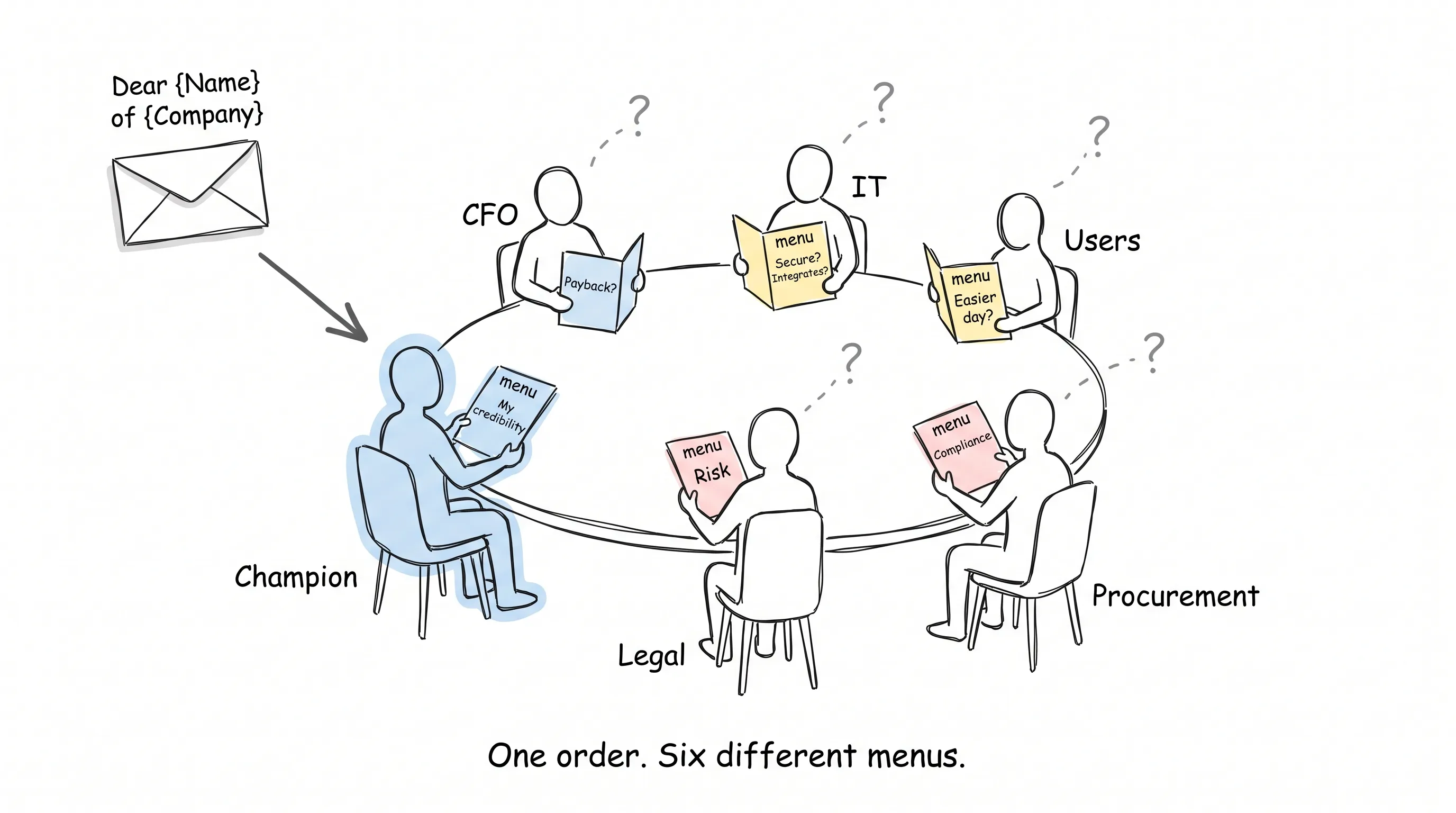
Those six people sit at the same negotiation table — and read six different menus.
The CFO cares when the money comes back. The IT director cares whether it plugs into existing systems and whether it's secure. The employees who use the product every day care whether it makes their work easier. Procurement cares about contracts and compliance. And there's an internal champion in the mix — someone who vouches for you inside their company, and whose real need is not losing face.
Send the CFO a product feature sheet? They won't even open it.
So the essence of B2B personalization is saying something different to each person on the same order.
B2C is chasing one person. B2B is persuading a whole table.
Is It Worth the Trouble? Do the Math
Now, some of you might say: this sounds exhausting. Isn't mass email just fine?
Let's do the math — three ways.
First, McKinsey's research found: companies that do personalization well out-earn the mediocre ones by 40% in revenue.
Second, and this one stings more: Madison Logic's research shows that across the entire buying journey, a buyer spends only 5% of their time with sales. The other 95%, they're quietly researching on their own — reading content, comparing options, forming a judgment.
In other words, before they ever meet your people, they've already met your content.
Guess who they end up talking to? Most likely, the company that sounded like a human being while they were quietly doing their homework.
Third, Gartner's survey found that 86% of B2B customers expect you to know them when you engage. How high is that expectation? Forget where your last conversation left off, and they'll walk.
Is it a grind? Yes. But when you run the numbers, the grind itself is the moat.
Most Companies Fail Because They Spread the Effort Evenly
So why does personalization fall apart at most companies?
It's not the wrong direction. It's that the effort is spread evenly.
Take 100 points of energy and spread them evenly across ten thousand customers, and each customer gets 0.01 points. The result: every customer feels you don't know them at all.
The fix is tiering.
What's tiering? Split customers into three tiers by value, and put different muscle behind each:
Tier one: one-to-one. The handful of must-win accounts. Fully custom content, dedicated landing pages, individually written proposals — a different playbook for each one.
Tier two: one-to-few. The ten or twenty accounts in the same industry with similar pain points. Build one industry content framework with a few variables left open, and swap them per customer.
Tier three: one-to-many. The broader pool. Let rules do the matching: this industry gets this version.
But tiering alone isn't enough. For the system to run, it needs an engine. The engine is intent data (data that shows what an account is researching — which topics it's consuming, which vendors it's comparing, how far along it is).
With it, the tiers come alive. A tier-three account suddenly starts intensively researching solutions like yours, and the system automatically promotes that account, so you treat it as a priority.
They've walked all the way to your front door, and you're still sending them mass emails off an old list. That's not discipline. That's waste.
How do you tell real personalization from fake personalization? Here's a self-test: after you promote an account into tier one, does the content they see change? Does the first thing they see change? Does the outcome the content pushes them toward change? If none of the three changed, that's still mail merge.
A Different Menu for Every Person
Tiering solves how deep to go. It doesn't solve what to say to whom.
Back to that negotiation table. Give every role its own menu:
- For the CFO: the financial case they can take back to the board. What you invest, how fast it pays back, what doing nothing costs.
- For the IT director: architecture diagrams, API docs, security certifications. Fewer adjectives, more parameters.
- For the end users: peer case studies and hands-on demos — let them see what their day looks like after adoption.
- For the internal champion: the materials that help them make the case inside their company. Peer win stories, ready-made internal deck templates. They've staked their own credibility on you; it's on you to lower their risk.
- For procurement: compliance documents and credentials, complete in one pass — don't make them chase your sales rep for it.
Put all five menus on the table at once, and the committee drifts your way on its own. Miss one, and the negotiation stalls right at that person's seat.
Now the question is: before you make a move, how do you know who's at the table and who's sitting in which chair?
That's where data comes in. Take ZoomInfo's contact database — 500 million contacts with role, seniority, and department information. Its use boils down to one thing: letting you see the whole table before you send the first email.
What AI Does: Add Leverage, Not Headcount
So you might ask again: more customers, more roles, more content — how many people do I have to hire?
You don't add people. You add AI.
Take ZoomInfo as an example. It positions itself as a one-stop AI GTM platform, and its architecture has three layers.
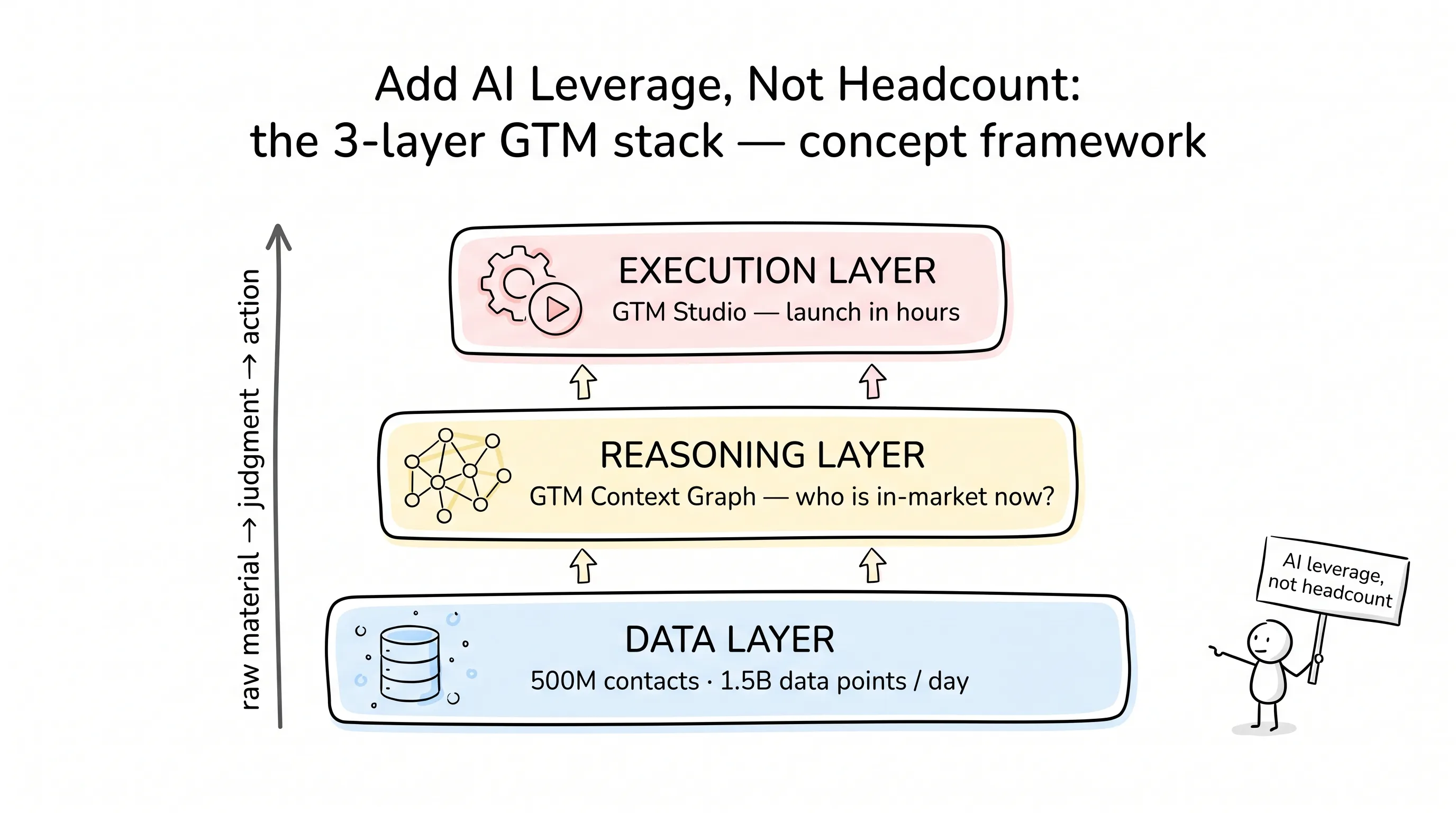
At the bottom, the data layer. 500 million contacts, processing more than 1.5 billion data points a day. This is the raw material. If the raw material isn't fresh, nothing built on top matters.
In the middle, the reasoning layer. It has something called the GTM Context Graph, which connects those data points and reasons across them: which accounts are in-market right now, why, and who to approach first. Note: what it hands you isn't a list of companies that "look like" your target customer — it's a list of accounts with their wallets already out. And if you want to pipe this layer's intelligence into your own AI tools and agents, ZoomInfo left the door open: an MCP and an API.
On top, the execution layer. Tools like GTM Studio let marketing and RevOps teams build audiences, launch account-based marketing (ABM) plays, and trigger personalized sequences within hours — no feature-request tickets to engineering, no stitching together data silos between systems.
Does it work? Customers have already run the experiment.
Smartsheet used its FormComplete: form fills up more than 40%, marketing-qualified leads (MQLs) up 84%, sales opportunities up 26%, win rate up 59%.
Mendix wired intent data into email and nurture flows, and turned lead-to-opportunity conversion into 14 times the original.
Redwood Logistics ran intent-driven ABM campaigns: cost per click down 99%, 25 hours saved every week. Why so steep? Because they stopped spraying ads at stale lists and only went after accounts that were actively researching.
Spekit used ZoomInfo's data for account tiering, and high-scoring accounts moved through qualification 58% faster.
See the pattern? In these cases, copywriting was never the star. The star was this: the content reached the right person.
Before You Start, Do the Buzzkill Task First
Finally, how to begin. If you're fired up and ready to charge back to your desk and start building — first do the buzzkill task: clean your data.
Your account list is the foundation of personalization. When the foundation is crooked, the faster you build, the faster it all comes down. Here's a particularly sneaky trap: an account list that hasn't been updated in years gets uploaded to an ad platform for audience matching, and the match rate can fall below 50%. What does that mean? Half the target customers in the "precision targeting" you paid dearly for never see your ads at all.
Then, match content to stage. A customer still figuring out the problem gets educational content — don't rush to sell. One already comparing vendors gets comparisons and proof. One close to deciding gets ROI models and an implementation plan. Hand the wrong thing at the wrong stage, and you may push them straight into a competitor's arms.
Last, how do you know it's working? Watch a handful of numbers: engagement depth per tier, pipeline velocity, the share of the buying committee you've reached, stage conversion rates, and whether your sales cycle runs shorter than it does for non-personalized accounts. If attribution is broken, fix attribution first. Don't optimize blind.
Back to That Email
Back to my friend. He has since torn the whole swap-the-greeting template down and rebuilt it around the three layers: data, intent, roles. Last month he told me reply rates were up — but the more valuable change was something else: the quality of the customers sales was getting into conversations with had changed.
He said something I'd gladly frame on a wall: "We used to study how to make emails sound human-written. Now we study when to hand what — and to whom."
B2B personalization was never about spelling names right.
It's about this: during that 95% of the time they never see you, every step is already laid out ahead of them.
Here's hoping you get a clear view of your customers' negotiation table — soon.
Continue reading
Related articles

Cross-Border Business: Time to Upgrade Your AI Toolbox
A learn article explaining how AI tools help cross-border e-commerce sellers clear five hurdles: language, regulation, logistics, payments, and fraud. It outlines a five-compartment toolbox, a five-step adoption path, and metrics such as conversion rate and CLV, while cautioning against over-reliance on AI.

AI Is Taking Over the Dirty Work of Social Media Marketing, One Task at a Time
This learn article outlines four social media marketing tasks AI can handle — audience analytics, content drafting and design, ad targeting and creative testing, and spam moderation — and cautions that taste, judgment, and data security remain human responsibilities.

AI Is Already This Good — Why Is Your Social Media Marketing Still Pure Manpower?
An overview of 18 AI tools for social media marketing, organized into six categories covering audience research, content creation, scheduling, comment and DM handling, ad management, and visual production, plus notes on personalization, prediction, and emerging trends.