
Six Months with AI: Why Hasn't the Team Gotten Any Faster?
A learn article explaining why AI-boosted content output often fails to speed up delivery, as bottlenecks shift to approval and review stages. Through team case stories, it argues that fixing processes—clear ownership, brand standards, and data accountability—matters more than choosing AI tools.
A while back, a friend of mine who works in content marketing came to me to vent.
His team had adopted an AI writing tool at the start of the year. Before buying it, the boss slammed the table in a meeting and did the math: five times the output, half the headcount.
Six months later.
Output did multiply. Content came pouring out, and the volume was far bigger than before.
But delivery speed? Not one day faster.
I laughed when I heard this. I told him: this is completely normal — you're not the first team to fall into this trap.
A lot of people still haven't figured out one thing:
AI is not a productivity cheat code. AI is a mirror.
If your process works, AI amplifies it. If your process is broken, AI exposes it. The faster you run, the sharper the reflection.
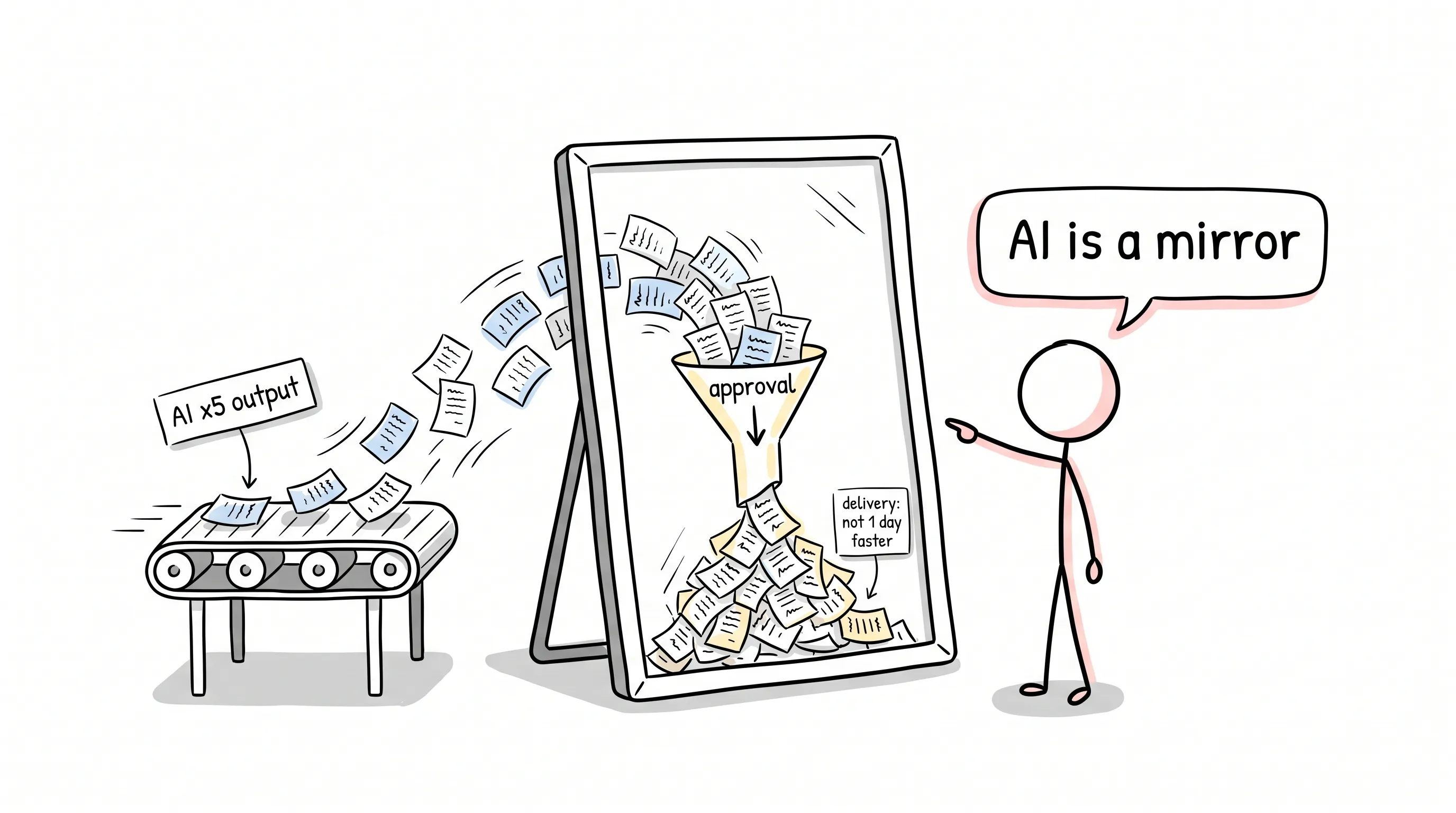
Today, I'm going to explain this once and for all.
Why Did Output Speed Up While Delivery Didn't?
First, back to my friend. His team produces insurance content.
Back then, they put out one batch of articles a month, and the colleagues in charge of review worked through them at a steady, matching pace.
Then AI arrived, and the picture changed. Content came flooding toward the approval stage like water bursting through a broken dam.
And spare a thought for the colleague in charge of final review. She used to review one batch a week; now she faces five times the volume. The approval process itself? Not one step changed.
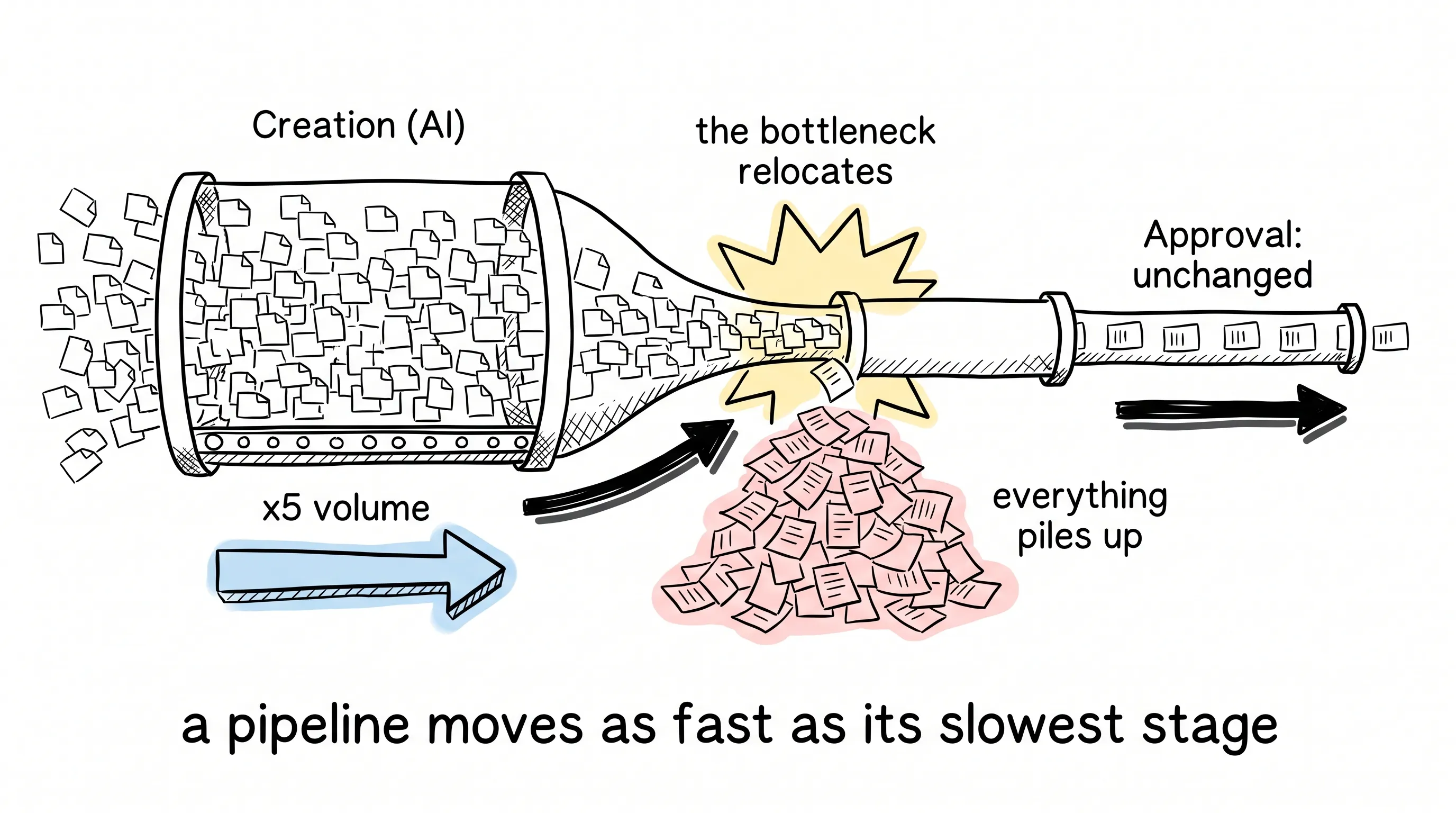
The result: every article piled up at her desk. Production had sped up fivefold, but approval was still crawling at a snail's pace. And a pipeline only moves as fast as its slowest stage.
This isn't AI failing. This is the bottleneck relocating.
What does "bottleneck relocation" mean? A bottleneck never disappears — it just moves house. Speed up production, and it relocates to the next slowest stage. It used to hide inside the slow rhythm where nobody could see it; now it's fully exposed.
So what did they do?
First, they put everything on the table and talked it through, so everyone could see it: the sticking point was in approval, not creation.
A few months later, they built an AI first-pass review line. The machine went through everything first, cleaning up formatting issues and basic errors. Humans only handled the final spot check.
That colleague finally climbed out from under the fivefold pile of articles.
You might say: that's just one case, right?
It really isn't. Over the past two years, I've watched the same drama play out at plenty of marketing teams. The moment AI goes live, years of hidden, broken processes stand revealed all at once.
Here are three stories.
Let Me Tell You Three Stories
Story One: Three Days Arguing Over Colors and Fonts
The brand department of a healthcare organization needed a full set of promotional materials for a new hospital opening.
In the past, this job would have taken weeks. This time, with AI, they finished everything in a few days. The team was overjoyed.
Then the approval stage began, and the arguing started.
Some said the primary color was wrong. Some said the font wouldn't do. Everyone talked over everyone else, and nobody could convince anybody.
By the end of it all, everyone stumbled onto an embarrassing fact:
This company had never written down its brand standards.
Colors were picked by feel, fonts by personal taste. Work used to be slow — a project dragged on for weeks, and disagreements got papered over by time. Now work was fast, and every single disagreement detonated at once.
Afterward, they ran a few workshops and defined their brand standards, line by line. At the next review, there was far less arguing — and delivery got faster.
Story Two: The Boss Asked One Question, and the Room Went Silent
A fast-food chain ran a back-to-school campaign in September: every Friday, high school graduates could come into the store and claim free food.
AI earned its keep this time. Campaign plan, creative assets, launch — all done in one smooth sweep. The team was bursting with pride.
Then the boss asked one question: across this whole campaign, how many people actually came in and redeemed?
The room went silent.
Nobody knew where the data lived. And nobody could say who was supposed to crunch the numbers.
The campaign was fast — so fast that no one even had time to think about whether its impact had been measured.
Fast answers arrive in a flash; the right answer never arrives at all.
That knock on the head actually woke the team up. They created a dedicated data role, and from then on, before any campaign went live, they first worked out which metrics to watch and who would own the numbers.
Now, after every campaign, data speaks first at the review meeting.
Story Three: Half a Day of Work, Three Weeks of Approval
A residential developer was launching a new community and needed a wave of promotional materials.
The most capable person on the team used AI to whip up the flyers, collateral, and social media assets in a blur. How fast? Plan settled in the morning, everything ready by the afternoon.
Sounds great, right?
Trouble arrived just as fast. Everything landed on the leadership's desk the same day, waiting for approval. But not one person could answer: whose approval is this?
One person pushed it to the next, who pushed it right back. Leadership batted it back and forth for three full weeks.
Work AI finished in half a day spent three weeks in approval.
Still, every cloud has a silver lining. The jam shone a light on a problem nobody normally saw: the approval chain had never been defined.
So they reworked the process while they were at it: who approves what, written out in black and white. And they added one hard rule — a decision must come within 24 hours.
Now, on new projects, everything produced in a day clears the whole pipeline within two.
Three Stories, One Lesson
Have you noticed?
These three teams tripped into different pits, but the pits grew from the same root:
AI didn't create a single new problem. It just pressed fast-forward on the old ones hiding underneath.
Teams with unclear approval used to get exposed once a week; now it's five times a day. Teams missing standards used to argue at a trickle; now they argue all at once. Teams with no one owning the data used to run slowly enough to fix mistakes in time; now they run fast — and they make mistakes fast too.
And here's the part that stings: many teams still operate the way they did ten or twenty years ago. If you don't change the process, most of the money you spend on AI just speeds up a broken process.
So stop agonizing over "which AI tool should we buy."
The real question is: which of our processes need fixing?
How do you fix them? Two steps.
Step one: map out your current process in full, from kickoff to delivery. At every stage, ask: who owns this step? How long until a decision is due?
Once the map is drawn, you'll find the bottleneck at a glance.
Step two: change the process with the whole team. Note the words "whole team." Process problems are never one person's problem — they're the organization's. Count on one person to fix it, and it won't get fixed.
Finally, Back to That Friend
I ran into him again a few days ago and asked how the team was doing.
He said: same tool, no new hires, but the whole team is noticeably faster.
I said: that's exactly how it's supposed to work.
AI was never just a technical tool — what it reflects are the problems of the organization and its people. No tool can save a broken process. The only thing that can save a broken process is fixing the process.
The mirror has already shown you the dust on your face. Don't rush to blame the mirror — and whatever you do, don't smash it.
Go wash your face.
Here's hoping your team gets its processes running smoothly soon, so that every bit of speed AI adds turns into real, tangible delivery.
Continue reading
Related articles

Cross-Border Business: Time to Upgrade Your AI Toolbox
A learn article explaining how AI tools help cross-border e-commerce sellers clear five hurdles: language, regulation, logistics, payments, and fraud. It outlines a five-compartment toolbox, a five-step adoption path, and metrics such as conversion rate and CLV, while cautioning against over-reliance on AI.

AI Is Taking Over the Dirty Work of Social Media Marketing, One Task at a Time
This learn article outlines four social media marketing tasks AI can handle — audience analytics, content drafting and design, ad targeting and creative testing, and spam moderation — and cautions that taste, judgment, and data security remain human responsibilities.

AI Is Already This Good — Why Is Your Social Media Marketing Still Pure Manpower?
An overview of 18 AI tools for social media marketing, organized into six categories covering audience research, content creation, scheduling, comment and DM handling, ad management, and visual production, plus notes on personalization, prediction, and emerging trends.