
She Has 390K Followers and Makes $10K a Month — But She Doesn't Exist
A feature article on AI influencers, covering the virtual persona business, brand motivations, and what rising synthetic creators mean for human influencers.
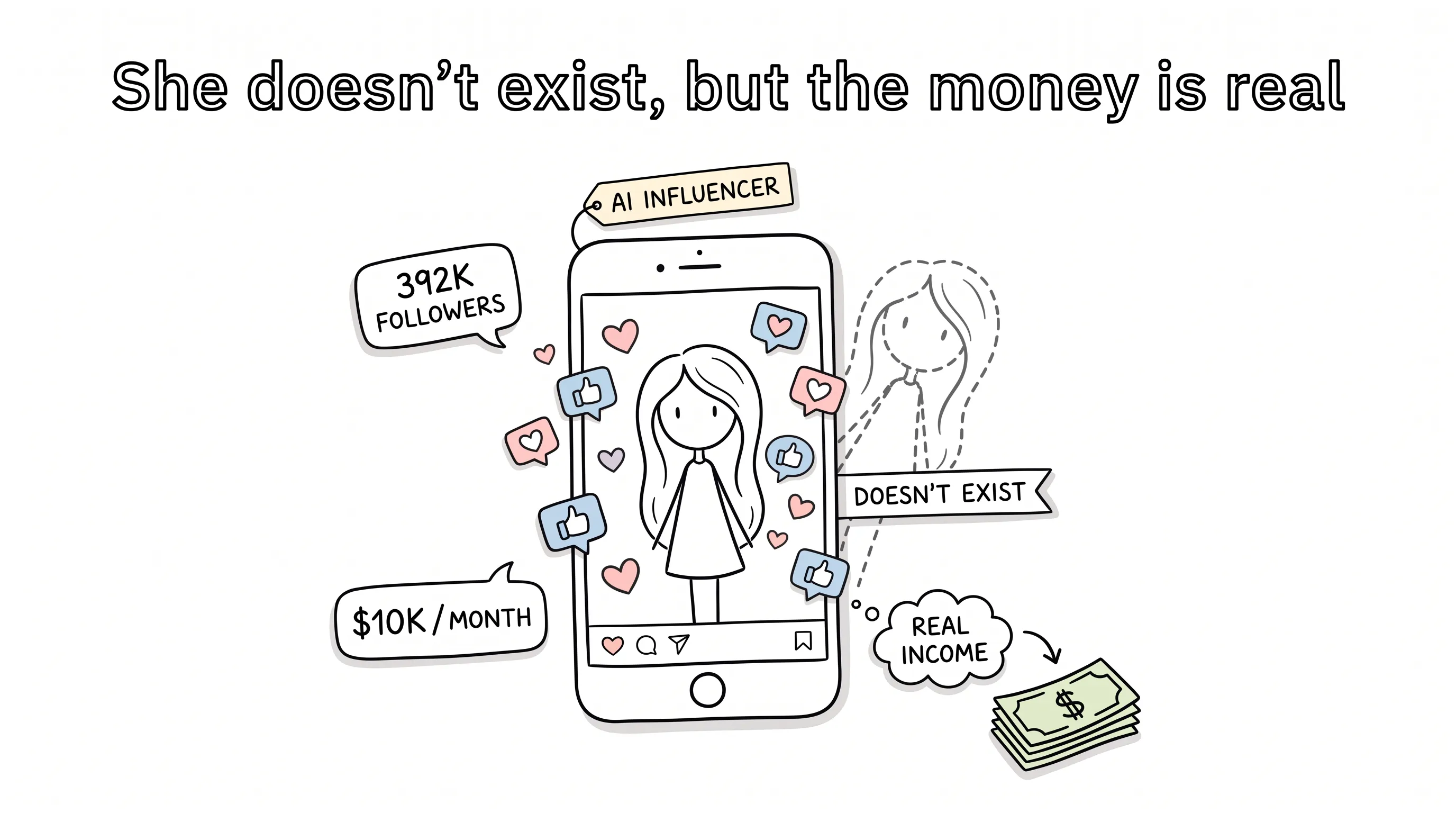
The other night I was scrolling on my phone and came across a set of photos from Coachella.
Pink hair, a bohemian maxi dress, a tan only California sunshine can deliver, holding a custom cup sleeve for the Hailey Bieber and Kendall Jenner tequila collab. The comments were a wall of "Stunning" and "She looks incredible."
The girl's name is Aitana Lopez. She has 392,000 followers on Instagram and, according to the company behind her, earns up to $10,000 a month.
My first reaction was: wow, brand deals are that easy to land now?
Then I saw the most damning line in her bio: she was created with AI by a Barcelona company called The Clueless. Her own bio says it out loud, too — she's a "digital soul."
A person who doesn't exist makes ten thousand dollars a month by posting photos.
That's what I want to talk about today: AI influencers. How big has this business gotten? Should human influencers actually be worried? Let's start from the beginning.
What Exactly Is an AI Influencer?
An AI influencer is an account built around an AI-generated persona and run exactly like a human creator's account.
Outfit-of-the-day videos, gym pics, iced Americanos, Dior eye patches — nothing missing. When it crosses your feed, you probably don't think twice.
Take the AI sisters Mia and Ana Zelu, made by an agency called Zelu House. The two of them post "travel photos" every day, popping up in the stands at sporting events.
Or Granny Spills, a "little old lady" pink from head to toe, whose bio says she's "been spilling tea and flashing big-brand receipts since 1950." Two million followers. At Coachella, she even "took photos" with the Kardashians and the Biebers.
That's right — the celebrities' faces were AI-generated too.
Even wilder: an actor with 5 million followers once sent her a DM asking to meet up in person. That's straight from Aitana's own designer.
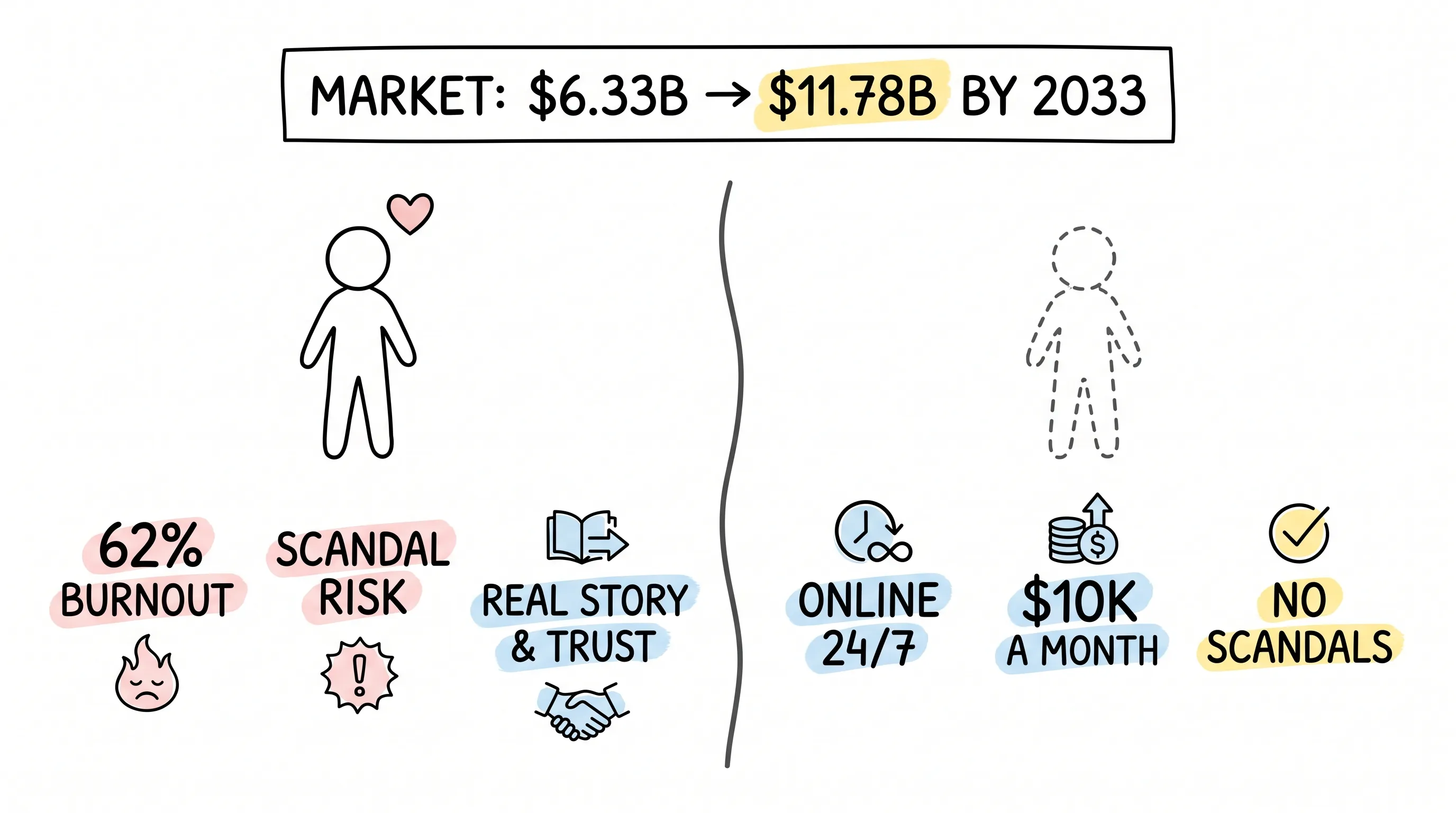
How big is this business? In 2024, the virtual influencer market was valued at $6.33 billion, and some forecasts put it at $11.78 billion by 2033. There are thousands of these accounts across Instagram and TikTok.
And users aren't put off.
Sprout Social ran a survey: half of UK consumers are fine with brands using AI influencers alongside human ones; 41% would follow an AI influencer directly.
Think about it: in a feed where everyone runs their beauty filter at max level, a completely fictional persona barely counts as the fakest thing on screen.
The industry even has its own award show now. The first "AI Personality of the Year Awards" — the organizers call themselves "the Oscars of AI influencing" — has drawn more than 2,000 virtual persona entries, with a total prize pool of $90,000. Aitana is the official ambassador.
And the contestants aren't all outfit-template clones. There's RoRo Castillos, a Mexican LGBT+ reggaeton musician. And Alex Laine, an Arsenal fan created jointly by The Clueless and another company, Pixel, with a "born-and-raised North London" persona who posts "live match" shots, Pilates classes, and coffee — currently under 1,700 followers, still struggling in the lower leagues.
But here's the question: why should a persona generated from a line of text get to collect awards?
To answer that, you have to go back to where it all began.
This Business Was Invented
The first virtual influencers showed up about ten years ago.
The most famous was Lil Miquela, created by a Los Angeles company called Brud. Blunt bangs, a bun, freckles; persona: California model. Note that she was drawn with CGI back then — AI had nothing to do with it yet.
Her team figured out one thing: instead of paying to "rent" an influencer, why not "build" your own, with full creative control? Maddie Travers, creator partnerships lead at digital agency Deviation, calls it a pivotal moment, when "influencer marketing began exploring the boundaries of 'authenticity.'"
The fashion world embraced her immediately. Prada gave her an Instagram takeover during Milan Fashion Week; Calvin Klein shot an ad of her kissing real supermodel Bella Hadid, was criticized for exploiting a same-sex kiss for buzz, and later apologized.
But the real train wreck came in 2025. She posted that she'd been "diagnosed with leukemia," in partnership with NMDP, the US bone marrow donor registry. Real patients and their families were furious: how could a virtual character cash in on our illness?
That's where this business paid its first tuition. A virtual person has no real life, but the mess she makes is very real.
Why Did It Suddenly Explode?
One word: technology.
Jago Sherman, head of strategy for North America and EMEA at Goat Agency, puts it bluntly: the barrier to creating a "synthetic influencer" is now absurdly low. Type one line of prompt and you get passable images and video. No coding required. No design skills required.
A human creator might grind for hours to polish a 30-second video. The AI version: seconds.
So this thing quickly grew into a "get rich on the side" playbook. Sherman says part of the fuel behind the wave is the promise of "easy money" — exactly like the dropshipping and online-course gold rushes of years past.
And don't laugh. Plenty of AI influencer accounts are, at their core, storefronts for the course "how to build an AI influencer."
Take virtual influencer Athena's Coachella post. The caption reads: "No flight to the US. No festival tickets. No agonizing over what to wear. All you need is a vision and a system to bring it to life. Comment AI, and I'll send you the details."
Sound familiar?
Tom Sneddon, head of social at Serviceplan Group UK, offers a more concrete estimate: even a small, automated AI influencer account can pull four figures a month (in US dollars) from platform ad-revenue sharing and custom videos.
Let me do the math for you. Small accounts start at $10K a year; a top account like Aitana makes $10K a month — $120K a year. No business trips, no camera time, no exhaustion, no aging, no cancellation scandals.
Feeling tempted? Brands are even more tempted.
Why Brands Are Obsessed with Them
Megan Dooley, brand lead at TAL Agency, nailed it: human influencer marketing is expensive and hard to control. You never know when your partner might blow up. "In today's risk-sensitive social media environment, AI influencers don't easily fall into scandals and controversy — that's a huge advantage."
Of course, "unlikely to blow up" is not "can't blow up" — Lil Miquela's leukemia post is the counterexample. But overall, virtual humans are a lot cleaner.
Aitana's creator Rubén Cruz has talked about the original motivation: The Clueless built her because too many projects had been dragged down by human influencers. "The problem usually lies with the influencer or the model herself, not with the creative."
Beyond control, there's efficiency. An AI persona is online 24/7, replying to fans without ever getting tired or annoyed; generate once, distribute globally — no logistics, no time zones, no expense reports.
From a pure operations standpoint, the efficiency is scary.
Then the chain reaction hit: real humans waded in too.
In 2025, top TikTok influencer Khaby Lame (160 million followers) signed a $975 million deal with Hong Kong's Rich Sparkle Holdings, licensing them to build his AI virtual twin. Another TikTok influencer, Whoa Vicky, launched her own AI avatar as well. Her agent Jonnie Forster says: "Every creator will eventually have their own digital version — voice, video, AI clone."
Are they crazy? Probably not. A survey of more than 500 North American creators found that 62% reported burnout. Handing the repetitive grind to your digital double sounds like self-rescue.
But here's the question: when your persona is built on "genuine connection," how much "genuine" is left once you've copied yourself?
So, Should Human Influencers Panic?
Sherman's verdict comes in two halves.
Half is an alarm: creators living off "polished aesthetic content" are the most at risk. Because that's exactly the game the Aitanas of the world are playing — and they don't draw a salary.
The other half is the antidote. Most successful influencers, he says, understand that their value comes from genuine connection with their audience — creativity, taste, authenticity, and story. Those are hard for AI to replicate convincingly. No matter how much the virtual ones love calling themselves a "typical Scorpio" or posting matcha.
And some categories leave AI naturally out of its depth. Dooley puts it sharply: any field that runs on credibility — mental health, parenting, fitness, skincare. Would you take serum recommendations from someone who doesn't exist?
I actually ran into one of these myself. I scrolled onto videos from a "digital it-girl" called Olivia Brand, earnestly discussing her Christian faith.
One thought filled my head: why am I watching a robot talk about the soul?
This kind of content is, at best, weird; at worst, digital garbage.
So Dooley predicts that real creators will lean harder into the human part of themselves — flaws included. Sherman agrees that the rise of AI will "force creators to become more distinctive": find the style, the niche, the creative IP that belongs to you alone.
Well said. AI turned standardized content into a commodity — and, in the same stroke, turned real humans into a scarcity.
A Few Final Words
Sherman left one warning that I think deserves a spot in your phone's notes app.
As technology keeps advancing and human-AI interaction deepens, he says, "the boundary between human-AI relationships and human-human relationships will begin to blur. The manipulation risks and mental health consequences this brings are unprecedented. Honestly, it's like a dystopian movie."
For now, human influencers probably don't need to worry about their livelihood.
But in ten years?
I don't have the answer. All I know is that the pink-haired girl from Coachella will look even more real the next time she posts — and the monthly bill will keep arriving right on schedule.
And the next real human who asks to meet her still won't know who they're asking for.
Continue reading
Related articles

Cross-Border Business: Time to Upgrade Your AI Toolbox
A learn article explaining how AI tools help cross-border e-commerce sellers clear five hurdles: language, regulation, logistics, payments, and fraud. It outlines a five-compartment toolbox, a five-step adoption path, and metrics such as conversion rate and CLV, while cautioning against over-reliance on AI.

AI Is Taking Over the Dirty Work of Social Media Marketing, One Task at a Time
This learn article outlines four social media marketing tasks AI can handle — audience analytics, content drafting and design, ad targeting and creative testing, and spam moderation — and cautions that taste, judgment, and data security remain human responsibilities.

AI Is Already This Good — Why Is Your Social Media Marketing Still Pure Manpower?
An overview of 18 AI tools for social media marketing, organized into six categories covering audience research, content creation, scheduling, comment and DM handling, ad management, and visual production, plus notes on personalization, prediction, and emerging trends.