
Selling into the US: Doing the Math on SEM
A practical breakdown of why SEM costs keep climbing in the US market, and how six AI tools — SellerSprite, Writesonic, Semrush, HubSpot, Blend AI, and Topkee — fit different seller situations.
A while back, a friend of mine who does cross-border e-commerce invited me out for coffee.
He sells home storage products, focused on the US market. He started on Amazon, and over the past couple of years has been pushing hard into a standalone website and Google Ads. Revenue is nothing to sneeze at — tens of millions of yuan a year.
He sighed the moment we sat down.
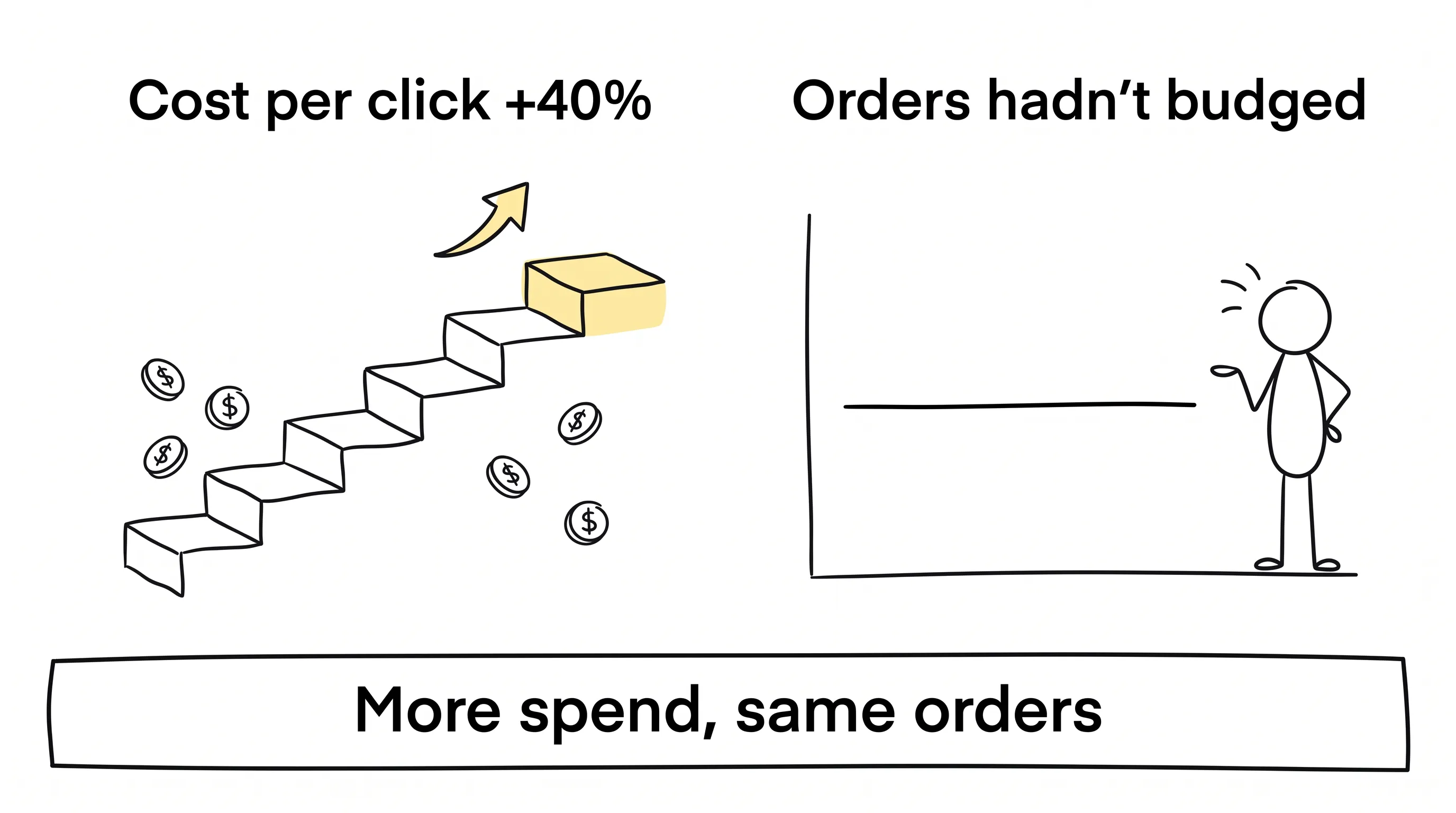
Ad spend had climbed again. Cost per click was up 40 percent from last year — more money out the door, yet orders hadn't budged. His question: was it time to buy an AI tool? His feed was full of pitches every day — AI running your ads, AI writing your copy — and it all blurred together.
I told him: don't open your wallet just yet.
Think one thing through first: what exactly makes SEM in the US market so hard today.
What Is SEM? Paying for Placement
SEM — search engine marketing. Plainly put, you pay for a spot in the search results.
A shopper searches "storage box." Ten results on the page, and the first one is an ad you paid to put there. They click, you pay for that click. It's that simple.
The playbook used to be simple too. Pick keywords, set bids, wait for the orders to roll in. Sharpest keywords and boldest bids won.
And now?
Three headaches have arrived at once.
Clicks got expensive. More and more bidders chase the same keywords, and the auction keeps climbing. That 40 percent my friend grumbled about? That's exactly how it climbed.
Consumers built up immunity. Americans get bombarded with ads all day; whatever you shout, they don't quite believe it. They want reviews, price comparisons, and their own round of searching before they feel safe buying.
And the rules keep tightening. State privacy laws in the US get stricter every year; freely tracking users or recklessly stitching together profiles gets riskier by the day.
Stack these three together and one conclusion stands out: the era of buying keywords and coasting is over.
Today's SEM is a contest of using AI, across a pile of platforms, to fish out the people who actually want to buy — precisely.
Which raises the question: there's a fistful of AI tools out there — where do you even start?
Six Contenders, One by One
Of the names worth knowing on the market, I counted for him: five single-point tools, plus one integrated offering. One at a time.
SellerSprite: Bank the On-Amazon Money First
If your main battlefield is Amazon, SellerSprite may already be an old friend.
Its data lives inside the transaction. For the same keyword, it sorts out which are browsing keywords — people just wandering — and which are purchase keywords — people ready to check out. Put your budget on the purchase keywords and ACOS becomes controllable. What is ACOS? Advertising Cost of Sale — ad spend as a share of ad-driven sales. If you can't control that number, you're just working for the platform.
Then there's ASIN reverse lookup (ASIN is Amazon's product ID). For any competitor's product page, it lays bare the organic traffic keywords and the paid traffic keywords. Want to enter a small category? First study how the incumbents fight.
Oh, and it has a pretty capable free tier — which is friendly to anyone just starting out.
The shortcoming? It's locked to Amazon. It can't help you with your Google Ads. And features iterate fast — you have to keep learning.
In one line: for on-platform SEM on Amazon US, it gives the deepest data.
Writesonic: The One Testing Fifty Copy Variants a Day
Beyond Amazon, say you want to take on Google. What's step one?
You need creative. Ad copy and landing pages — somebody has to write them.
Writesonic does exactly this. In seconds, dozens of Google Ads copy variants. Test three today, five tomorrow, and you quickly learn which messaging clicks with consumers in which part of the US.
It also has a "Brand Voice" feature. Set it once, and hundreds of ads all come out sounding like the same brand. This matters more than it looks — funny today, aloof tomorrow, and users will think your brand has a split personality. Who'd dare buy from you?
Two pitfalls. First, it understands complex, specialized domains only shallowly; write B2B or technically dense material and it tends to float on the surface. Second, it can't carry a full strategy — how to pick keywords, how to split budgets, it doesn't handle; you'll need a partner for that.
Who's it for? Small and mid-size sellers who want to test creative fast and develop a feel for the language. Cheap, flexible, quick to iterate.
Semrush: The One Watching Your Rivals for You
Creative alone isn't enough.
You need to know what your rivals are up to. What is competitive intelligence? Knowing which keywords they're bidding on, what copy they're writing, and roughly how much they're spending.
Semrush does precisely this. It grew from an SEO tool into an AI-driven marketing intelligence system. Rivals' ad playbooks in the US market are one lookup away. There's also an AI assistant called Copilot embedded in the workflow, feeding you suggestions in real time.
It can also directly manage Google Ads and Microsoft Advertising campaigns, with the AI suggesting bids and budget splits based on historical data.
Powerful, genuinely powerful. But the catches are real too.
Price. The Pro plan runs a hundred-plus dollars a month, over a thousand a year — roughly eight to nine thousand yuan. For a small seller, that's no light fixed cost.
Hard to learn. The feature list is dizzying for newcomers; it takes time to chew through.
And the most fatal one: it's the strategist, not the army. However sharp the analysis, you still place the ads yourself and build the pages yourself. Between strategy and execution lies a river.
Mid-to-large sellers with professional teams who intend to fight the intelligence war — get on board.
HubSpot Content Hub: The One Who Remembers Every Visitor
Your ad brought people in. Then what?
Visitors click through, look around, and leave nothing behind — the most common waste there is. HubSpot's play is to make sure every click gets remembered.
It kneads content creation, SEO, multichannel distribution, and data analysis into one platform, wired into CRM. A visitor clicks your ad; what they viewed, what information they left — it lands in the CRM in real time. Every customer you accumulate in the US market has a long-term value you can calculate to the cent.
It can also show different pages to different visitors based on CRM data. Americans lap this up — they expect "special treatment."
The catch? It's an ecosystem. To unlock its full power, you'll want its Marketing Hub and Sales Hub layered on top, a few hundred dollars a month and climbing. Managing paid click ads, of all things, is its weak spot. Setup and maintenance take effort; small teams without technical staff will strain.
It serves growth-stage companies already on HubSpot CRM that want to build long-term content assets in the US market. The ecosystem is pricey, sure — but the customer assets you pile up are real.
Blend AI: The One Monitoring Your Campaigns for You
Single-point tools all bought. New headache: who runs them?
Bids need adjusting, audiences need mining, creative needs rotating — Meta, Google, YouTube, TikTok, four or five platforms running at once. Where does a small team find the hands for all that?
Blend AI exists to solve exactly this. An Australian adtech company that entered the US market just this year, with an office in Austin, Texas. It hands cross-platform ad management to AI on autopilot: how to shift budget, how to mine audiences, how to combine creative — the machine decides.
An American brand called Lalabu cut its customer acquisition cost (CAC) by a solid margin after adopting it. In a place as click-expensive as the US, a notch off CAC is real money.
Its AI models are trained on American users' behavioral data, so they read how local buyers make decisions that much better.
The catch? The brand is still young and still building its name. You have to be willing to hand your ads to a machine — if you're used to manual bid adjustments, that's a mental hurdle to clear first. Pricing isn't public, and it's most likely tied to ad spend, so sellers with swinging budgets will see costs swing along.
For small and mid-size e-commerce sellers with budget and growth but not enough marketing hands — worth a look.
Topkee: The One Who Wants It All — Come Right In
This last one is nothing like the other five.
The previous five are all single-point tools. Topkee is a full set — a marketing technology ecosystem built for the Asia-Pacific and North American markets: website building, customer data, conversational marketing, social media content, and lead management, all kneaded together.
Let's take it apart.
WEBER, for building landing pages fast. Click through from an ad and the page matches the ad — no dropped ball at this link of the funnel.
YME, conversational marketing. Human agents plus AI bots catch American consumers' questions 24/7. When a user clicks your ad, they're passively looking at you; once they enter a conversation, they're actively seeking you out. Those are two different things. The AI can also auto-detect intent and capture contact details — and just like that, a click becomes a lead.
TTO CDP, pooling data from your website, chats, and forms to draw a 360-degree profile of every customer. Once the profile is clear, the bots can personalize service, and social media content knows what to say to hit the right note.
YIS, managing social media content. Facebook, Instagram, YouTube in one dashboard, with AI generating content and scheduling posts. A post performing well organically converts into a paid ad with one click.
Leadbox, managing leads. Leads from multiple channels flow in through one stop, automatically cleaned, scored, and followed up — one pipeline pulled all the way to the deal.
The catch? Topkee's name recognition in the US market still needs time to grow. Also, teams used to "picking the best tool for every job" will need a mindset shift to accept one closed loop.
Pricing follows modules and usage, so everyone from small teams to large enterprises can find a fit.
Mid-to-large sellers with ample budget, a full team, and the ambition to carry strategy all the way to closed deals — this suite deserves a serious look.
Pick by Where You Stand
Six contenders covered. How to choose?
Don't ask "which one is best."
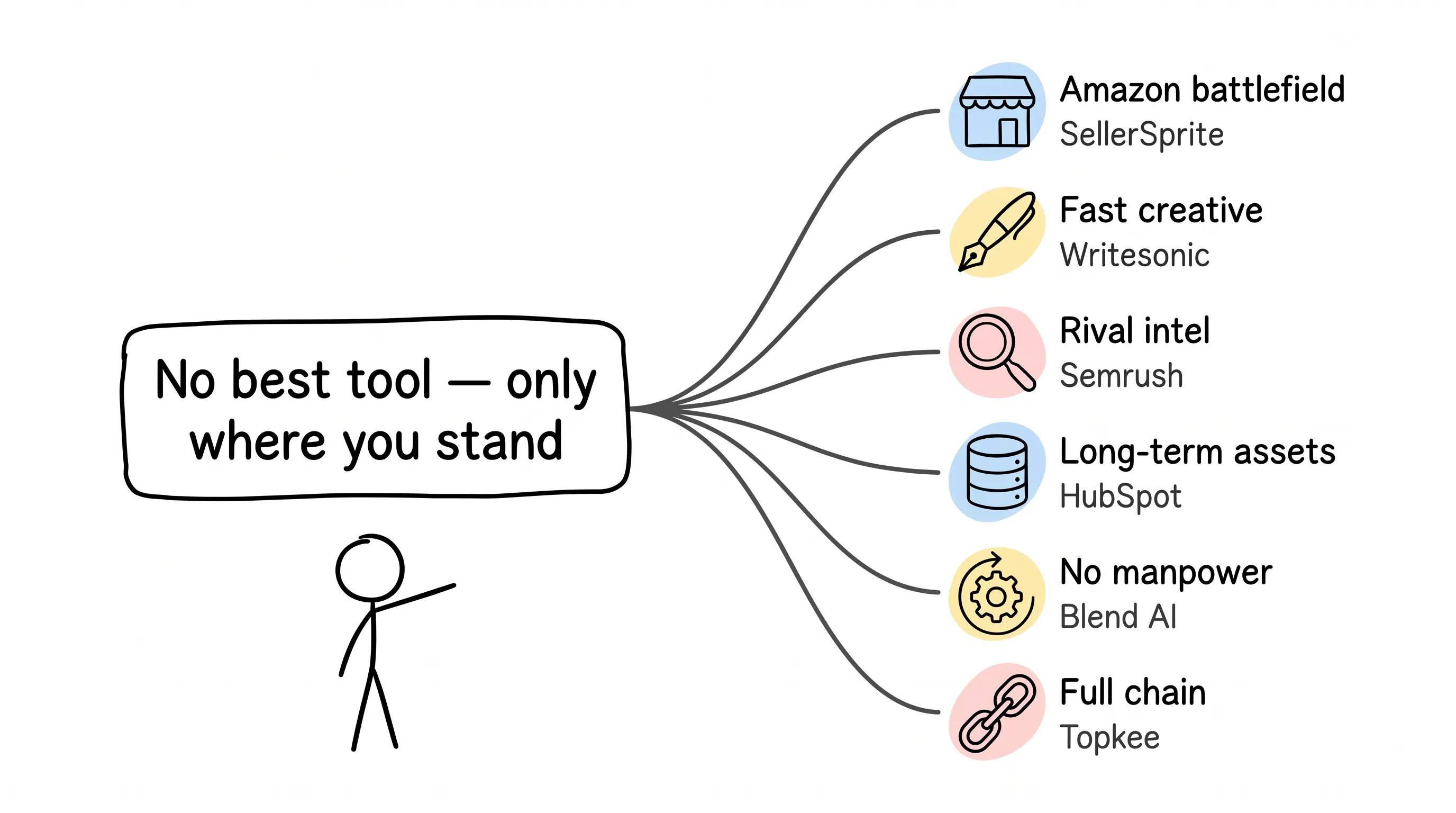
There's no such thing as the best tool — only which step you're standing on.
Main battlefield on Amazon: squeeze every drop out of SellerSprite first and bank the on-platform money solidly. Want to test creative fast: get Writesonic running first. Fighting an intelligence war: pair Semrush with a professional team. Building long-term customer assets: look at HubSpot's stack. Money but no manpower: let automation like Blend AI monitor your campaigns for you. Ample budget and wanting the whole chain from traffic to deal pulled through: look at integrated offerings like Topkee.
One more honest note.
The last vendor happens to be in this very business. When it says the all-in-one suite is great — listen, but stay clear-eyed. Single-point tools have their own virtues, and plenty of people throw the combination punches well. I'll leave that thought right there for you.
How That Coffee Ended
At the end of that coffee, here's what I told my friend:
What you're missing isn't tools. Tools are everywhere — expensive and cheap, single-point and all-in-one.
What you're missing is clarity on three things. Where is your main battlefield? How many people are on your team? How long can your cash burn?
Once those three are clear, which vendor to pick is obvious at a glance.
Tools are cold. Business is warm. However clever AI gets, it only helps the things you've already thought through run faster and truer.
If any step isn't thought through yet, don't buy the tool.
May every one of your clicks turn into a real business.
Continue reading
Related articles

Cross-Border Business: Time to Upgrade Your AI Toolbox
A learn article explaining how AI tools help cross-border e-commerce sellers clear five hurdles: language, regulation, logistics, payments, and fraud. It outlines a five-compartment toolbox, a five-step adoption path, and metrics such as conversion rate and CLV, while cautioning against over-reliance on AI.

AI Is Taking Over the Dirty Work of Social Media Marketing, One Task at a Time
This learn article outlines four social media marketing tasks AI can handle — audience analytics, content drafting and design, ad targeting and creative testing, and spam moderation — and cautions that taste, judgment, and data security remain human responsibilities.

AI Is Already This Good — Why Is Your Social Media Marketing Still Pure Manpower?
An overview of 18 AI tools for social media marketing, organized into six categories covering audience research, content creation, scheduling, comment and DM handling, ad management, and visual production, plus notes on personalization, prediction, and emerging trends.