
Same Coupons — So Why Do Some Brands Make an Extra $100 Million?
A case-study article on personalized marketing: a US fast-food chain used ZS's Personalize.AI to replace blanket coupon blasts with per-customer journeys and continuous multivariate testing, reporting over $4 return per $1 spent and over $100 million in cumulative incremental revenue.
The other day, while cleaning up my phone, I counted the coupons sitting idle in my apps: 27 in total.
Burger coupons, coffee coupons, fried chicken coupons. Not a single one used.
Here's the interesting part: there's one brand whose coupons I've used almost every single time. It pushes me a $5 breakfast combo that lands exactly on that every-morning "what should I eat?" dilemma.
Same mechanic — why do some coupons go out as scrap paper while others turn into real money?
I recently dug into a case study that finally answered that question for me.
First, a Story
There's a fast-food chain in the US with locations all over the country.
Its annual marketing budget tops $50 million, spread across more than 100 campaigns a year.
Sounds impressive, right?
The results were anything but. The money went out; the customers stayed away. Coupons sent, no takers. Campaigns launched, no splash.
So where was the problem?
The post-mortem came down to a single phrase: carpet-bombing.
Every customer got the same set of offers. A newcomer who walked in last week and a regular who hadn't shown up in three years received word-for-word identical texts. Burger lovers and salad-only buyers saw the same poster.
It's like a clothing store that hands every person who walks in — man, woman, young, old — the same XL T-shirt. Hand them out all day, and nobody's going to thank you.
And just like that, $50 million went down the drain, year after year.
What Is Personalized Marketing?
Later, the brand partnered with the consulting firm ZS and used their AI platform, Personalize.AI, to rebuild its marketing from the ground up.
So what is personalized marketing?
Put simply: stop asking "what does this group like" and start asking "what does this one person need, right now?" That's personalized marketing.
The old playbook sliced customers into a few big groups: young people in one, office workers in another, parents with kids in a third — each group with its own set of coupons.
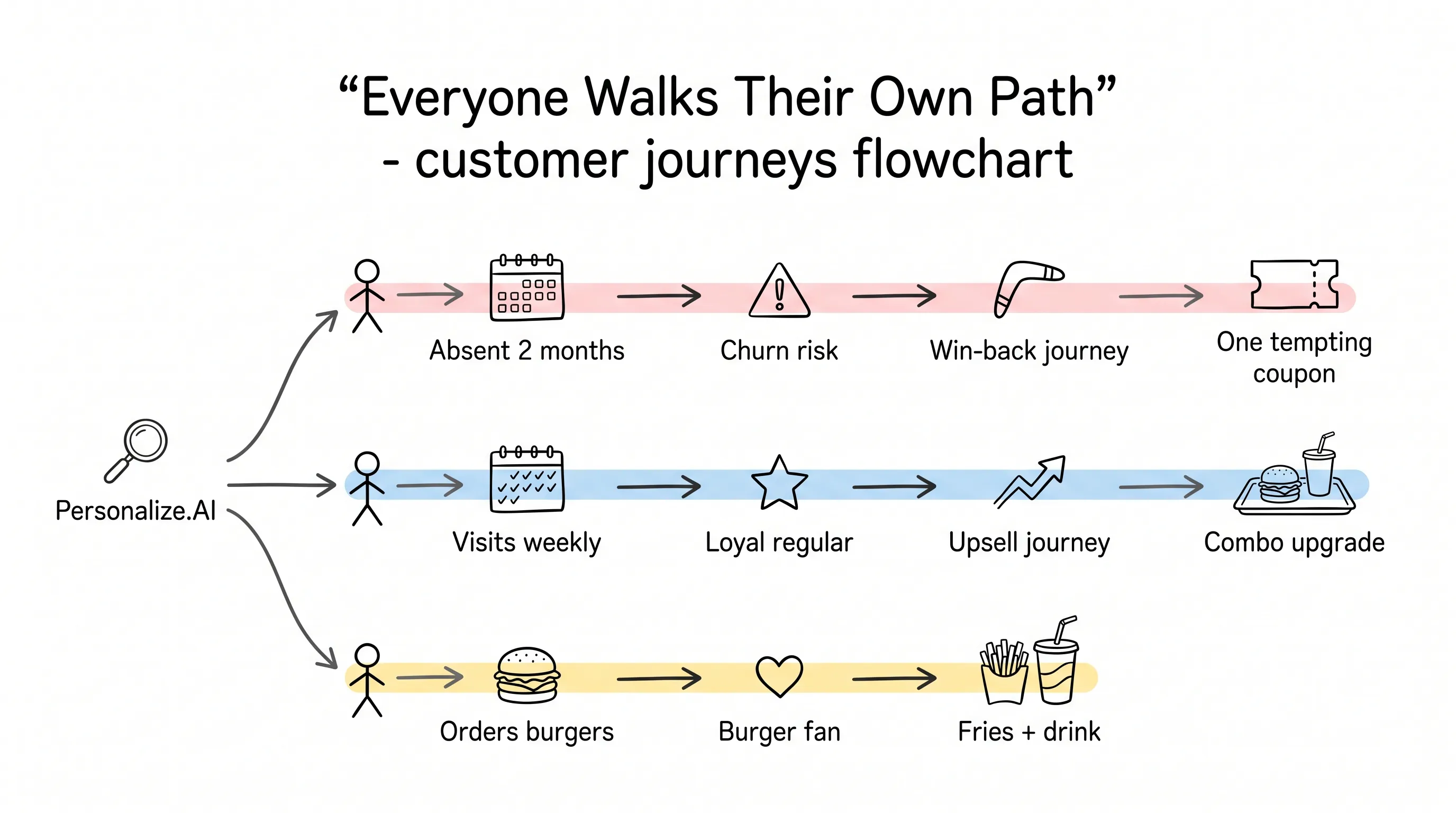
Personalize.AI goes much further. It watches every single person and, based on purchase history and real-time behavior, places each customer into a dedicated "journey."
What's a journey?
A customer hasn't shown up in two months. The system flags the churn risk, automatically drops them into a "win-back" journey, and pushes the one coupon most likely to tempt them back.
A customer comes in every week. The system moves them into an "upsell" journey — pushing new items and combo upgrades to nudge each order a little higher.
A customer orders a burger every single time. The system tries suggesting fries and a drink.
Everyone walks their own path.
The Real Value Is Testing, Relentlessly
At this point you might say: isn't this just one-to-one personalization? Plenty of platforms claim they can do it.
Hold on — the most valuable part of this case is still coming.
Think about it: sending out a single coupon actually leaves a pile of questions unanswered. Spend-more-save-more or a straight discount? Warm, enthusiastic copy or something restrained? Push burgers or chicken nuggets? Red poster or yellow? Price it at $8 or $9.99?
Any one of these variables decides whether the coupon gets tapped open or swiped away.
So what do you do? Gut call it? Fight it out in a meeting?
Personalize.AI's answer: put them all in play and test them at the same time.
Coupon type, tone of copy, product featured, creative design, price point — five knobs, all turned at once. Watch the data in real time, shift the budget toward whichever version is winning, then run the next round.
Honestly, this is what turns marketing from a game of experience into a game of experiments.
Instead of the marketing department making the final call, the data does the talking. And the verdicts refresh daily — today's optimal answer might be obsolete tomorrow.
Let's Run the Numbers
After the rebuild, the report card looked like this.
Every $1 of marketing spend brought back more than $4 in revenue.
Net revenue per personalized customer rose 70%.
Overall revenue climbed more than 6%.
The system has kept running ever since, and the cumulative incremental revenue it has brought now exceeds $100 million.
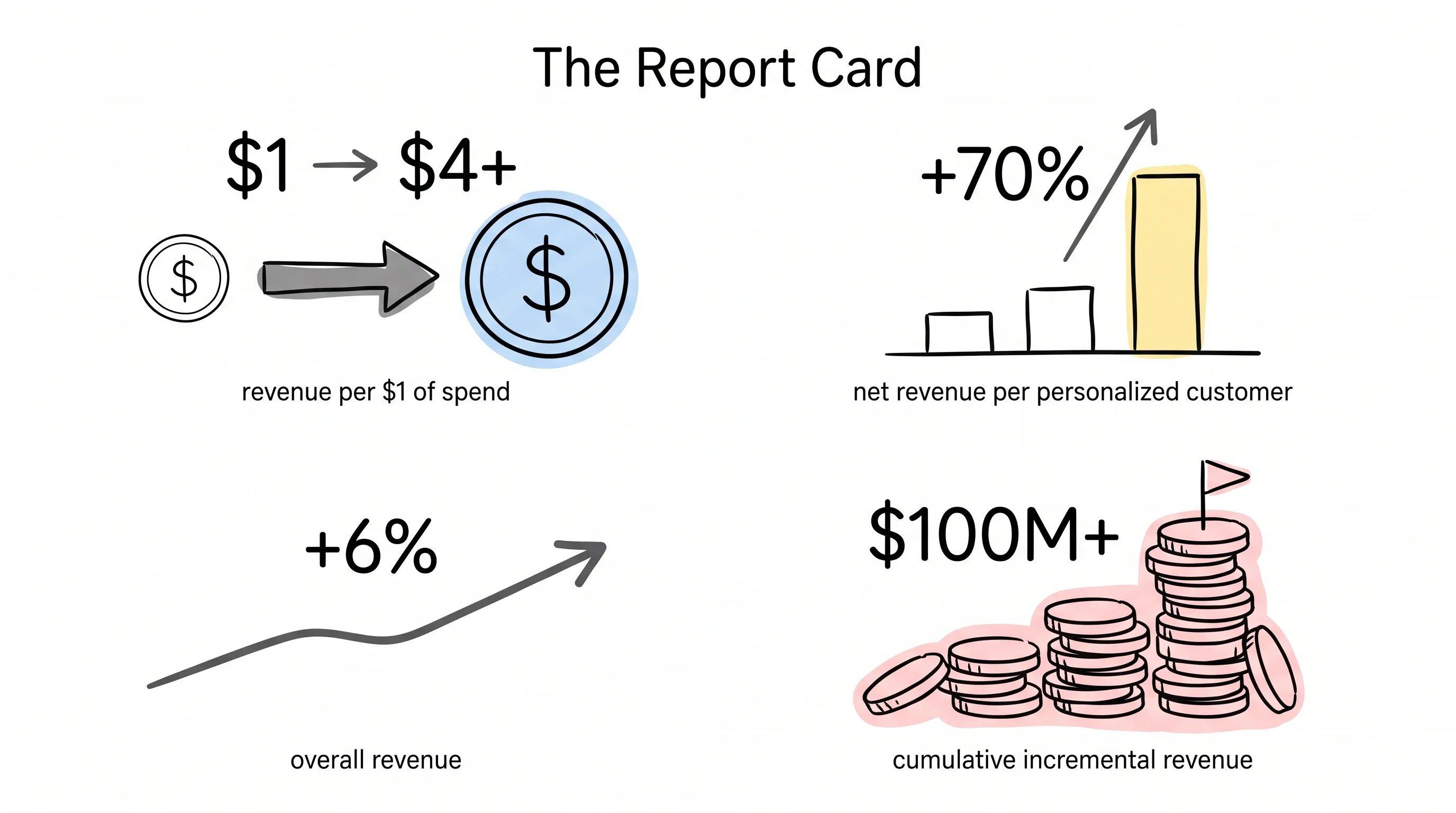
That $100 million was stacked up one "right coupon" at a time.
And there are changes you can't see, too: customers who once shrugged the brand off started coming back, again and again.
Loyalty is nothing more than a customer feeling understood.
The Lesson Behind It
I've turned this case over in my head for a long time, and it really comes down to one sentence:
Customers don't care about your campaign. They only care about themselves.
Your anniversary sale, your product launch, the viral poster you pulled an all-nighter to make — none of it matters to them. They care about exactly one thing: right here, right now, does this have anything to do with me?
No connection? They swipe away. A connection? They pay up.
So the marketing arms race is over. From here on, the contest is who understands every single customer better.
Finally, back to those 27 coupons from the beginning.
The reason they're still sitting unused in my phone is simple: the people who sent them never once thought about who I am.
Here's hoping the next coupon you receive is exactly the one you wanted.
Continue reading
Related articles

Cross-Border Business: Time to Upgrade Your AI Toolbox
A learn article explaining how AI tools help cross-border e-commerce sellers clear five hurdles: language, regulation, logistics, payments, and fraud. It outlines a five-compartment toolbox, a five-step adoption path, and metrics such as conversion rate and CLV, while cautioning against over-reliance on AI.

AI Is Taking Over the Dirty Work of Social Media Marketing, One Task at a Time
This learn article outlines four social media marketing tasks AI can handle — audience analytics, content drafting and design, ad targeting and creative testing, and spam moderation — and cautions that taste, judgment, and data security remain human responsibilities.

AI Is Already This Good — Why Is Your Social Media Marketing Still Pure Manpower?
An overview of 18 AI tools for social media marketing, organized into six categories covering audience research, content creation, scheduling, comment and DM handling, ad management, and visual production, plus notes on personalization, prediction, and emerging trends.