
Running TikTok Ads: Should You Hand the Steering Wheel to the Machine? — On Smart+ and "Controllable Automation"
Explains TikTok Smart+ ad automation: module-level control over targeting, budget, placements, and catalog ads, plus playbooks for e-commerce, app promotion, and lead gen. Covers Symphony Automation generative AI creatives and a 2025 TikTok test citing 29% CPA improvement for smart catalog ads.
A while back, I had dinner with a friend who runs paid campaigns for an e-commerce business.
His daily routine goes like this: wake up, grab the phone, open the ads dashboard and check last night's numbers. Ad group stalling? Shut it down. Group running hot? Add budget. Audience needs a refresh? Swap it. Creative gone cold? Ship a replacement.
Adjusting one by one, watching one by one.
I asked him: exhausting?
He said: exhausting. But I don't dare let go.
Why?
His exact words: it's my money. What if the machine burns through it at 3 a.m.?
I'd guess every media buyer has wrestled with this. Go manual, and you're genuinely worn out — monitoring around the clock, eyes bloodshot. Go automatic, and you're nervous, always feeling like you've lost control.
TikTok has offered its own answer to this dilemma. It's called Smart+.
What Is Smart+?
Smart+ is TikTok's automation product for advertisers. It doesn't build a new dashboard from scratch — it lives inside the campaign flow you already use. As you set up an ad, it's right there, taking the repetitive work off your plate.
Sounds like handing over the steering wheel, doesn't it?
Not so fast. I prefer a driving analogy.
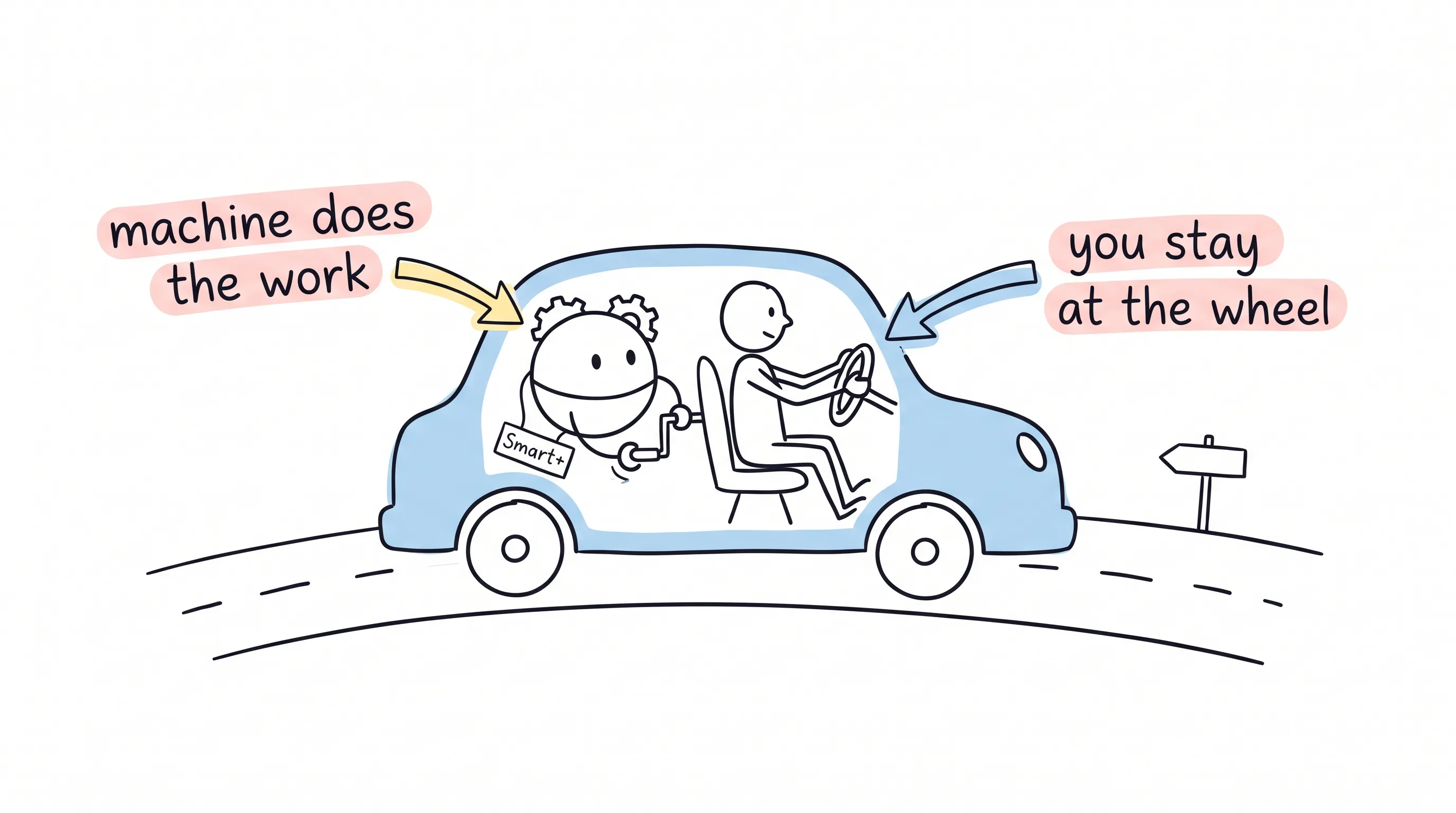
With today's driver assistance, a car can follow the vehicle ahead, stay in its lane, and brake on its own. But would you fully release the wheel? No. Your hand stays on it, eyes on the road. The machine saves you the effort; you remain the backstop.
Smart+ takes exactly this route: the machine does the work, and the steering wheel stays in your hands.
First, Run the Numbers
Some will ask: I get the logic, but how much is automation actually worth?
TikTok ran an internal closed test with advertisers worldwide, comparing smart catalog ads against manual campaigns. The result: cost per acquisition — CPA — improved by 29%.
Note: this was a 2025 test.
What does 29% mean? Let's run the numbers on a 100-yuan acquisition cost. You used to pay 100 yuan to win one order; now you pay 71. With the same 10,000-yuan budget, that's 100 orders before, roughly 140 now.
Same money, roughly forty percent more orders — and that surplus is the machine saving it for you.
And it's not just money you save. Adjusting budgets, swapping creatives, watching placements — all of that costs attention.
Attention is a media buyer's most expensive resource.
"Control" Is the Real Key
Where to begin? With that phrase: "I don't dare let go."
How does Smart+ solve the fear of letting go? One word: control.
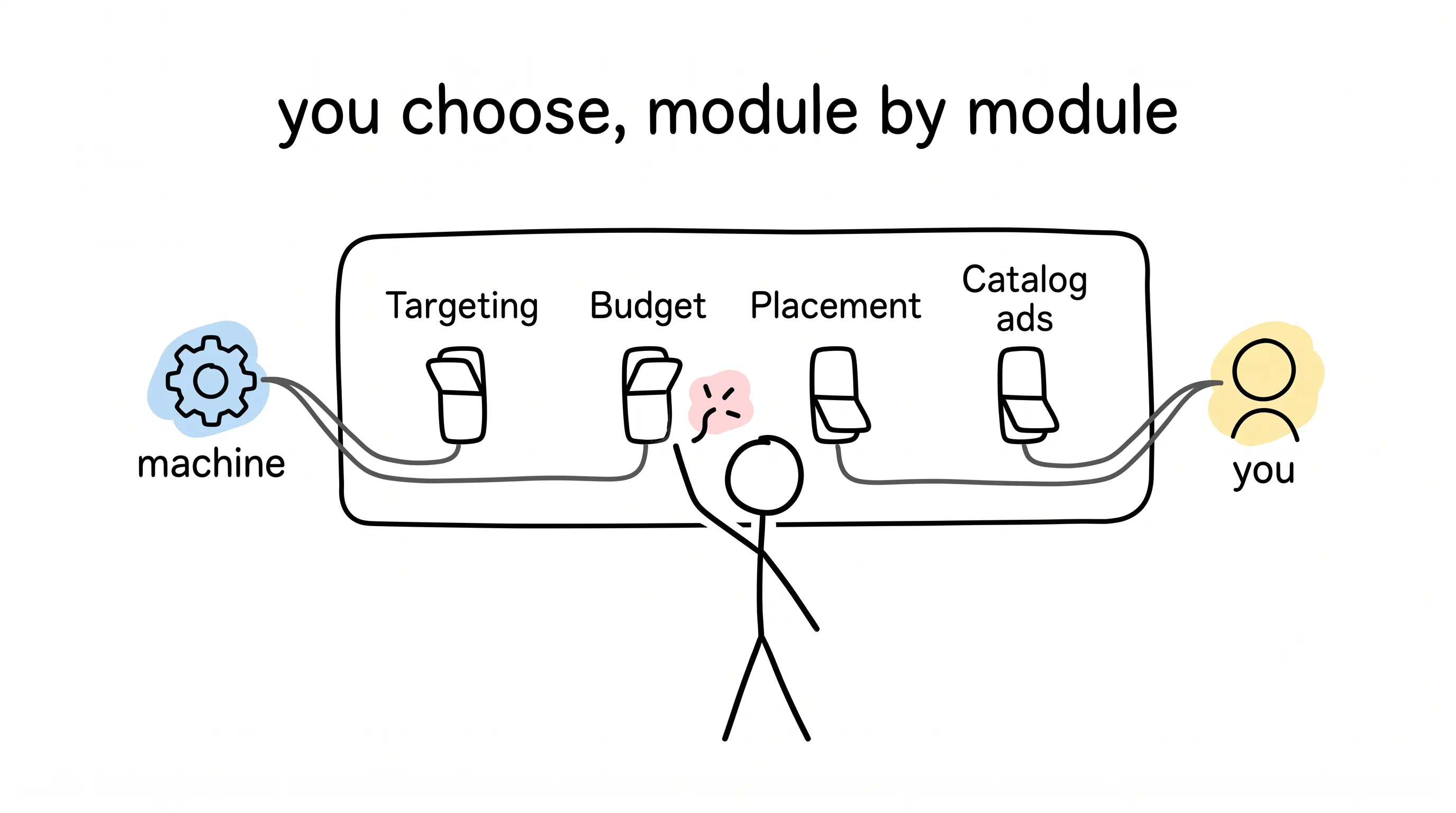
What does control mean? The automation isn't one master switch in your hands. It's a row of small switches — one per module.
Targeting, budget, placement, catalog ads. Running ads really comes down to these few things. Smart+ turned each one into an independent module. Whatever you want the system to handle, switch on. Whatever you want to manage yourself, switch off. You can hand budget optimization to the system and keep targeting for yourself. Or the reverse.
Take placements. Many advertisers worry: will my ad end up in some odd corner of the internet? Now you can check boxes manually — keep your ads on TikTok only, or widen the net to app networks like Pangle, Lemon8, and Global App Bundle, up to you (as long as that inventory is open). Choose automatic placements, and the system shifts budget to wherever creatives perform best.
Or take music. One of the most annoying chores in campaign ops: the track in your creative can't be used because of licensing, and the ad stalls. Now, in app promotion, the system spots the problem, alerts you, and picks a usable track straight from the Commercial Music Library.
That kind of fine-grained work used to depend entirely on a human keeping watch.
One more change: Smart+ used to be limited to lower-funnel objectives. It now extends to traffic objectives. Even "getting people in the door," a more upper-funnel job, lets you decide which steps go to the machine and which stay yours.
Three Businesses, Three Playbooks
How do these modules play out in real businesses? Let's take three.
First, selling goods.
The core weapon is catalog ads. Feed your store's product catalog to the system and it recommends products automatically, per person. Different shoppers see different goods. E-commerce, travel, hotels, flights — any business with a catalog can use this.
Where do the creatives come from? Three sources: one, it picks out your historically best-performing creatives. Two, it mixes in trending content from the platform. Three, it generates new creatives with AI. Three streams converge, and the creative well never runs dry. This capability used to be called Creator+; it's now Creative Upgrades. It can even crawl compliant images and videos off your landing page to use as creatives, sparing you the manual uploads.
Is budget spend transparent? You can connect Google Analytics and reconcile across platforms.
Brands are already walking this path: Ray-Ban used catalog ads to lift efficiency and sales in the US market; fashion brand Motel Rocks used them to push CPA down; dating app Taimi used app promotion to cut its iOS acquisition costs.
Second, promoting an app.
Bidding is the core. Early on, when you need volume, bid for installs. Later, when you need quality, watch ROAS. The knobs are ready in the system: Target ROAS, Cost Cap — turn whichever matches your goal.
Hand creatives to Auto Selection: creator content, brand assets, and AI-generated content feed in continuously, and you choose the degree of automation.
The most comfortable part is iOS conversion data, returning nearly in real time. Waiting on iOS data used to feel like waiting for a letter. Now it's like watching a stock ticker.
Third, collecting leads.
Instant Forms, web forms, DMs, call ads — many routes in, and the auto industry even has its own dedicated format.
In the lead business, the hard part is quality. So you run deeper-funnel optimization, pulling high-quality conversions up from deeper in the funnel. On spend, Cost Cap pins costs near your target line.
More Creatives Than Hands to Go Around
You may have noticed I keep saying the word "creatives."
Why? Look at these numbers: one campaign can hold up to 30 ad groups. Each ad group, 30 creative groups. Each creative group, 50 creatives.
30 × 30 × 50. Think about it — a combination space that big, tested by hand? How long would that take?
So the platform moved campaigns, product catalogs, and creative assets into one panel, called Asset Manager. With "product" as the key linking everything, you see at a glance what pairs with what.
Reporting evolved too. You can now slice performance by creative, copy, and enhancement — three dimensions — to find which combination hits hardest. There's also a feature called Summary that lets AI read your reports, translate complex data into plain language, and hand you next-step recommendations.
People used to chew through data. Now AI chews first and passes you the conclusions.
Generative AI Enters the Frame
Speaking of AI, Smart+ has a layer built in called Symphony Automation. TikTok plugged its own generative AI arsenal directly into the campaign flow.
It does two things.
First, recommend creatives. From your asset library, it picks the ones most likely to land. It can even generate a vertical short video from a single product link. There's also Auto-add, which swaps in better-performing creatives automatically while the campaign runs — refreshing the lineup mid-flight.
Second, one-click enhancement. Upscale the quality, crop to vertical, swap the music, rework the opening hook — even translate and dub into over 50 languages.
Over 50 languages. Let that sink in.
One creative, and overnight it becomes versions in 50 languages. Not long ago, that was months of work for a localization team.
Of course, the rule stands: before AI acts, the creative control settings are in your hands. What gets generated, and whether it goes live — you decide.
The Machine Runs Execution; Humans Set Direction
Which brings us back to the opening question: should you hand the steering wheel to the machine?
Here's how I'd answer my friend:
What you hand over is repetitive labor: adjusting budgets, swapping placements, filtering creatives, watching data. The machine does all of it faster than you, and it never stays up late.
What you cannot hand over is direction: understanding your users, judging what makes a good creative, deciding where the business goes. No machine can do these for you.
The end state of automation isn't nobody at the wheel — it's humans doing nothing but choosing.
A few days ago I ran into him again. He said he'd gone through the dashboard, saw that every automation switch can be turned off individually, and felt a lot more at ease. He's already turned on two modules to test the waters.
Good for him.
May your ads run fast and steady. And may the steering wheel always stay in your own hands.
Continue reading
Related articles

Cross-Border Business: Time to Upgrade Your AI Toolbox
A learn article explaining how AI tools help cross-border e-commerce sellers clear five hurdles: language, regulation, logistics, payments, and fraud. It outlines a five-compartment toolbox, a five-step adoption path, and metrics such as conversion rate and CLV, while cautioning against over-reliance on AI.

AI Is Taking Over the Dirty Work of Social Media Marketing, One Task at a Time
This learn article outlines four social media marketing tasks AI can handle — audience analytics, content drafting and design, ad targeting and creative testing, and spam moderation — and cautions that taste, judgment, and data security remain human responsibilities.

AI Is Already This Good — Why Is Your Social Media Marketing Still Pure Manpower?
An overview of 18 AI tools for social media marketing, organized into six categories covering audience research, content creation, scheduling, comment and DM handling, ad management, and visual production, plus notes on personalization, prediction, and emerging trends.