
Running Ads for Cross-Border E-Commerce: The Hard Part Was Never the Ads
A guide to cross-border e-commerce advertising arguing that success depends on localization, compliance, logistics, and payments rather than ad-buying skill, with pitfalls, metrics, and a step-by-step launch checklist.
A few days ago, a friend who runs a cross-border business invited me out for tea.
His product wasn't bad, and his pricing was competitive. Having found his footing in the domestic market, he wanted to open a second front overseas. He threw a pile of money at ads — plenty of clicks came in, but the orders trickled.
He asked me: is my ad-buying just not good enough?
I told him: probably not.
When it comes to cross-border e-commerce advertising, the hard part was never the ads.
What does that mean? Let me break it down for you.
What Exactly Is Cross-Border E-Commerce Advertising?
What exactly is cross-border e-commerce advertising?
Put simply, it means your products are sold to another country, and through digital channels — search engines, social media, e-commerce platforms — you get consumers over there to see you, click you, and buy from you.
Sounds simple, right? Isn't it just "translate the ads into English and push them out"?
Not quite.
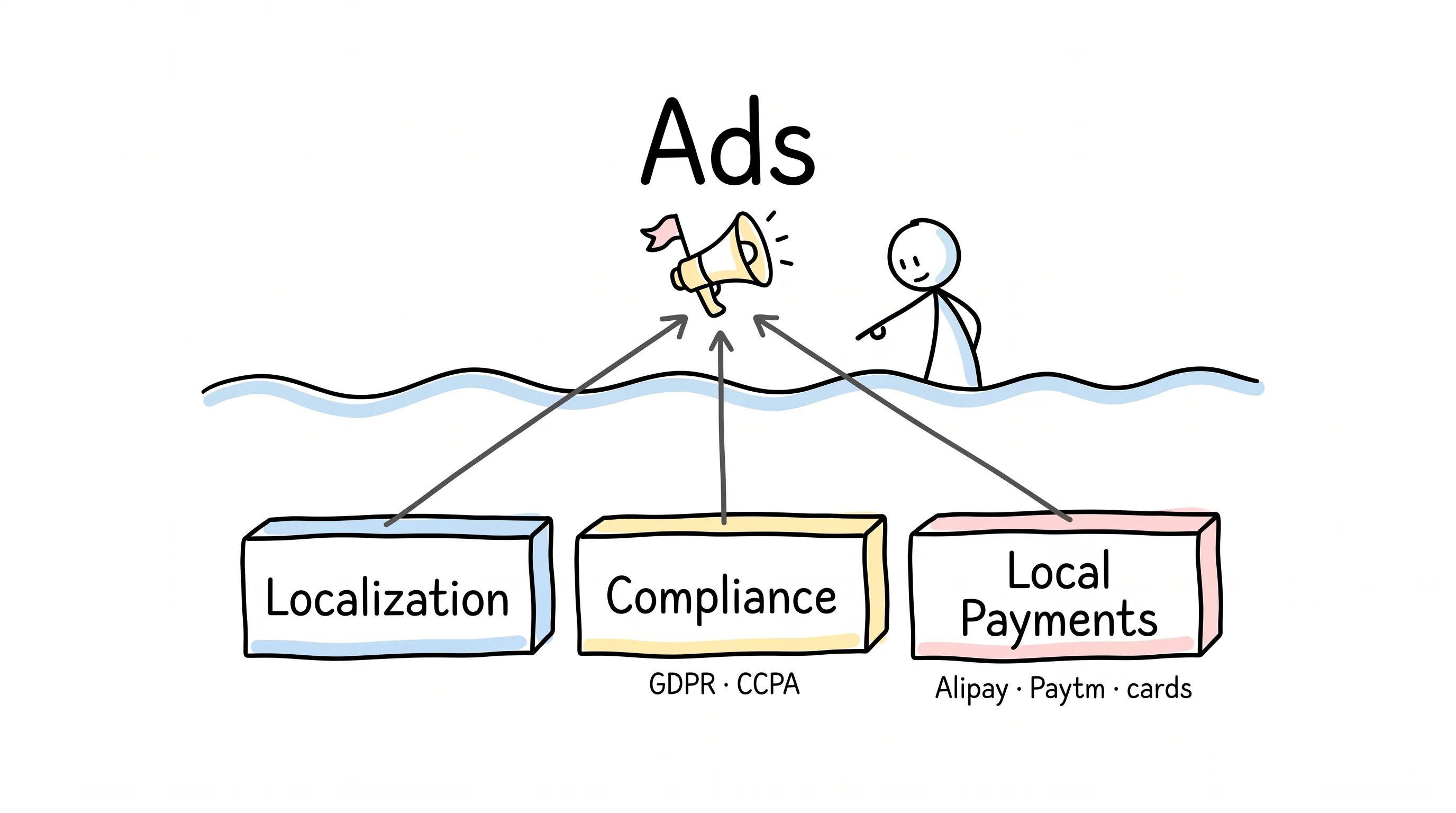
Advertising is only the outermost layer. Underneath it lie three foundations: localization, compliance, and local payments. Localization means making your content, language, and visuals look like they were made by locals. Compliance means your ads have to obey local laws — Europe has the General Data Protection Regulation (GDPR), California has the CCPA (California Consumer Privacy Act). Local payments mean that when customers go to check out, they can pull out the wallet they're used to.
If the foundation is weak, the louder your ads, the faster it all comes down.
Is This Business Worth Squeezing Into?
Some of you might be muttering: going global is already this crowded — is it still worth getting in?
Let me run the numbers for you.
A few years ago, research firms predicted that the global e-commerce market would touch $6.3 trillion by 2024, with cross-border transactions growing the fastest of all. When the pie is that big, it's worth doing some serious math on what entry will cost you.
Think about it:
No matter how big the domestic market is, there's a ceiling on revenue. Going overseas means opening up several more revenue lines — when one dims, another lights up.
Run ads internationally, and your brand gets seen again and again across the globe; trust accumulates over time. Brand trust rewards whoever banks it first.
And here's what many people miss: the demand is already there. Amazon, Alibaba, eBay — these platforms have turned "buying foreign goods" into a routine consumer habit. Consumers aren't refusing to buy — they're waiting for you to show up.
So the early movers feast on the first-mover dividend, while latecomers squeeze through a pricier door. The sooner you think it through, the lower your cost of entry.
The Real Pitfalls Are All Outside the Ads
So where do cross-border ad campaigns most often die?
From what I've seen, they don't die on media-buying craft. They die in these six places.
First is culture. An ad line you find funny may turn offensive in another cultural context. No translation software will give you that understanding.
Second is language. Consumers can spot a machine-translated ad at a glance — and the moment they spot it, half their trust is gone. Think about it: when you see an ad full of awkward Chinese, do you place an order?
Third is regulation. Every country writes its own rules on advertising and data. Europe clamps down hard on data privacy — step over the line once, and the fine could cost more than a year's ad budget.
Fourth is logistics. High shipping costs, slow delivery — no matter how good the ads were up front, the customer reaches checkout, sees a two-week wait, and walks away.
Fifth is payments. If you take only one currency and one payment method, you're essentially handing customers their coats and showing them the door. Chinese shoppers are used to Alipay, Indians to Paytm — you have to meet people with the wallet they already trust.
Sixth is ad fatigue. The same creative shown over and over: the more people see it, the less they click.
How do you break through? One pitfall, one fix.
For culture, have locals vet it — don't just go with your gut. For language, let AI translation lay the base layer, then have a native speaker polish it. For regulation, hire a compliance consultant to draw the boundaries clearly — that's money you cannot save. For logistics, pick reliable partners and state delivery times plainly on the page. For payments, plug in the wallets your target market actually uses. For ad fatigue, keep running A/B tests and let the data decide.
Notice something? Not one of these six pitfalls can be fixed by "getting better at running ads."
Tools Are the Lever, Not the Fulcrum
There are plenty of tools; here are a few I find handy.
For search and display, Google Ads has the broadest reach; for social, Meta's ad platform targets with real precision; if you sell on Amazon, Amazon Advertising is home turf. For building a site, Shopify ships with international selling built in. For translation, platforms like Smartling and Weglot can lay the base layer. For analytics, Google Analytics and SEMrush are standard kit; heavy reporting adds Tableau; email marketers should keep a close eye on Klaviyo.
But one warning: tools are the lever. If the fulcrum is wrong, nothing gets pried loose.
What's the fulcrum? Your understanding of the local market.
A few rising trends worth watching. AI and machine learning are already working inside targeting and personalization; with voice search on the rise, ads need to learn to "answer questions"; AR can already let people "try before they buy" in apparel and home goods; some are exploring blockchain to drag ad spend into the sunlight; and programmatic advertising keeps making multi-market ad buying more and more automated.
You don't have to chase every trend. But keep up with at least one.
Three Cases, One Lesson
Three cases.
Nike entered the Chinese market with a full set of localization moves fitted to Chinese culture and values — not by shipping over the American playbook. Amazon went global by doing three things at once: local websites, local payments, local advertising. Only with all three does it stand. And Airbnb? On Instagram, it hardly hawks its own wares — travelers' photos and stories do the talking.
That's powerful. Three players, three different plays, one destination.
Whether your ads succeed depends on how well you understand the local market.
Was the Money Well Spent? Watch These Numbers
The ads are out — how do you tell good from bad?
Watch five numbers.
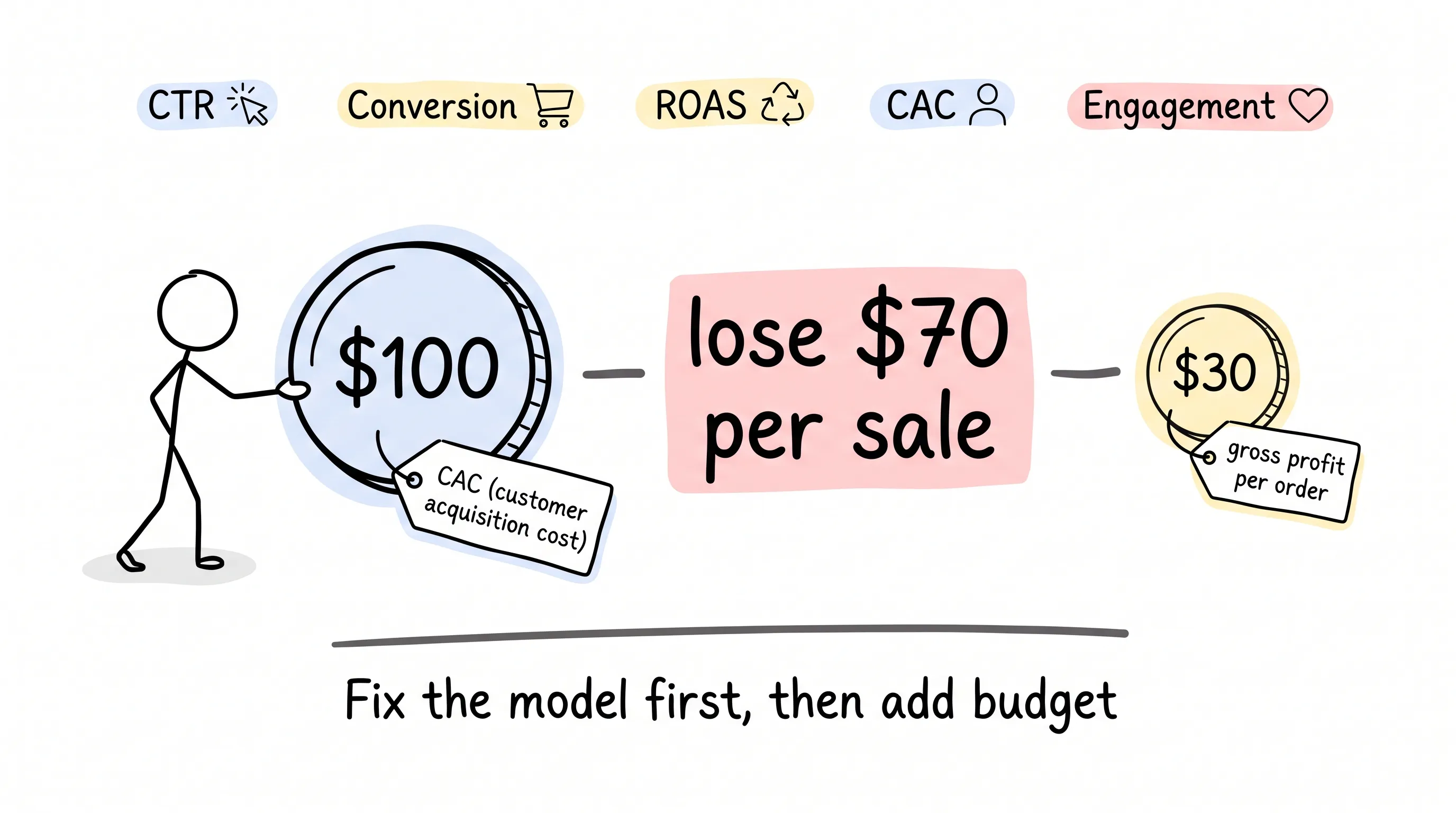
Click-through rate (CTR) — are your copy and creatives grabbing people? Conversion rate — of those who enter the store, how many actually pay? ROAS (return on ad spend) — how many dollars come back for every dollar spent; this is the harshest ruler of all. Customer acquisition cost (CAC) — what it costs to win one new customer. And then engagement — likes, shares, and the like — to see whether your content is alive and breathing.
Here's the simplest way to run the math: put CAC next to gross profit per order. You spend $100 to win a customer whose order brings $30 of gross profit — you lose $70 on every sale. Then the problem is in the business model. Go fix the model first; don't rush to add budget.
From Zero to One, in Six Steps
So you're ready to act — where do you start?
Six steps, one at a time.
Market research: figure out where you're going, what the locals like, what the law allows. Set goals: sales or buzz — don't be vague. Pick platforms: go where your users already are. Build localized content — this step may take twice as long as you expect, and it's worth it. Launch, and watch the data closely. Then let the data decide where to double down and which new market to copy into.
My advice: get it working in one or two markets first, then scale.
Plenty of companies die of "launching in ten countries at once" — beaten before the first campaign ever ran, dragged down by their own sprawl.
What to Do, and What Never to Do
Here's a checklist, both sides of the page.
Do: localize separately for every market; learn the local regulations cold; start small, test first, then scale; make decisions with data; offer multiple options for payments and logistics.
Never do: run one set of creatives worldwide; launch without even glancing at regulations; charge into ten markets in parallel; decide on gut feel alone; accept only one currency.
This list costs nothing — but it can save you most of the tuition.
A Closing Word
Back to my tea-drinking friend.
Eventually he figured it out: the problem wasn't his ad buying. His creatives were machine-translated, his landing page took one currency, and his shipping times were hidden away, too embarrassing to print. He fixed those three things, and the conversion rate turned around.
So the same line holds: in cross-border e-commerce advertising, the hard part was never the ads. The hard part is whether you're willing to crouch down and lay each of those three foundations under your ads, one by one.
Here's to a smooth journey overseas — and not a cent of ad spend wasted.
Continue reading
Related articles

Cross-Border Business: Time to Upgrade Your AI Toolbox
A learn article explaining how AI tools help cross-border e-commerce sellers clear five hurdles: language, regulation, logistics, payments, and fraud. It outlines a five-compartment toolbox, a five-step adoption path, and metrics such as conversion rate and CLV, while cautioning against over-reliance on AI.

AI Is Taking Over the Dirty Work of Social Media Marketing, One Task at a Time
This learn article outlines four social media marketing tasks AI can handle — audience analytics, content drafting and design, ad targeting and creative testing, and spam moderation — and cautions that taste, judgment, and data security remain human responsibilities.

AI Is Already This Good — Why Is Your Social Media Marketing Still Pure Manpower?
An overview of 18 AI tools for social media marketing, organized into six categories covering audience research, content creation, scheduling, comment and DM handling, ad management, and visual production, plus notes on personalization, prediction, and emerging trends.