
Run Campaigns, Win a Moment; Build an Engine, Win the Long Game
A learn article on how AI assistants and agents now sit between consumers and brand marketing, filtering out campaign messages. It presents five pillars for building a continuous AI marketing engine—insights, creative at scale, hyperpersonalization, visibility to AI agents, and orchestration—plus adoption guidance.
Let me start with a story.
Alex signed up for her first-ever 10K trail race. Instead of digging through reviews, browsing forums, and comparison-shopping, she asked her AI assistant: give me a training plan, and recommend a pair of running shoes that work for flat feet and an old knee injury.
Seconds later: she had her plan, a comparison of three shoes, and a summary of hundreds of user reviews.
Then, as she browsed posts from her favorite running influencers, her AI assistant served up a batch of short videos matched to her location and preferences, plus a few Reddit threads on which shoe suits which terrain.
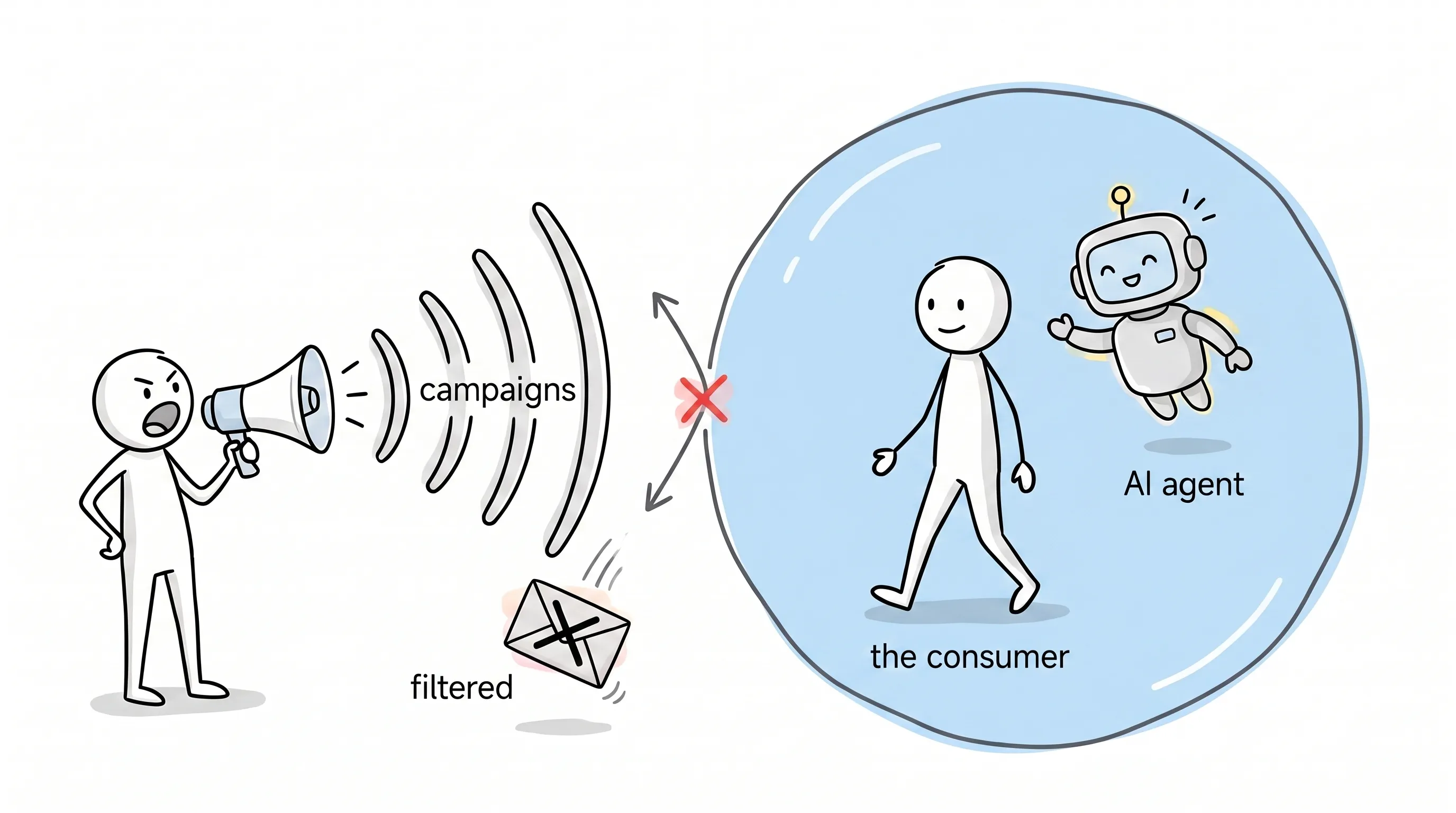
Right then, a promotional email arrived from a sports brand. Her AI assistant gave it one glance: generic cross-training ads, irrelevant to her. Filtered out.
At checkout, the AI found that one retailer had a poor return policy, so it switched to a seller with next-day delivery and hassle-free returns, completed the purchase, and—while it was at it—arranged travel and lodging for the race venue within her budget.
This story isn't science fiction. But have you spotted the most gut-punching detail?
It isn't about how capable the AI is. It's the sports brand: it did its marketing, spent its budget, sent its email—and its message never reached the consumer's ears at all. The one listening was the AI. And the AI's verdict: not needed.
The consumer hasn't changed. What's changed is that a new "agent" now sits beside them.
How Fast Is This Happening?
A McKinsey survey from August 2025 found that nearly half of consumers already use AI search to support purchase decisions. Today, people use twice as many channels to decide what to buy and whom to buy from as they did a decade ago. And as AI agents become more widespread, shopping will only get faster—and more agentic.
What does agentic mean? Shopping shifts from something you browse to something your AI handles for you. You state the need; it takes care of everything else.
What does that mean for marketing?
It means marketing has hit a structural wall. The old playbook ran on the rhythm of campaigns: plan, launch, review, wave after wave. But when an AI stands beside the consumer, it never even looks at your campaign. It only cares about who is more credible and whose product is better.
What AI changed isn't marketing's efficiency. It's marketing's opponent. Your rival is no longer "a competitor's ad." It's "the judgment criteria inside the consumer's AI."
The Awkward Reality
Consumers have run ahead. What about marketers themselves?
In McKinsey's research, 86% of marketers are excited about AI's possibilities, and 90% of CMOs are piloting AI use cases. On the surface, everything looks red-hot.
But turn the page and the picture changes: fewer than 10% have actually scaled AI and captured value in their marketing workflows.
Why?
The diagnosis is spot-on: most are just "patching." They use AI to speed up old processes, leave the old campaign model untouched, and stuff AI into the role of a faster copywriter or a cheaper designer. Only 28% of organizations are actually reshaping their teams and workflows.
That's the core problem. A new engine can't save an old machine. The old machine's flaw was never about speed—the entire logic is outdated.
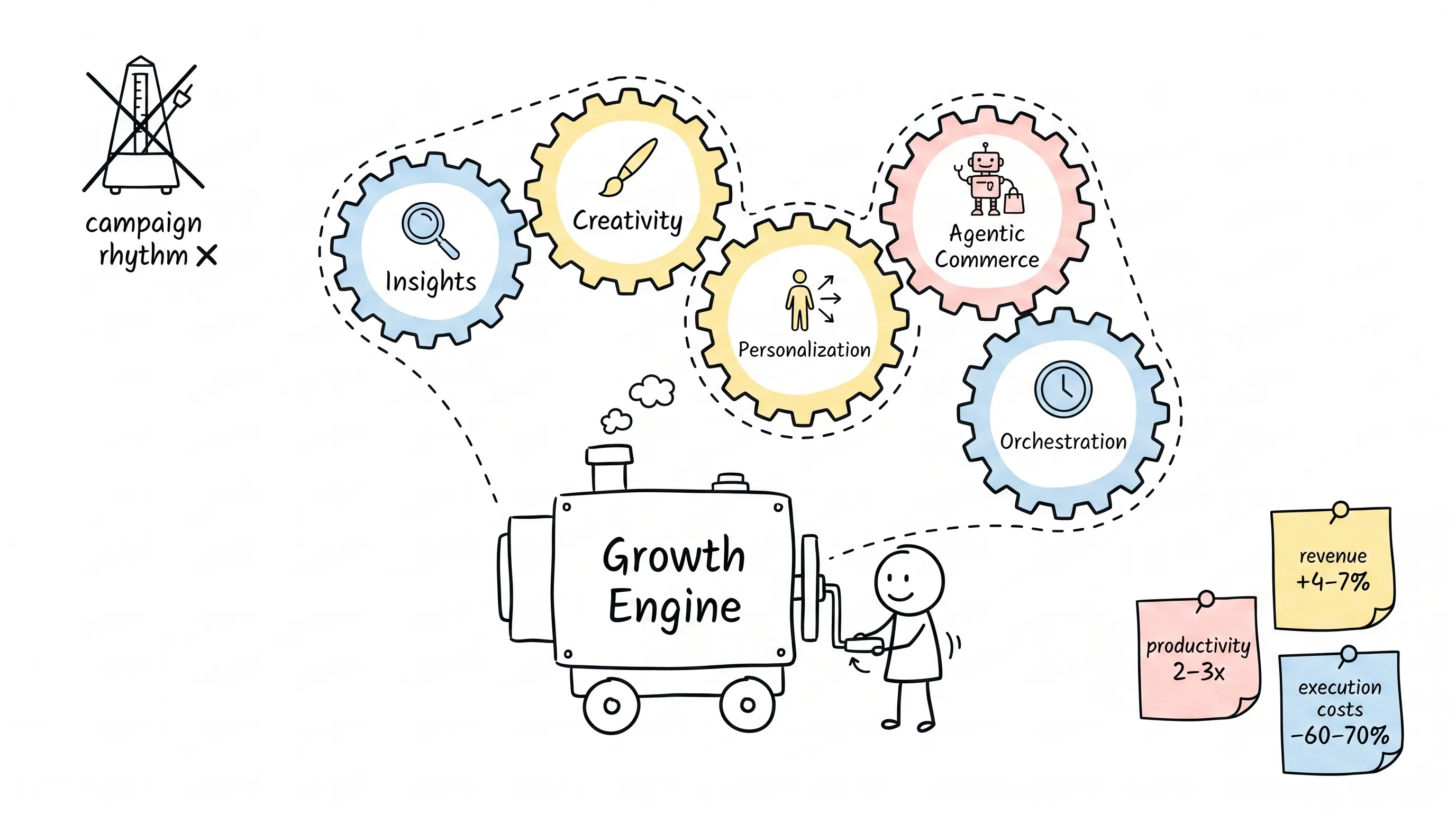
What AI should do is redesign marketing into a continuously running growth engine: insights, creativity, personalization, agentic commerce, and orchestration—five moving parts meshing in real time, never stopping. While we're at it, let's get three terms straight: AI calculates; generative AI writes and draws; agentic AI plans, decides, and executes on its own.
How much horsepower can this engine produce? McKinsey's benchmarks: revenue up 4–7%, productivity up 2–3x, and costs on execution-type tasks down 60–70%. Zoom out further: McKinsey estimates AI could add $3–5 trillion in value to the global B2C retail market.
So what does this engine look like? Take it apart, and you find five pillars.
Pillar 1: Continuous Insights—Chatting with the Consumer's "Digital Twin"
What is continuous insight? The moment a signal emerges from customers, the market, or a channel, it becomes a decision in real time.
My favorite example: digital twins. Build a "digital twin" of the consumer, and marketers can talk to it directly—testing how it reacts to a campaign, how it receives a price point, how it rates a product's reputation. No more waiting two weeks to round up a focus group.
The precondition, of course, is that the data stays "alive": first-party and third-party data flowing in continuously, governance keeping pace, and data protection done solidly.
McKinsey pairs this capability with a new role: Customer Wayfinder—the customer navigator. What do they do? Use AI to map customer behavior and needs, test with synthetic audiences, then layer on human cultural understanding and strategic judgment.
Pillar 2: Creativity at Scale—Treating Creative as Infrastructure
Of the five pillars, this one is the most mature. Some organizations have multiplied creative output 2–5x and cut costs by 10–30%. And campaign cycles? They used to take six to ten weeks; now they run same-day.
Think about what that means.
Before, a creative team sprinted for one campaign, then dispersed. Now, AI agents can camp out permanently inside large models, search, and social platforms—watching new trends, tracking shifts in user intent, testing and optimizing content as it ships, speaking one language to humans and another to AI.
But there's a precondition that's all too easy to miss: write the brand down first. The brand's voice, visuals, and boundaries must become explicit rules and guardrails before AI can mass-produce without drifting. Put plainly, before creative can be industrialized, the brand has to be codified into law.
The matching new role is Creative Guru—the creative chief. Set the rules, guard the rails, use performance data to sharpen content over time, and stay responsible for the "big ideas" AI can't produce.
Pillar 3: Hyperpersonalization—Everyone Sees "Their Version"
McKinsey's estimate: AI-driven personalization can lift customer satisfaction 15–20%, raise revenue 5–8%, and cut service costs by up to 30%.
How? Four pieces meshed together:
Clean, usable customer data; a real-time decision engine computing each person's "next best action" at every moment; a reinforcement learning system where every interaction corrects the next; plus an offer system managed uniformly across channels.
The new role here is Hyperpersonalization Architect. They own the data models, the business rules, and compliance. Personalization must be accurate, compliant, and trusted—lose any one, and it crashes.
Pillar 4: Marketing to AI Agents—Putting Your Shelf Inside the Machine's World
In my view, this is the make-or-break pillar of the five.
Today, AI already guides more than half of consumers' purchase decisions, and a substantial share of traffic is draining away from traditional web search. McKinsey frames it as a migration: from the "attention economy" to the "trust economy."
What does that mean? Marketing used to compete for human attention—the loudest voice won. Now, it's AI recommendation systems that make the first judgment for consumers. Whoever they recommend is the one who can get chosen.
So being "seen" is no longer enough. Brands must let machines "read" them and "trust" them: content that directly answers user questions, machine-verifiable trust signals (detailed product specs, authentic reviews, expert endorsements), and continuously updated information.
Interestingly, in McKinsey's survey, executives agreed that this is precisely where they feel least prepared.
My favorite new role name: Agent Whisperer—the one who whispers to AI agents. The job: make sure the brand is accurately understood and confidently recommended inside AI systems.
Pillar 5: Always-On Orchestration—Throwing Out the Metronome
The final pillar governs how marketing itself runs.
The word campaign carries battle in its DNA: prepare, attack, withdraw, debrief. Orchestration in the AI era has no rhythm at all—hybrid human-AI teams keep marketing running and optimizing continuously, like an assembly line.
How well does it work? McKinsey's experience: marketing ROI up 30%; time marketers spend on execution compressed from 60–70% down to 10–15%. And what do they do with the time saved? Higher-value work.
This requires a unified data and orchestration layer—and clarity on one thing: which decisions belong to machines, and which to humans.
What does it look like when all five pillars spin together? McKinsey cites a leading consumer-tech company that embedded all five capabilities into its marketing processes: campaign launch time down 35–50%, external spend down about 20%, and a content-and-audience generation process that once took 10–12 weeks compressed into minutes.
Powerful stuff. But don't rush to copy the playbook. An engine alone isn't enough.
An Engine Isn't Enough—Someone Has to Know How to Drive It
A leading financial services firm recognized early that AI was changing how users discover and evaluate products, so it redesigned marketing around AI search and always-on orchestration: building a machine-readable knowledge engine so search engines and large models could accurately understand and cite its content; and in high-value workflows, letting AI agents form hypotheses, test creative, and dynamically reallocate budgets—while humans judge which signals matter and where to place the bets.
In nine months, organic traffic grew sixfold, customer acquisition costs fell, and retention improved.
How do you replicate this? Four things.
First, reshape high-value workflows. Generative AI could theoretically carry 60% of marketing tasks, but what's actually paying off in the near term is decomposing work around human-AI collaboration: breaking it into tasks and clearly marking which go to people and which go to AI. The reality: fewer than a quarter of marketing teams surveyed have a clear, prioritized transformation roadmap.
Second, build hybrid human-AI organizations. For many companies, the bottleneck in capturing AI value isn't technology—it's people. Marketing organizations will become smaller, faster, and built around end-to-end workflows: the people who build systems, the people who manage human-AI collaboration, and the people who own judgment and quality. In McKinsey's survey, executives ranked "skills development" as the biggest hurdle to AI adoption.
Third, invest heavily in the technology and data foundation. The biggest value lies at scale, and scale requires an agentic platform architecture that integrates internal systems, external services, and in-house capabilities; a modular, interoperable data layer; and rigorous governance—with testing standards, codes of conduct, and decision rights all in writing.
Fourth, fixate on value and rebalance fast. This one sounds the plainest, yet it stings the most. The biggest problem in AI marketing is usually not that AI fails to produce value—it's that companies fail to capture it: they measure "activity" instead of "value," and the money saved never actually gets pocketed. If AI saves a marketer 20% of their time and that 20% simply gets diluted away, it amounts to nothing. Traditional transformation offices that meet quarterly can't keep up with AI's speed. Set clear value targets from day one, track them daily, adjust when you fall short, and proactively redirect the freed-up resources into high-growth work.
If You Want to Start Now
Four starter recommendations, translated into plain language:
- Look in the mirror first. Companies routinely overestimate their own maturity. Take a full inventory of your capabilities, skills, data, and infrastructure before deciding where the money goes.
- Pick the quick wins. From the five pillars, choose an entry point where AI can visibly change speed, cost, or performance. Watch value, not "how much AI you use"—and check the numbers daily.
- Learn while you build. Wire feedback loops into every model and workflow from day one, so every interaction improves the next.
- Connect the pillars from the start. Even if you build only one or two first, define upfront how they'll share data models and common identifiers for customers, products, and intent. Otherwise you won't build an engine—just a row of dead-end pilots.
Finally, Back to Alex
Back to where we started.
Did the sports brand do anything wrong? Not really. It was simply still using an old map: send ads, buy exposure, wait for clicks. Yet Alex's purchase decision never passed through a single one of its touchpoints.
In the second half of marketing, the contest isn't about who has the most tools. It's about who can link insights, creativity, personalization, agentic commerce, and execution into an engine that improves itself.
Only when the engine is turning will AI's benefits land on the income statement—instead of sitting in slide decks.
May your engine fire up soon.
Continue reading
Related articles

Cross-Border Business: Time to Upgrade Your AI Toolbox
A learn article explaining how AI tools help cross-border e-commerce sellers clear five hurdles: language, regulation, logistics, payments, and fraud. It outlines a five-compartment toolbox, a five-step adoption path, and metrics such as conversion rate and CLV, while cautioning against over-reliance on AI.

AI Is Taking Over the Dirty Work of Social Media Marketing, One Task at a Time
This learn article outlines four social media marketing tasks AI can handle — audience analytics, content drafting and design, ad targeting and creative testing, and spam moderation — and cautions that taste, judgment, and data security remain human responsibilities.

AI Is Already This Good — Why Is Your Social Media Marketing Still Pure Manpower?
An overview of 18 AI tools for social media marketing, organized into six categories covering audience research, content creation, scheduling, comment and DM handling, ad management, and visual production, plus notes on personalization, prediction, and emerging trends.