
Profound or Athena — Which One Should You Buy? I Ran the Numbers on Both
A first-hand, numbers-driven comparison of the two leading AEO tools, Profound and Athena: pricing models, engine coverage, credit mechanics, seats, agency programs, security credentials, and G2 reviews — plus a two-hour test to decide which one fits your team, and when HubSpot's AEO tooling is the better third option.
A while back, an old friend of mine who runs a B2B software company sent me a WeChat message at eleven at night.
"Buddy, our customers don't Google anymore when they research a purchase — they ask ChatGPT. And ChatGPT's answers are full of our competitors, but never us. What do we do?"
I told him this is called AEO — Answer Engine Optimization — and step one is getting your brand "seen" by AI. He gave a noncommittal "oh," then fired back another question: of all the AEO tools out there, Profound and Athena, which one should I buy? Then he sent over five comparison articles.
I opened them and froze. All five fell into one of three buckets: written by Athena itself, written for affiliate commissions, or calling both sides equally at fault before conveniently recommending some third tool.
There wasn't a single one I could trust.
So I did it myself. In late September, I went through both companies' pricing pages, product pages, and security docs one by one, and ran the numbers. Today, I'm handing you the conclusions.
First, What Exactly Is AEO
What is AEO? Answer Engine Optimization.
With SEO, the goal was to get Google to rank you near the top. That's not how it works anymore. Now your customers ask ChatGPT, Perplexity, or Gemini: "What's the best tool for this need?" The AI answers instantly — and casually drops in a few brand names.
The user reads the answer and leaves — without ever running a search.
Here's the trouble: a zero-click AI answer doesn't register a single visit in your website analytics. The traffic you see in traditional analytics tools badly understates the business AI is sending your way — or taking from you.
You can't optimize what you can't see. And if you can't see it, you don't even know who you're losing to.
AEO tools exist to plug exactly this hole: they watch how AI answers questions relevant to your business — whether you show up, whether what it says about you is accurate, and how many times the competitor next door gets named.
Profound and Athena are the two leading players doing exactly this.
Laying Both Cards on the Table
Profound's approach centers on an "AI marketer": a fleet of agents, a context library that stores your brand knowledge, and a monitoring layer behind it (answer-engine insights, prompt-volume estimates) feeding them data.
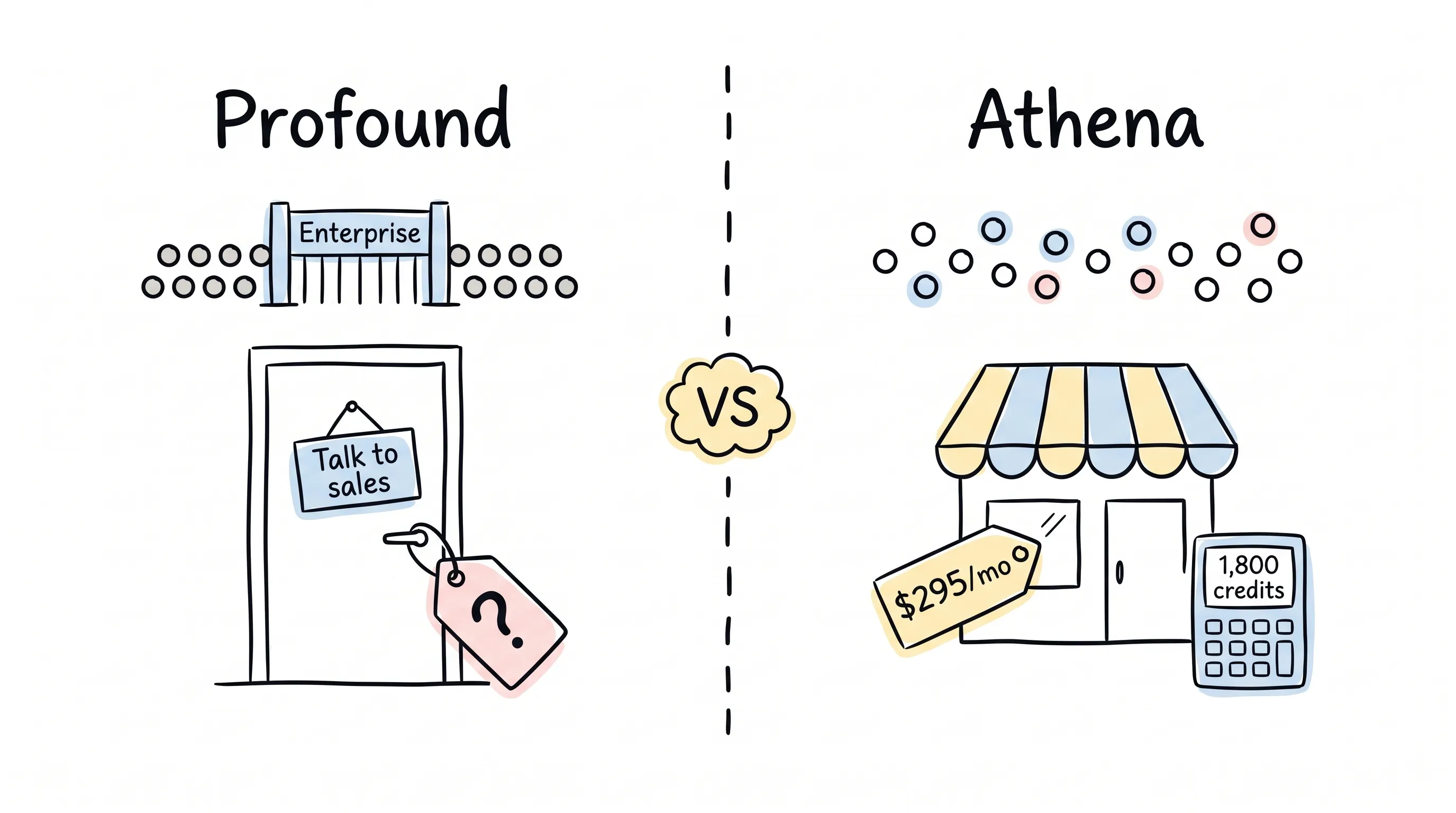
Its pricing is disorientingly simple: a free trial, and an enterprise plan you negotiate. That's it.
You read that right. Profound currently has no self-serve paid tier with public pricing. Earlier, it did publish two tiers at $99 and $399 per month. So any Profound pricing you see in older articles is probably stale. Before you commit, verify on the official site — and don't walk into a budget meeting with outdated numbers.
Athena (the brand is AthenaHQ) takes the other road: published prices. It hands you a one-time trial of $25 / 300 credits; the Starter plan is $295 per month ($245 billed annually), with 3,600 credits included; beyond that, the enterprise plan, negotiated. Incidentally, the team behind it comes from Google Search and DeepMind, and it's YC-backed.
One doesn't publish prices; one does. That's the fundamental divide between the two, and nearly every difference that follows grows out of this point.
Engine Counts — Don't Count the Wrong Thing
Compare engine coverage on the self-serve side alone: Athena's Starter plan lists 11 names — ChatGPT, Perplexity, Gemini, Claude, Grok, DeepSeek, Meta AI, Mistral, and more. Profound's free trial gives you only 3: ChatGPT, Gemini, and Google AI Overviews. Profound's ceiling is 9 engines, but that lives only inside the enterprise plan.
The gap is real. But here's the reality check:
A long engine list is not the same as a useful one. What matters is which engines your buyers actually ask questions in.
Think about it: if you're a B2B software company whose customers live in ChatGPT and Perplexity, who are you covering Grok and Mistral for? You open your shop where the customers shop.
So don't start by comparing engine counts. Open your own data first: GA4, server logs, the source fields in your CRM — see which AI engines are already sending traffic to your site today. Cover those first; talk about someone else's list later.
On internationalization, both companies gate it at the same place: multi-region and multi-language support are locked behind the enterprise plan. Athena's Starter is explicitly single-region, single-language, and Profound's trial is the same. If you sell globally, don't expect a self-serve plan to hold up — build the enterprise negotiation straight into your budget from the start.
Some third-party pages claim Athena can track 60-plus countries and regions. That number comes from Athena's own marketing, not independent verification. When you're in talks, ask for a live demo on the spot — seeing is believing.
With Data, Watch the Trend, Not the Screenshot
There are a few terms in both companies' dashboards you need to nail down first.
Visibility is how often your brand appears in AI answers across a fixed set of prompts; citations are the specific web pages an AI cites when answering; sentiment is whether the AI says nice things, nasty things, or neutral things about you; and accuracy is whether the AI confidently gets your information wrong.
The last one is the deadliest. AI ages confidently — it will keep repeating outdated facts with total conviction. Athena built a dedicated correction feature into its enterprise plan to watch for exactly this.
But there's one shared quirk of both platforms' data you must know: all of it is probabilistic. Ask the same question today and tomorrow, and the answer may differ. A visibility score wobbling a point or two means nothing.
Look at trend lines over weeks. Trust no single screenshot.
There's also a hidden bill: credits. Athena runs everything off one shared credit pool — monitoring draws from it, its Q&A assistant draws from it, its content agent draws from it too. Want to increase your monitoring frequency? That's not an extra line item; it's another ladle out of the same pool. The pool is only so big, and the number of mouths drinking from it keeps growing.
On Profound's side, agents consume credits per run, with usage sized by its customer team. Whether exceeding the limit means automatic billing or a pause — get that in writing during negotiations.
On integrations: Athena connects directly to GA4 and Google Search Console; Profound's GA4 hookup lives inside its Agent Analytics. Neither offers native CRM integration. Profound's API (enterprise) lets you build your own integration, but that means writing code — not just plugging in a connector.
Now the Important Part: Running the Numbers
Come run the numbers with me. This is the most valuable part of the whole piece.
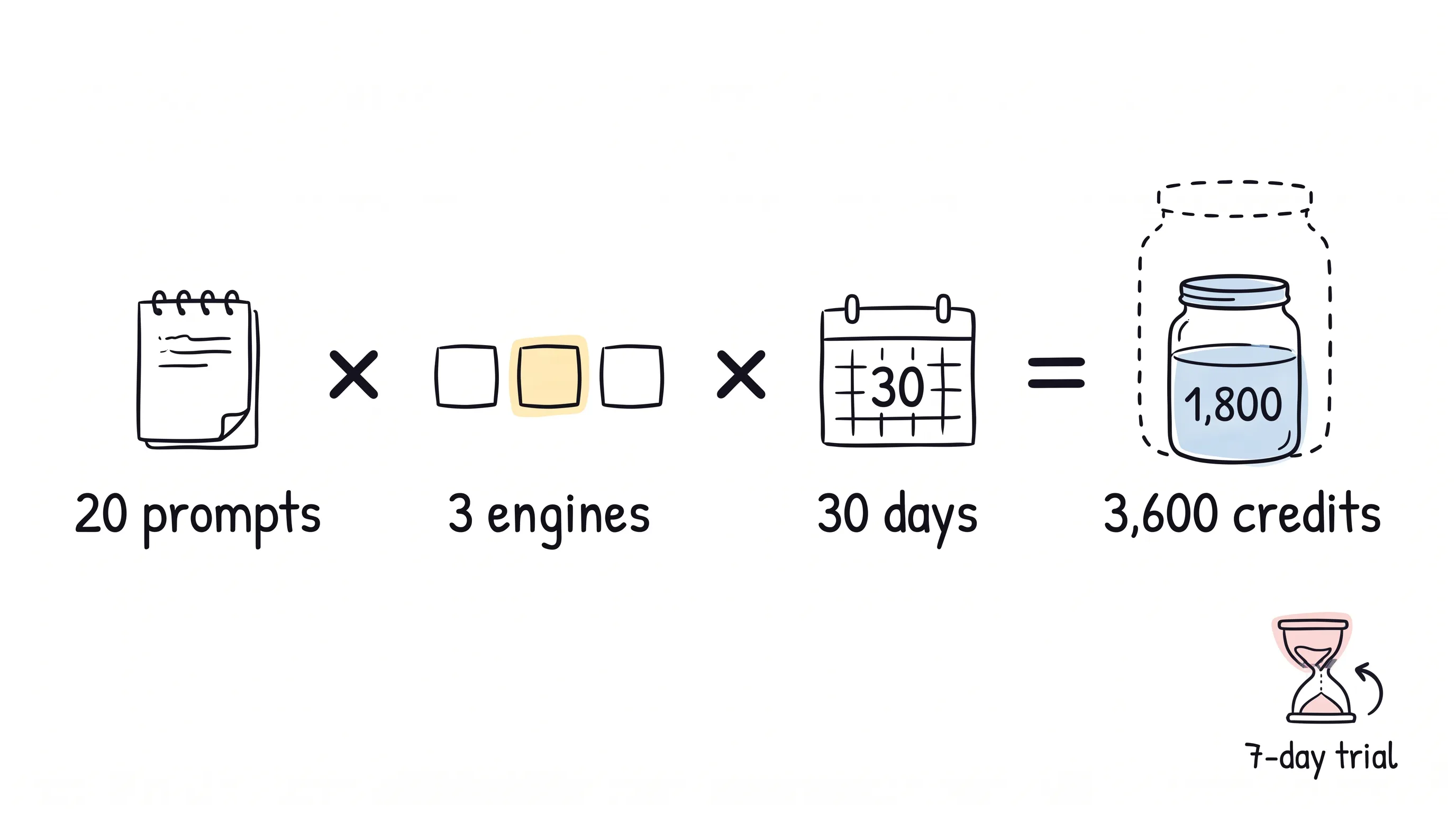
Say you're a lean little team watching a single market: 20 prompts a day, across 3 engines.
On Athena, one credit equals one AI answer. 20 × 3 × 30 days = 1,800 credits a month. Starter includes 3,600 — comfortable headroom, and the occasional use of its assistant won't hurt.
On Profound? The free trial gives only 7 days, 50 prompts a day, 3 engines — and when the trial ends, your data resets to zero. However tiny your real usage, there is exactly one path forward: negotiate the enterprise plan.
Now the second scenario: a growth-stage team, 40 prompts a day, across 6 engines.
Athena: 40 × 6 × 30 = 7,200 a month — double the Starter allowance. Either buy add-on credit packs or go negotiate an enterprise plan. Profound? Coverage of 6 engines is itself an enterprise feature — go straight to negotiations.
See the pattern?
Athena gives you a visible starting price and a usage ceiling you defend with discipline; Profound gives you a price you have to negotiate into existence.
One you can budget for on your own; for the other, you have to book the sales team before the meeting. This isn't good versus bad — it's two entirely different procurement postures.
One more reminder: estimate with the number of prompts you actually intend to act on, not the number you can imagine "theoretically monitoring." Watching too much and acting too little is the number-one way teams burn through their credits.
Seats, Agencies, and What to Ask Face to Face
Both are generous on seats: every tier says "unlimited seats." Don't celebrate yet — the key is in the admin details.
Athena includes role-based permissions from Starter up; SSO, audit logs, and a two-hour response SLA are locked to enterprise. Profound's trial-period support is "none"; the enterprise plan is what gets you email support, a dedicated Slack channel, or a 24-hour SLA.
Both have agency programs, structured differently. Athena's is written out more clearly: one login managing multiple brands, resale discounts, a workspace for generating visibility reports for prospects on the spot, and the ability to route leads the platform generates to certified partners. Profound mentioned an agency plan billed per client workspace in its pricing FAQ, without expanding on the details — if you want it, go confirm current terms with the company directly.
If you're an agency, ask these questions face to face and get them in writing:
- Multiple client workspaces — can you switch between them from a single login?
- When clients log in to view reports, does that consume my seats and credits?
- At which tier do white-label reports become available?
- How are credits split and billed across clients?
- If a client pauses mid-contract, what happens to the historical data?
Whether the agency business makes money hides inside these five questions. Ask before you sign — don't find out after.
Security Credentials — Don't Be Fooled by Badges
Both companies keep their security documentation in third-party-hosted trust centers. You can go read it yourself, without a salesperson's paraphrasing.
Profound lists SOC 2 Type II certification and HIPAA compliance; Athena lists SOC 2 Type I, Type II, and GDPR.
Here's a trap many people have fallen into: "SOC 2 compliant" and "SOC 2 Type II certified" are two different things. The former may only mean "we followed the practices"; the latter is what an auditing firm has actually issued a report on.
Profound's data processing agreement mentions alignment with SOC 2, ISO 27001, and NIST 800-53. "Aligned to a standard" is not the same as "holds the certification." Before buying, ask for the actual audit reports — from both companies. Especially if your industry is regulated, this step cannot be skipped.
What Users Say
On G2, Profound sits at about 4.5, with over a thousand reviews; Athena is at about 4.9, with just thirty-some.
A high rating on a small sample and a high rating on a large sample are not the same kind of high rating.
A 4.9 held up by thirty reviews, and a 4.5 held up by a thousand — the latter is actually more likely to have absorbed the real world's full range of edge cases.
Scroll through the reviews, and the high-frequency feedback on both sides is interesting. Profound gets praised for deep data, strong competitive comparison, and fast support response — but more than one user says the interface is so feature-dense it leaves newcomers dazed; the learning curve is real. Pricing being steep for small teams comes up repeatedly, too. Athena's praise centers on easy onboarding and fast results, and its biggest sore spot is still credits: several users say that once you widen the monitoring scope, the balance burns much faster than expected.
There's also a widespread skepticism in the community: these tools claim they can attribute revenue down to a single AI citation — is that believable? My view: that skepticism applies to the whole category, not to anyone in particular. If any tool gives you a guarantee on this point, keep a healthy dose of skepticism.
Oh, and one mix-up to avoid: search "Athena AI" online, and half the results are an identically named AI tutor for students. What you're looking for is the AEO platform AthenaHQ — confirm you've got the right one before you read on.
So Which One Should You Pick?
There's no universal answer. But I can give you a few clear starting points.
If you want analytical depth and can afford a team that likes to tinker: Profound's enterprise plan — a 9-engine ceiling, the most mature agent tooling. The cost: a learning curve, and a negotiated price.
If you want to order today, see published prices, and get results fast: Athena's Starter — the only self-serve plan between the two with a real price tag, and the content-optimization agent is included at the entry price, not locked to enterprise. The cost: watching the credit pool closely.
An in-house team for a single brand: either one works. The decisive question is, do you want the platform to decide for you what to fix first? If yes, go negotiate the enterprise plan — at either company. If you'd rather call the shots yourself and just want handy execution tools, Athena's Starter fits better.
An agency managing multiple clients: Athena's agency program is better documented today; Profound's per-workspace-billed agency plan is worth asking about directly.
Before you act, here's a lightweight test you can finish in two hours:
- Take your brand and two or three real competitors, and run the same set of 10 to 15 prompts through both platforms' free versions or demos.
- Watch how it explains a citation, a competitor mention. Don't judge whether it can detect things — judge whether its explanations could go straight into a report without you translating them.
- Ask sales for a reference customer in your industry, at your scale.
- Multiply your real prompt volume by engine count, run the numbers for both sides, and only then compare the price tags.
Is There a Third Option?
After all this, there's one shared shortcoming worth calling out: Profound and Athena are both good at "seeing" the gaps, and both can help you optimize a little, but your content, your customer data, and your publishing workflow do not live inside them.
You see the gap — then what? Who edits which piece of content? Where do they edit it? Where do they track it afterward?
HubSpot's AEO tooling is aimed squarely at this question. It likewise gives you visibility scores and competitor comparison across the major answer engines; the difference is that it lives inside a marketing platform: prompt suggestions draw directly on your CRM customer data, and once you spot a visibility gap, you can draft or update content, publish, and track it in the same platform. No export-import dance between insight and action.
Of course, whether every feature is available in your specific plan — confirm item by item before ordering; everyone is iterating fast in this category.
The tools help you see, but the hand that acts is always yours. The only difference is how far the place where you act is from the place where you see.
A Closing Word
Later, I sent that friend a one-page reply. I recommended neither one.
I said: first, pull up the past 90 days and see which AI engines are sending traffic to your site; next, list the 20 prompts you actually intend to monitor; then use those two numbers to run the math on both companies. When you're done, the answer will surface on its own.
The next day, he replied with one line: "Done with the math. Turns out my problem was never about choosing a tool — I hadn't even thought clearly about which questions to monitor."
See? Tools can only tell you what AI is saying about you. What AI ought to say about you — that's something you build yourself, one step at a time.
Here's to seeing it clearly — and running the numbers clearly.
Continue reading
Related articles

Cross-Border Business: Time to Upgrade Your AI Toolbox
A learn article explaining how AI tools help cross-border e-commerce sellers clear five hurdles: language, regulation, logistics, payments, and fraud. It outlines a five-compartment toolbox, a five-step adoption path, and metrics such as conversion rate and CLV, while cautioning against over-reliance on AI.

AI Is Taking Over the Dirty Work of Social Media Marketing, One Task at a Time
This learn article outlines four social media marketing tasks AI can handle — audience analytics, content drafting and design, ad targeting and creative testing, and spam moderation — and cautions that taste, judgment, and data security remain human responsibilities.

AI Is Already This Good — Why Is Your Social Media Marketing Still Pure Manpower?
An overview of 18 AI tools for social media marketing, organized into six categories covering audience research, content creation, scheduling, comment and DM handling, ad management, and visual production, plus notes on personalization, prediction, and emerging trends.