
Plenty of Leads, but the Revenue Doesn't Add Up? How to Pick a B2B Marketing Automation Platform
A guide to choosing a B2B marketing automation platform, covering what automation does, profiles of HubSpot, Marketo, and Pardot, and five selection questions including pricing, integrations, and revenue attribution.
Say you run marketing at a B2B company.
This month, the ads ran as always, the content shipped as always, the events went off as planned. At the month-end review, the number you report to your boss looks great: 3,200 new leads. Your boss nods, then asks one question: of those 3,200, which channels did they come from — and how many turned into deals?
You freeze.
The lead data is right there in your dashboard. You just can't say which channel's spend actually paid off, and which went straight down the drain.
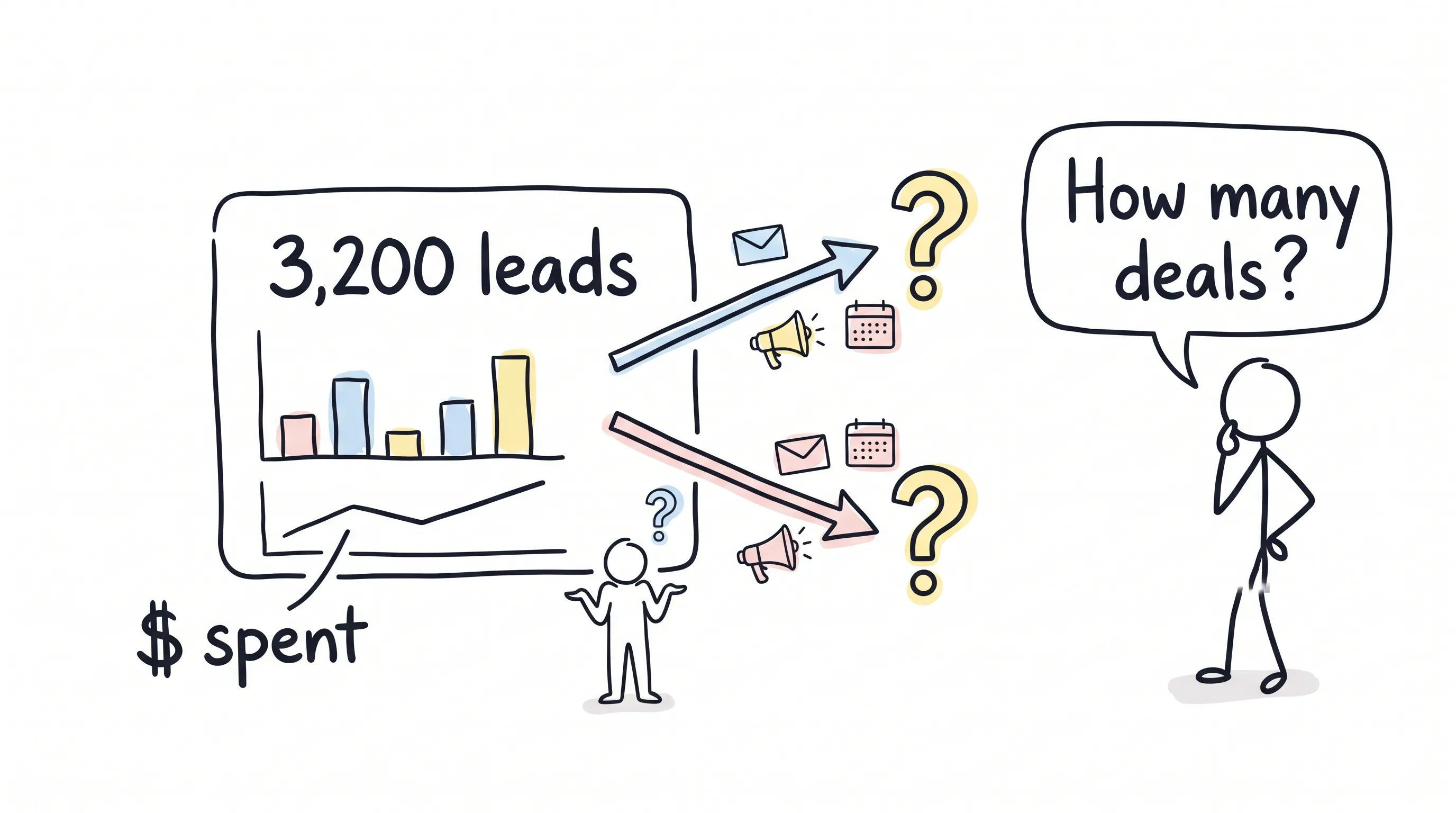
You're not the only one in this bind. B2B marketing, in the end, comes down to two things: speed and scale. No amount of manual grinding produces either — which is why, these past few years, a marketing automation platform has become all but standard equipment. But once the tools pile up, a new question shows up: with this many platforms out there, which one do you actually pick?
Today, let's talk this through properly: what marketing automation is, what the representative platforms on the market each feel like, and the big one — how to choose without wasting money.
What Is Marketing Automation?
First, the concept.
Marketing automation is software that takes over the repetitive, mechanical, playbook-driven marketing tasks.
Sending emails, scheduling social posts, running ads, scoring leads, grouping people by behavior... These tasks share one trait: the rules are clear and the actions repeat. Done by a person, they're slow and error-prone. Done by software, they're fast and steady.
Picture an assembly line. Raw material comes in, the machines run their set steps, and people stand only at the critical stations, making judgment calls.
That's exactly what marketing automation does. It doesn't do your marketing for you — it sets your hands free.
What automation saves is hands, not brains. Setting strategy, shaping creative, judging which customers are worth chasing — those are still your job.
So what does it actually earn back for you? I'd say three things.
First, personalization at scale. Sending a thousand people a thousand different emails — a person can't do it; software does it with its eyes closed. What a user viewed, what they clicked, where they gave up — the system keeps track of it all, then turns around and generates the matching action. The classic scenario: a customer fills their cart and walks away. The system automatically follows up with an email carrying a limited-time offer. That one email may just rescue the whole deal.
Second, a ledger you can actually see. The moment a campaign goes live, the data flows back in real time. Which version earns more clicks, which audience converts better — run your A/B tests, and next month's budget shifts toward what works.
Third, marketing and sales finally speak the same language. Once the automation platform is connected to your CRM, the leads marketing sees, sales sees too; and wherever a deal stands inside sales, marketing knows it just as clearly. Less wrangling, more teamwork.
All right — value covered. Now, with so many platforms out there, how do you choose? Let me sketch portraits of three representative players.
Three Platforms, Three Temperaments
HubSpot, the established pioneer.
Email marketing, content management, data analytics — one suite covers it all. Its defining trait is how easy it is to get started: a clean interface, and a small team can be up and running quickly. The CRM is native, so marketing moves and sales moves live in the same pool. It has an endearing side, too: the learning resources are generous — online courses, blogs, certifications by the dozen — so the team learns while it works.
In one line: it fits companies building a system from scratch, especially small and mid-sized teams.
Marketo, now under Adobe's roof, plays the enterprise game.
The bigger the organization, the more tangled the marketing logic: tens of thousands of leads to score, segment, and route by behavior. Marketo's strength is precisely there, in lead management. Third-party integrations run wide as well — if you want a marketing tech stack tailored to your own needs, it can plug in. The analytics go deep, and the advanced plays are on the menu: predictive content, plus account-based marketing — the ABM everyone talks about — aimed at your target accounts.
In one line: it fits large organizations with complicated marketing machinery. The catch: you'd better have people who know how to run it.
Pardot, Salesforce's homegrown product, born for B2B.
Lead scoring, email marketing, ROI reporting — the essentials are all there. Its strongest card is the seamless connection with Salesforce CRM: marketing, sales, and customer data, all visible in a single view. Social media management and event management come along as well.
In one line: if your company already runs on Salesforce, this is about as natural a pick as it gets.
Of course, the market holds more than these three. ActiveCampaign, for instance, makes a smooth starting point for a small team. Setting a few platforms side by side isn't about memorizing a list — it's about seeing one thing clearly: every platform has its own temperament, and fit matters more than fame.
So how do you judge the fit? I've broken it into five questions. Ask yourself each one in turn.
Five Questions Before You Choose
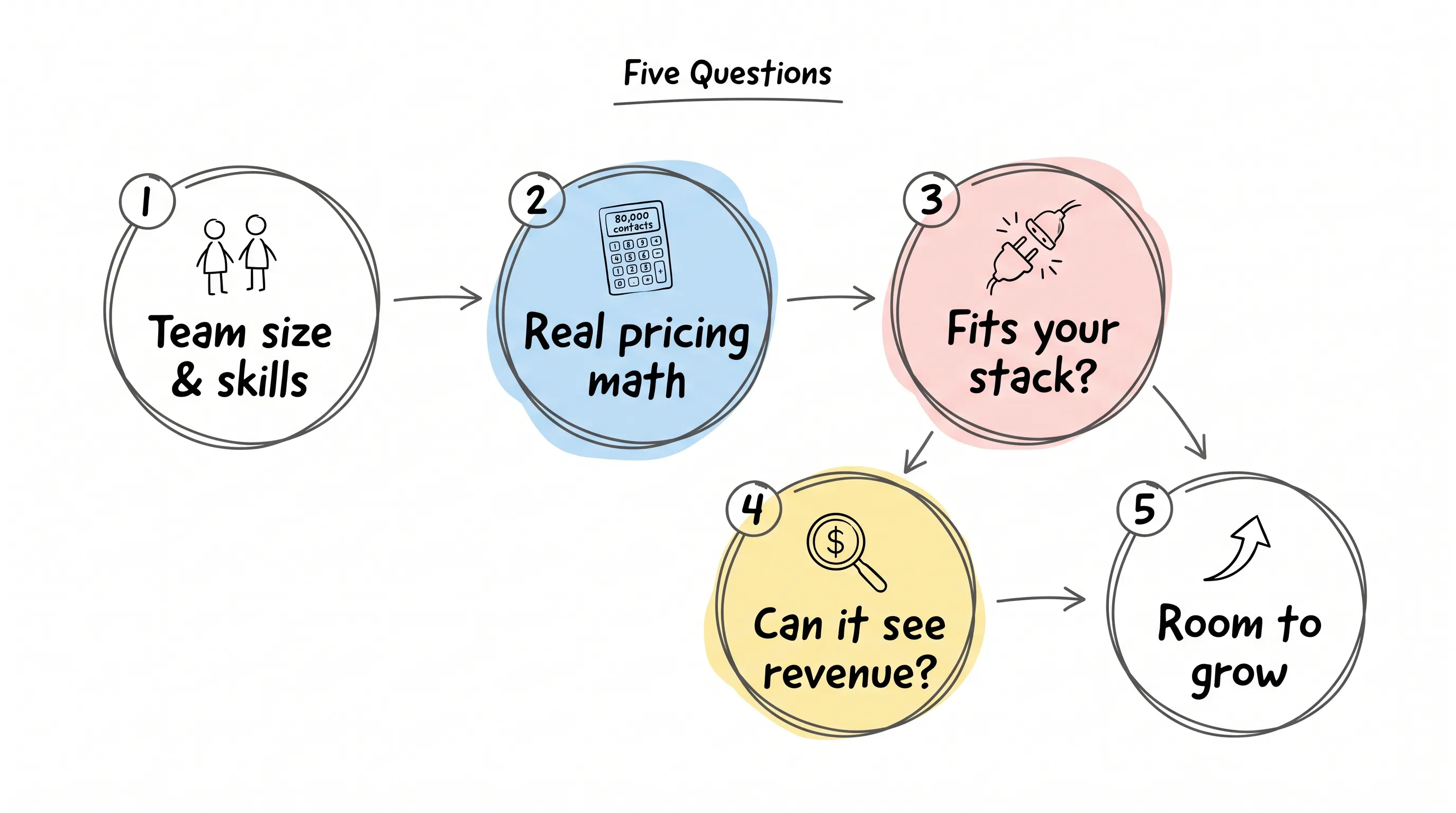
Question one: how big is my team, and how skilled?
A startup of a dozen or so people shouldn't mount heavy machinery — what it needs is out-of-the-box and quick to learn. A company of several hundred or a thousand-plus needs complex segmentation and automation logic — that's Marketo and Pardot weight class. One more layer: does anyone on the team have technical chops? Some tools you have to build with yourself; others work the moment you plug them in. With nobody around to babysit the tool, pick one with strong support, plenty of templates, and an active community.
Question two: how does the pricing work?
Pricing models come in every shape. Some bill per seat, some by the number of contacts, some by feature tier.
Here's the trap: don't just read the sticker price — run the full math. Take a platform that bills by contacts: if your database holds 80,000 people, you're paying for all of them — even if 60,000 have long gone dormant. That's the math you run before you sign anything. Implementation fees, paid integrations, add-on modules — nail each one down. Sometimes the platform that costs a bit more upfront but fits your needs right turns out cheaper in the long run.
Question three: will it plug into what I already have?
Your stack already holds a CRM (HubSpot, Salesforce, Pipedrive), ad accounts (Meta, Google Ads, TikTok), an email service provider, plus website builders and form tools (Webflow, Typeform, that crowd). The new platform has to talk to all of them: either native integrations, or an API flexible enough. Don't take the data migration lightly either — a sloppy move leaves you with muddy books afterward. When you evaluate, ask pointed questions about migration support and the onboarding timeline.
Question four: can it see revenue?
This is the deadliest of the five questions.
Back to the opening scene: 3,200 leads — where from, and how many closed? The vast majority of automation platforms can tell you how many emails went out and how many leads came in. At the revenue layer, they go quiet. Plenty of people don't discover that gap until renewal day.
So confirm at least four things: does it support UTM tagging and campaign tracking; does it offer multi-touch attribution models — first-touch, last-touch, linear, U-shaped, with different models producing completely different numbers; can you set up custom events; and does it support Conversion API?
One more word on that last item. Since Apple tightened its privacy rules in 2021, third-party tracking has only gotten harder, and whether conversion data can pass straight from your own systems back to the ad platforms has quietly become a hard requirement.
So what do you do? The advanced play is to plug in a dedicated attribution tool alongside your automation platform — Cometly, for example. Its role is to line up actions like "emails sent, forms filled" with outcomes like "deals closed, dollars collected."
The lead number is for the boss to see; the revenue number is for you.
Question five: can it keep up with next year's ambitions?
The features you need today won't necessarily carry you six months from now. Buying a platform today is really buying two years of room to expand: advanced segmentation, dynamic personalization, behavior-triggered workflows, lead scoring and lifecycle management — you'll need these sooner or later. Are custom fields flexible enough? Is the API open enough? Can it run complex branching logic? Think one step ahead on all of it.
Once the five questions are done, the answer mostly floats to the surface on its own.
Looking Ahead: How Will This Change?
Three directions worth watching.
AI will move from executing for you to judging for you. Today's automation runs on rules you set, and the machine follows. Going forward, the machine starts predicting: which lead looks most like a buyer, which content works on which people. It will gradually take over part of the judgment work.
Personalization will shift from bonus to baseline. Customers have seen too much to be impressed; a generic blast might as well not exist. Segmentation gets cut finer and finer — whoever cuts finer gathers more data, and more data lets them cut finer still. Once that flywheel starts turning, latecomers struggle to catch up.
Channels will keep converging. Email, social, SMS — wherever the customer is, marketing has to follow. One interface to run every channel, one ledger to account for every touchpoint — the direction is already unmistakable.
You see, all three point to the same destination: finer personalization, and clearer books.
Finally, Back to That Question
Remember the opening scene? The boss asks: 3,200 leads — how many closed?
Choosing a marketing automation platform is, at its core, your answer to that question. However tall the tool stack grows, however loud the feature promises, everything lands on one plain test: can you say clearly what every dollar of marketing budget bought back.
Say it clearly, and you can dare to raise the budget and play big. Can't say it clearly? Then you're left with gut feel. And money spent on gut feel always comes due sooner or later.
Here's to picking the platform that both runs fast and keeps a clean ledger.
Continue reading
Related articles

Cross-Border Business: Time to Upgrade Your AI Toolbox
A learn article explaining how AI tools help cross-border e-commerce sellers clear five hurdles: language, regulation, logistics, payments, and fraud. It outlines a five-compartment toolbox, a five-step adoption path, and metrics such as conversion rate and CLV, while cautioning against over-reliance on AI.

AI Is Taking Over the Dirty Work of Social Media Marketing, One Task at a Time
This learn article outlines four social media marketing tasks AI can handle — audience analytics, content drafting and design, ad targeting and creative testing, and spam moderation — and cautions that taste, judgment, and data security remain human responsibilities.

AI Is Already This Good — Why Is Your Social Media Marketing Still Pure Manpower?
An overview of 18 AI tools for social media marketing, organized into six categories covering audience research, content creation, scheduling, comment and DM handling, ad management, and visual production, plus notes on personalization, prediction, and emerging trends.