
OpenAI Sells Ads: $1 Billion Is Just the Ticket, $100 Billion Is the Real Exam
An analysis of OpenAI's ChatGPT Ads, covering its reported $1 billion annualized revenue within 200 days of launch, the $100 billion ad revenue forecast for 2030, and skepticism from eMarketer and Ipsos, alongside early advertiser results and platform challenges.
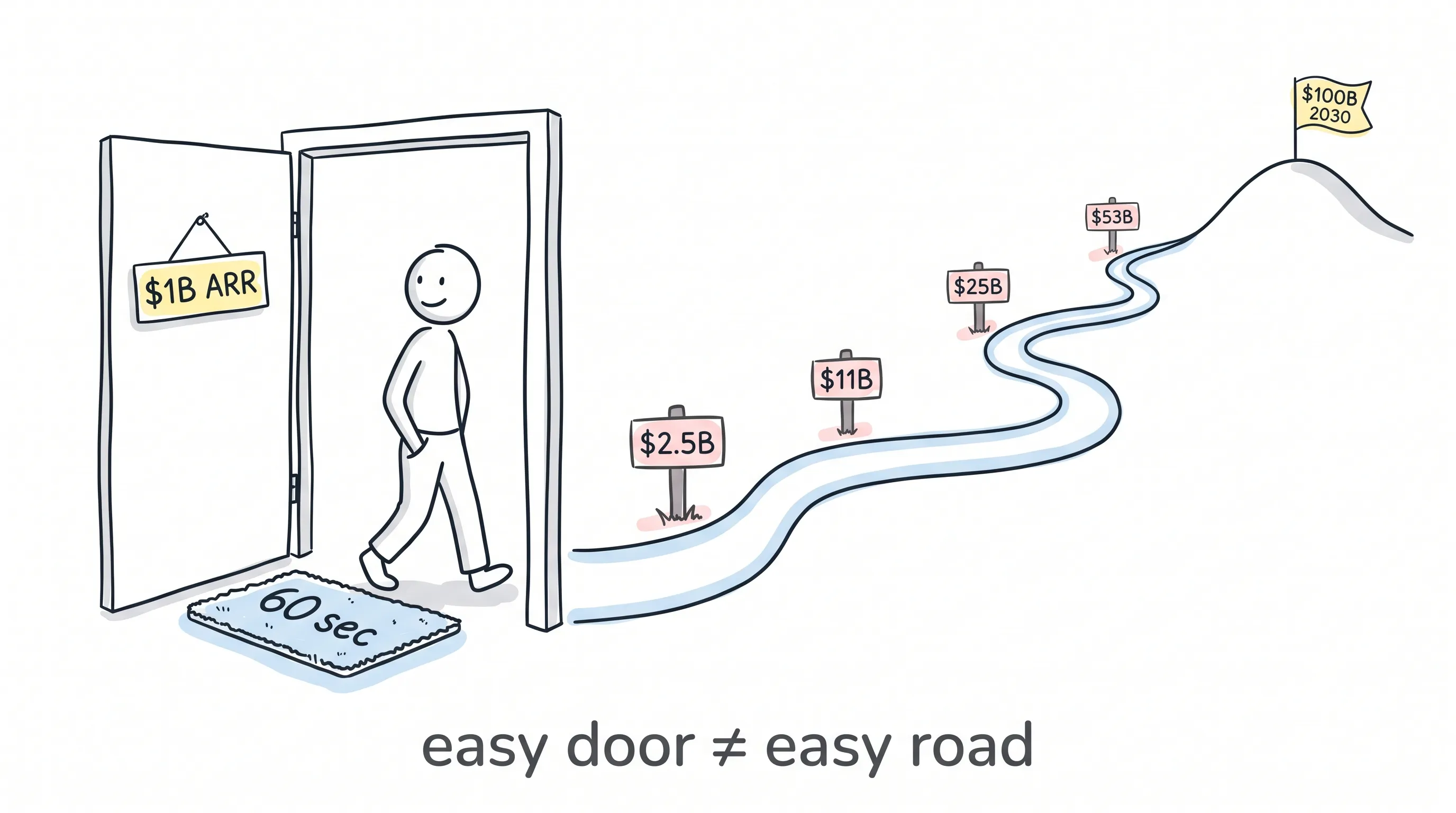
On Monday, OpenAI made an announcement: hand it a URL, and within 60 seconds it will turn your website into a launch-ready ChatGPT ad campaign.
It will go look at what business you run, what products you sell, and who you want to reach, then suggest which conversations your ads should appear next to — with the copy and creative generated on the spot. All you have to do is fill in your region, bidding method, and billing details.
The same day, OpenAI casually dropped another number: less than 200 days after launch, ChatGPT Ads has already climbed to $1 billion in annualized revenue.
Good grief.
On the surface, a big new business has just broken ground. But the more I turn it over, the more I feel these two announcements, placed side by side, are really worth talking through.
First, What Exactly Does "$1 Billion Annualized" Mean?
So what is ARR?
ARR stands for annualized revenue run rate. Put plainly: you take the revenue from the most recent stretch of time, extrapolate it at that pace across a full year, and arrive at a number for "if it keeps running like this, how much would we collect in a year."
Here's an example. You open a bubble tea shop and it does 70,000 yuan in sales in its first week. You tell everyone you meet: this shop of mine does 3.6 million a year.
Is that mathematically wrong? No. But would you dare take that number to a bank for a loan?
ChatGPT Ads launched in February. Reaching a $1 billion annualized run rate in under 200 days is genuinely fast. OpenAI added one more line: since early August, daily ad revenue has grown another 25%.
Wow — 25%.
But cool down for half a second and you'll see: for a business just getting off the ground, a small base makes the percentages look huge by nature. Sell 100 yesterday, sell 125 today, and that's 25% growth. It tells you the momentum is good; it doesn't tell you how big this business will eventually get, or how long it can hold up.
Besides, OpenAI is a private company — it doesn't have to open its books to the public, so this figure can't be independently verified. You can only choose to believe it, or not.
My position: $1 billion annualized, even if it's a projection, is enough to prove one thing — advertisers are willing to give it a try.
Trying, and staying, are two different things.
Let's Do Another Round of Math: What $100 Billion Actually Means
So why is OpenAI in such a hurry to widen the door, pave the road, and hand out coupons?
Because it needs money. A lot of it.
In projections shown to investors, OpenAI drew this line for ad revenue: $2.5 billion in 2026, $11 billion in 2027, $25 billion in 2028, $53 billion in 2029 — and in 2030, $100 billion.
Good grief.
What does $100 billion mean? It's the annual revenue scale of the biggest advertising companies on the planet. Put another way: OpenAI intends to take an ad product that only launched in February and, in three and a half years, grow into a top player in the global advertising industry.
And that line comes with a premise: by 2030, OpenAI's full product family must have 2.75 billion weekly active users.
Let's do the math on its behalf. Even if 2.75 billion people really did show up every week, $100 billion split evenly across all of them means every single user must contribute more than $36 in ad revenue per year — about 250 yuan.
A chat assistant has to reliably collect 250 yuan a year in ad money from every user — without ever annoying them.
Sit with that level of difficulty for a second.
The Good News: This Traffic Sits Very Close to Money
Before you're quick to write it off as a big pie in the sky, know this: the business does have one genuinely seductive quality.
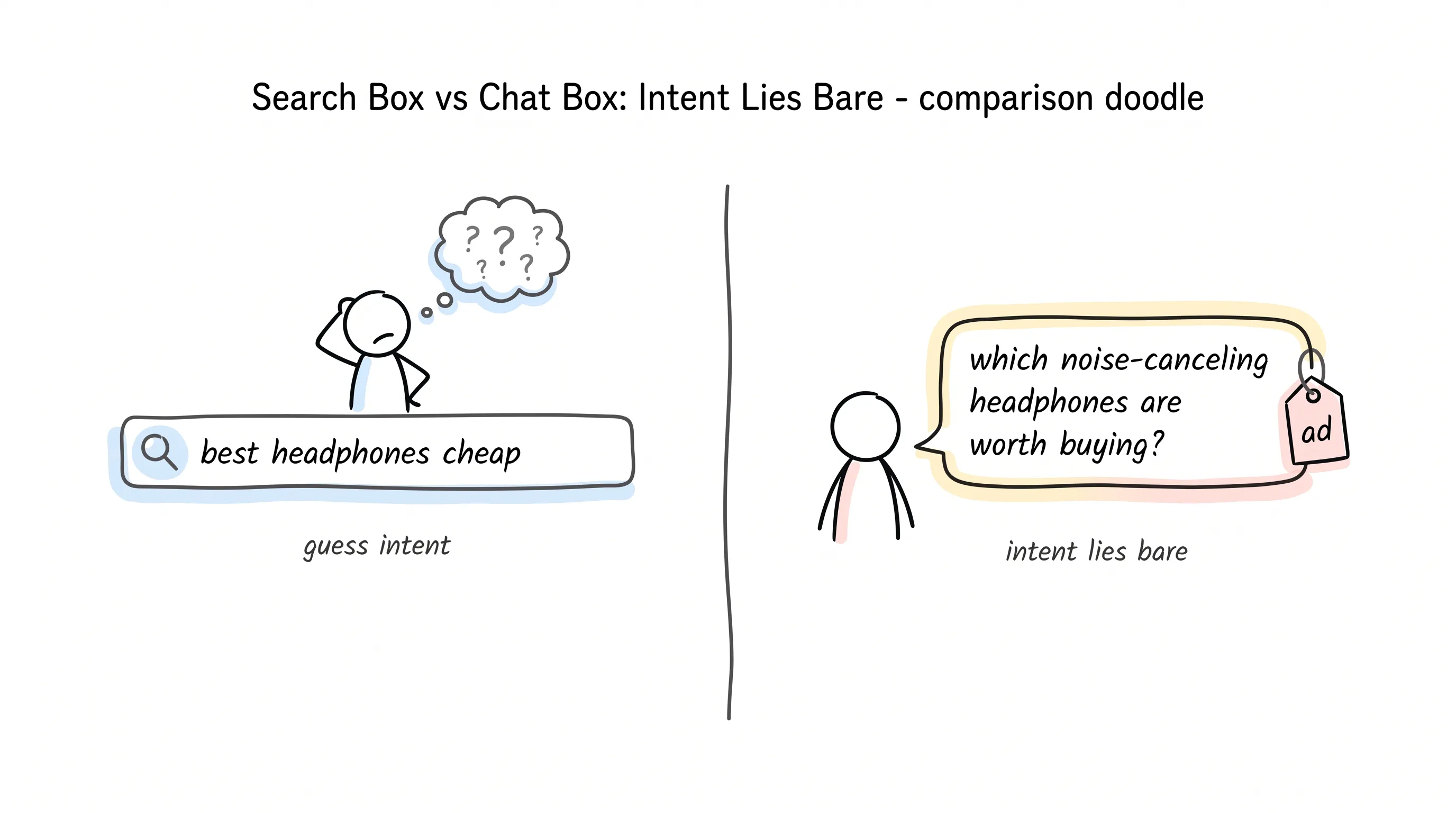
ChatGPT says it has more than 1 billion weekly active users. A large share of what these people type into the chat box goes like this: which noise-canceling headphones are worth buying? What's the difference between these two washing machines? Compare these two quotes for me.
Have you noticed? Those sentences are purchase intent itself.
In a search box, users type keywords and the ad platform has to guess intent. In ChatGPT, users state their intent outright. If an ad can show up right at that moment, it is half a step from closing the deal.
The thing ad platforms all over the world dream of is called "intent." And in the chat box, intent lies bare.
But that's exactly where the problem is buried, too.
A massive user base doesn't automatically become a massive ad business. Several gates stand in between: do the ads match the conversation accurately? Are targeting and measurement any good? Do they bring incremental sales, or just re-book the sales that would have happened anyway? Once the novelty wears off, will advertisers renew? And the most brutal question of all — when you insert ads into a conversation, how do you avoid wrecking the very experience that drew people in?
In a slide deck, these are called "implementation details."
But in the advertising industry, these aren't details. These are the business itself.
Two Buckets of Cold Water, Both With Names Attached
The first bucket comes from the research firm eMarketer.
Its read on OpenAI's forecast is anything but polite: the entire US standalone chatbot advertising market, all of it added together, is expected to come in at under $1 billion in 2026. It also states plainly that OpenAI is nowhere near reaching that $100 billion.
Nate Elliott, an analyst at eMarketer, said publicly in July that it's basically a long shot. In his telling, hitting that target would require several things to be true at the same time: explosive user growth, seizing dominance of the consumer AI market, extremely aggressive ad pricing, and packing conversations with a very dense ad load.
Four things, and every one of them is a hard nut to crack.
The second bucket comes from the survey firm Ipsos.
In its consumer research, it found that 63% of people believe ads would lower their trust in AI answers.
Sixty-three percent. More than half.
OpenAI's response: ads and answers are kept separate, and ads won't influence what ChatGPT says.
That may well be sincere. But you can also see what it means: this firewall is the lifeline of the whole business. The moment the wall comes down, users turn and walk, the traffic is gone, and everything behind it resets to zero.
The Platform Is Young, and the Data Is Still Fighting Itself
So what about the people who have put real money on the table?
It's too early to draw any conclusions, because the data contradicts itself.
One agency executive said they ran a round of campaigns in Canada and saw a click-through rate of roughly 0.6% — quite a bit lower than what they usually see in search ads.
Another advertiser, though, says that after switching to OpenAI's newly launched Max Results bidding strategy, both click-through rate and cost improved noticeably — though he also admits that spend varies a lot across channels, so it's hard to force a side-by-side comparison.
Opinions differ. OpenAI itself, meanwhile, has been cramming hard: it started out selling only on CPM, then added CPC; it plugged in the Conversions API and built pixel tracking; and the longer picture is that you give an agent a goal plus a budget, and it handles the whole campaign itself. Put plainly, it wants to raise an AI media buyer that never sleeps.
That's normal. All young ad platforms look like this: the product changes month to month, customer data is a mixed bag, and nobody can say for sure whether it will actually work once it matures.
The Door Is Easy to Enter Now; the Road Is Still Long
Back to those 60 seconds from the opening.
A lowered threshold does work. A campaign plan generated in 60 seconds can pull the hesitant through the door; spend $500, get a $500 voucher, and you reel in another batch of small advertisers; spread it internationally, and inventory can multiply over and over.
But these tactics, added together, answer only one question: how to get people to try.
They don't answer the real question: can advertisers actually make money here? Once they make money, will they raise budgets? Having raised budgets, will they still be investing next year?
$1 billion annualized — if it's real — proves "willing to try."
The $100 billion forecast bets on something else: that within four years, ChatGPT grows into one of the world's mainstream advertising platforms.
The door, to be fair, keeps getting easier to walk through.
But an easy door doesn't make for an easy road. These are two entirely different exams.
By the way, I honestly hope it pulls this off. A handful of giants have had the advertising pie to themselves for far too long; one more disruptor means those of us who work in marketing end up with more choices.
Just don't mistake the price of admission for the finish line.
Continue reading
Related articles

Cross-Border Business: Time to Upgrade Your AI Toolbox
A learn article explaining how AI tools help cross-border e-commerce sellers clear five hurdles: language, regulation, logistics, payments, and fraud. It outlines a five-compartment toolbox, a five-step adoption path, and metrics such as conversion rate and CLV, while cautioning against over-reliance on AI.

AI Is Taking Over the Dirty Work of Social Media Marketing, One Task at a Time
This learn article outlines four social media marketing tasks AI can handle — audience analytics, content drafting and design, ad targeting and creative testing, and spam moderation — and cautions that taste, judgment, and data security remain human responsibilities.

AI Is Already This Good — Why Is Your Social Media Marketing Still Pure Manpower?
An overview of 18 AI tools for social media marketing, organized into six categories covering audience research, content creation, scheduling, comment and DM handling, ad management, and visual production, plus notes on personalization, prediction, and emerging trends.