
OpenAI Is Putting Ads in ChatGPT. The First to Show Up and Click Them? Bots.
A few days ago a news item crossed my feed, and I stared at my screen for a good few seconds.
A few days ago a news item crossed my feed, and I stared at my screen for a good few seconds.
OpenAI is putting ads in ChatGPT. And this time it's not just text — the ads come with images.
You might ask: doesn't ChatGPT already have ads?
It does. But the earlier kind was modest: an advertiser's name, a logo, a link to a product, sitting quietly next to the conversation. If you don't click it, it just lies there.
This time is different.
When you generate an image in ChatGPT, the ad appears alongside it as an image. It can show what a product looks like, demonstrate how it's used, or give you a glimpse of the "life after you own it" scene. OpenAI has promised two things: these ads stay separate from the image being generated, and they won't creep into the answers you get.
The rollout starts in the US this month, with a small group of advertisers.
Why is OpenAI in such a hurry?
It says ChatGPT now reaches 1.2 billion people every week. A billion-plus people chatting, drawing, and asking questions in there each week — with traffic like that on the table, it almost seems wrong not to turn it into ad inventory. So OpenAI is rolling out new ad formats while bringing in third parties like Hightouch, Tealium, and LiveRamp to pipe in conversion data, making it easy for advertisers to measure results.
The ad slots got thicker, and the measurement plumbing is in place.
Everything looks ready.
But.
There's one question — the most basic of all — that nobody can answer: who exactly is clicking these ads?
TrafficGuard is a company that specializes in ad verification. They dug through ChatGPT's ad traffic — and what they found was startling.
Three weeks of data, 47 advertisers. Invalid click rates: the lowest was 0.1%, the highest was 34%.
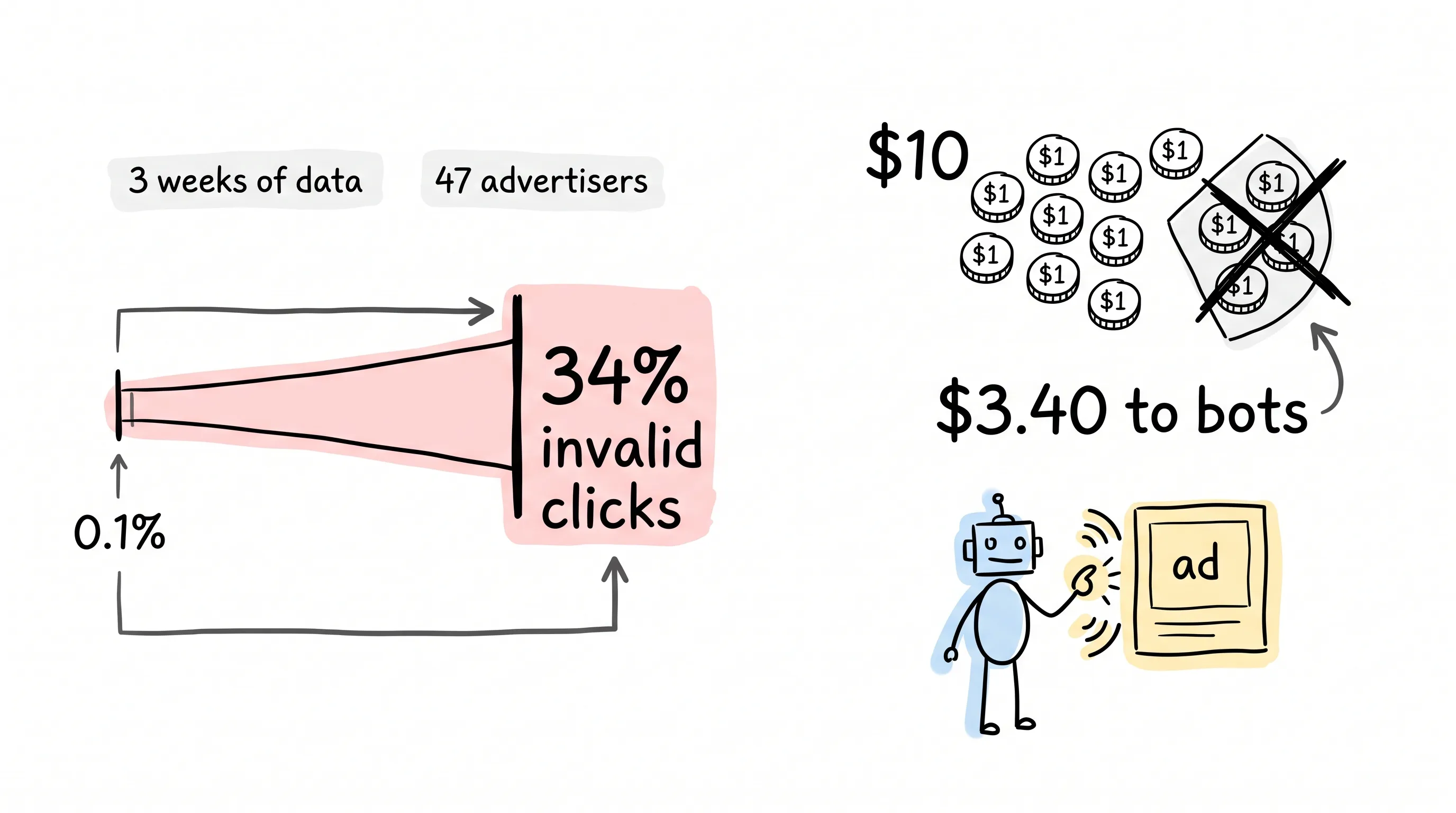
What does 34% mean? For every $10 that advertiser spends, $3.40 goes straight to bots.
Worse still is where those clicks come from. For ad clicks, ChatGPT traffic is 3.6 times more likely than Google's to come from data centers and proxy networks — and 10 times more likely to come from device configurations that simply couldn't exist in the real world.
One detail paints a particularly vivid picture.
One hosting provider — 15 servers, three weeks — clicked ads from 5 advertisers 318 times. Four more hosting and proxy networks reached 25 of the 47 advertisers, contributing half of all the invalid clicks.
The bots discovered the ChatGPT ads business before the advertisers did.
Here's how Mathew Ratty, TrafficGuard's co-founder and CEO, put it: ChatGPT's ads may be brand new, but automated traffic has already found them. It's coordinated, it's persistent, and it clicks every single day.
That's no exaggeration.
What does this remind me of? Imagine opening a new shopping mall. Leasing isn't even finished, the ribbon hasn't been cut, and there's already a long line at the gate. Your heart lifts: business is here.
You get closer — it's all scalpers.
Scalpers don't buy anything. They line up to make the store "look busy," then sell that look to the next person who actually pays.
Bots clicking ads work the same way. They don't buy anything; they manufacture the illusion that traffic is worth paying for, so the people willing to pay for it keep paying.
So here's the picture: OpenAI thickened the ad slots and laid the measurement plumbing — the dealing was flawless. Yet the most active players at the table turned out to be there for a free ride.
No matter how fast the traffic arrives, it doesn't count. What counts is whether the hand doing the clicking belongs to a human.
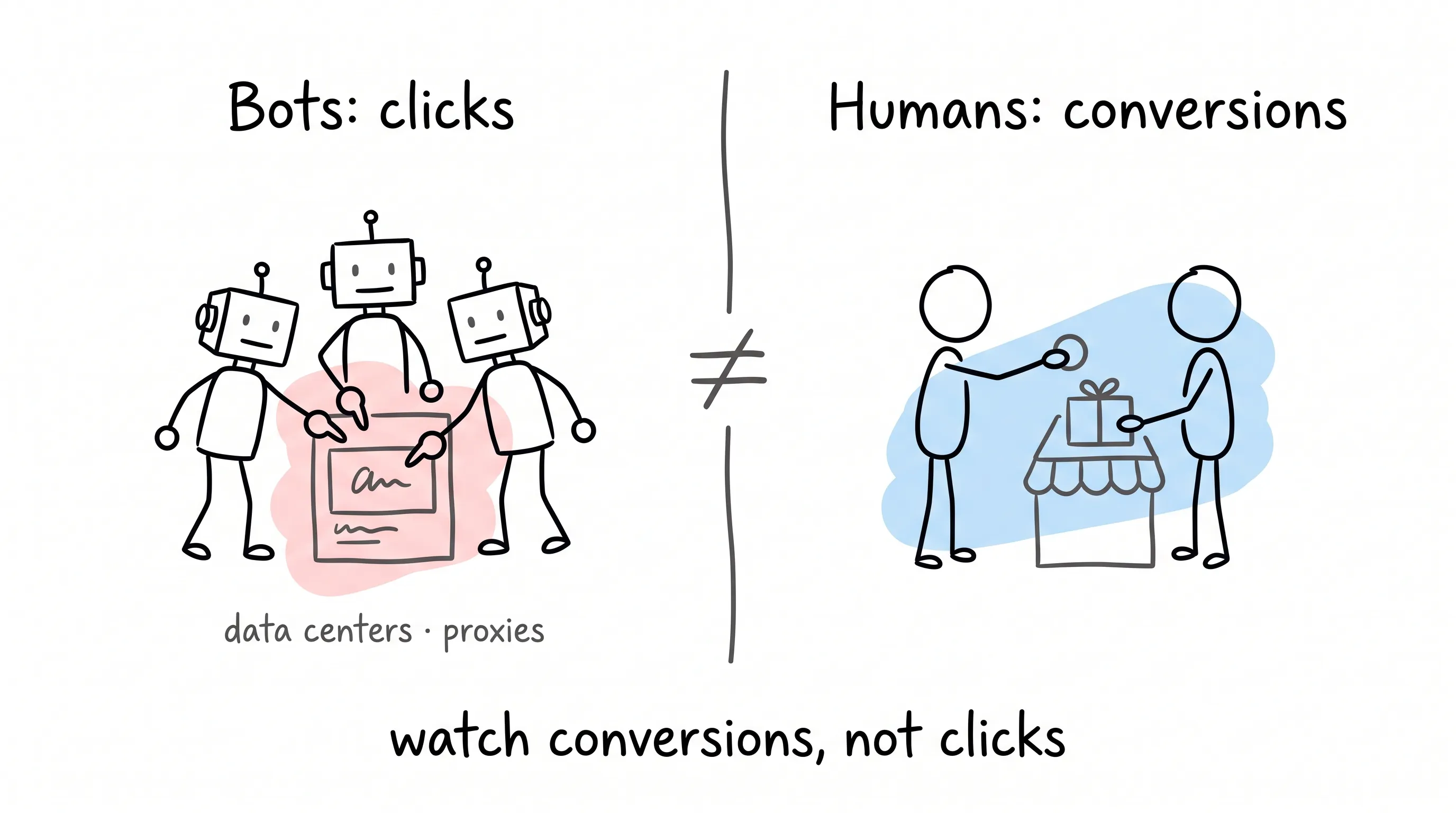
To advertisers, one honest word: when you run ads on ChatGPT, don't fixate on clicks — watch conversions. Ask whether your money went to bots or to people.
May every dollar of your ad budget buy a real human's attention.
Continue reading
Related articles

Cross-Border Business: Time to Upgrade Your AI Toolbox
A learn article explaining how AI tools help cross-border e-commerce sellers clear five hurdles: language, regulation, logistics, payments, and fraud. It outlines a five-compartment toolbox, a five-step adoption path, and metrics such as conversion rate and CLV, while cautioning against over-reliance on AI.

AI Is Taking Over the Dirty Work of Social Media Marketing, One Task at a Time
This learn article outlines four social media marketing tasks AI can handle — audience analytics, content drafting and design, ad targeting and creative testing, and spam moderation — and cautions that taste, judgment, and data security remain human responsibilities.

AI Is Already This Good — Why Is Your Social Media Marketing Still Pure Manpower?
An overview of 18 AI tools for social media marketing, organized into six categories covering audience research, content creation, scheduling, comment and DM handling, ad management, and visual production, plus notes on personalization, prediction, and emerging trends.