
Only 15% of CMOs Are Seen as "Getting AI" by Their CEOs. What About the Other 85%?
This article discusses why many CEOs doubt marketing's AI work, citing a Gartner figure that only 15% of CMOs are seen as understanding AI. It outlines three steps—clear goals and KPIs, data-driven personalization, and reporting results in growth terms—with Braze as an example.
A while back, I invited an old friend to dinner. He's the CMO (chief marketing officer) at a consumer brand — an impressive-sounding title, but the mood at that table was subdued.
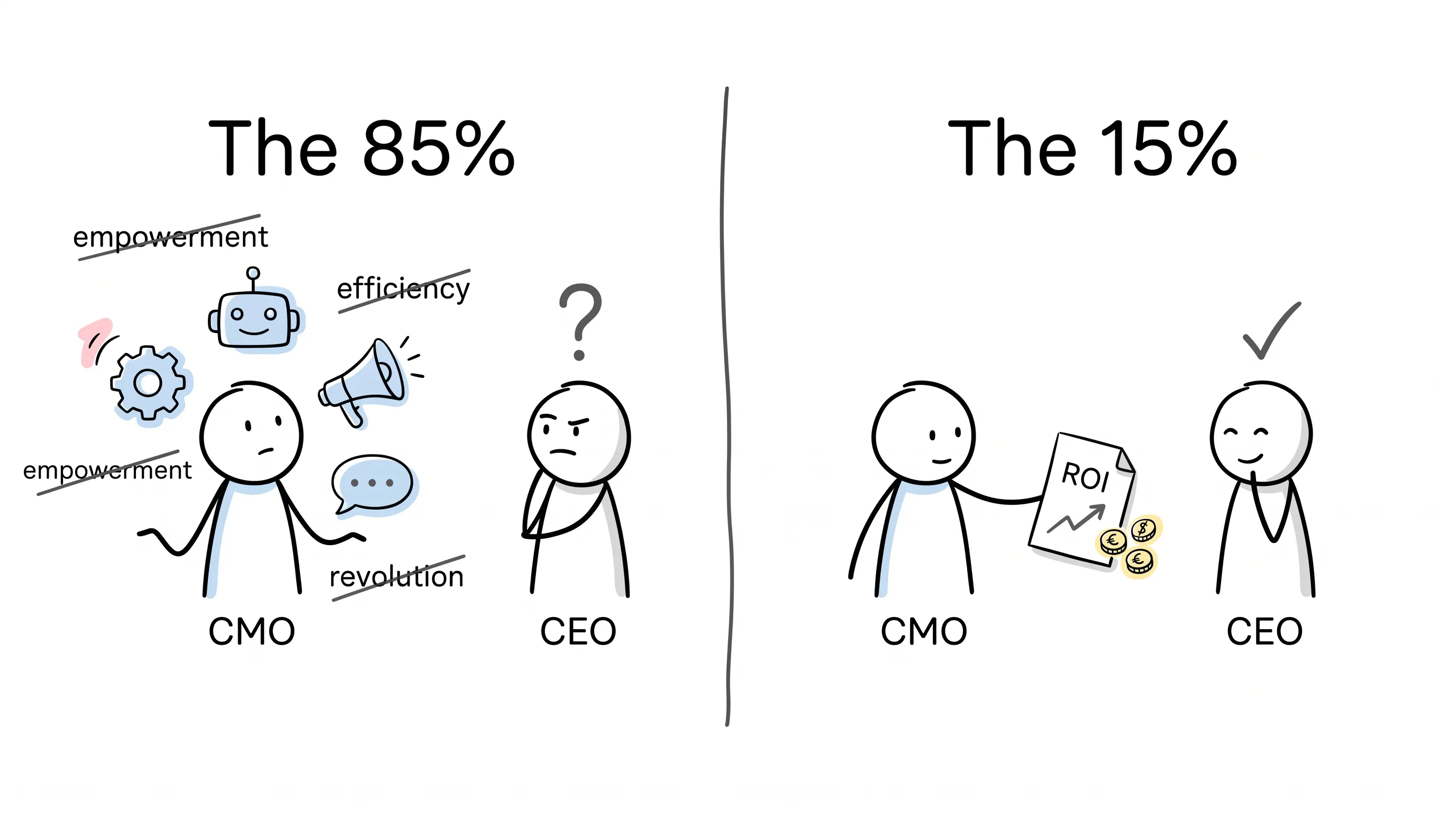
He told me the whole company shouts AI from the rooftops every day — AI-powered ad placement, automated content generation — he'd missed none of it, buying tool after tool. Then at last month's business review, the CEO asked him in front of everyone: all this money spent on AI — how much more has it actually earned the company?
He froze.
He'd walked in with a whole arsenal of "empowerment," "efficiency gains," and "revolution" — and not one of those words came out.
Impressive? Undeniably. But the CEO wasn't buying it.
It's like equipping a restaurant with a full Michelin-star kitchen, only for the guest to walk in and ask one question: the food — is it any good?
The more I turned it over afterward, the more I realized he isn't alone in this. Gartner once published a brutal stat: only 15% of CMOs are seen by their own CEOs as truly "getting AI."
Fifteen percent. The other 85% all count as "don't get it" in the boss's eyes.
Stings, doesn't it? It does. But on reflection, it makes sense.
Because in a CEO's eyes, getting AI has never been about how many tools you can use — it's about whether you can turn AI into numbers on the business reports.
The boardroom is no place for idealism. However beautiful the vision, if it never lands on profit, it's worth zero.
So what do you do? How do you turn the work AI does into ROI the CEO will actually credit?
I've boiled down what I've seen and thought into three steps: figure it out, pull it off, spell it out.
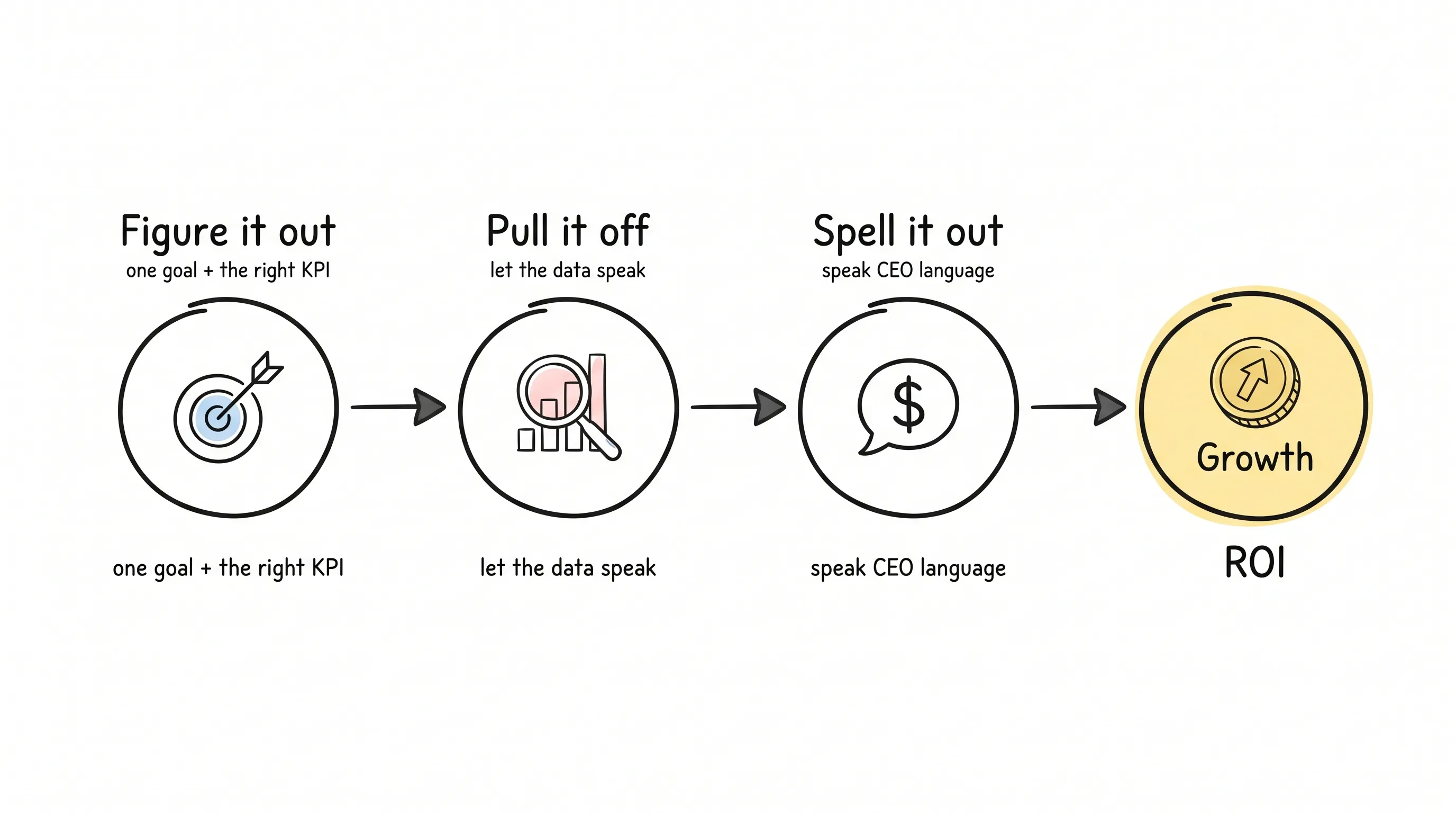
Step One, Figure It Out: What Problem Are You Actually Solving?
What does a clear goal actually mean?
It means that before you lift a finger, you can say in one breath what this round of AI adoption is ultimately for. Is it to make customers more willing to engage with you? To sharpen the targeting of your promotional spend? Or to convert leads faster?
Pick one. Nail it down.
Think about it: if there isn't even a goal, what's the point of AI generating a hundred posters or running a thousand ad combinations?
AI without a goal is a cost. AI with a goal is an investment.
Once the goal is set, you still need to know which ruler to measure with. That ruler is the KPI.
And every industry's ruler looks completely different. What does a bank look at? Probably customer acquisition cost and per-customer value. A retailer? Repeat purchase rate and inventory turnover. Fast food? How fast a single store can turn out orders at peak hours.
That's the trap many brands have stepped in: copying someone else's metrics. Measure your business with someone else's ruler, and all you get is error.
Step Two, Pull It Off: Let the Data Speak for You
Only when the goal is clear does AI finally get its turn.
What AI does best is read human preferences out of mountains of behavioral data. Consider: it finishes analyzing and discovers that one particular group responds exceptionally well to targeted social-media ads. What are you waiting for? Shift the budget over and double down.
And the result? Engagement goes up, and revenue climbs right along with it.
What is personalization, really? That's what it looks like when it actually lands.
Let's run another set of numbers. Say you have a promotional budget of 10 million. The old way was one-size-fits-all — everybody gets a share. Now AI tells you: concentrate 3 million of it on one specific group, and the return triples. Same money — the extra chunk that comes back is your ROI. The math really is that simple.
There is one precondition, though: the AI solution has to be tailor-made for you.
Take Braze. The way they serve brands is worth a closer look: the brand and the AI solution work side by side, with an AI services team alongside acting like consultants — first they get a thorough grasp of what you need, then they build the plan around your brand's ROI goals, monitor the results after launch, and tune the models for you round after round.
Your data, your boundaries, the things that are off-limits — pestering customers, misusing private data — all of it has to be welded into the plan. Why? Because the essence of business is relationships, and the moat of customer relationships isn't something you trade away for short-term numbers.
One more thing worth a reminder: with AI, going live is only the starting line.
Models need constant watching and constant tuning. Teams need constant learning too — new tricks and tactics pop up nonstop, and three months of not learning can leave you a good stretch behind. The habit of continuous learning is, in itself, a competitive edge.
Step Three, Spell It Out: Translate the Results into the CEO's Language
The first two steps done solidly, one last step remains: the report-out.
This is where many CMOs are truly weakest. The work got done, the results exist — but the moment they open their mouths it's all "AI agents," "one-to-one personalization," "omnichannel reach," and the CEO's brow starts to furrow.
What does the CEO care about? Growth. Strategic goals. The bottom line. Yes — it's that plain.
Think about it: CEOs don't actually oppose AI. If anything, they worry about the opposite — that marketing is embracing AI too slowly. They've said as much in public, plenty of times. So you see, the CEO isn't anti-AI — he's anti "AI whose returns can't be explained."
How do you present it? Two moves.
First, tell case stories. Companies in the same industry, of the same size — what results have they produced with AI? Dig them out and lay them on the table. Facts beat any adjective. Braze's website carries a whole library of customer case studies — find the ones that look like you and study them one by one; that beats a hundred well-turned sentences of your own.
Second, translate. Turn "engagement rose 20%" into "how much more profit came from repeat purchases by existing customers." Turn "ad efficiency improved" into "how much more the same budget brought back." Tie every AI project back to the same line: growth and company strategy.
A CEO may not understand "AI," but he always understands "money."
Finally, Back to That Dinner
That night after dinner, I told my friend: it's not that you don't understand AI — you just forgot to translate.
Three months later he told me: at the next business review, he never once mentioned a tool by name. He opened with three numbers — how much more we earned, how much we saved, how much faster we got.
The meeting room went quiet for a few seconds. Then the CEO nodded.
He said that moment felt better than closing any big deal.
When it comes to AI, whoever can translate technology into growth is the one who keeps a seat at the table.
And here's my bigger wish for you: be part of that 15% — the CMOs their CEOs believe truly get AI.
Continue reading
Related articles

Cross-Border Business: Time to Upgrade Your AI Toolbox
A learn article explaining how AI tools help cross-border e-commerce sellers clear five hurdles: language, regulation, logistics, payments, and fraud. It outlines a five-compartment toolbox, a five-step adoption path, and metrics such as conversion rate and CLV, while cautioning against over-reliance on AI.

AI Is Taking Over the Dirty Work of Social Media Marketing, One Task at a Time
This learn article outlines four social media marketing tasks AI can handle — audience analytics, content drafting and design, ad targeting and creative testing, and spam moderation — and cautions that taste, judgment, and data security remain human responsibilities.

AI Is Already This Good — Why Is Your Social Media Marketing Still Pure Manpower?
An overview of 18 AI tools for social media marketing, organized into six categories covering audience research, content creation, scheduling, comment and DM handling, ad management, and visual production, plus notes on personalization, prediction, and emerging trends.