
One AI Agent: Shopify Lets It In, Amazon Shoves It Out
An analysis of why Shopify welcomed Meta's Muse AI agent through its Agentic Storefronts program while Amazon blocked it, contrasting Shopify's treat-it-as-a-channel logic with Amazon's defense of its interface, ads, and customer relationships in the contest over AI shopping entry points.
Imagine you're picking out a birthday gift for your niece.
You say one line to your AI: "Pick something for me — under $100, delivered by Friday."
Then you go off and do something else.
The AI researches products on its own, digs through reviews, compares prices, checks stock, and finally serves up a few options. You nod, and the order is placed. The whole time, you never opened a single shopping website.
This isn't fantasy. In September, Meta released a personal AI agent called Muse that does exactly this job. It can browse stores, fill out forms, and place orders on the web for you — with your approval on every single purchase. Meta also built it a dedicated browser environment called Muse VM. And better yet, it has memory. The preferences you tell it, it remembers, and picks up where it left off next time.
Wow. It shops, it orders, and it remembers.
What's really interesting, though, is how the giants reacted.
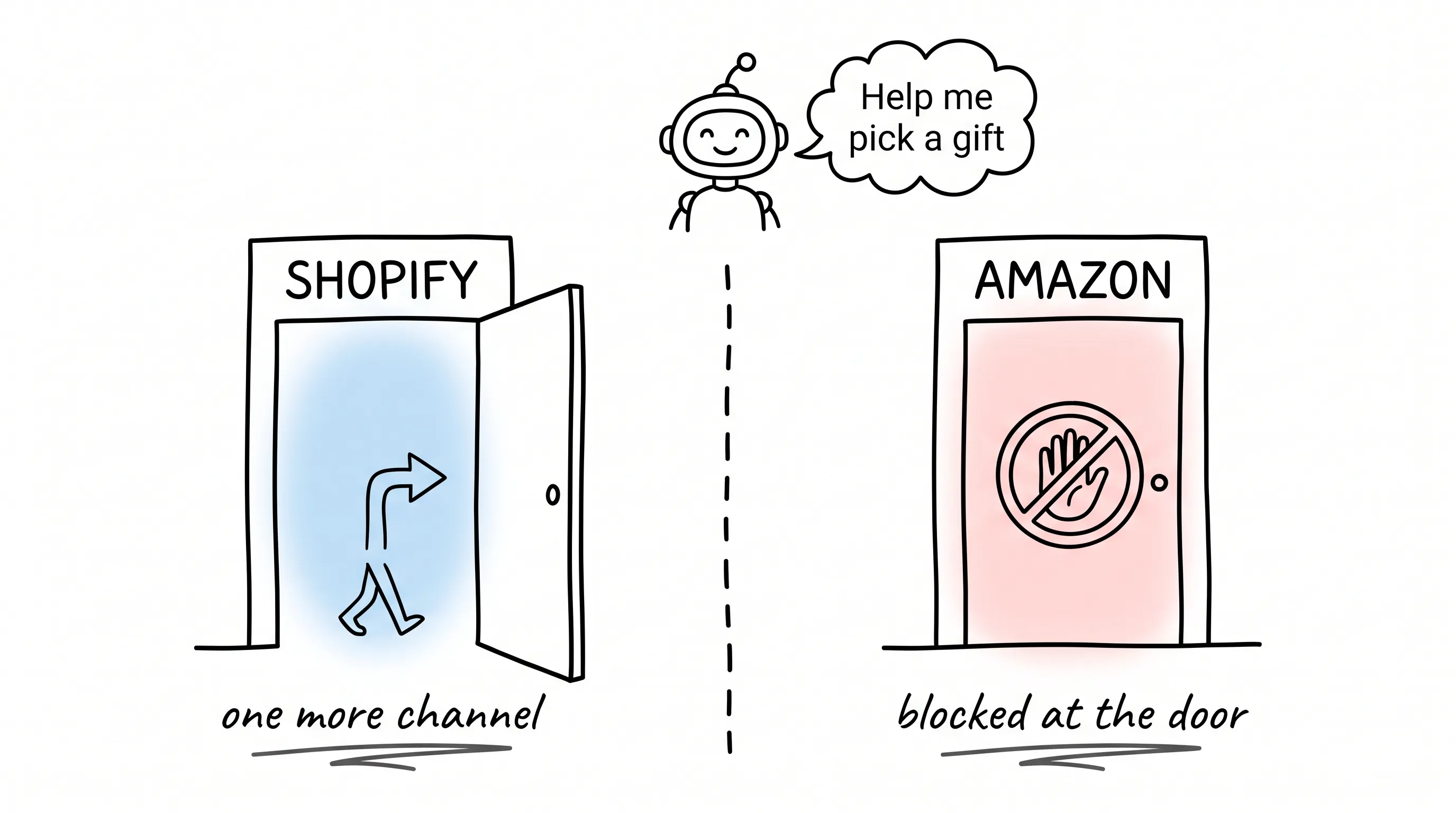
The same Muse: Shopify invited it in; Amazon blocked it at the door.
On September 8, the day Muse launched, Shopify added Meta to its Agentic Storefronts program. In plain terms, it's a sales channel built for AI agents. Merchants' products are shared with Meta by default; merchants keep control of catalog permissions and checkout themselves, and they can see how the Meta channel is performing in their dashboard.
And Amazon? It blocked Muse outright. If you direct Muse to buy something on Amazon, you'll see a notice: continued access by an unauthorized AI agent violates Amazon's terms of use. Amazon's public position: Meta never got authorization.
One opens the door, one slams it shut — and each is convinced it has done nothing wrong.
Why?
Because the two companies are keeping two different ledgers.
Shopify's Ledger: One More Channel
Think about how Shopify makes money.
It only earns when merchants sell. Whether a customer browses the website themselves, clicks in from a social platform, arrives from a search engine, or places an order through an AI agent — it's all the same to Shopify. A sale goes through, and the money comes in.
So for Shopify, Muse isn't a threat; it's a channel. One more channel, one more stream of traffic.
And think one step further: even if agents take over the entire shopping experience and customers stop visiting stores altogether, Shopify still owns the essentials: product catalogs, checkout, payments, order management. The foundation stays put — decorate the building however you like.
That's the platform's mindset: as long as the goods ship through me, I don't care who runs the storefront.
Amazon's Ledger: This Is My Turf
Amazon keeps a different set of books.
Where does its money come from? From the shopping interface, from ad placements. Why you search for this, why you click on that, why you toss in one extra item — all of it is worth money.
Now Muse has wedged itself in between Amazon and you. You tell it what you want; it searches, compares, and buys. So will you still browse Amazon's pages? Will you still click the ads in those recommendation slots?
In Amazon's eyes, the nature of this has completely changed: someone is walking off with its customers, right on its own turf.
So it has to block. Either play by its rules, or stay out.
One Layer Deeper
Neither company is wrong. The same agent can be a customer-acquisition channel, a checkout terminal, or a middleman squatting in between. The only difference is who controls it.
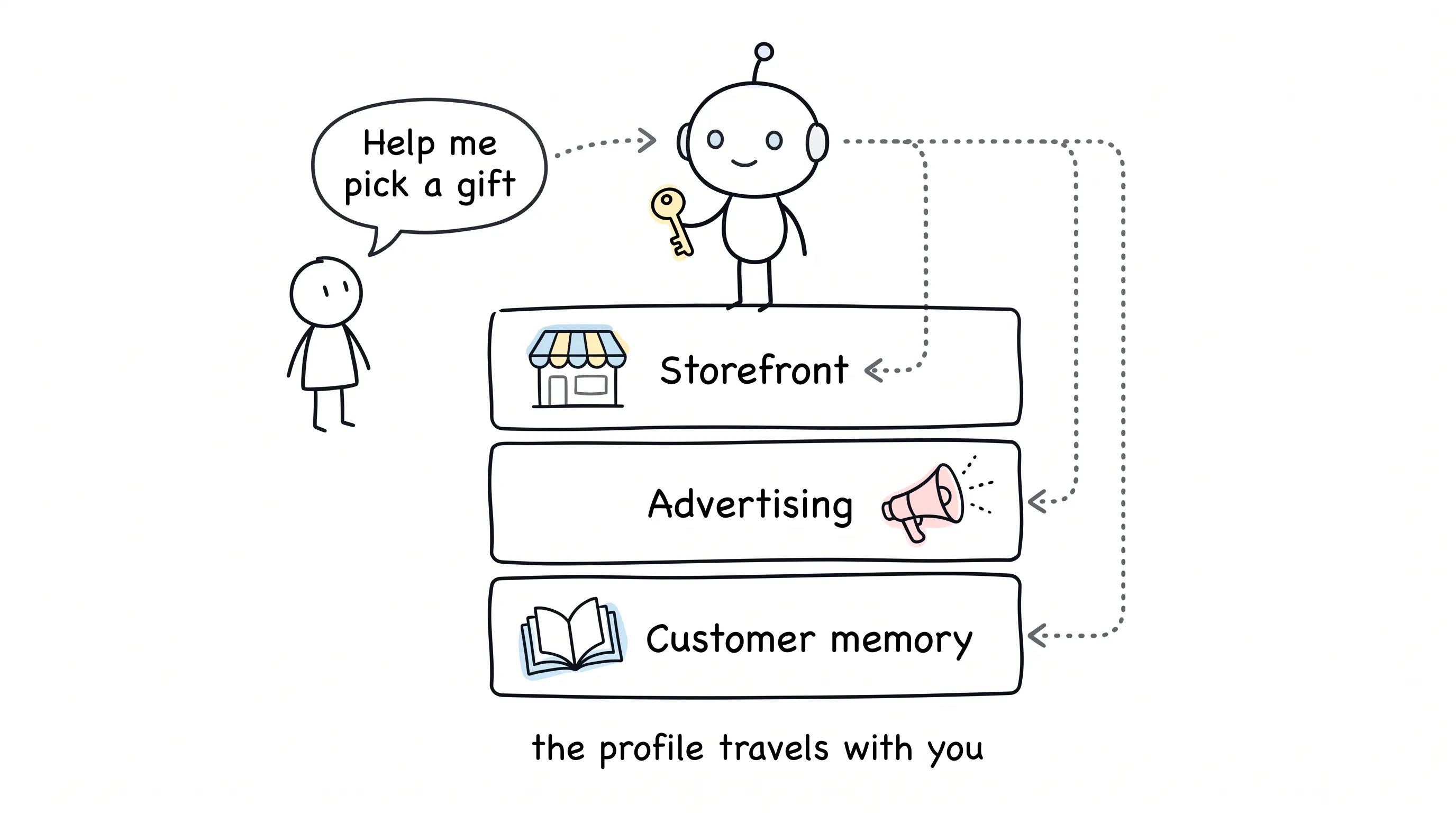
Where do you start looking? Start with that one line you said: "Help me pick a gift."
In the scene from a moment ago, the store is still there. The product data still comes from the merchants, the goods still ship from the platform. But the storefront now belongs to the AI. The customer never once set foot in a store.
One layer up is advertising.
Why do merchants buy search ads and retail media? To appear right in front of you at the exact moment you want to buy.
But now, your purchase intent gets intercepted by the agent before it ever reaches the ad system.
Say a consumer tells Muse: a month in Italy, needs a carry-on suitcase, $250 budget, genuine leather. The agent starts comparing options on the spot. By the time she opens a search engine or clicks into a shopping site, the shortlist is already drawn up. Your ads — she won't glance at a single one.
The power to decide "which products get seen" is shifting from the ad systems into the agent's hands.
The deepest layer is the customer's memory.
Retailers have spent years trying to piece together a complete picture of each customer. Transaction records, browsing behavior, loyalty data, email interactions... piece it together however you like, and each one is still holding only a fragment.
Now, Muse can remember everything you tell it: sizes, brands, budgets, expectations about delivery speed, what you've bought.
What does that mean? It means the customer profile no longer lies scattered across individual retailers — it lives inside a single agent, traveling with you from this purchase to the next.
Whoever controls the agent holds the customer's preferences and intent.
Traffic is the small matter. The customer relationship is the big one.
Two Bets
Shopify is betting that agents will become a new road for selling goods. I won't block it — I want to be underneath the road.
Amazon is betting that anyone who wants into its arena plays by its rules first.
One opens the door, one closes it, and each side's math is perfectly clear. But precisely because both sides are so firm, you can see just how much is at stake underneath:
An open door or a closed one — it's all surface. What lies underneath is a war over the entry point to AI shopping.
The war has only just begun.
The next time you tell an AI "help me pick a gift," pause for one extra second and ask: the brain that makes the decisions for you — whose house does it live in?
Continue reading
Related articles

Cross-Border Business: Time to Upgrade Your AI Toolbox
A learn article explaining how AI tools help cross-border e-commerce sellers clear five hurdles: language, regulation, logistics, payments, and fraud. It outlines a five-compartment toolbox, a five-step adoption path, and metrics such as conversion rate and CLV, while cautioning against over-reliance on AI.

AI Is Taking Over the Dirty Work of Social Media Marketing, One Task at a Time
This learn article outlines four social media marketing tasks AI can handle — audience analytics, content drafting and design, ad targeting and creative testing, and spam moderation — and cautions that taste, judgment, and data security remain human responsibilities.

AI Is Already This Good — Why Is Your Social Media Marketing Still Pure Manpower?
An overview of 18 AI tools for social media marketing, organized into six categories covering audience research, content creation, scheduling, comment and DM handling, ad management, and visual production, plus notes on personalization, prediction, and emerging trends.