
Once Your AI Agents Go Live, Who Owns Them?
This learn article examines who should own marketing AI agents after launch, arguing that central teams handle access, data, and the model layer while marketing owns instructions and tone, and applies software maintenance history to agent upkeep through five accountability questions.
A while back, I was having dinner with a friend.
He works at a large utility company. Next quarter, they're launching 200 AI agents. Most of them weren't built by the IT department — business units like marketing built them themselves.
"Impressive," I said.
Genuinely impressive. Business teams didn't have to wait for IT's schedule; they built the agents themselves. This is the state a lot of companies have dreamed of for years.
Then I asked, off the cuff: these 200 agents — once they're live, who's in charge of them?
He said, what do you mean?
I said: when the model gets upgraded, who follows up? When company policy changes, who updates the agent? If the person who wrote it moves to another role, whose problem is it then?
He froze.
He thought for a while. He didn't have an answer.
We're all busy building. Busy making agents do work, busy celebrating "another one is live." But few people stop and ask one question:
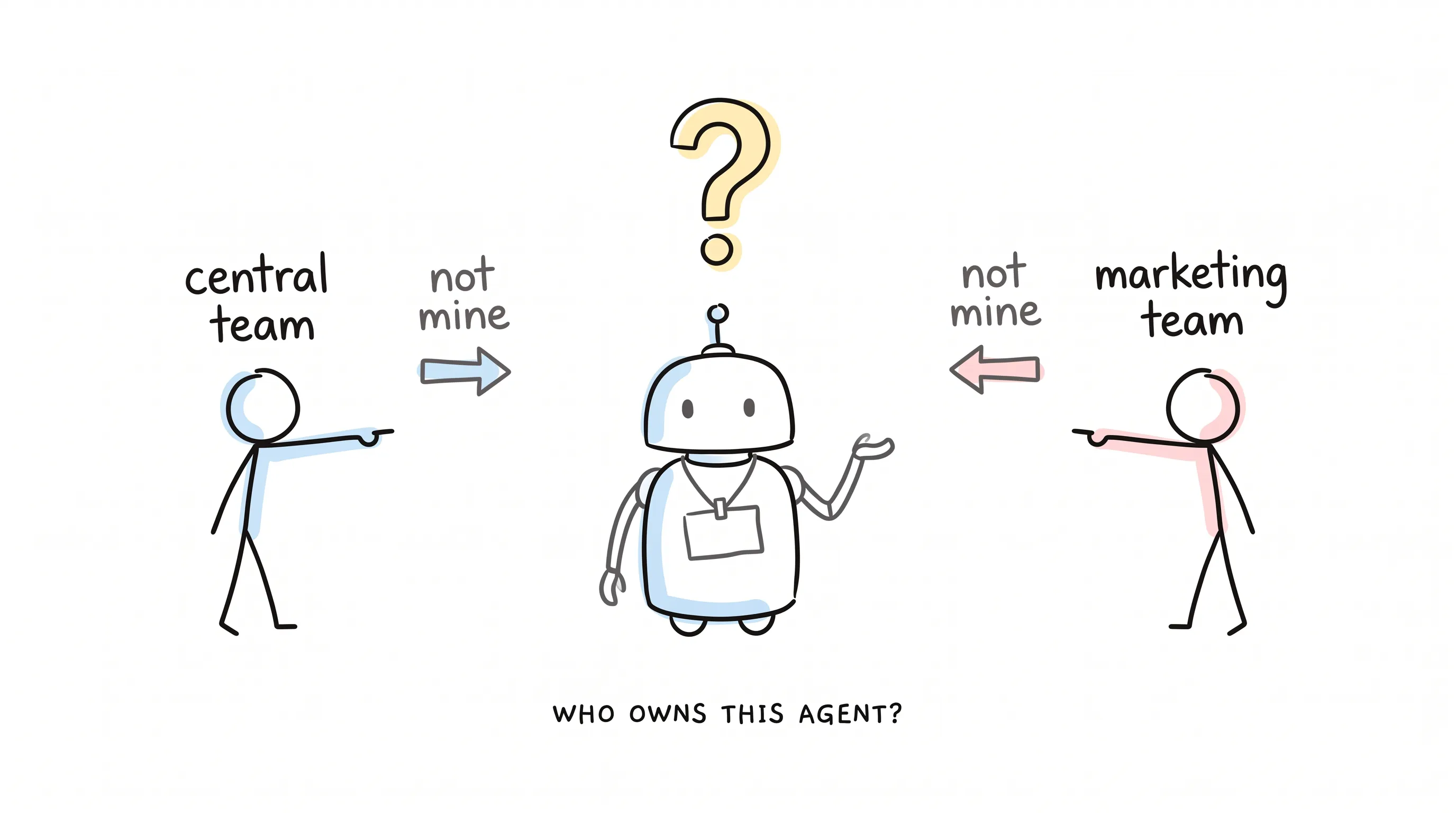
These agents — once they're live, who owns them?
"Should We Build?" Is No Longer the Question
Some background first.
This past May, Kana surveyed 225 executives at large American enterprises. 70% are already using custom agents in real marketing work. Only 3% use none at all.
What does that tell you?
The debate over whether to build agents is over. While you're still deciding whether to get on board, they're stowing a second suitcase.
The really interesting question is the next one: what happens after you build?
And that's exactly the vaguest part of all.
Ask the same executives "who should own marketing agents": about 40% say the Chief AI Officer should. Among AI leaders, that number is 52%. Ask marketing executives, and most pick their own department — or some shared model.
See it?
In plain terms: two groups of very capable people, each assuming the other is handling it.
So here's the real state of many companies right now: agents are running, data is flowing, and nobody is actually watching.
Both Sides Are Half Right
So who should own them, exactly? A central team, or the business teams?
I've heard both sides. Both make sense.
The central-team camp says: agents touch customer data every day, they're wired into compliance risk everywhere, and no department should rest easy letting an agent police its own output.
Right? Exactly.
The business-team camp says: people on central teams can't tell whether the agent's tone is right, don't know whether the offer it's pushing is still valid, and have even less idea whether its audience-targeting logic still fits the current playbook.
Also right? Also true.
When both sides are right, that's when things get messy.
Departments will each assume the other is in charge. A named person won't.
So, split it.
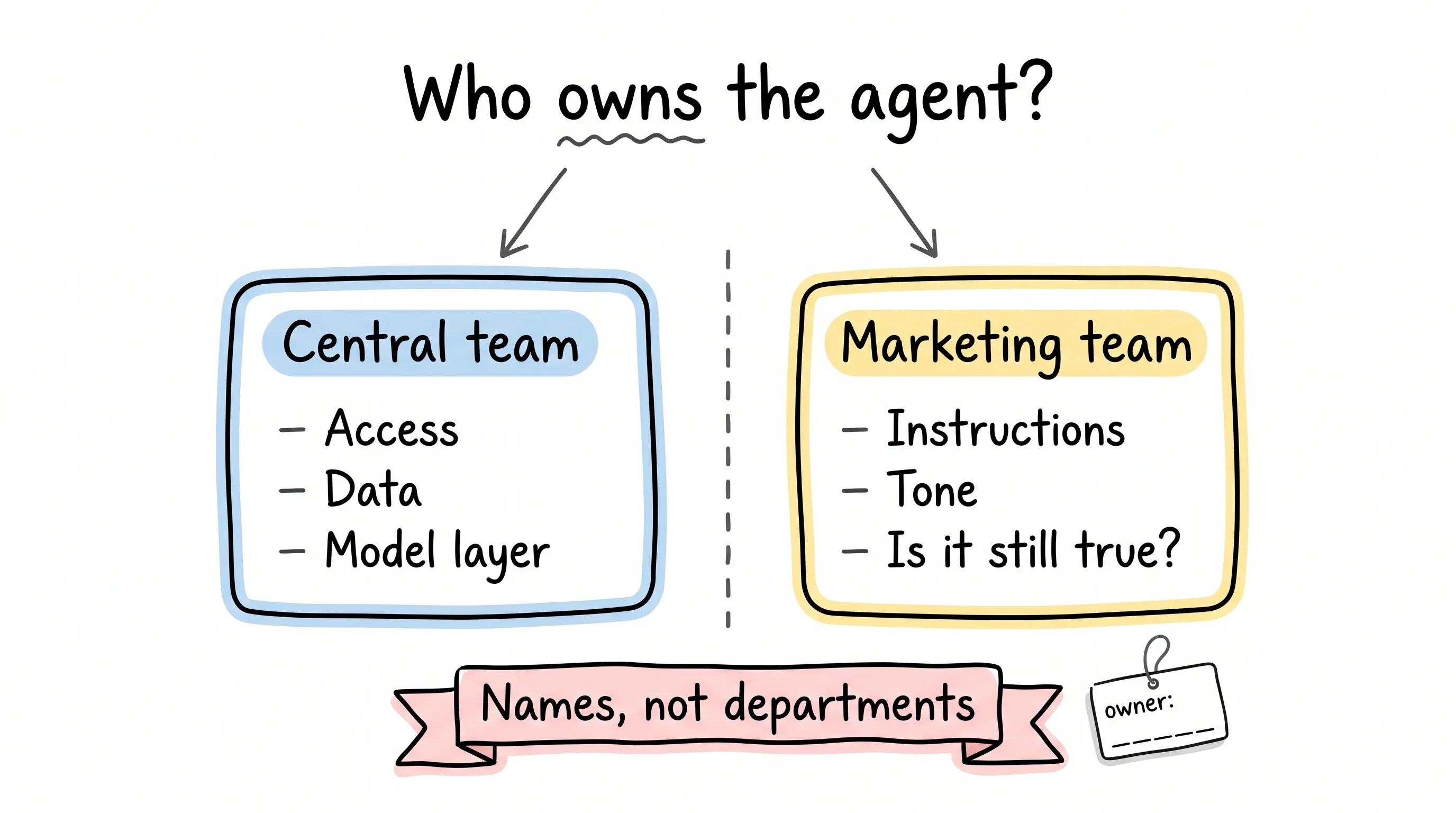
Split one big question into two smaller ones: the central team owns access, data, and the model layer. The marketing team owns the instructions, the tone, and whether what the agent is saying right now is still true.
Both lists have to land on specific names.
Note: names, not departments.
A Name Isn't Real Ownership
Speaking of names, one stat really stings.
In February and March, Ivanti surveyed 1,500 IT professionals. 85% said: every agent we run has a named owner. Only 42% said it's clear who that owner is and what they're responsible for.
85 against 42 — a 43-point gap.
What is that gap?
It's the distance between "having a name" and "actually being accountable." The name sits in a document, and when something breaks nobody knows whom to call. That kind of "having" is about as good as not having.
There's also a habit worth checking in your own systems.
A lot of organizations build agents by cloning a real user's account. Easy. Fast.
The cost?
Your campaign agent may be wandering through your systems right now carrying the CRM permissions of whoever built it. That person has left, moved roles, and their access was supposed to be revoked — but the agent still roams the building with those credentials.
Fine on launch day. What about now?
Who would ever notice?
One more number while we're here: 65% of organizations review agents before launch. Governance shows up on release day, like a ribbon-cutting. The ribbon gets cut, the agent works every day, and a human looks in once a quarter.
The Software Industry Has Already Taken This Beating
At this point, let me tell you a bit of history.
From the 1940s to the 1960s, code was a one-time thing in most people's eyes. Write it, accept it, ship it, done — about like knocking together a chair.
Then more and more critical systems started running 24/7. The "write it and ship it" logic collapsed.
- Garmisch, a small town in West Germany. NATO convened a conference, and engineers from a dozen countries sat down to compare notes — and discovered they were all stuck on the same problem: software goes stale. Correct on the day it's built; six months later, maybe not.
Out of that conference grew the software lifecycle in today's textbooks: requirements, design, build, test, deploy... and then, maintenance and retirement.
Those last two steps weren't designed in — they were bolted on after the beating. The whole industry paid real money to learn one lesson: software doesn't maintain itself.
So how expensive is maintenance, really?
In 1980, two researchers, Lientz and Swanson, studied 487 organizations and found that maintenance ate roughly half of software budgets.
Half!
The itemized bill is even more interesting. The biggest chunk is called perfective (requirements changed): the code has to change. The second biggest is adaptive (the environment changed): the code has to change. Actual defect-fixing corrective maintenance? The smallest chunk of all.
What does that mean?
Most maintenance cost goes to "the code isn't wrong — the world changed."
Now Map This History onto Your Agents
Your content agent went live in March, written against March's offers and March's messaging.
Your SDR (sales development rep) agent learned from customer profiles built before the price change.
Your brand-voice guardrail is tied to a model version the vendor retired over the summer.
Are these bugs?
None of them are. Not a single line of code has broken.
But the world changed. The offers expired, the prices moved, the model got retired. In software terms, this is maintenance. And maintenance requires someone who knows "what changed," and "what to do next."
Picture your agent walking into Monday's standup and introducing itself:
"Hi everyone, I'm the campaign agent. I was born in March, built for a promotion that ended in June. And right now, I am still sending."
You're not laughing, are you.
Five Questions to Ask Yourself
So go check. Pick one agent already running in production and ask five questions:
- Who wrote its instructions?
- Who updates those instructions — and how often?
- Who tracks model updates and translates "what changed in the model" into actions your team can actually use?
- Who watches its output drift? Against what baseline?
- Who decides when it retires?
I've talked to a lot of teams. Question one gets an instant answer. By question two, the room starts going quiet. After question five, dead silence.
Silence means nobody owns this today.
How do you fix it? No new headcount needed — spread these five jobs across seats you already have.
Instructions and revision cadence go to marketing ops. The workflow is already theirs.
Output drift goes to brand. They're the only ones in the company who can say whether a piece of copy still sounds like "us."
Model updates go to the AI team or the platform team. They already watch version releases — this comes almost for free.
And retirement? Retirement usually has no taker. Give it to whoever owns the budget.
Why?
Because they're the only person in the company who will stare at that budget line and ask: why is this still being spent?
And you get to pick the granularity. Small team, three to five agents — one person per agent, crystal clear. Large organization with workflows running across the whole system — split by platform, and check drift by sampling.
Tools are coming too. Salesforce has already started naming the pieces: an agent development lifecycle, roles like Agent Supervisor. Other vendors will follow.
But keep one distinction clear: tools solve "how to manage." Organization solves "who manages." No vendor can answer the second question for you.
Build the Habit While It's Cheap
The good news: right now is when this is cheapest.
Habits built at 8 agents become muscle memory at 80. Wait until 80, and managing them turns into a company-wide campaign.
Software had to crash into a crisis and spend another decade to learn that "launch is only the first half."
We don't have to take that beating.
Agents are raised, not planted.
Next Monday, before you walk into that meeting room, bring two questions:
Who owns your oldest agent?
When was the last time anyone seriously looked at what it's producing?
If you can't answer, that's okay.
Go check this afternoon. There's still time.
Continue reading
Related articles

Cross-Border Business: Time to Upgrade Your AI Toolbox
A learn article explaining how AI tools help cross-border e-commerce sellers clear five hurdles: language, regulation, logistics, payments, and fraud. It outlines a five-compartment toolbox, a five-step adoption path, and metrics such as conversion rate and CLV, while cautioning against over-reliance on AI.

AI Is Taking Over the Dirty Work of Social Media Marketing, One Task at a Time
This learn article outlines four social media marketing tasks AI can handle — audience analytics, content drafting and design, ad targeting and creative testing, and spam moderation — and cautions that taste, judgment, and data security remain human responsibilities.

AI Is Already This Good — Why Is Your Social Media Marketing Still Pure Manpower?
An overview of 18 AI tools for social media marketing, organized into six categories covering audience research, content creation, scheduling, comment and DM handling, ad management, and visual production, plus notes on personalization, prediction, and emerging trends.