
No New Hires, More Campaigns Than Ever: AI Agents Are Taking Over Marketing's Grind
This learn article contrasts traditional automation with AI agents for marketing teams, describing how HubSpot's campaign agent builds campaign workflows, the nurture agent generates personalized email variants from CRM data, and Breeze Assistant flags campaign anomalies early.
A few days ago, an old friend of mine — a marketing director — invited me out for tea.
The first thing he said when we sat down: "Same team as always, but the workload is about to bury us. What do I do?"
I asked him what kind of work, exactly, had piled up.
He counted it off on his fingers: building audiences, configuring workflows, writing the outreach, watching the numbers. Every time they run a campaign, the same routine plays out again, channel by channel, nothing skipped.
I told him: you're not short on people. What you're missing is something that does the repetitive work for you.
What Is an AI Agent?
When people hear the term, their first reaction is usually: "Isn't that just automation?"
It really isn't.
Traditional automation is like a subway. The routes are laid, the stations are fixed, and every departure time is printed in the schedule. It runs only on the script. Off-script, it doesn't move an inch.
An AI agent is more like a reliable assistant. You hand it the goal and the boundaries — no step-by-step walkthrough needed. When something comes up along the way, it notices, it adjusts, and it can even coordinate several tools on its own to get the job done.
In one sentence: automation executes actions; an agent completes goals.
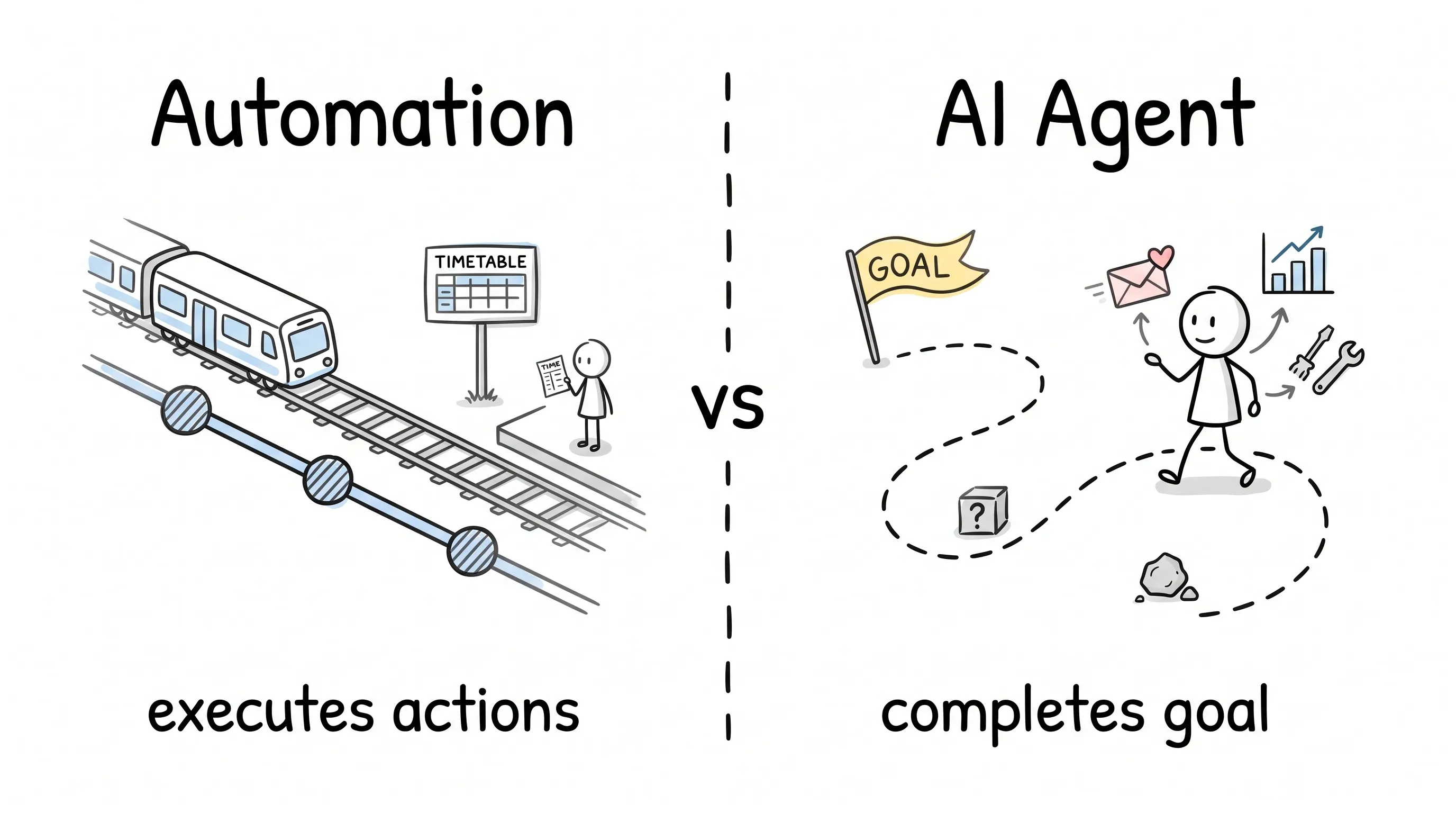
What does this distinction actually mean for a marketing team?
Where to begin? Let's start with my friend's routine.
The First Thing: Workflows You No Longer Have to Babysit
How much does it take to get a single campaign live?
Enrollment criteria, send cadence, wait steps, branching logic. And setting it up isn't the end: the moment conditions change, you go back and edit. Fix this part, and that part shifts.
Think about it: once the campaigns multiply, all your time gets fed into maintenance. Maintenance is thankless work — done well, nobody sees it; left unattended, the workflows break immediately.
HubSpot's campaign agent does exactly this job. You set the goal and the parameters; it builds the workflow, lays out the timeline, and manages the downstream branches, with Agent Hub handling the underlying execution so nothing drifts off-script. The time the team saves goes straight into thinking about the next campaign.
It's like hiring a duty manager. You set the operating policy; they keep the day-to-day running.
The Second Thing: Personalization, No Longer Handwritten
What counts as personalization?
For many teams, it means dropping a first name and a company name into an email. Recipients see through it instantly: mass send.
Real personalization means looking at where someone is in their buying journey, what they've clicked open, what their behavior reveals about their intent — and then talking to them differently because of it.
The problem is, this is expensive.
Writing one email isn't hard. But writing a version for every audience segment, every stage, every campaign? After five or six versions, nobody can keep writing them. That's why most teams end up sending only one or two versions. In plain terms: the production capacity isn't there.
HubSpot's nurture agent uses CRM data and behavioral signals to generate those versions. Breeze Assistant drafts different variants by segment, stage, and interaction history, and sends them out directly.
It can write the volume a human never could. And relevance no longer has to be the first thing on the chopping block.
The Third Thing: Problems Call You Before You Spot Them
When do people usually look at reports? At the weekly meeting. Or when someone senses something is off.
By the time a sagging open rate and fading clicks show up on a report, the problem has been happening for a while.
Worse, problems often hide inside one channel or one segment. Left to someone watching by hand, they typically take several days to surface. What slips away isn't just a few conversions — it's list health, sender reputation, even an entire pipeline downstream.
Breeze Assistant watches these signals and flags anything unusual the moment it appears.
What you get is an early warning. Not an autopsy report.
Marketing Teams Never Lack Ideas
What they lack is the time to finish executing them.
Campaigns queue up, personalization gets cut, problems are found too late. It's not that the team isn't good enough. It's that a day only has 24 hours.
At the end of that tea, here's what I told my friend: don't rush to hire. First list everything on your plate, and hand over the work that was never meant for humans in the first place.
HubSpot's campaign agent and nurture agent, together with Breeze Assistant, have already run this playbook end to end: more campaigns in flight, personalization intact, problems caught early — and not a single extra hire.
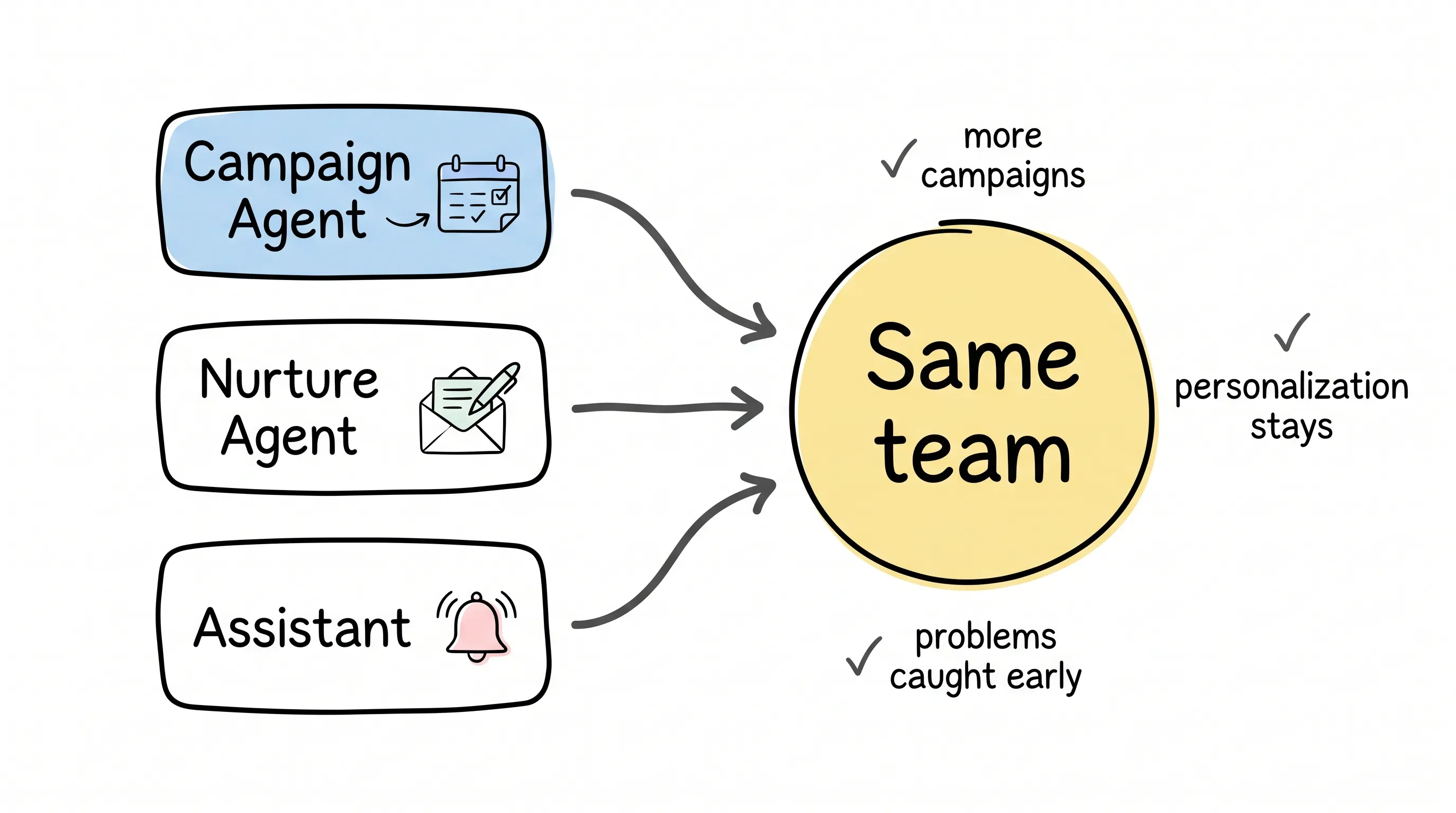
People shouldn't spend their hours on work a machine can do. Offload the execution, and you keep the judgment.
Here's to your marketing team spending time only on what's worth it, from here on out.
Continue reading
Related articles

Cross-Border Business: Time to Upgrade Your AI Toolbox
A learn article explaining how AI tools help cross-border e-commerce sellers clear five hurdles: language, regulation, logistics, payments, and fraud. It outlines a five-compartment toolbox, a five-step adoption path, and metrics such as conversion rate and CLV, while cautioning against over-reliance on AI.

AI Is Taking Over the Dirty Work of Social Media Marketing, One Task at a Time
This learn article outlines four social media marketing tasks AI can handle — audience analytics, content drafting and design, ad targeting and creative testing, and spam moderation — and cautions that taste, judgment, and data security remain human responsibilities.

AI Is Already This Good — Why Is Your Social Media Marketing Still Pure Manpower?
An overview of 18 AI tools for social media marketing, organized into six categories covering audience research, content creation, scheduling, comment and DM handling, ad management, and visual production, plus notes on personalization, prediction, and emerging trends.