
No English, No Tech Skills — Yet He Makes $30,000 a Month Overseas with AI
A bilingual story of a Chinese seller running an Etsy shop for AI-generated pet portraits without speaking English, covering customer service with AI, course selling, and the limits of AI in cross-border e-commerce.
Let me start with a story.
Xu Kaijie is from Tongxiang, Zhejiang, born after 1995. In early 2024, he had just quit a sales job for health reasons and was scraping by playing video games for other people. What is game boosting? Other people pay him; he grinds ranked ladders inside their games.
By 2025, his Etsy shop was pulling in a steady $30,000 a month.
Early that year, the tariff war upended global trade, and a whole wave of Chinese exporters took a beating. His shop was barely touched.
Why?
Because what he sells never goes through customs: AI-generated watercolor pet portraits. A customer sends a photo of their dog; he uses Midjourney to generate a watercolor-style portrait, packages it as a digital file, and sends it back. No inventory, no shipping, not even printing. If someone wants a physical copy, he hands the design to a third-party platform like Printify, and production and logistics become someone else's problem.
Oh, and he doesn't speak English. He runs an overseas business — no English.
What Exactly Did AI Change?
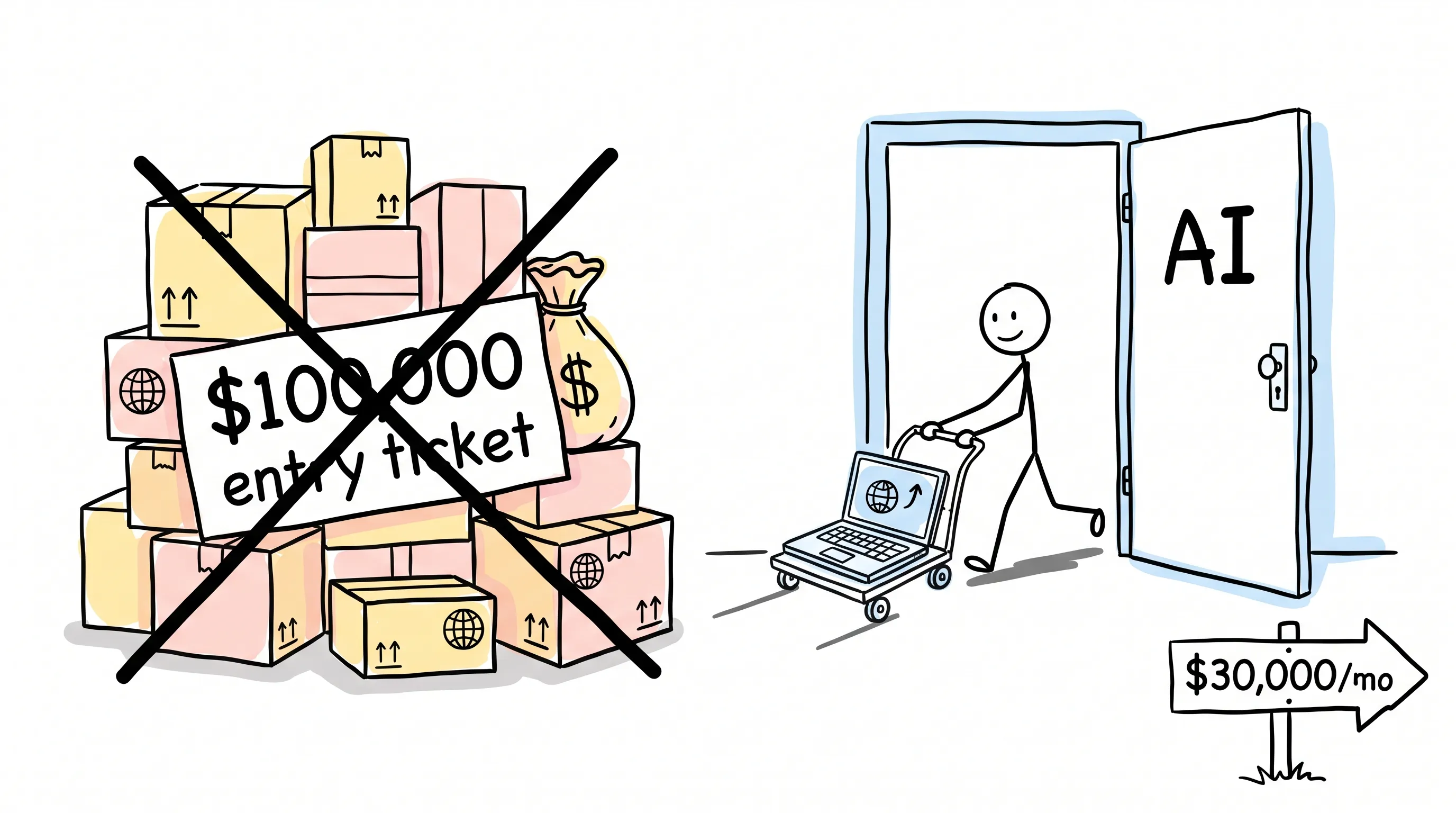
Xu once ran the numbers: in the old days of cross-border trade, without a few hundred thousand RMB of capital, you couldn't even get a seat at the table.
Buy stock, hire designers, find factories, sit on inventory, then sell it. By the time that cycle wrapped up, the window of opportunity had already closed.
AI? It compressed nearly all of that to zero.
Think about it: no inventory, no designers. One computer, one person, one rented room.
And this isn't one man's stroke of luck. In early 2025, after DeepSeek opened up for free, droves of sellers suddenly realized they could mass-produce multilingual sales copy and promo videos on their own — success stories flooded Chinese social media for a while. AI tools built by Chinese teams, like Manus, Flowith, and HeyGen, were all eyeing overseas markets too. Data platform Sensor Tower has tallied it up: two of the top ten most-downloaded AI apps worldwide in 2024 were Chinese — Doubao (ByteDance's chatbot), and Talkie, made by MiniMax.
The door really has opened.
But hold off on the envy.
He Fell into a Black Hole Too
Xu's starting point was rougher than you'd imagine.
From January to July 2024, all outflow, no income. His own words: like falling into a pit of despair, with no light at the end of the tunnel.
What he did first wasn't even selling. Watching fellow content creators back in China grind each other into the ground, he went to Instagram and TikTok posting AI-generated videos — news compilations, cute pets, anything he could try. He built up 80,000 followers.
The ad revenue? 1,000 RMB in total — about $140.
80,000 followers. 1,000 RMB.
Later he figured something out: hand-drawn pet portraits are an established market overseas. Artists' waiting lists run long, a single painting sells for thousands of dollars, and the buyers are in Australia and North America. AI happens to make this faster and cheaper.
So he switched to Etsy, selling digital files at $10 to $13 apiece.
Low price is only one side of the coin. The other side: this lane is already packed. AI-illustration digital goods, as a category, are a market on the order of a few million dollars, and it isn't easy for a solo seller to stand out.
He practiced with Midjourney through roughly 5,000 images, endlessly tweaking prompts and formulas before grinding out a watercolor style of his own. Now a single image takes two minutes, plus a bit of manual cleanup in Photoshop.
Can't understand the English messages customers send? Screenshot them, toss them to ChatGPT or Claude, and have the AI role-play an American customer-service rep, or an Australian one, answering in the tone of a local. Looks good? Copy, paste, send.
By the way, he packaged this whole experience into courses: a ¥299 image-and-text bundle and a ¥4,980 one-on-one coaching program, with roughly 200 students. Selling courses is now a big slice of his income.
Most People Don't Have It This Smooth
Same AI, but the script most people follow reads differently: draw some patterns, print them on T-shirts and mugs, list them on SHEIN, Temu, or Shopify.
Search Chinese social media and you'll find endless posts about this kind of export business. Actual success stories? Few.
Which patterns will sell — pure guesswork. Inventory and logistics — AI can't manage. Bad reviews — AI really can't manage.
Even domestic buyers regularly receive goods that don't match the product photos. Overseas buyers are only pickier.
What about moving upmarket?
Shen Ying, the social media lead at a cross-border jewelry company, suggested a few years ago using AI to generate model photos. The results didn't pass muster. She is very specific about why: jewelry lives in the details — every ring needs its own shooting angle, too many variables. AI can't deliver customization at that level.
Her team uses AI in exactly one place now: checking the English grammar on engravings and greeting cards.
Social media copy she flat-out refuses to write with AI. Her reasoning stuck with me: if you want the line that makes the gift recipient feel it was written with care, a human still has to write it. It's like the handwritten note in a package from a brand — it always feels more sincere than the printed one.
So Where Is the Line?
There is a marketing consultancy in Beijing whose founder is now being pushed toward AI by his clients. The reason is blunt: competitors are mass-producing content with AI, and the volume clients want is beyond what human hands can deliver. Don't use it, and you go unheard.
He uses it too: writes his SEO titles himself, has ChatGPT draft blog posts from detailed outlines. But he has drawn a hard line that no amount of pleading will move: no taking a competitor's work, renaming it, and passing it off as your own — especially in music and web design.
Then there's HeyGen. Record two minutes of yourself talking, and the AI generates a "you" that speaks from any script — even in a language you don't speak at all.
This founder won't use the platform's stock avatars; he insists on his own face. His words: it's my face, my words, my responsibility.
And the platforms? Neither Temu nor Amazon has clear rules on AI-generated content yet.
Etsy actually launched a feature early on, letting sellers voluntarily flag whether a product is AI-generated. Xu says almost nobody flags it. Before the feature existed, some people were even labeling AI-generated images as "hand-drawn." But he adds something interesting: nowadays, even honest "AI-generated" labels don't hurt sales. Virtual customization, at its core, lets ordinary people spend a little money to experience something that used to feel like a luxury.
Same thing. Some see deception. Others see an equalizer.
Roller Coaster
Xu spends 1,000 RMB a month on AI subscriptions alone. Every time a new model drops, he feels he has to try it immediately.
The business makes money, the courses sell. But he describes his state as riding a roller coaster: the wind shifts, or a new tool suddenly replaces your work and you fail to catch it — your income drops off a cliff.
Shen Ying is the opposite extreme. Her company's processes have run for years, and she has done the math: the time it takes to figure out how a new AI tool fits into existing workflows often exceeds the immediate gains it brings. So for now, she's not adding anything.
One is terrified of falling behind. The other runs the numbers and decides it isn't worth it.
Finally, Two Thoughts
After reading these stories, my biggest takeaway:
What AI flattens is the barrier to entry. What it cannot flatten is the business itself.
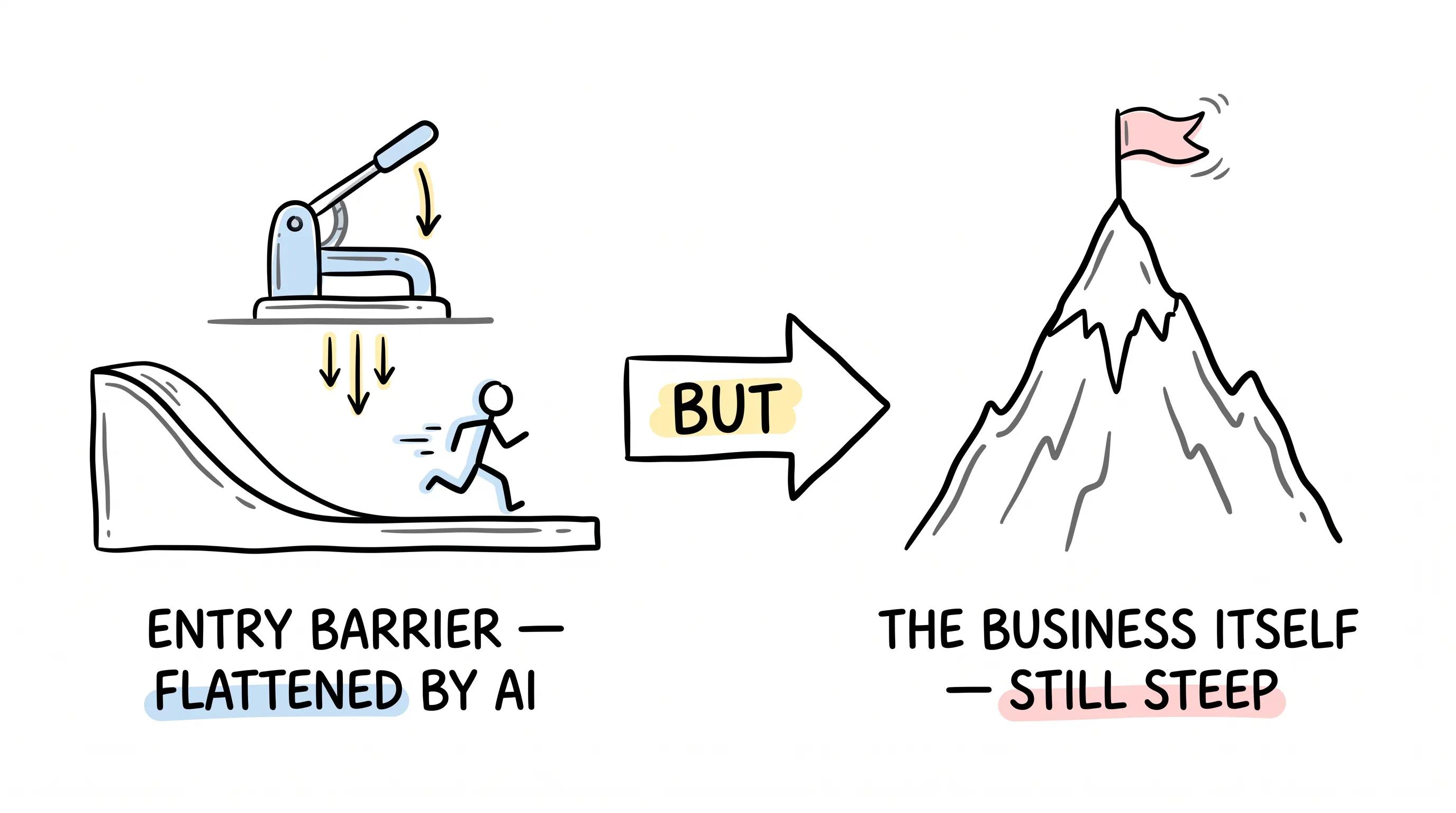
That door used to be guarded by money — without a few hundred thousand RMB, you didn't get in. Now it's guarded by mindset. 5,000 practice images, reviewing your data every day, 1,000 RMB a month in subscriptions, jumping on every new model the moment it ships. Those are the new tickets.
Windfalls are never divided evenly. They just change hands: money that used to belong to the capitalists now goes to whoever moves fastest and does the most careful math.
As for that line — where innovation ends and theft begins — nobody can draw it clearly yet.
But the time left for everyone to figure it out is running short.
May you be among the first movers.
Continue reading
Related articles

Cross-Border Business: Time to Upgrade Your AI Toolbox
A learn article explaining how AI tools help cross-border e-commerce sellers clear five hurdles: language, regulation, logistics, payments, and fraud. It outlines a five-compartment toolbox, a five-step adoption path, and metrics such as conversion rate and CLV, while cautioning against over-reliance on AI.

AI Is Taking Over the Dirty Work of Social Media Marketing, One Task at a Time
This learn article outlines four social media marketing tasks AI can handle — audience analytics, content drafting and design, ad targeting and creative testing, and spam moderation — and cautions that taste, judgment, and data security remain human responsibilities.

AI Is Already This Good — Why Is Your Social Media Marketing Still Pure Manpower?
An overview of 18 AI tools for social media marketing, organized into six categories covering audience research, content creation, scheduling, comment and DM handling, ad management, and visual production, plus notes on personalization, prediction, and emerging trends.