
My Friend Wanted to Hand Marketing to AI. I Told Him to Think Through Four Things First
An opinion piece on adopting AI in marketing, covering data ownership and privacy rules, effects on team roles, content homogenization, and accountability for AI errors, ending with governance practices such as human review of AI drafts.
A few days ago I met up with an old friend. He runs an e-commerce business — not a big company, a hundred people or so.
The moment I sat down, he announced his decision: "I've made up my mind. Next quarter, half of the marketing department's work goes to AI. Copywriting, graphics, customer service, ad campaigns — all of it. That's nearly two million yuan a year in savings."
I asked one question: did you count what you might lose, not just what you'd save?
He went quiet.
Let's be honest: the upside of AI marketing is obvious. It's fast, cheap, and never gets tired. Everyone has been jumping on board these past few years, and if you don't, it feels like falling behind before the race even starts.
But I still told him: don't rush to sign anything. Four things to think through before you act.
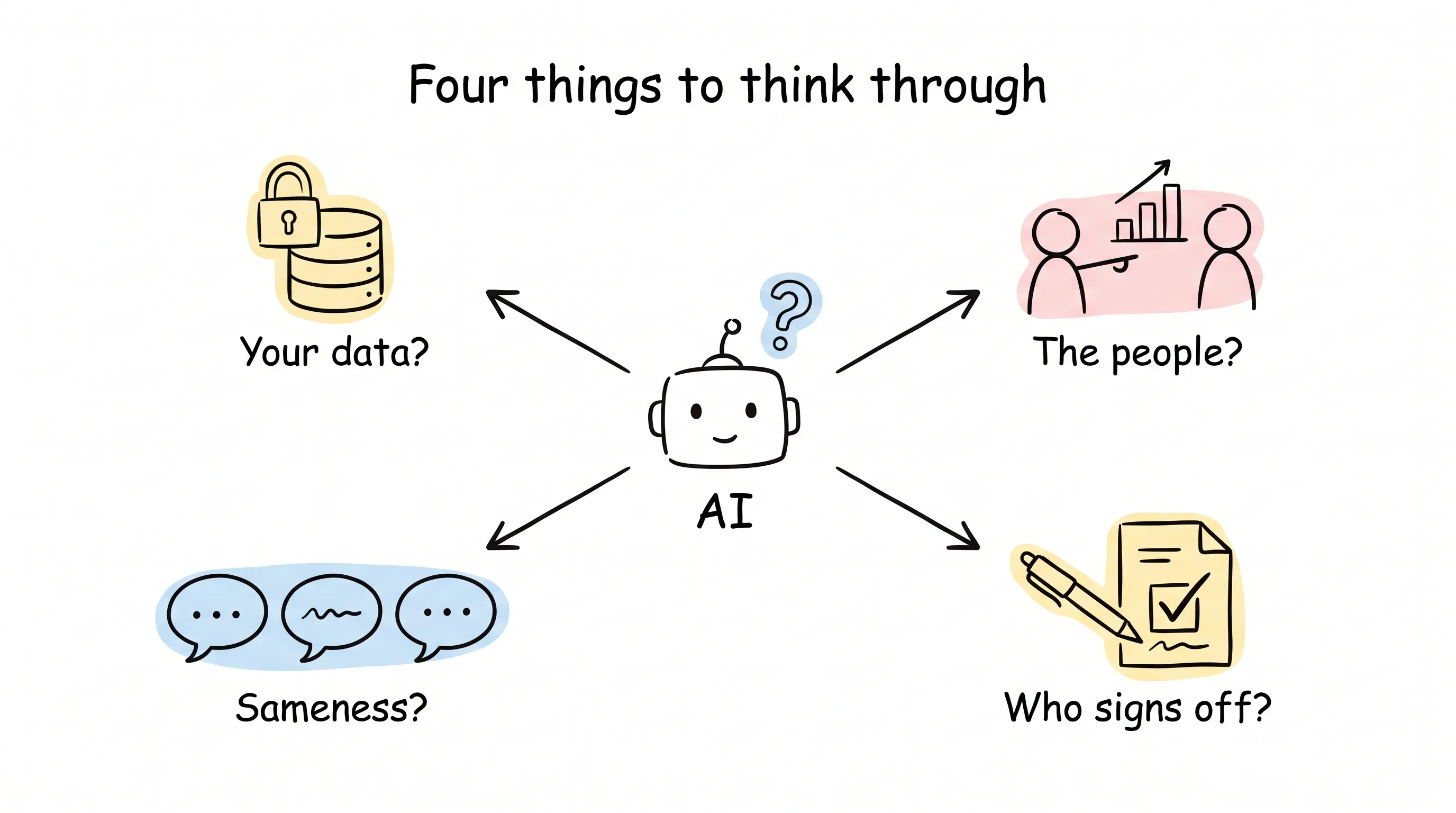
The First Thing: Is Your Data Really All Yours?
Personalization with AI is tailoring at heart. And to make the suit fit, the tailor has to measure you first.
Before it can show you a single ad, it has to know who you are: what you searched for in the middle of the night, what's sitting in your shopping cart, what kind of videos make you stop scrolling.
The owner of the corner store downstairs keeps track too. He knows you love iced black tea, so the moment you walk in he hands you a bottle. You're happy, and so is he. That memory is his own.
AI is different. AI's memory is millions of "yous" stacked together — it can be copied, sold, and put to uses you'd never expect. And once it leaks, it's a problem for millions of people all at once.
And don't forget: GDPR (GDPR — the EU's General Data Protection Regulation), in force since 2018, can fine companies up to 4% of global annual revenue. California's CCPA runs on the same logic. Put into plain language, these two laws say one thing: this data didn't fall into your lap — it belongs to someone else.
What's worse, many AI models are black boxes. What's a black box? Ask it why it showed this particular user this particular price, and it can't tell you. It can't even explain itself.
So if you really want to use it, ask three questions first: Where did the data come from? Did users actually say yes? And if something goes wrong, who can explain it? If you can't answer, that's money you can't afford to save.
The Second Thing: What About the People?
My friend's math was simple: let AI write the copy, handle the service tickets, run the campaigns — then you can cut the headcount.
This exact calculation has been wrong once before.
When ATMs first arrived in banking, everyone said tellers were finished. What happened instead? The number of tellers in the United States went up, not down. Machines drove down the cost of opening a branch, so branches multiplied — and so did the people.
But note who the extra tellers were: the ones who could sell wealth-management products and advise customers. The ones who could only count cash still disappeared.
AI will most likely play out the same way: it will change more jobs than it eliminates. But for any individual, "change" lands as an exam to pass.
If all you do is execute, you're in danger. People who can exercise judgment, set strategy, and spot when the AI goes off track are worth more than ever.
My advice to my friend: sure, give the budget to AI, but carve out a separate pot of money for the team to learn new things. That money isn't a perk. It's insurance.
The Third Thing: Will the Whole Street End Up with the Same Haircut?
A lot of people think this worry is overdramatic. I don't think it is at all.
Picture it: every barber in town works from the same template. The customer before you walks out with that cut, and so do you. It's cheaper, sure — but can you still tell anyone apart?
Marketing works the same way. There are only a handful of copywriting tools, a handful of image tools, and everyone may even be running on the same underlying model. You write "an exclusive experience," the shop next door writes "an exclusive experience," and the AI-produced openings come out almost word for word the same.
A brand's worst fear isn't going unseen. It's being seen and forgotten.
And AI has a built-in flaw: it can only learn from what already exists. However cleverly it stitches things together, it's still recombining old material. The kind of "new" that truly makes people's eyes light up is, to this day, a human job.
So don't treat AI's output as the finished product. Treat it as the starting point: let the AI produce the draft, but the stance, the temperament, the fighting spirit — those have to be your own. Without that human spark, AI can't give you distinctiveness. It can only give you an average score.
The Fourth Thing: When It's Confidently Wrong, Who Answers for It?
This is the easiest one to overlook.
AI is an apprentice with unshakable confidence. It never shows a trace of doubt — but it learned everything from piles of old data, and the biases in that data, it took on board wholesale. Recruitment ads shown only to men, entire groups systematically excluded from ad targeting — these aren't scare scenarios; they're old news that actually happened. If the data is biased, the AI will be more biased still, because it learns fast and learns hard.
Then there's the collateral damage. Generative tools will casually fold someone else's copyrighted images, text, or music into your materials; automated ad systems can place your ad next to a piece of content that wrecks your image. Best case, a PR fiasco. Worst case, you'll see each other in court.
When this happens, you can't tell your users "the AI did it." Users come looking for you — and so do regulators. In finance, healthcare, and similar fields, there's now an extra question on the test: you must be able to explain clearly why the system made the decision it did.
What to do? Strip it down and it's simple: AI can do the work, but a human has to sign off.
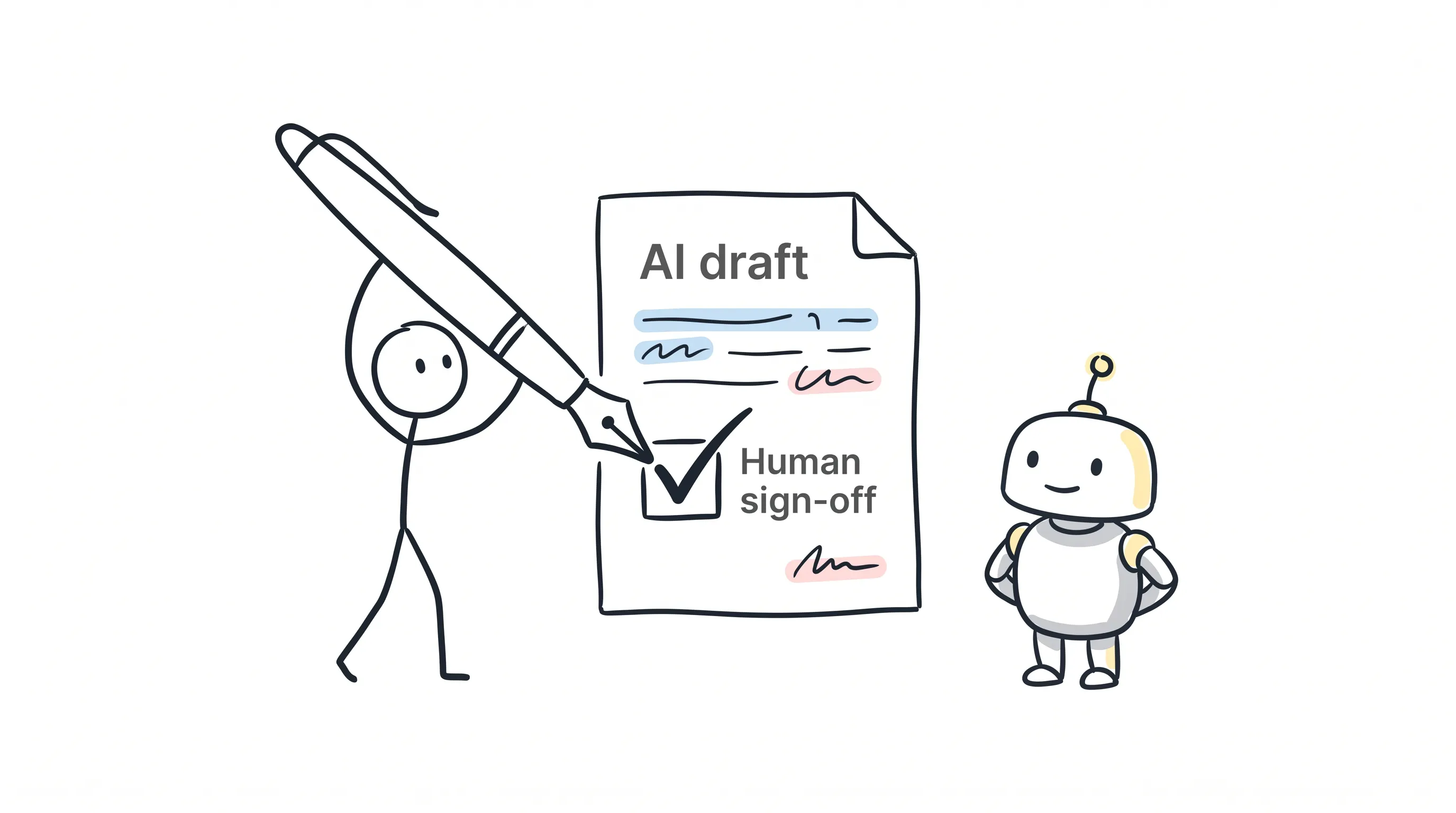
Just as a company handling money needs financial controls — who can expense what, which amounts need approval, all written out in black and white — using AI calls for the same kind of rulebook: which use cases are allowed, who has final say, and which checkpoint you go to first when something goes wrong.
What Happened Next?
In the end, my friend never "handed" marketing over to AI.
He kept his people, bought tools for the team, and set a few ground rules: every AI draft gets a human read-through before it goes out; user-data access stays on a tight leash; and every month, the whole team sits down to review what the AI botched this month and what it nailed.
I asked him whether it was worth it. He said something that stuck with me: "I used to worry my people were too slow. Now I worry the AI opens its mouth too fast."
Honestly, AI walking into marketing is no different from every new machine that ever walked into a factory. The bigger the machine, the more you need qualified people at the controls. What has always been dangerous is a machine with nobody watching it.
AI won't be what kills the marketer — it'll be the competitor down the street who learned to use AI before you did. I believe that line. But I believe the first half even more: use it well first. Only then does the comparison even matter.
Here's wishing you the same: put this machine to good use. But the pen that signs the contract — never hand it over.
Continue reading
Related articles

Cross-Border Business: Time to Upgrade Your AI Toolbox
A learn article explaining how AI tools help cross-border e-commerce sellers clear five hurdles: language, regulation, logistics, payments, and fraud. It outlines a five-compartment toolbox, a five-step adoption path, and metrics such as conversion rate and CLV, while cautioning against over-reliance on AI.

AI Is Taking Over the Dirty Work of Social Media Marketing, One Task at a Time
This learn article outlines four social media marketing tasks AI can handle — audience analytics, content drafting and design, ad targeting and creative testing, and spam moderation — and cautions that taste, judgment, and data security remain human responsibilities.

AI Is Already This Good — Why Is Your Social Media Marketing Still Pure Manpower?
An overview of 18 AI tools for social media marketing, organized into six categories covering audience research, content creation, scheduling, comment and DM handling, ad management, and visual production, plus notes on personalization, prediction, and emerging trends.