
Meta Wants to Run Your Marketing for You — Should You Hand Over the Wheel?
A learn article tracing Meta's move toward AI-managed advertising: Advantage+ placements, the Andromeda traffic-tiering layer, AI-enhanced Pixel and catalog features, Meta AI account insights, and the Business Agent, arguing advertisers should delegate execution while keeping strategy, budget, and compliance judgment.
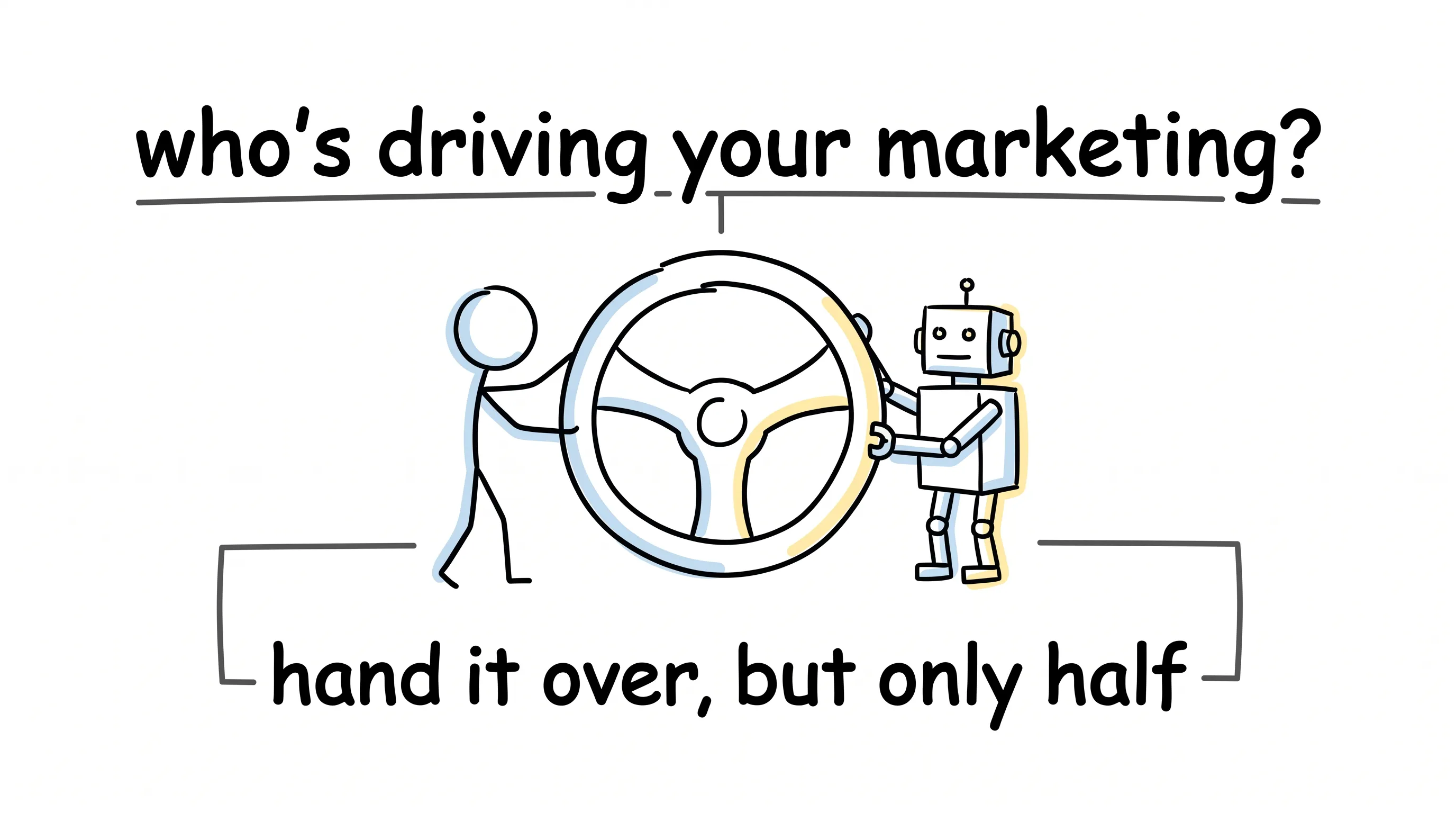
A while back, I was having dinner with a friend who buys ads for a living, and we got to talking about the recent changes. He said something that stuck with me.
He said: Meta has taken away yet another thing.
Taken away what? The permission to manually exclude placements.
Simply put: at the ad set level, you can no longer specify things like "my ads should only show to iPhone users," "desktop only," or "don't serve them on those third-party websites." The change has already shown up in the Ads Manager of some accounts, and it will most likely roll out to all of them.
You might think: fine, take it. It's just one less switch, right?
Honestly, that was my first reaction too. But after chewing on it, I realized this is no small switch. It's the latest stop on a whole roadmap. And if this roadmap runs to its end, what Meta wants to run for you may not be just your ads, but your entire marketing pipeline.
So today I want to get three things straight: What exactly is Meta taking? What makes it bold enough to take it? And most importantly — how much of the steering wheel should you hand over?
Let's take them one at a time.
Stop One: It Took Away Your Power to Pick the Places
What is a placement?
Your ads can show up in many places: the Instagram feed, the Facebook feed, Stories, third-party websites (that category is called Audience Network), plus Threads, WhatsApp, and Messenger. Every additional place an ad can appear is one more placement.
You used to be able to pick for yourself. Didn't want one? Remove it manually.
But for years, Meta has been nudging you: stop picking. Use its Advantage+ Placements and let the algorithm decide where and when your ads appear. Every time you manually removed a placement, it would pop up a warning box to stop you.
Now Meta has simply done away with manual picking altogether.
So does the algorithm actually pick better than you?
Media buyers have run long-term tests across large numbers of client accounts, and the conclusion is somewhat counterintuitive: with Advantage+ Placements on, performance is better and lead quality is higher. Conversely, when you manually cut the placements that "look like a waste of money," ads get more expensive, and the quality of your leads and sales slips.
Why?
Think about it. Ads that fail to render in a certain placement, fonts that are too small, formats that don't fit — the algorithm learned to dodge these rookie mistakes long ago. It will not spend money where ads can't be served. You think you're saving money; in fact, you're tying the algorithm's hands.
So where does the money actually go? Look at the spend distribution under Advantage+: roughly sixty percent, sometimes more, goes to Instagram; Facebook takes the lion's share of the rest; Audience Network gets only a very small slice; and Threads, WhatsApp, and Messenger automatically pick up ads whenever the format is compatible.
Sixty percent to Instagram. That tells you the algorithm's read on "where your customers are" beats your gut.
Can anyone still choose for themselves?
Yes. At the account level there's still a door open: you can have Meta skip Audience Network entirely. Also, for industries with strict compliance requirements — healthcare, finance, credit — Meta keeps fine-grained placement controls. Where their ads may appear is decided by regulation, not by the algorithm.
Beyond those, the answer for ordinary accounts is blunt: turn everything on, don't touch it.
When it comes to media-buying execution, the algorithm already makes fewer mistakes than you do.
What Makes It So Bold About Taking All This?
Placements are only the first stop.
Meta's whole route starts from Advantage+. Advantage+ is the entry point where AI takes over delivery decisions. Where is the endpoint? A generative model called GEM: you hand it an image and a budget, and the AI generates all the creative, iterates on its own, optimizes delivery on its own — no humans needed, end to end.
Right now, we're somewhere in the middle. And the middle stop is called Andromeda.
What is Andromeda?
In October 2025, Andromeda launched globally and has now entered every ad account. You can think of it this way: Meta has layered the algorithm that governs its organic traffic into the paid system.
It favors high-quality content. It routes the highest-quality traffic to the accounts with the best creative. It rewards ads that generate positive engagement.
What does that mean?
Paid delivery is no longer "pay and you get everything." Paying only buys the ticket. Which row you sit in depends on creative quality.
Before, money was the only pass. Now, money is just the admission ticket. Traffic has been tiered: with strong creative, you reach better tiers of traffic at lower cost; with weak creative, the money's spent, but the good traffic has nothing to do with you.
So the "creative diversity" Meta keeps stressing everywhere is a hard requirement of its own system.
Why does it want massive, wildly varied creative? Because the road to GEM has to be paved with data. The more varied the creative formats and angles you provide, the more the algorithm has to learn from — and the better your own delivery performs.
It's a two-way deal: you feed it diversity, it pays you back in lower costs.
At this point I have to talk about something that made me go "whoa."
An advertiser saw a beta feature inside a client account: from just a few static images already in the account, Meta's AI generated two complete video ads on its own. No script. Nothing. The AI distilled customer pain points from the account data, pitched the product's benefits, handled objections, quoted an entry-level price, and used those images to take a "virtual walk" through the client's physical location.
The result was so complete you couldn't spot a seam.
Impressive. Genuinely impressive.
Of course, before AI-generated creative goes live, you still have to review and approve it. The approval screens look different in different accounts, but the review step is there.
The advice from media buyers is blunt: turn every AI creative option on. The quality is already there, and Andromeda rewards accounts that do.
The Data Layer Has Been Quietly Swapped Out Too
That covers delivery. One layer deeper is data.
Meta's Pixel — the line of tracking code embedded on your website — has changed. Not a single character of the code changed, but it is now the AI-enhanced version. In a media buyer's words: ten times smarter.
Before, e-commerce merchants had to manually feed the Pixel detailed product information — product descriptions, SEO-grade tags — to help Meta match products with audiences.
Now? The AI reads your website by itself. It scans your products, content, and SEO data, organizes them into a format it can use, and puts them to work on audience matching.
You don't have to feed it anymore. It feeds itself.
Here's a move you can make today: go back and clean up the errors in your Pixel.
The vast majority of accounts have configuration issues: permissions not fully granted, event tracking broken, settings left incomplete. Every time you log into Ads Manager, it reminds you. In the past, you could turn a blind eye to these errors; now you can't. The cleaner the Pixel is installed, the more the AI can do.
The catalog layer is changing too. The catalog is no longer an accessory exclusive to "catalog ads"; it's becoming the core input for all sales-oriented campaigns. Meta's AI can generate and optimize shopping ads in real time, and personalize them one-to-one based on what it knows about each consumer. Deep Shopify integration is on the way.
Even more aggressive is on-platform Q&A. A user taps on a bottle of lotion, and Meta AI guesses what they might want to ask: "Is it okay for sensitive skin?" "What do the reviews say?" The answers are served right there on the platform — no need to hop over to your website.
Shopping, as much as possible, is being kept on Meta's turf.
Oh, and the consumer personalization toggle has moved too. Before, feed and ad personalization could be chosen separately; now it's all on or all off — turn it off, and you get only random content. This bundling will most likely keep more users opted in to personalization. For advertisers, that means more raw material for targeting.
Now It Reads Your Books and Staffs Your Counter
Not done yet.
meta.ai, Meta's own AI assistant, can now connect directly to your ad account, your Instagram, your Facebook Page, even Google Workspace. Log in with your Facebook or Instagram account, authorize Business Manager once, and it can read your account data.
It's free for now. Heavy use down the road will reportedly come with a MetaOne subscription.
What can it do?
For an ad account that has been running for a few weeks and is past its learning phase (Meta's calibration window while a new campaign stabilizes), you can just ask it: "What's working? What isn't? How can I do better?" Based on real data — how much was spent, how many impressions, how each piece performed — it gives you specific suggestions.
Organic content is fair game too. Have it evaluate your last 30 days of Reels, and it hands you a performance ranking, plus an analysis of why each one worked. You can also set up recurring reports — say, every Monday morning, a summary of the key metrics across ads and organic.
One small trick: it has modes. The default instant answers aren't very deep; switch to "Think" mode to give it more compute, and the analysis goes a level deeper.
How is it different from tools like Claude or ChatGPT? You can also connect external AIs via MCP (Model Context Protocol, a standard for wiring outside tools and models into an assistant), but Meta AI holds something no one else can get: the platform's own data.
Someone tried uploading a competitor-analysis folder for a large client account. Meta AI found the competitor's longest-running ad, analyzed its messaging strategy, and then proactively offered: want me to come up with five differentiated ad angles for you?
That's a perspective only it has. No other AI can give you that.
Of course, the old rule applies: you have to run its suggestions through your own head. Some you've already tried; some would cross compliance red lines in your industry. The ones you haven't tried and that break no rules are worth testing. One media buyer says they've been surprised several times by suggestions that "looked too simple at first glance" or "looked too complicated at first glance."
One layer deeper still sits Meta Business Agent: an AI store clerk that runs inside WhatsApp, Messenger, and Instagram DMs. It can answer customer questions, recommend products from your catalog, book appointments, qualify leads, and close sales on the e-commerce side. When to switch to a human — that's your call.
It can also run the post-mortem for you: summarizing customer conversations, distilling messaging patterns, delivering a daily communication briefing.
Some teams have already piloted it on lead ads — the ads where users leave their contact info without leaving Meta. The AI clerk is helping qualify leads and steer people to the right product. The early data is thin, but the direction looks bright.
The core advantage of this whole thing comes down to one word: speed.
Think about it. How many merchants leave their DMs unanswered? Or nobody home at midnight, nobody home on weekends? Hiring someone who can actually drive conversations to conversion is expensive — and hard to count on.
An AI clerk is on duty around the clock and replies in seconds — and it has read your account data and chat history, so it knows what tone to use.
It's 11 p.m., and a customer walks into your store with five questions. The store where someone replies instantly and the store where nobody does will have two very different outcomes the next morning.
Merchants selling complex things benefit the most. Product details, shipping, price, "is this right for me" — the more questions there are, the more valuable instant answers become. The AI clerk quickly spots the real buyers and weeds out the window-shoppers. That's what sales is supposed to do anyway.
Flip it around: if you don't adopt this — Meta's or anyone else's — be prepared: consumers have already been spoiled by "instant answers." When everyone else replies in seconds and you reply the next day, customers vote with their feet.
Some tools can add yet another layer on top of the sales page. Take VideoAsk: it embeds a small video window of the founder or a team member on the page, and whichever question a visitor taps routes them to the corresponding pre-recorded answer. Paired with an AI chat, you get a text layer and a face layer.
So — Should You Hand Over the Wheel?
Back to the opening question.
What Meta wants to run for you goes deeper, layer by layer: first it picks your placements, then it tiers your traffic, then it reads your data and personalizes for you, then it reads your books — and finally, it staffs your counter and talks business.
My judgment: hand it over, but only half.
The execution layer, give away generously. How placements are picked, how budget is split, how creative gets iterated, how data gets connected — the algorithm does all of this better than you. Doing it yourself only costs more, takes longer, and produces more mistakes.
The judgment layer, grip it tight and never let go. Who your ads speak to, what they say, what they don't say, your budget floor, your compliance red lines, and the final call on "should we test this suggestion" — these, you do not hand over.
The algorithm owns how the ads get delivered. You own what gets delivered — and why.
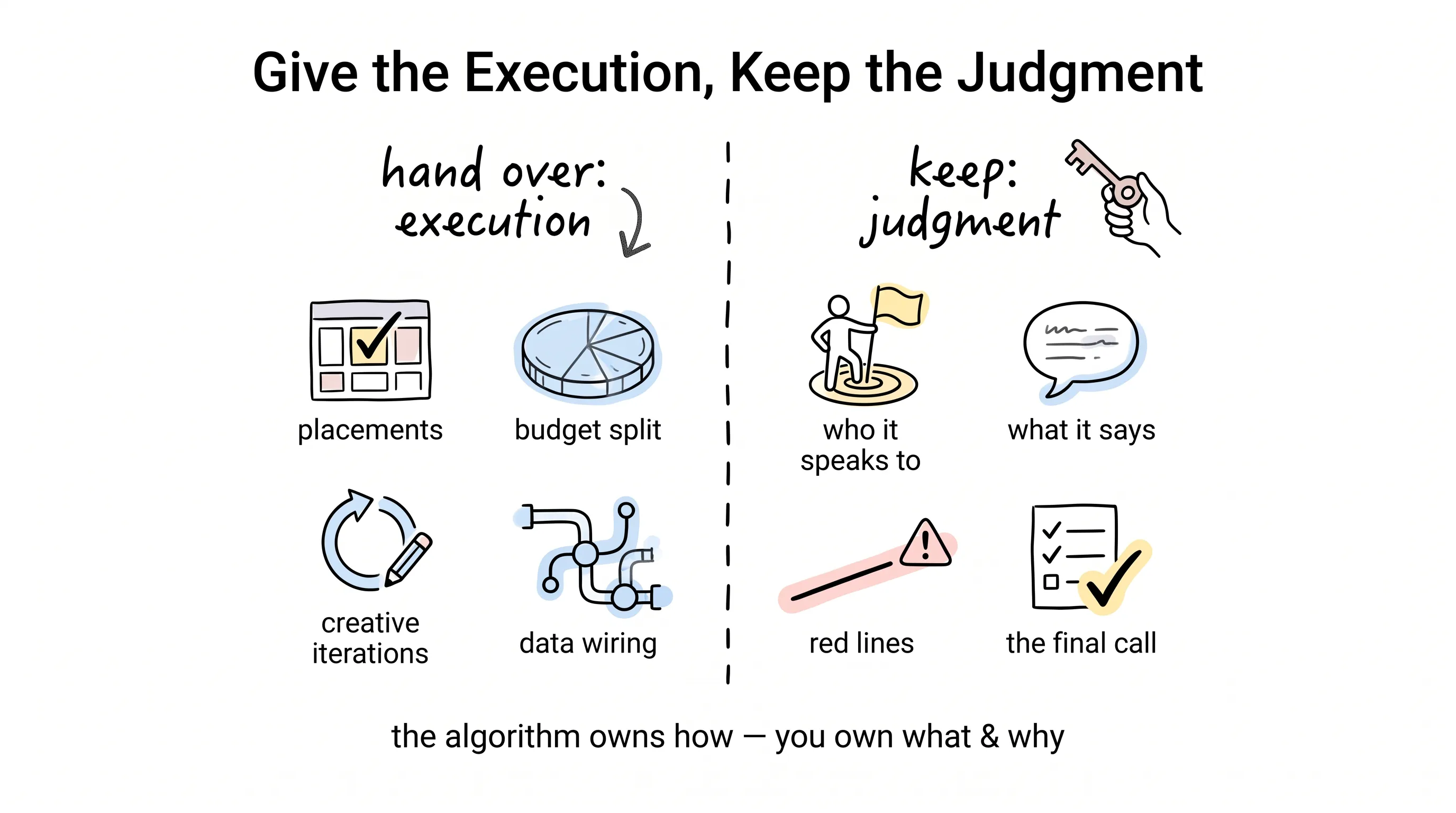
What Advantage+ takes away is execution. What it cannot take away is your judgment.
People who hand over execution will spend the time they save on creative and strategy, and run faster and faster. People who cling to everything are racing the machine at hand speed, in a task the machine is far more practiced at than they are.
Give what should be given. Keep what should be kept.
Here's to driving this car fast and steady — the kind of steady that comes from holding the wheel in your own hands.
Continue reading
Related articles

Cross-Border Business: Time to Upgrade Your AI Toolbox
A learn article explaining how AI tools help cross-border e-commerce sellers clear five hurdles: language, regulation, logistics, payments, and fraud. It outlines a five-compartment toolbox, a five-step adoption path, and metrics such as conversion rate and CLV, while cautioning against over-reliance on AI.

AI Is Taking Over the Dirty Work of Social Media Marketing, One Task at a Time
This learn article outlines four social media marketing tasks AI can handle — audience analytics, content drafting and design, ad targeting and creative testing, and spam moderation — and cautions that taste, judgment, and data security remain human responsibilities.

AI Is Already This Good — Why Is Your Social Media Marketing Still Pure Manpower?
An overview of 18 AI tools for social media marketing, organized into six categories covering audience research, content creation, scheduling, comment and DM handling, ad management, and visual production, plus notes on personalization, prediction, and emerging trends.