
Marketing's Yardstick Needs Replacing
An explainer on why last-click attribution and vanity metrics fall short, arguing marketing measurement should align to revenue, profit margin, and LTV, with notes on AI forecasting, always-on optimization, and common measurement pitfalls.
A while back, a friend of mine who runs an e-commerce business invited me to dinner. Halfway through the meal, he pulled out his phone and showed me last month's marketing report.
Impressions, clicks, conversion rates — row after row, beautifully formatted.
I asked: and then?
He said the boss read the whole thing and asked just one question: what do these numbers have to do with the business?
He froze. Eight years in marketing, and for the first time, he had no answer.
You've probably seen this scene play out yourself, right? The reports get thicker, the boss's brow furrows deeper. Where's the problem? In the yardstick itself.
The yardstick we measure marketing with needs replacing.
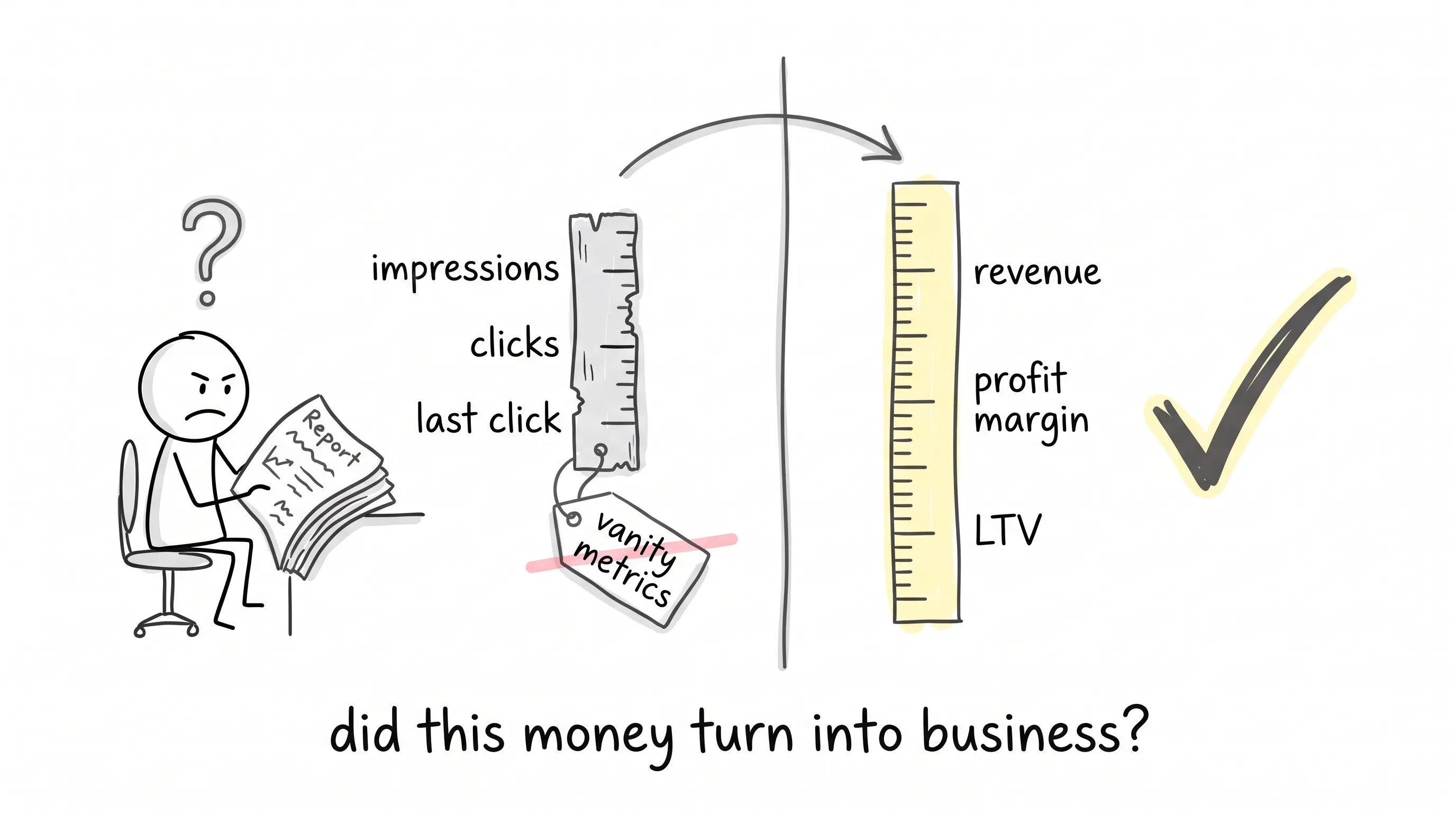
What Is Attribution?
First, let's see what the old yardstick looked like.
What is attribution? Attribution answers one question: when a deal closes, who gets the credit?
The most common method of the past was called last-click attribution. A user sees an ad, runs a search, scrolls onto a video, finally clicks a link, and places an order. Done — all the credit for that order goes to the last click.
Sounds reasonable. Whoever takes the final shot gets the credit.
But run the numbers. You spend 1 million yuan on ads, and the report says the people who clicked the link last brought in 600,000 yuan in sales. The boss stares at the other 400,000 and asks you: is that money down the drain?
Is it really down the drain?
A person goes from seeing, to wanting, to buying — touched many times along the way. The early seeding, the groundwork, the reminders — all of it works; the books just log every bit of it under "the final shot." It's like a soccer team that pays only the goal-scorer, while the midfield and the defense work for nothing.
As for the lazier approach — just look at impressions, follower counts, read counts. Those numbers look good and are easy to report up the chain, but they share a common name: vanity metrics. What are vanity metrics? Numbers that make you feel good about yourself while not one cent hits the till.
Truth is, everyone had a vague sense of the old yardstick's flaws. There just wasn't a better option back then, so we made do.
The Exam Has Changed
Until AI changed how the money gets spent, too.
Last October, the marketing technology company Zeta held its annual conference, called Zeta Live. One session there was a 25-minute talk devoted entirely to marketing measurement. I dug it up later and watched it more than once.
One point in that talk I agree with completely: what AI changes is how marketing is planned and executed; what changes with it is the yardstick of measurement. The yardstick has been raised — but it has also come into focus.
Reading that, I wanted to bang the table: a truth this simple — how do the reports still miss it?
Just how clear? One sentence: did this money turn into business?
What counts as turning into business? Clicks don't. Engagement doesn't. Revenue does. Profit margin does. And something called LTV.
LTV — lifetime value. Plainly put: over a lifetime of doing business with you, how much value does one customer contribute in total?
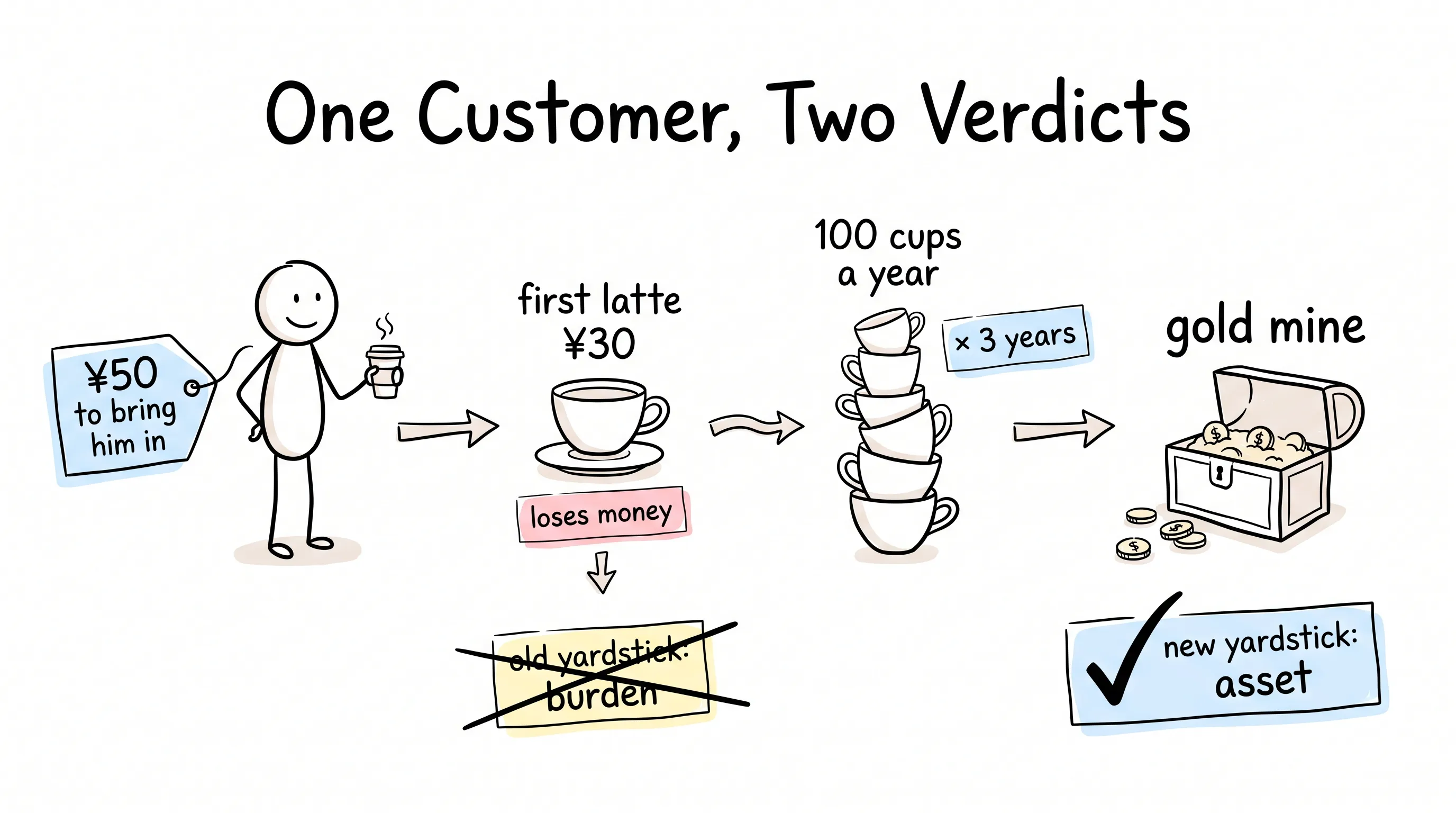
Let me run the numbers for you. You run a coffee shop. It costs you 50 yuan to bring in a new customer. His first latte is 30 yuan; strip out the costs, and that transaction loses money. Measured by the old yardstick, this acquisition doesn't make the grade.
But what if he drinks 100 cups a year at your place? And what about the next three years?
Run the LTV math, and this customer is a gold mine. The old yardstick calls him a burden; the new one calls him an asset. Different yardsticks push you toward opposite moves: one says cut the budget, the other says raise it.
If the scoreboard never changes, the plays will never be right.
Check the Forecast Before You Set Sail
A few other things from that talk are worth passing on to you.
First: forecast before you spend.
The old playbook: scatter the money, let it run a month, pull the data, hold a retrospective. By the time you discover that batch of creative doesn't work, the money is already spent.
And now? Before you spend a cent, AI can project from your historical data how this piece of creative, this channel, will most likely perform. It's like checking the marine forecast before putting out to fish. The old fisherman guesses at the clouds from experience; the weather bureau computes the wind from data. Guess whose boats capsize less?
The sharper the forecast, the cheaper every experiment becomes. How to fix the creative, which media to pick — you have a read on it before work even starts. That saves a fortune compared with Monday-morning quarterbacking.
Second: once things are running, keep optimization always on.
How to split the budget, how to adjust the bids, when to rotate the creative — these used to depend on someone watching. The moment that person gets busy, it stops.
Now you can let AI adjust without pause: today's data shows up in tomorrow's budget. Creative, bids, budget — always in a state of learning, like an engine that never shuts off.
But there's one precondition here, and it's critical: it cannot be a black box.
What's a black box? It adjusts things for you, and you can't explain why. Would you ride in a car that can't explain why it just braked? Neither would a CFO hand millions in budget to a box that can't explain its logic. So good AI optimization has to translate every single adjustment into plain language: why it cut, why it raised, why it stopped.
If you can reconcile it, you can trust it.
Three Pitfalls, All Right at Your Feet
The talk made a point of listing a few pitfalls. I think every one of them deserves to be pinned above your desk.
Pitfall one: dirty data. The same customer has three or four profiles sitting in your systems; online and offline don't line up. What AI swallows is garbage, so what it spits out can only be garbage. When the foundation is shaky, no amount of building speed saves the tower.
Pitfall two: chasing proxy metrics. What's a proxy metric? It isn't the goal itself — only the goal's shadow. Click-through rate is the classic case. Grind on click-through rate and your team will build things everyone wants to click and nobody wants to buy. Chase the shadow, and you'll never catch the person.
Pitfall three: misaligned measurement windows. If you're selling insurance or renovations, the journey from first spark to signed deal takes a customer about three months. Your review window is seven days. On day seven you look: no conversions — cut! The two-plus months of groundwork before that, all for nothing. The season for planting trees is never the season for sitting in their shade.
From the Department's Books to the Company's Books
Finally, there's one bigger shift still.
Marketing used to keep its own books: channel KPIs, campaign ROI, measured against itself. That talk introduced a concept — True Value of Marketing, marketing's true value. The idea: put marketing back into the enterprise-wide ledger. Its contribution to revenue, to profit, to long-term customer value has to survive the CFO's reconciliation.
By the way — the host, Zeta, walks this same road with its own Zeta Marketing Platform: wiring data, creative, and media into a single assembly line, with AI doing the personalization. During the conference, Zeta also announced a strategic partnership with Palantir. Notice: even Palantir, a data company, got pulled in — everyone is pressing on that same foundation of data. Especially now, with privacy rules tightening by the day, the ability to stitch identity data scattered everywhere into "the same person" is a rare capability in its own right.
At bottom, this is a revolution in how the books are kept: from "crediting the final hop" to "settling the whole ledger."
Back to That Dinner
After dinner, I broke my advice to that friend into three lines:
Swap out the scoreboard, and align to revenue, profit margin, and LTV. Before the money goes out, let AI put a forecast on the table. Hand optimization to AI running online — but every step has to be explainable in plain words.
He said: this, at least, the boss would understand.
I said: exactly. The only good marketing is the kind that gets the CFO's nod.
May your next budget be spent like an investment. Every line of it, accounted for.
Continue reading
Related articles

Cross-Border Business: Time to Upgrade Your AI Toolbox
A learn article explaining how AI tools help cross-border e-commerce sellers clear five hurdles: language, regulation, logistics, payments, and fraud. It outlines a five-compartment toolbox, a five-step adoption path, and metrics such as conversion rate and CLV, while cautioning against over-reliance on AI.

AI Is Taking Over the Dirty Work of Social Media Marketing, One Task at a Time
This learn article outlines four social media marketing tasks AI can handle — audience analytics, content drafting and design, ad targeting and creative testing, and spam moderation — and cautions that taste, judgment, and data security remain human responsibilities.

AI Is Already This Good — Why Is Your Social Media Marketing Still Pure Manpower?
An overview of 18 AI tools for social media marketing, organized into six categories covering audience research, content creation, scheduling, comment and DM handling, ad management, and visual production, plus notes on personalization, prediction, and emerging trends.