
Marketing's First Shelf Is Being Replaced by AI
This article examines how AI assistants are replacing search results as the first stop in shopping research, and outlines three moves for marketers: improving brand visibility in AI answers through GEO, using AI to scale distinctive brand content, and reinforcing human recommendations and community trust.
A few days ago, a colleague of mine wanted to buy a pair of noise-canceling headphones.
In the past, his routine was textbook: open a search engine, type in "noise-canceling headphone recommendations," and dig through piles of blue links for ages.
Not this time. He opened an AI assistant and asked one question: which noise-canceling headphones are good for commuting?
The AI handed him a tailored answer. Three brands, each with a one-line reason.
He read it, and placed the order on the spot.
No price comparison, no flipping through ten pages of reviews, no clicking on ads.
At that moment it suddenly hit me: the "first shelf" marketing has relied on for twenty years is being dismantled.
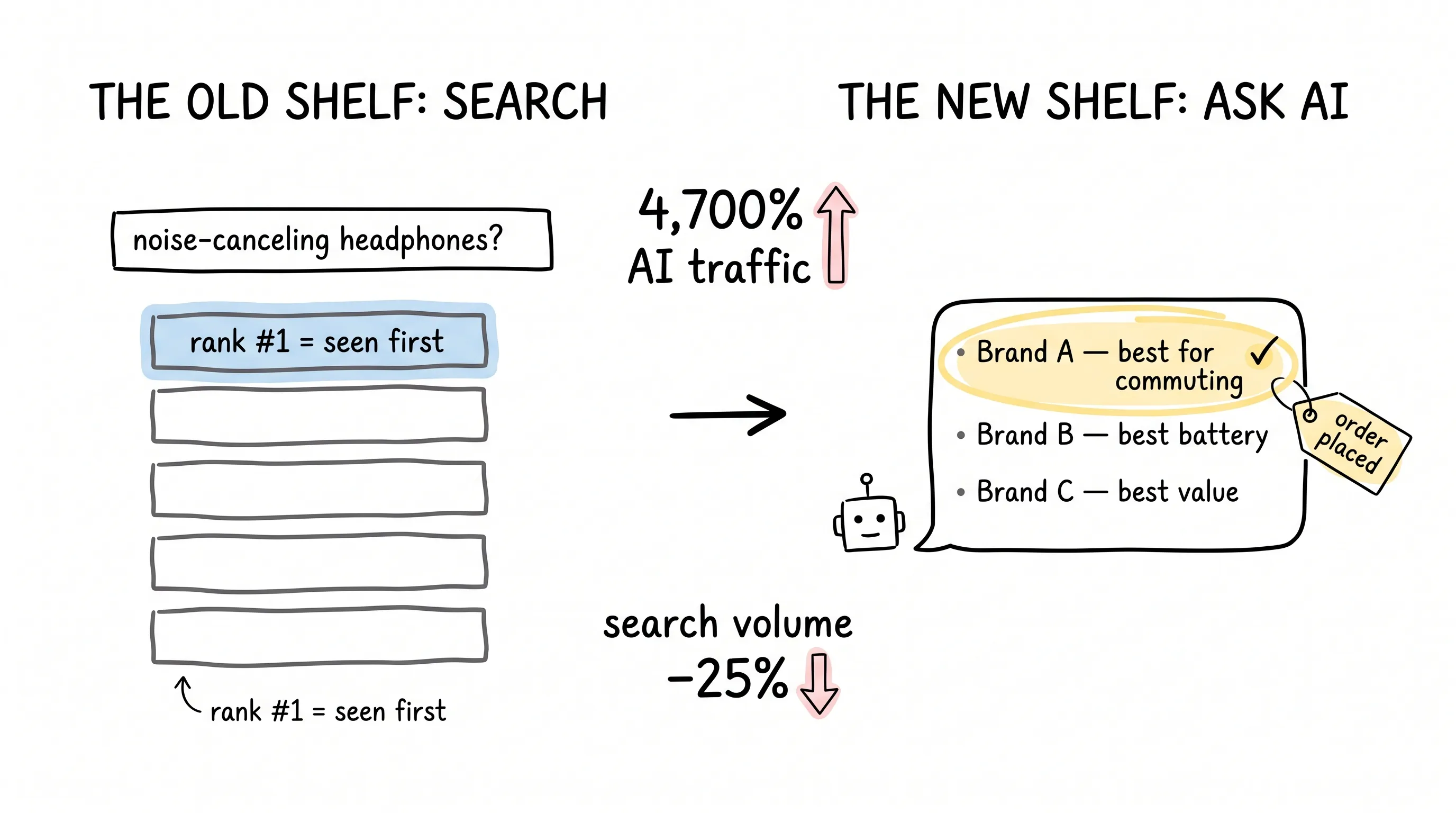
What is the "first shelf"? It's the first place consumers look before they buy something. For the past twenty years, that place was the search engine results page. Whoever ranked higher got seen first.
Now, more and more shopping starts with a question. You ask AI, AI gives you the answer.
How fast is this changing? Here are two numbers.
In July 2025, the traffic AI sent to US retail websites was up 4,700% year over year.
Yes—4,700%.
The other number comes from Gartner, the market research firm, forecasting that traditional search volume will shrink by more than a quarter.
Put the two numbers together and the meaning is clear: the entrance is moving.
And many practitioners believe this isn't the end point. The next step is AI agents — they won't just give you answers, they'll do work for you and place orders for you. For everyday essentials as a category, the entire shopping journey might be handled by AI.
What does this mean for marketers?
Scott Shepard, head of sales at Tremendous — a company that helps enterprises manage marketing rewards and incentives — put it bluntly. His point: the prime positions on the search results page matter less and less. That's a threat, and also an opportunity.
The threat is easy to understand. Where's the opportunity?
The opportunity is this: the old playbook has stopped working, and the new one hasn't been worn out yet. Whoever rewrites their playbook first gets to capture the upside.
As I see it, it comes down to three things.
Move One: Make Sure AI Can See You
Brand exposure used to mean occupying the front page of search results. Now you have to ask a different question: does your brand show up in AI's answers?
Jack Smyth, Brandtech's lead for Australia, specializes in a new discipline called Generative Engine Optimization (GEO). One line of his stuck with me: in some scenarios, AI is the most important audience you will never meet.
What is an audience? Audiences used to be people. Now the audience is the model. It screens your brand on behalf of millions of people, then decides whether or not to mention you.
So how do you get AI to talk about you?
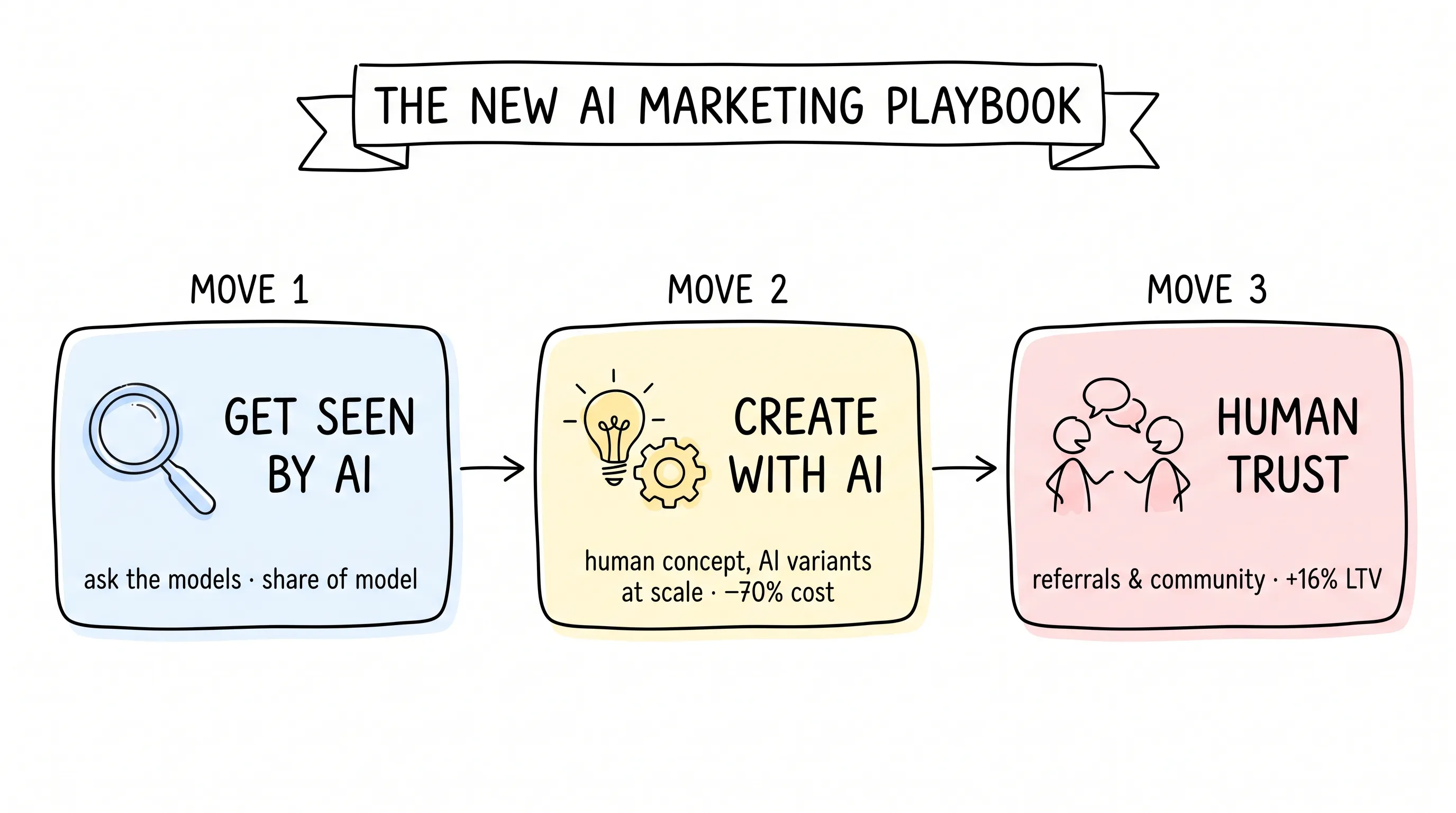
Step one: get clear on the current state. Go ask the major models directly. If you sell face cream, ask "which face cream is best" — see who it recommends, what features it emphasizes, which websites it cites. If you don't ask, you have no idea how AI is introducing you to your customers. Or whether it's introducing you at all.
Smyth coined a concept for this, called share of model: how often your brand appears in AI's answers, and in what context.
This metric matters enormously.
How do you raise it? A lot of the old SEO craft still works: write content that's clear and machine-readable, make pages open within two seconds on a phone, include more facts and data, link out to your sources.
But there's new craft too. Let me list four:
- Stop piling up keywords — go figure out how consumers will "ask." Weave those natural-language questions into your content.
- Package information in formats AI can lift directly. Tables of product specs, bulleted lists — they all count. Chatbots love citing this kind of thing.
- Include some conversational expert commentary, broken into short paragraphs. AI prefers citing that style.
- Don't forget images. AI looks at pictures and judges your product's tone from the visuals. If your selling point is "cheaper than the competition," for heaven's sake don't shoot it like a luxury campaign. AI can't read subtext; it only sees the picture.
You see, this pipeline runs on the same logic as SEO: analyze, create, distribute, measure. It's just that the gatekeeper has changed. The old gatekeeper played by the rules; the new gatekeeper understands color palettes, understands product forms, even understands tone of voice.
When the gatekeeper changes, your shot has to change with it.
Move Two: Redo Traditional Marketing with AI
Some will ask: if AI is making decisions for consumers, does traditional advertising still work?
Quite the opposite. Traditional marketing may matter even more.
Why? Think about it. You make running shoes. What do you want consumers to ask AI? You want them to ask: which pair of "your" shoes is right for me?
If your brand never got into their heads, they can't even ask that question.
And even if they don't name you, when AI lays out a row of options, the familiar name is the one more likely to get picked.
So brand awareness hasn't been devalued — it's worth more. It determines how the question gets asked, and how the answer gets chosen.
The good news: the barrier to making brand content today is absurdly low. Midjourney can produce images, Google's Veo 3 can produce video, chatbots can help write copy. And it's not just cheap — it scales: in the past, making a thousand asset versions aimed at different audiences would blow the budget sky-high; now the cost is under control.
One case study says it all. The British Council ran a marketing campaign built on The Brief, an AI ad-creation platform. More than a thousand assets, production costs down 70%, with fast localization for eight different regions.
Incredible. The savings are real money.
But don't miss one detail: the creative behind those thousand-plus assets was still dreamed up by human designers.
Tammy Nam, CEO of The Brief, has a take I completely agree with: soon, nobody will ask "did this campaign use AI?" Because the answer is always, yes.
So what will people compete on then?
On the things that can't be automated: aesthetic sense, visual craft, a unique tone of voice. In her words, these remain extremely important.
Her other line is even more worth pondering: using AI isn't about pouring more content into channels — it's about making content that's smarter, more relevant, and able to strike a chord with people.
So the practical path is three steps: humans first set a creative concept that's bold and distinctive enough; then use AI to generate variants for different audiences at scale; finally use AI for localization — language, region, cultural habits, adapted one by one — so the global campaign doesn't turn into a one-size-fits-all template.
Small companies actually get the advantage in this wave. No layers of approval — think it, try it; if it fails, switch. In a flood of mediocre AI-generated content, being small makes it easiest to stay distinctive.
Move Three: Push Human Recommendations to the Extreme
AI has a natural persona: neutral. But many consumers don't fully trust it.
Especially when buying expensive things, or personal things. AI says this mattress is good — would you order it right away?
Many people wouldn't. They'd want to confirm with another human first: check the reviews, browse discussions from real users.
Scott Shepard says that across electronics, furniture, beauty, and travel, demand for human recommendations has always been strongest. His point: no matter how far AI evolves, before ordering a big-ticket item like a mattress, people still want a living person's endorsement.
One signal: search interest in real-user discussions on Reddit has kept rising.
For brands, two opportunities hide inside this.
First, go participate genuinely in community discussions. A good conversation might ignite someone's shopping journey on the spot; the positive discussions about you that get left behind become the "human verification" for later buyers before they order.
Second, even better: these real discussions are themselves an index source for AI models. Who AI recommends depends, to a large degree, on what real people online say about whom. Managing your community reputation well amounts to making recommendations to "humans" and "AI" at the same time.
Kill two birds with one stone.
Also, don't underestimate the oldest, most old-fashioned word-of-mouth play: referral programs. Existing customers introduce the brand to their friends and family — that move is worth even more in the AI era.
Why? AI is inflating the production capacity of marketing content without limit; a large share of it is mediocre, and users who see too much get fatigued and get suspicious. At a moment like this, a recommendation from someone they know carries more weight.
The math works out too. The data Shepard cited shows referred customers are more likely to buy, more likely to stay, with lifetime value 16% higher.
16% — that's the price tag on a friend's recommendation.
Shepard puts it even more bluntly: there's too much information out there, and it's hard to know what to trust. But word of mouth, people believe.
Even better: referral programs themselves can now be optimized with machine learning — when to speak up, what to say, what incentive to give, all computed to just the right degree.
Finally, Back to Those Headphones
After my colleague bought the headphones, he added one thing: shopping now starts with asking AI — it's just become a habit.
So you see, this is not a minor adjustment. This is a full rewrite of a marketing playbook that's been in use for decades.
Three things: make sure AI can see you, use AI to amplify your distinctiveness, use human trust as your safety net. Keep an eye on the new channel, but the essence of the traditional channels hasn't changed: make people remember you, make people trust you.
Shepard says companies that handle this shift well are watching both ends. And the returns have already started coming in.
If you're building a brand too, you can run a small experiment today: open an AI assistant, and type in the question your customers are most likely to ask.
See whether the answer includes you.
I hope it does. I hope you're in there.
Continue reading
Related articles

Cross-Border Business: Time to Upgrade Your AI Toolbox
A learn article explaining how AI tools help cross-border e-commerce sellers clear five hurdles: language, regulation, logistics, payments, and fraud. It outlines a five-compartment toolbox, a five-step adoption path, and metrics such as conversion rate and CLV, while cautioning against over-reliance on AI.

AI Is Taking Over the Dirty Work of Social Media Marketing, One Task at a Time
This learn article outlines four social media marketing tasks AI can handle — audience analytics, content drafting and design, ad targeting and creative testing, and spam moderation — and cautions that taste, judgment, and data security remain human responsibilities.

AI Is Already This Good — Why Is Your Social Media Marketing Still Pure Manpower?
An overview of 18 AI tools for social media marketing, organized into six categories covering audience research, content creation, scheduling, comment and DM handling, ad management, and visual production, plus notes on personalization, prediction, and emerging trends.