
Marketing with AI: Revolution or Bubble? Let Me Tell You 3 Stories
An article examines AI in marketing through three case stories: a Brazilian broadcaster automating social publishing with AI, SAP testing cookieless contextual ad targeting, and 10Adventures growing with human-written SEO content, concluding repetitive tasks suit machines while quality judgment stays human.
A few nights ago, past midnight, a good friend who works in marketing messaged me: "Our boss wants to go all in on AI. He wants a plan next quarter. Tell me — can this thing actually be trusted?"
I stared at my phone and thought for a long time.
I've heard this kind of talk too many times.
Every few years, something new pops up claiming it will completely upend marketing. Some of them truly are revolutions — the internet, for example. Some are all thunder, little rain. Second Life, Google+, those Google Glasses — and even earlier, that QR-code wand called CueCat. Which of them wasn't hyped to the skies back then?
The new thing doesn't matter. What problem it actually solves — that matters.
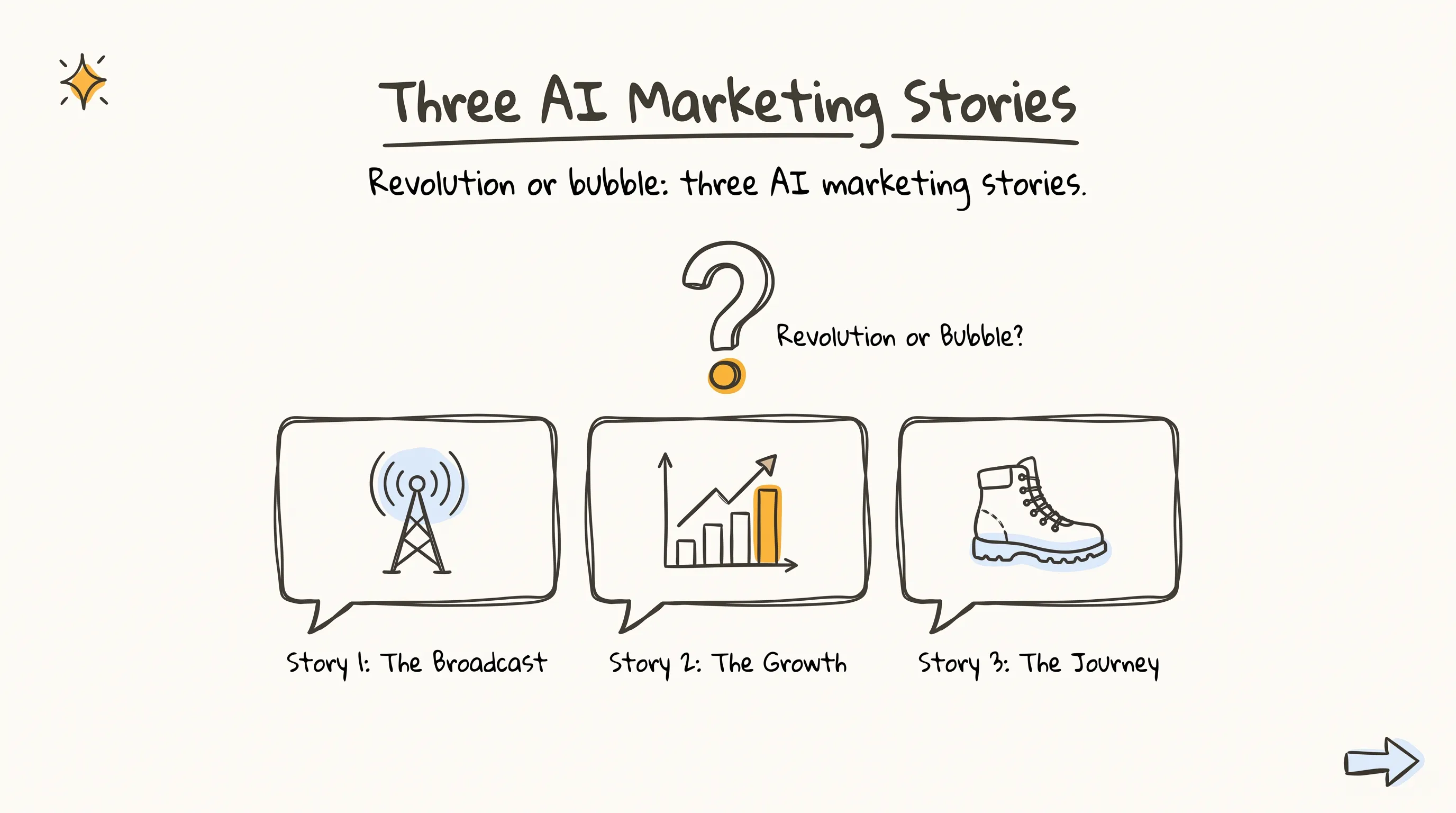
So today, no concepts. I'll tell you 3 stories. The first two are companies that scored real results with AI. The third is precisely the opposite: a company that firmly refuses to let machines write content — and sold for real money anyway.
After reading, judge for yourself.
Story One: A TV Station That Frees Up 14 Hours a Day
The first story takes place in Brazil.
SBT — the Brazilian Television System — a free-to-air broadcaster with 114 affiliated stations and more than 6,000 employees. Its website draws 11 million monthly unique visitors and over 99 million page views, and its main Facebook account sits on 12 million fans.
Sounds impressive, right?
But look at its situation and you'll know how uncomfortable it is.
SBT has no centralized social media team. About 20 people across the company fight their own battles, each publishing their own content. Facebook alone demands 100 to 150 posts a day.
150 posts a day. Picture that scene.
What's worse, 40% to 50% of the station's website traffic comes from Facebook. The company's traffic lifeline is effectively held in the hands of a bunch of colleagues who "post when convenient." Post too early, nobody sees it. Post too late, you miss the heat. It's all by feel.
Later they did one thing: deployed an AI and machine learning based publishing system from Echobox.
What does this system do? Think about it.
First, it calculates "when to post." It watches real-time hot topics on the platform on one side, SBT's fans' activity habits on the other, while also deciphering what the Facebook algorithm has changed today. Computing all three sides, it gives the optimal posting time.
Second, it changes its own mind. Once a post is out, the moment data shifts it auto-adjusts: higher-potential new content arrives, old posts get pushed back; an old post's momentum builds, it gets pulled forward.
Put plainly: it wrestles the Facebook algorithm 24 hours a day on your behalf.
And the result?
4 months.
Daily average clicks up 25%, daily average organic impressions up 61%. Looking at Facebook alone, daily average impressions up 52%. Page views from Twitter up 63%.
Over those 4 months, the team published nearly 40,000 posts and saved 14 hours a day.
14 hours — roughly 1.75 full-time employees — handed back to the company for nothing.
SBT's media integration manager Rodrigo Hornhardt says this is only the beginning. With the freed-up time, he plans to build finer platform strategies and even assemble a dedicated audience operations team.
You see, this is one correct use of AI: it doesn't produce content; it manages distribution.
Story Two: SAP Spent Money Well Without Cookies
The second story is about a cake that's disappearing.
What is a third-party cookie? It's a little tracking note quietly slipped to you while you wander the web. You glance at running shoes on site A, and site B instantly knows — then chases you with ads. For the past decade-plus, digital advertising has relied almost entirely on it.
But now, browsers are shutting down this little note one by one. Every data-driven company has to rethink: without cookies, how do you invest ads?
Global software company SAP ran an experiment in 2022.
Their method is called contextual targeting. What is contextual targeting? Forget "who you are" — it only looks at "what you're looking at right now."
The technology isn't mysterious: let AI read the entire page — text, images, audio, video, scan it all — judge what the page is about and whether it's safe, then place the ad where the content tastes right. It never touches cookies, never touches any personally identifying information.
The ad format is interesting too. A "wrapper" ad wraps around the content you're reading like book pages: an entrance animation grabs attention, the right panel counts down to a webinar, the left carries core information plus a call to action. Scroll down, the background changes scenes, the title moves to the left column — always in your sight.
How was the effect verified? They split people who hadn't seen the ad into a control group, compared results against the test group who had, and hired eye-tracking to measure whether people actually looked.
And the result — good grief.
61% of users who saw the ad took action or planned to. Ad visibility 93.2%, click-through rate 0.9%.
Brand level: overall awareness rose a direct 4%, positive attitude among target audiences up 5%, the share believing "SAP provides the best business software" up 5%, agreement that "SAP is a trustworthy brand" up 7%. One in every three people found the ad informative.
SAP's EMEA integrated media manager Moritz Fisecker's conclusion is direct: investing entirely without cookies performs no worse — and may even perform better.
Cookies will exit the stage. "The context of this moment" will not.
Story Three: Not Letting Machines Write — $1 Million in 18 Months
The third story runs against the grain.
10Adventures — an online platform connecting adventure travel enthusiasts with local guides. Founded in 2019, it started with only a WordPress website and a pile of good content. Now it draws over 1.5 million unique visitors a year, with more than 50,000 registered users.
Founder Richard Campbell's attitude toward content borders on stubborn.
He says the web is full of shallow content mass-produced by content farms, and the outdoors market is especially bad. Many companies, to save cost, pick cheaper options: AI writing, or outsourcing. But if quality falls short, you won't wait out the results you want.
So they insist: real people, writing genuinely useful content. Their most popular assets are their free route guides — the best hiking, biking, cross-country skiing routes of a given region, specific down to every single one.
On this foundation, they laid SEO's basic drills: metadata, URL structure, image alt text, page titles, heading hierarchy, internal links. They tried third-party vendors for backlinks and found doing it themselves was better — cheaper, and it guaranteed every link was natural.
Then they hit a wall: website speed.
They judged that a Google algorithm change punished slow-loading pages. Every optimization WordPress could offer — database, code — they turned upside down. Still slow.
The solution was resolute: the entire frontend rewritten in a new language, migrated to a static site. Every page pre-rendered, no longer querying the database in real time, paired with global edge servers.
One month later, organic traffic up 67% year over year. Strong.
And paid ads? Tried plenty; the accounts looked ugly: paid leads converted at only one-tenth the rate of organic traffic. Just starting out in 2019, customer acquisition cost was about $300; by late 2021 through the first seven months of 2022, it had risen to around $1,000.
Over the past 18 months, sales driven by organic traffic approached $1 million, up nearly 5 times year over year.
The team is still experimenting: is it easier to lift a page ranked 3rd to 2nd, or drag one from 8th to 3rd, or charge from 40th to 8th? Do different content types and different regions give the same answer?
You see, this company's methodology isn't mysterious at all: good content written by humans, plus dumb effort, plus speed.
Back to Your Friend's Question
Three stories told. Back to the beginning: should you go all in on AI?
My answer is: AI is a lever. Where you place the fulcrum is your business.
Think one level further.
SBT uses AI because the problem it faces — massive, repetitive, real-time-shifting distribution — is the machine's home court. SAP uses AI because what it must solve — reading page context at scale — is also the machine's home court.
And 10Adventures insists on human-written content because content, at its core, bets on quality and trust — that's the human's home court.
So don't rush to ask "should I use AI." First ask one thing: is this matter's core repetitive computation, or quality judgment?
The former — confidently hand it to machines. The latter — don't skimp on this money.
Once you've done the accounts clearly, it's not too late to talk about going all in.
May you always see the problem clearly first, then choose the tool.
Continue reading
Related articles

Cross-Border Business: Time to Upgrade Your AI Toolbox
A learn article explaining how AI tools help cross-border e-commerce sellers clear five hurdles: language, regulation, logistics, payments, and fraud. It outlines a five-compartment toolbox, a five-step adoption path, and metrics such as conversion rate and CLV, while cautioning against over-reliance on AI.

AI Is Taking Over the Dirty Work of Social Media Marketing, One Task at a Time
This learn article outlines four social media marketing tasks AI can handle — audience analytics, content drafting and design, ad targeting and creative testing, and spam moderation — and cautions that taste, judgment, and data security remain human responsibilities.

AI Is Already This Good — Why Is Your Social Media Marketing Still Pure Manpower?
An overview of 18 AI tools for social media marketing, organized into six categories covering audience research, content creation, scheduling, comment and DM handling, ad management, and visual production, plus notes on personalization, prediction, and emerging trends.