
Marketing Compliance: Stop Running It on Human Power
A learn article on why manual marketing compliance tracking no longer scales and how AI automation can handle regulation monitoring, content review, and evidence keeping, with a four-step rollout path.
A while back, a friend of mine who runs a cross-border e-commerce business invited me out for tea. He had barely sat down before the venting started.
Last month, one of their ad creatives got pulled by the platform. The reason? The product page was missing a single disclaimer line. One line.
He told me: "These days, writing an ad means moonlighting as a half-lawyer first. The EU has its rules, California has its own, healthcare is a whole other book, and Brazil has yet another set. My whole team burns the better part of a day every week just keeping an eye on this stuff."
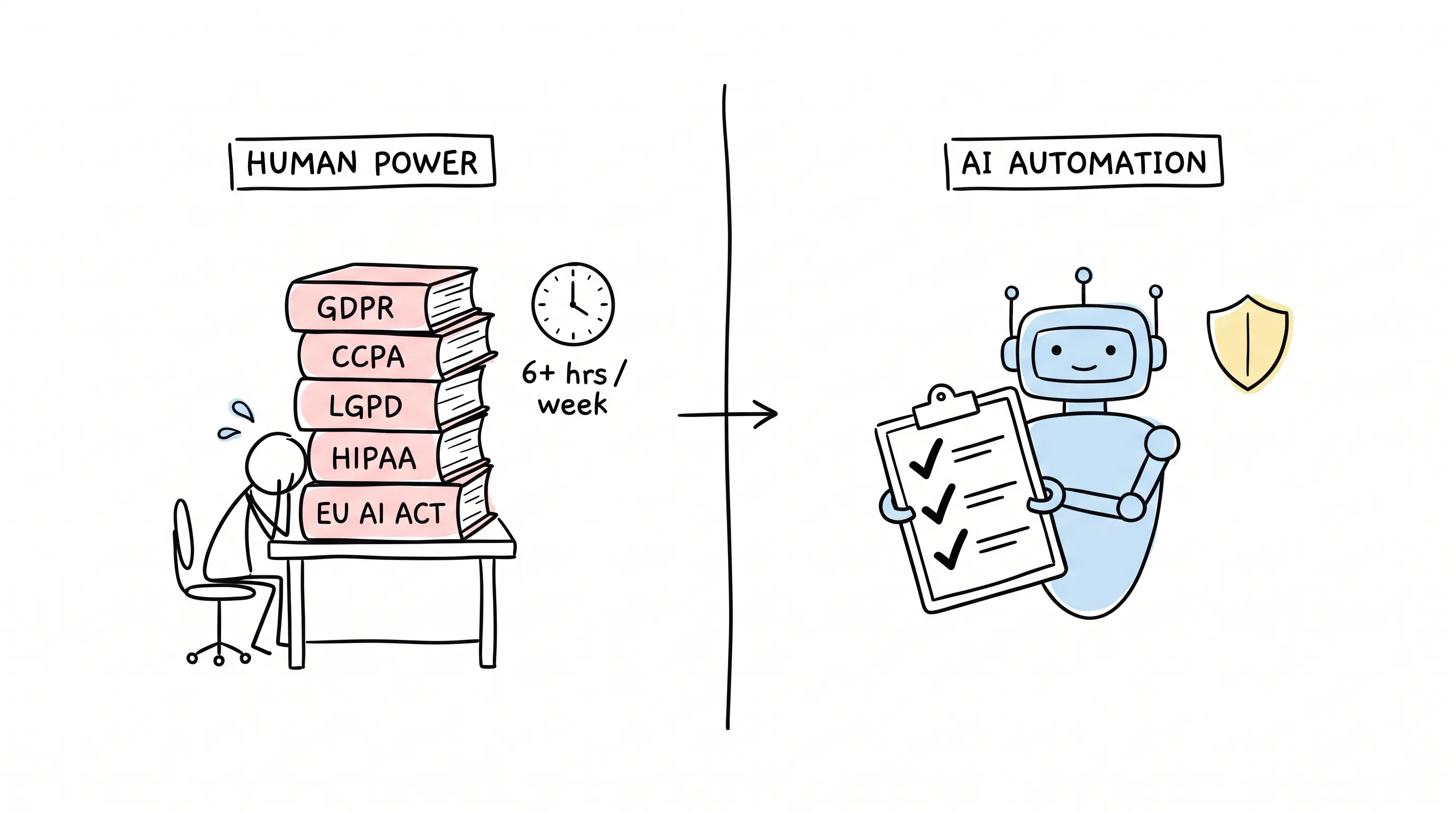
I wasn't the least bit surprised. I've seen a data point that still shocks me: 56% of companies spend at least six hours a week manually monitoring compliance. And more than half of them complain that the review process is a grind — revise once, review once, revise again.
So today, let's talk seriously about this: does marketing compliance really have to be this exhausting?
Here's the conclusion up front: Yes. And the sooner you hand it to machines, the better.
Why Humans Can't Keep Up
Think about it: how many rulebooks does a marketer have to serve today?
The EU has GDPR, governing data privacy. California has CCPA. Brazil has LGPD (Brazil's GDPR-style privacy law). Touch healthcare and HIPAA watches over patient information. Run ads and you answer to advertising standards and consumer protection law, plus accessibility requirements. And in the last few years, new AI governance frameworks have joined the pile.
And that's not all. One campaign aimed at the whole world means serving European users under GDPR, California users under CCPA, Brazilian users under LGPD. The same poster lands in different markets under entirely different rules.
And the rules never sit still. What applies today may be amended next month.
How are you supposed to track all that with people? Excel spreadsheets? The naked eye?
"So hire more people," you say. Hiring doesn't fix the root problem: content is growing exponentially — emails, social posts, ad creatives, landing pages, across dozens of platforms and thousands of assets. Human eyes have a fixed bandwidth.
What stings even more is the cost. Under the EU AI Act, fines run up to €35 million, or 7% of your global revenue — whichever is higher. The Act took effect in 2024, and as of 2026 it is in full enforcement.
And fines are only part of the bill. When a compliance incident hits, it's your brand that takes the hit, user trust that walks out the door, and lawsuits that could sink the business.
I like to say: For every wall you can't go around, someone will find a way to build a ladder.
That ladder is called AI compliance automation.
What Is Marketing Compliance Automation?
So what is marketing compliance automation?
Put simply, it means letting machines do three jobs for you: track the regulations, review the content, and keep the evidence.
Let me break it down for you.
First, let machines read the regulations. Regulatory text reads like gobbledygook, but AI can actually digest it. The moment a regulation updates, it scans the change automatically and tells you: which parts of your business this new rule affects, which process to change, whom to notify.
This used to be a job like manually leafing through every newspaper, every day, to fish out the three stories that concern you. Now it's like having a subscription feed that only surfaces what's relevant to you.
Second, let machines review content. Send a marketing email, and the machine automatically checks: any prohibited wording? Required disclosures present? Tone compliant? Images and video too — the machine looks for infringing material, misleading visuals, and accessibility compliance.
Better still, the machine triages. Low-risk routine content passes straight through. High-risk items and triggered alerts go to human experts for careful review. Human time goes exactly where it counts.
Third, let machines manage the data and keep the evidence. The most tedious part of privacy compliance is being able to say clearly: a user's personal data — who collected it, where it's stored, who has used it. A manual pass used to take four weeks. An AI scan takes 18 minutes.
Four weeks versus 18 minutes. You heard that right.
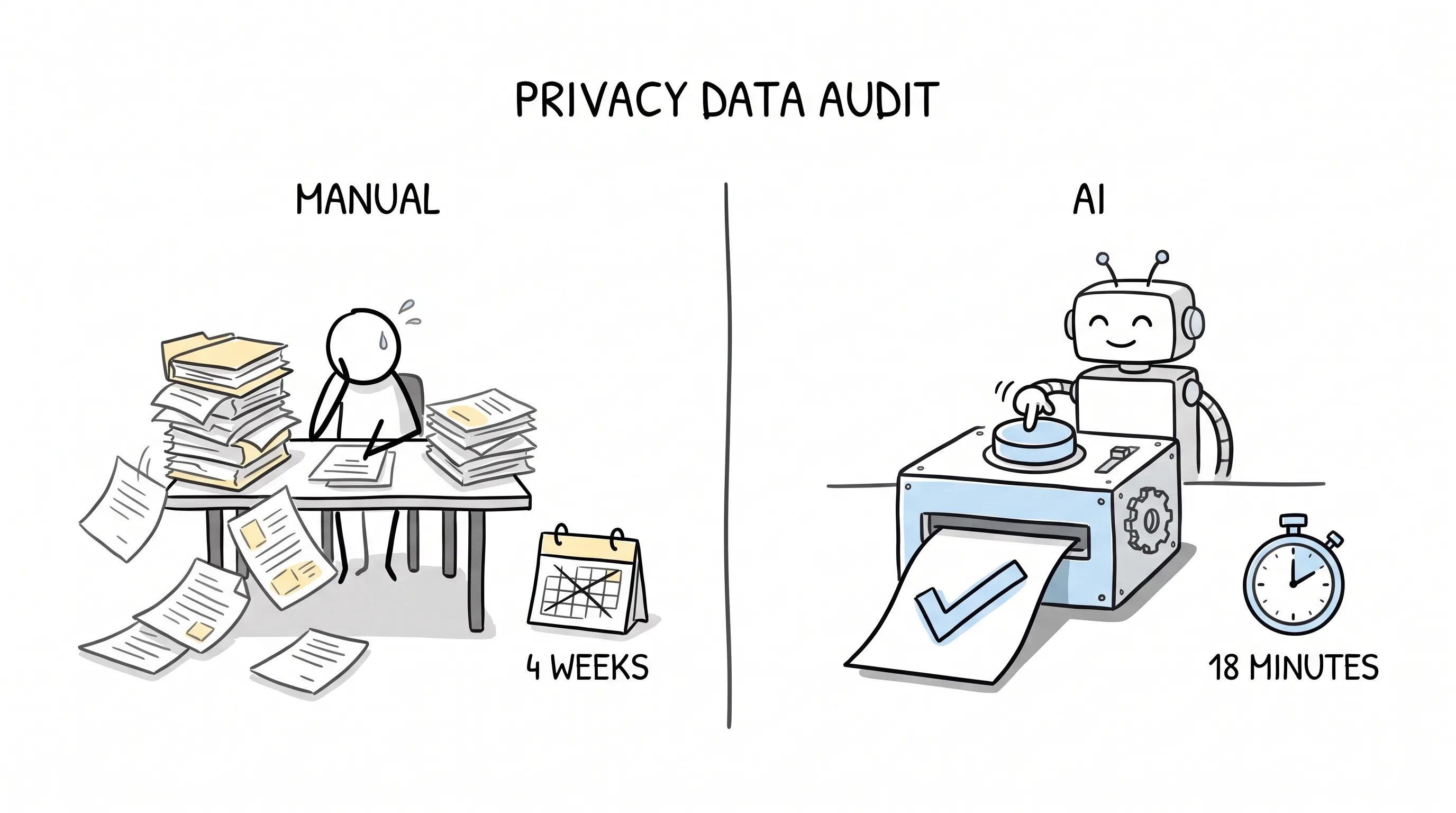
Audits work the same way. Day to day, consent records, approval records, and policy confirmations are filed away by the machine as a matter of course. When a regulator comes to check, you don't tear the whole house apart — you just pull the file.
That's marketing compliance automation: from "cleaning up after the fact" to "blocking it before it happens."
Let's Run the Numbers
By now you're surely asking: I get the logic, but is it worth it?
Let's tally up three numbers.
First tally: time saved. Say your compliance team spends 56 hours a week on manual monitoring — a typical load in this industry. Automation cuts that workload by 70%, saving 39 hours a week. At a fully loaded cost of $75 an hour per compliance staffer, that's more than $150,000 a year. And that's just the "monitoring" part.
Second tally: risk avoided. Assume that under a manual regime, you get one major violation every two years — fines, legal fees, remediation all told, a $500,000 loss each time. Automation cuts the violation probability by 80%, which spreads out to $200,000 a year in expected benefit.
Third — harder to tally but more important: confidence. Among organizations running automated compliance, 60% feel confident in their compliance posture. Among those doing it all by hand? Only 36%.
A 24-point gap. What the gap measures isn't technology — it's whether you can sleep at night.
By the way, 93% of compliance professionals report that AI has noticeably reduced human error while efficiency went up. You see: machines don't tire, machines don't get frustrated, machines don't let things slip.
Here's one more industry reference number: marketing automation returns $5.44 on every $1 invested. Compliance automation is the least glamorous slice of that — and the one that lets you sleep the soundest.
Different Industries, Different Watch Points
Of course, compliance is not one set of rules to rule them all. Let me walk you through a few typical industries.
In healthcare marketing, three blades hang over your head: HIPAA guards patient privacy, FDA polices advertising claims, and state medical boards add rules of their own. What does AI watch for you? Whether patient information has leaked, whether efficacy claims have clinical evidence backing them, and whether disclaimers are complete and correctly formatted.
In finance, the focus is "disclosure." Requirements differ by product and by region. AI's value lies in this: one campaign, sent to different markets, with local rules applied automatically. Before, that meant a person with a checklist, ticking line by line.
In e-commerce, watch whether pricing is transparent, whether promo terms are written clearly, whether product claims have substantiation — plus cookie popups and privacy notices. The harder you push personalized marketing, the more data you collect, and the stricter your consent management must be.
In SaaS, there's an easily overlooked trap: the security certifications showcased on your website — have any expired? When a certification gets renewed, is the marketing page updated? AI can keep this kind of claim consistent with actual credentials and remind you to update the moment anything changes.
You see, the rules differ, but the underlying logic is the same: turn compliance knowledge into machine rules, and let the machines take the first pass.
Want It to Land? Don't Rush to Buy Tools
At this point, you might be tempted to buy a system tomorrow.
Slow down. I've seen plenty of failures, and they share the same flaw: automating a broken process as-is. Automate a bad process and all you get is a bad process that runs faster.
The right path, in four steps.
Step one, draw the map first. List every regulation that applies to you, one by one: which are high-risk, where the current process gets stuck, how many person-hours a week this consumes. That's your baseline, and the yardstick for measuring improvement later.
Step two, pick a small opening and pilot there. Don't try to do it all in one step. For example, start with compliance review for email marketing. Pick a scenario with high review volume, clear rules, and obvious pain — win one early, and the team has the confidence to keep going.
Step three, redesign the process, then bring in the system. Decide where humans stay in the loop: rule-setting stays human, judgment calls on hard cases stay human, and anything the machine isn't sure about escalates to a person. Also, tell the team clearly in advance: the machine is taking over the repetitive labor so people can do the judgment-heavy work. Skip that conversation, and even the best system stalls.
Step four, set metrics and keep tuning. Hours saved, problems intercepted, false-alarm rate. With metrics laid on the table, the project can stand on its own.
One-line summary: automation doesn't replace people — it replaces the repetitive part of what people do.
Looking Five Years Ahead
Finally, the trends I see.
This isn't my intuition alone. Already, 65% of organizations have concluded that automation is the most effective way to reduce compliance complexity and cost. And 80% of compliance professionals believe that within five years, AI will have a big — even transformative — impact on their work.
Why do I believe these two numbers?
Think about it: marketing is using AI heavily, so AI itself has become an object of regulation. The EU AI Act has a full set of requirements for high-risk AI systems: keep documentation, keep human oversight, monitor continuously. One day, your personalized recommendation algorithm may also have to prove that it "doesn't discriminate against anyone." So the next generation of compliance platforms will start auditing AI itself.
Also, compliance capability will gradually be embedded into the marketing tools you use every day, becoming default and built-in rather than a separate purchase with a separate workflow. Companies selling into global markets will rely more and more on machines for cross-border orchestration: one set of content, with the machine automatically tuning compliance to each region.
By then, the gap between companies that have this capability and those that don't will only keep widening.
Back to That Cup of Tea
That day over tea, my advice to him came down to one sentence: don't try to do everything in one leap — start with compliance review for email marketing, and for one month, write down the time saved and the problems intercepted. Let the numbers speak.
Last month he sent me a message: the pilot is running, the machine review is spot-on every time, and the team never has to rotate shifts watching thousands of creatives anymore.
Regulation will only get stricter, and there's no turning back on this road. Early movers turn compliance into a moat; late movers turn it into a stack of fines.
Here's hoping you never have to pay one.
Continue reading
Related articles

Cross-Border Business: Time to Upgrade Your AI Toolbox
A learn article explaining how AI tools help cross-border e-commerce sellers clear five hurdles: language, regulation, logistics, payments, and fraud. It outlines a five-compartment toolbox, a five-step adoption path, and metrics such as conversion rate and CLV, while cautioning against over-reliance on AI.

AI Is Taking Over the Dirty Work of Social Media Marketing, One Task at a Time
This learn article outlines four social media marketing tasks AI can handle — audience analytics, content drafting and design, ad targeting and creative testing, and spam moderation — and cautions that taste, judgment, and data security remain human responsibilities.

AI Is Already This Good — Why Is Your Social Media Marketing Still Pure Manpower?
An overview of 18 AI tools for social media marketing, organized into six categories covering audience research, content creation, scheduling, comment and DM handling, ad management, and visual production, plus notes on personalization, prediction, and emerging trends.