
Marketers' Five Dashboards, and a "Universal Plug" Called MCP
A few days ago, an old friend who runs an e-commerce business asked me out for coffee.
A few days ago, an old friend who runs an e-commerce business asked me out for coffee. Before he even sat down, he pushed his phone across the table: Look, this is my every morning.
I leaned in. Five dashboards open side by side. Google Ads for ad spend, Meta for the other side, GA4 watching site traffic, Ahrefs tracking keyword rankings, HubSpot for tweaking customer segments. He said his fixed morning routine was copying data from five places into one spreadsheet, comparing them, then manually moving money from the underperformers to the winners. Two hours, every single day, no exceptions.
I asked: why not let AI do it for you?
He sighed and said he'd tried. AI couldn't reach. Five platforms, five accounts, five formats — every new connection meant another round of "wiring," and the wiring alone was enough to make your head spin.
I told him: what you're missing is a universal plug. It already exists. It's called MCP.
The more tools you have, the more exhausted you get. The root of the exhaustion: every lock comes with its own key.
What exactly is MCP?
MCP stands for Model Context Protocol.
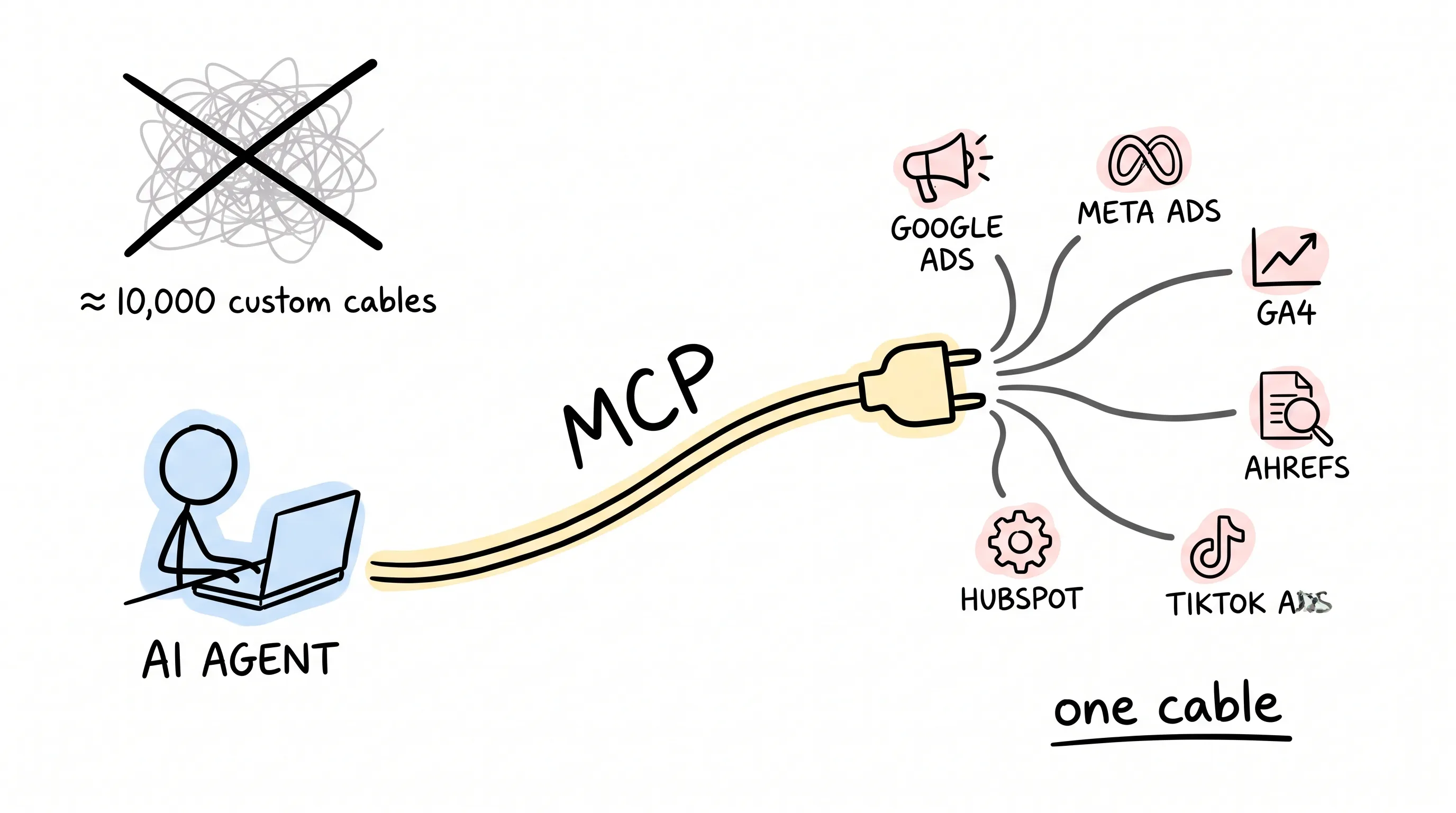
The name sounds intimidating. Simply put, it's USB-C for AI.
Think back a few years. To charge your phone you had Micro-USB, Lightning, and the round-barrel plug lying in your drawer — one trip meant packing three cables. Then USB-C unified everything, and one cable rules them all.
AI is living in the "three cables" era right now. Ask AI to analyze your ad data — it can't reach Google Ads. Ask it to adjust keywords — it can't reach Ahrefs. In the past, connecting each platform meant building a custom integration. Do the math: a hundred platforms means nearly ten thousand possible pairings. Who could ever build them all?
What MCP does is standardize every interface into one. Platforms open a "server" according to the spec; an AI agent plugs in on the other end and can read data, run analysis, and take actions. On one end, AI. On the other, hundreds, even thousands, of software tools. In between, a single cable.
Yes, just one cable.
Why is marketing the first to catch fire?
Some background first. In marketing circles there's a guy named Scott Brinker who draws a marketing technology landscape every year. The 2025 edition packed in 15,384 tools. Fifteen years, a hundredfold increase. That year alone added 2,489 new ones — and 77% of them were born with AI built in.
Tools are exploding. People? People are still switching between five dashboards.
Absurd, isn't it. Tools were born to save time; instead, the more tools there are, the harder people work at copying data.
And marketing happens to be the most "fragmented" industry of them all. Ad platforms multiply year after year; for a mid-sized company to run ads in five places at once — Google, Meta, LinkedIn, TikTok, Amazon — is completely normal. Each has its own bidding logic, its own reporting standards, its own audience formats. SEO is a round-the-clock job: rankings, backlinks, site health, competitor moves — someone has to watch it all the time. Customer behavior data sits in GA4, product data sits in Mixpanel, contact records sit in HubSpot, and none of them speaks to the others.
So when the MCP "universal plug" showed up, everything marketing had been holding back came pouring out at once.
Who's moving fastest?
Here's the interesting part: the ones moving fastest tend to be people whose data is the business itself.
Search ads lead the pack. On Google Ads alone, the community has grown more than a dozen MCP servers. The most polished one is the semi-official version from Google's own marketing engineering team — 143 stars, read-only by design: query only, no changes, built for analysis and reporting.
SEO tools form the tidiest category of official support. Ahrefs ships an official server; SEMrush offers a remote server with zero installation; DataForSEO's official server drops in hundreds of tools at once — SERP data, keyword research, backlink data all included. On the GA4 side, even Google has stepped in officially, and the community also has a nearly 200-star implementation.
The hottest community energy is around Meta ads. One Meta ads server has pulled in over 700 stars — the strongest of all ad-related MCPs. There's also a dedicated Meta analytics tool that can diagnose why an ad "fell back into the learning phase" (a recalibration window Meta puts ads into after significant edits) or why performance suddenly collapsed. That kind of diagnosis used to take a veteran media buyer an afternoon of digging through reports.
Email isn't slow either. Resend, Postmark, and other email providers practically each ship an official server.
This year, the big four ad platforms finally assembled
The truly landmark moment came this May.
At its annual marketing event, TikTok launched an official ads MCP server. From now on, AI agents can create ads, adjust bids, split budgets, and monitor performance directly on behalf of advertisers — no more clicking around its ads dashboard. It also shipped a developer toolkit for building custom AI-powered campaign workflows. With that, Google, Meta, Amazon, and TikTok — all four major ad platforms now have official or semi-official MCPs.
Amazon moved even earlier: its official server opened in beta, letting you create ads in plain natural language.
There's also a battlefield that's easy to overlook: retail media — the ad inventory that retailers like Amazon and Walmart sell on their own turf. This May, Pacvue — a company serving more than 70,000 brands worldwide and handling roughly 12% of global retail media ad spend — released the first dedicated retail media MCP server. An advertiser asks in plain English, "How are conversion costs looking across platforms?", and the agent pulls the data into line across 13+ retail platforms and generates a report. Their head of product put it bluntly: AI tools are becoming the primary interface for analysis and decisions, and business data needs to travel to where teams actually work.
You may have noticed a detail: nearly all of these servers emphasize "read-only."
Why? Because real money runs through ad accounts. If AI gets a bid wrong just once, it's your money burning. So in this first phase everyone is holding back: first let AI see, then slowly let it touch. There are bolder ones in the community that have opened both Google Ads and GA4 for reading and writing — but they built guardrails specifically around write operations: every time it's about to act for real, a confirmation comes first.
Any interface that can move money has to learn to say "no" first.
Once AI agents plug in, what can they actually do?
Let me simulate a scenario for you.
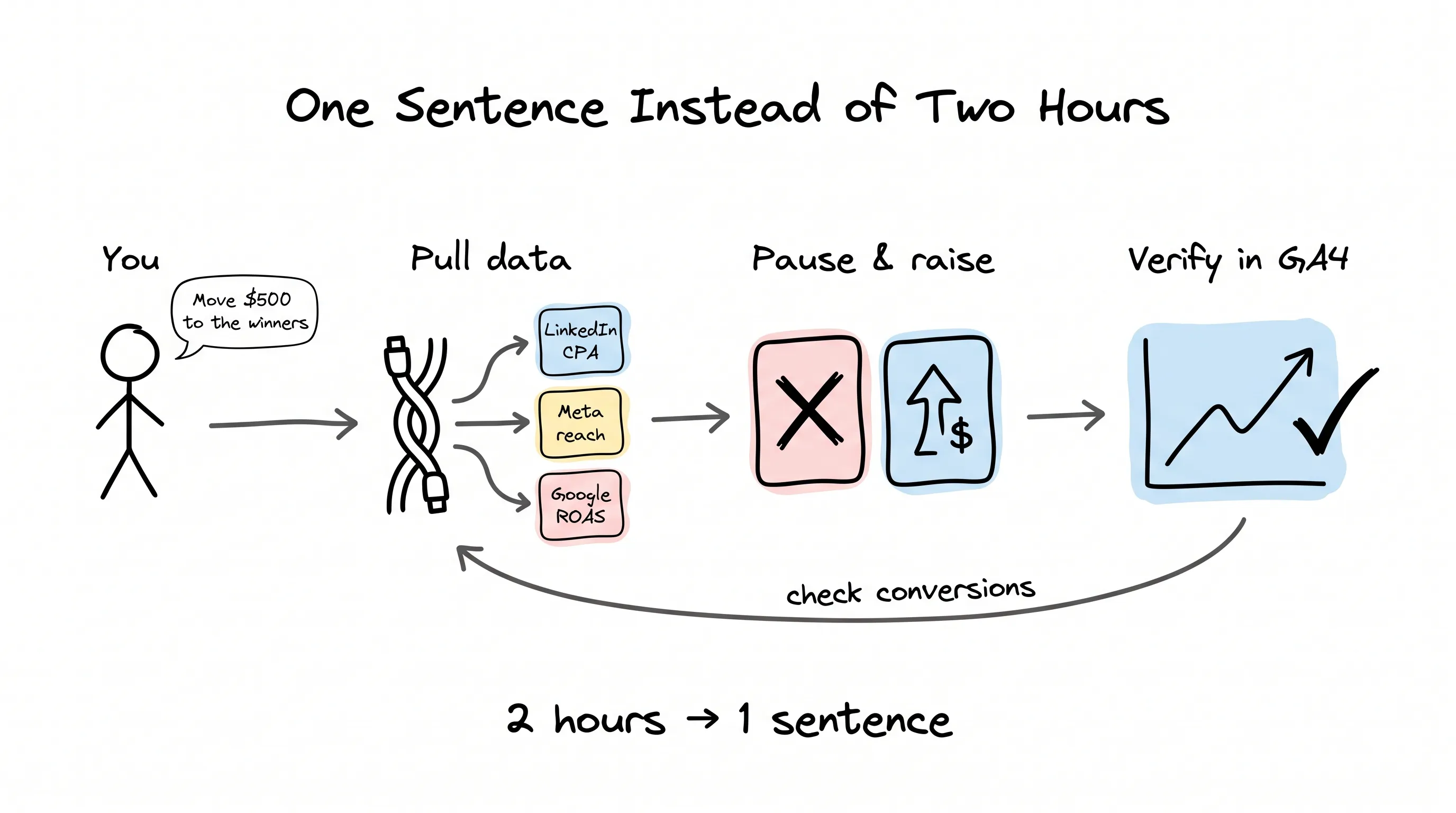
First thing in the morning, you tell your AI: "Move $500 of budget from the underperforming LinkedIn campaigns to the strong performers in Google Ads."
What does the AI do? First it pulls data from several platforms' MCP servers: LinkedIn's cost per acquisition, Meta's cost per reach, Google's return on ad spend. It puts them side by side and calculates how much to move, and where. Then it pauses the inefficient campaigns and raises bids on the strong ones. Finally, it checks GA4: after the budget shift, did conversions actually go up?
That whole routine used to be your two hours of manual work every Monday morning. Now, it's one sentence.
Take SEO. An AI agent hooked up at the same time to search data, backlink data, SERP data, and technical audit tools can discover on its own: which keyword clusters are slipping, which pages are stuck on page two by a whisker, which technical issues are dragging everything down. Then it dives straight into the CMS — the content management system — updating titles, refreshing content, patching internal links. SEO audits that agencies used to run once a month can now run every day.
The most valuable of all is full-funnel attribution. The term sounds technical, but it boils down to one question: where do my customers actually come from, and what does each channel really cost per customer? It used to be that answering that meant buying an expensive dedicated attribution system. Now an AI agent pulls three kinds of data together — ad spend, on-site behavior, CRM revenue — and walks you through it channel by channel: the true cost, how many times customer lifetime value covers acquisition cost, and where next quarter's money should be pushed.
Insights you once had to buy with money now come plugged in.
Where are the gaps?
Enough with the fireworks. Now for the craft. On this map, the blank spaces say more than the highlights.
Adobe is absent across the board. Enterprise analytics, experience management, testing, marketing automation — not a single MCP. Big companies running on Adobe's stack can only watch, for now.
The Trade Desk, the largest independent ad-buying platform, has no server. A/B testing as a category is nearly at zero — AI can't design experiments for you or analyze them. Affiliate marketing is even more extreme: the top affiliate networks, counted together, have zero servers. Customer data platforms are silent too — Segment and its peers haven't entered the arena, which means AI can't get a unified customer profile.
Why the slowness? Two kinds of reasons. One is the walled garden — data is the lifeblood, and the gates are heavily guarded. The other is enterprise software — heavy legacy baggage, and moving a single interface takes half a year of process.
And a gap is an opportunity. Whoever opens their platform as an MCP first gets to route the AI-agent traffic to their own house first.
When money is involved, AI has to follow the rules
One serious note to end on. Once an AI agent starts touching ads and user data, it's no longer just a tool — it has to follow the rules.
Which rules? Europe's GDPR has racked up more than $5.8 billion in cumulative fines since 2018, $1.2 billion of that in 2024 alone. Before AI builds remarketing audiences for you or installs tracking pixels, it has to confirm that users actually consented. In California, new rules took effect this January: when a user says "don't sell my information," AI can't use that data for targeting. And then there's Apple: iOS tracking authorization rates hover between 25% and 35% all year round, so the conversion data AI gets from ad platforms is inherently missing a piece.
AI-generated ad copy must carry the required disclosures; bulk email needs an unsubscribe link and a real physical address. These aren't formalities. They're the fines, itemized.
Bottom line, in one sentence: You can hand your data to AI. You cannot hand over the responsibility.
Finally
I sent this piece to that coffee friend.
He replied with a question mark. Ten minutes later, another message: let's start with the official Ahrefs one.
See? That's how change begins. No earth-shattering manifesto — just a guy who copies data into a spreadsheet two hours a day, suddenly finding his afternoons handed back to him.
Marketing tech has grown to more than fifteen thousand tools, and it will keep growing. As it grows, nobody can ever wire up all ten thousand cables. What saves everyone in the end is one universal plug — and a crowd of AIs that have learned to use it.
Maybe before long, you'll be saying it to your computer too: move the budget over.
And may you soon turn those five dashboards into one sentence.
Continue reading
Related articles

Cross-Border Business: Time to Upgrade Your AI Toolbox
A learn article explaining how AI tools help cross-border e-commerce sellers clear five hurdles: language, regulation, logistics, payments, and fraud. It outlines a five-compartment toolbox, a five-step adoption path, and metrics such as conversion rate and CLV, while cautioning against over-reliance on AI.

AI Is Taking Over the Dirty Work of Social Media Marketing, One Task at a Time
This learn article outlines four social media marketing tasks AI can handle — audience analytics, content drafting and design, ad targeting and creative testing, and spam moderation — and cautions that taste, judgment, and data security remain human responsibilities.

AI Is Already This Good — Why Is Your Social Media Marketing Still Pure Manpower?
An overview of 18 AI tools for social media marketing, organized into six categories covering audience research, content creation, scheduling, comment and DM handling, ad management, and visual production, plus notes on personalization, prediction, and emerging trends.