
Localization in Cross-Border E-Commerce Has Completely Changed
This article explains how AI is changing localization in cross-border e-commerce: regenerating market-specific copy instead of translating, optimizing for AI assistants (GEO), serving AI shopping agents with structured data, linking content to inventory, and using controlled generation with human oversight.
A few days ago, I had dinner with a friend who runs a cross-border e-commerce business.
He told me something: his company had cut its contract with the translation vendor. I said, cut it? Aren't you selling in a dozen-plus countries?
He said, "We don't do 'translation' anymore."
I froze for a second. If you don't do translation, what do you do?
The answer came in a single phrase: regenerate from scratch.
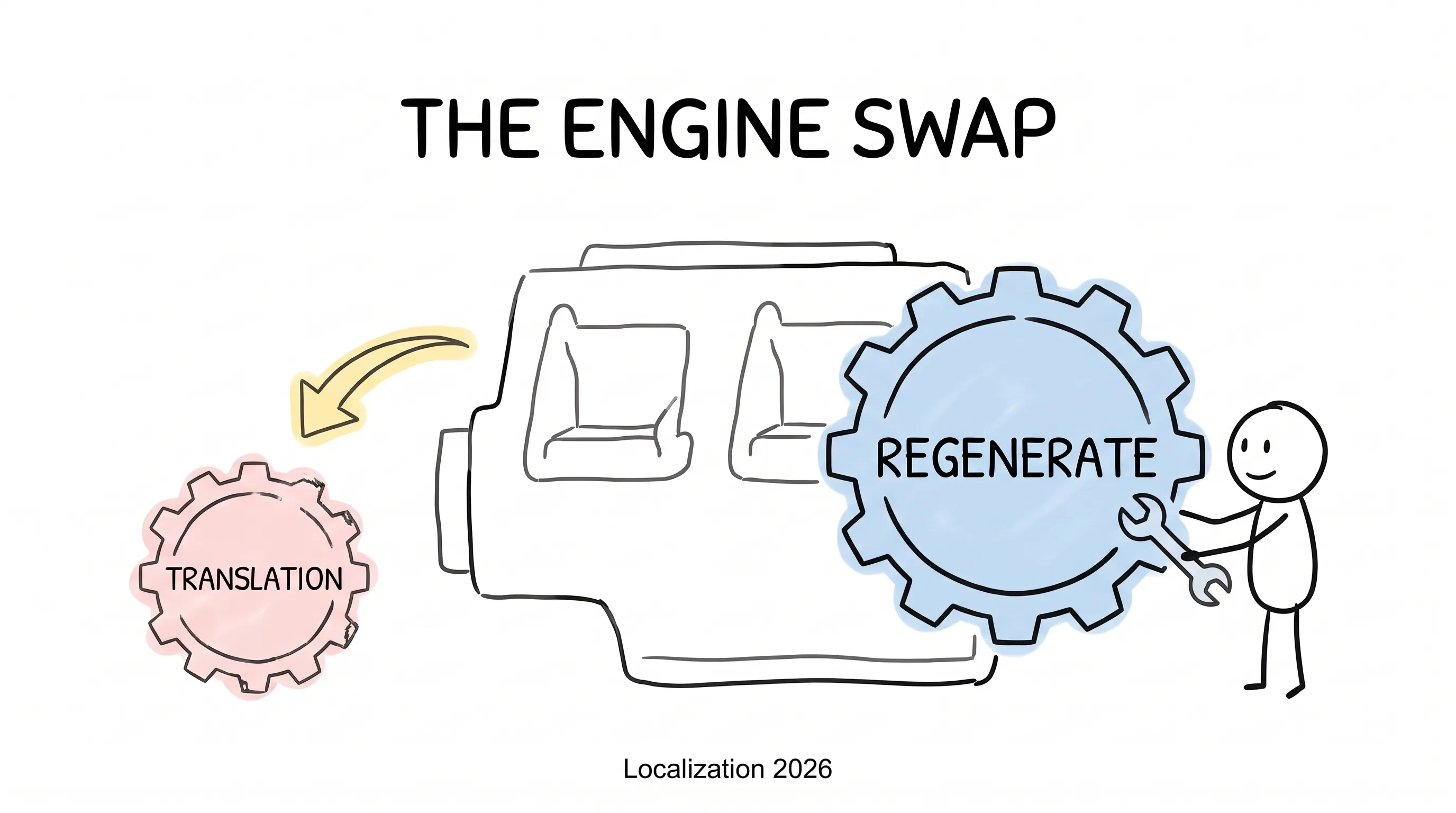
After that dinner, I went home and untangled the whole business of localization in cross-border e-commerce, from the inside out. The more I untangled, the clearer it became: this is not a tool upgrade. This is an engine swap.
Today I'm sharing what I found with you.
1. What Is Localization?
Let me start with a question: what is localization?
Three years ago, if you'd asked a retail executive, he would have told you: translate the website into the local language, switch the currency to local money, swap the faces in the hero images for local ones. The budget goes to the translation agency, plus a line item for manual work by regional marketing managers.
That was the whole playbook. Crude, but it worked.
And now? Today, localization means AI generating a version of content from zero, in real time, based on where the user is, the cultural context they live in — even the weather outside their window.
Yes, generated from zero. Not translated.
What does "from zero" mean? Let me give you an example.
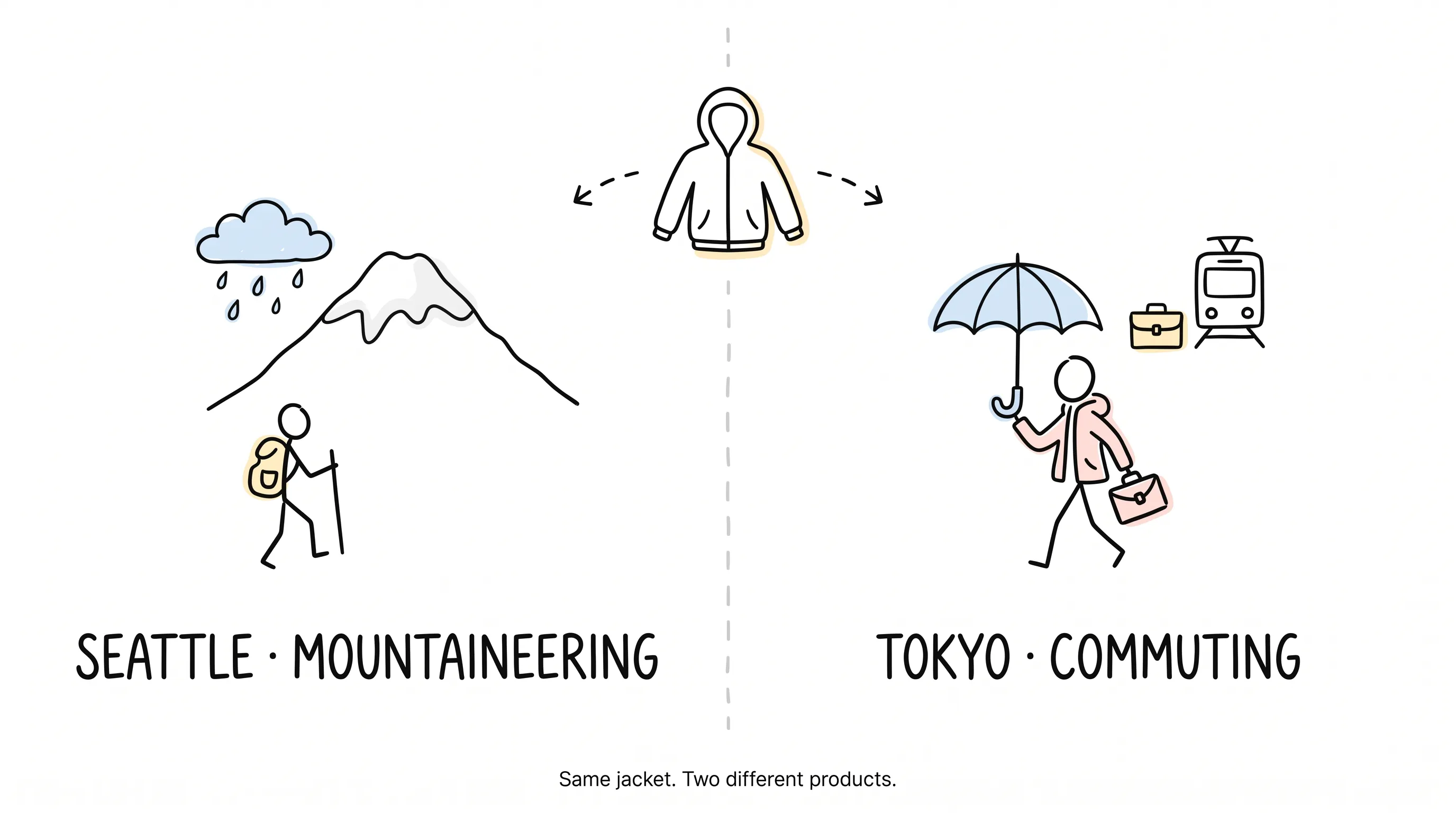
An outdoor brand has a waterproof shell jacket — one single SKU, sold worldwide.
The user is in Seattle. What does the AI-generated copy say? Mountaineering, windproof breathability, and how dependable that waterproof membrane from the Gore family (Gore-Tex) is up in the mountains.
The user is in Tokyo, right in the middle of the rainy season? The AI instantly switches scripts: commuting, light enough to stuff into a work bag, how the jacket pairs with office attire — so even a packed subway ride won't leave you disheveled.
Same jacket. Two completely different "products."
My God. This is what my friend meant by "regenerate."
Translation used to be saying what you wanted to say, in the other person's language. Today's AI localization is thinking what the other person wants to hear. Between these two lies a moat.
In one of its trend reports, Phrase — a company that builds a localization management platform — put forward an idea I love: AI's position in the localization pipeline has been "pushed upstream." What does that mean? Instead of waiting for humans to move first, AI now finishes the checks — translation quality, whether the copy even fits the interface space — and humans do only the final gatekeeping.
Translation has gone from being one step in the process to being a strategic engine.
2. The Second Upheaval: Buyers Stopped Searching
But the story doesn't end there. Localization only solved "how to speak." There's a worse problem: is anyone even hearing what you say?
Think about it: the next time you want to buy a pair of running shoes, will you still open a search engine, type "best running shoes," and dig through a pile of blue links?
Plenty of people already don't. They just ask their AI assistant: I'm running the Berlin Marathon in September, I have flat feet, I often run on wet pavement — which shoes should I buy?
The AI will give it one answer — or a few. And note this: that's all the answers there are. If you're not in them, you might as well not exist.
And so a new game emerged: Generative Engine Optimization — GEO for short.
What is GEO? Simply put: study what an AI assistant "looks at" when it answers questions, then feed it your product data in the exact shape it most likes to cite — structured, local, semantically rich product information.
If you sell running shoes in Germany, your German product pages must use the words German runners actually use when they talk about "overpronation," "wet-surface grip," and "marathon training" — and go deep enough. When the AI reads it and finds the content authoritative, it recommends it out as the standard answer.
The old game was keyword density. The new game is semantic depth.
Some merchants are already cashing in. Those using AI to auto-generate in-depth product content for every market are intercepting the high-intent traffic flowing out of AI assistants.
3. The Wildest Part: the Buyer Might Not Even Be Human
The next part is the most science-fiction thing I found in my research.
DHL published an e-commerce trend report with a striking number: nearly one in three shoppers is willing to hand everyday shopping over to AI agents.
What is an AI agent? It's an AI that runs errands for you. You say "we're out of coffee," and it goes and finds it, compares prices, places the order, arranges delivery — you never click a mouse.
Impressive. And terrifying.
Because it means your website may now have to serve two completely different kinds of "customer" at once.
When a human arrives, they look at emotion, imagery, other people's reviews.
When an AI agent arrives, it doesn't see your beautifully retouched homepage hero. It scans machine-readable data: structured prices, API documentation, local inventory, delivery times.
So today's leading e-commerce players have started using AI to generate two parallel sets of things: a culturally tuned storefront for humans to see, and a data-dense shelf for agents to read.
Here's a concrete scenario. Paris. A user's AI agent notices the household's favorite coffee beans are running low, and instantly connects to a local e-commerce platform's API. Who catches this order? The merchant whose local inventory reads accurate, whose delivery times can be quoted, whose payment protocols line up — and who responds in milliseconds.
The deal closes with zero clicks. The human never knows.
This kind of order isn't won by copywriting. It's won by infrastructure.
4. Content Must Be Wired to the Warehouse, or the AI Will Talk Nonsense With a Straight Face
By now you may have spotted the problem: the harder AI localization pushes, the bigger one risk grows. Will it just make things up?
It really happened. In the early days of AI marketing, plenty of companies learned this the hard way: the localized promo copy invented a promotion that didn't exist; or a product got pushed hard in London while the inventory was still floating off the California coast on a container ship.
The fix? There's only one: stitch the content system to the supply chain.
In an industry report, Stord — an e-commerce logistics company — describes e-commerce moving toward agentic operations: AI that can run analysis, auto-replenish inventory, reroute deliveries.
Let me paint you a vivid picture of how this system runs.
A brand's Toronto warehouse hits an unusually warm November, and a batch of heavy winter coats piles up. In the old days, that was called slow-moving inventory, and you'd wait for the regional managers to meet and discuss markdowns.
Now? The AI notices on its own. Then, in one breath, it does four things:
- Dynamically reprices across the region the Toronto warehouse covers;
- Generates a batch of localized copy along the lines of "stock up on one before the cold snap hits";
- Writes emails in the local tone of voice and sends them to high-intent customers in Canada;
- And while it's at it, produces TikTok and Meta ad creatives, targeted at Toronto.
No human touched any of it. A warehouse's pressure became a front-line marketing campaign.
This is what I meant by "engine swap": the supply chain is no longer just a cost center. It has become the engine of revenue.
5. The Images Are Made to Order Too
So the words are handled. What about images?
In the old multi-market playbook, one product photo served the whole world — at best, you swapped out some text overlays. Local models, local sets? Too expensive. Couldn't afford the shoot.
Now, multimodal generative AI can render scene images on the spot, matched to the user's environment.
The same set of outdoor patio furniture: a user in Miami sees it on a sun-drenched seaside patio; a user in Seattle sees it on a modern overcast deck, pine trees behind it.
The product itself doesn't move a single pixel — avoiding false advertising. Only the environment changes.
Virtual try-on works the same way. AI virtual try-on adapts to different body types, different regions' sizing standards, even different cultural dress norms, letting users "see" the product on their own body before they order.
This is a game-changer for fashion e-commerce. Return rates — that multibillion-dollar-a-year hole in the books — finally have a new fix.
6. The Most Surprising Winners Are the Small Players
By this point you might be thinking: with AI infrastructure this heavy, can only the giants — Amazon, Walmart, Alibaba — afford to play?
The interesting part is precisely here.
A Columbia Business School study offers a counterintuitive number: over the past few years, AI-driven efficiency gains contributed roughly 6% of per-employee revenue growth in global e-commerce.
And the biggest gainers? Not the big sellers. The small, new ones. They had no budget, thin staffing, and once couldn't even afford translation fees — so once AI knocked the costs down, their relative improvement was the steepest.
In cross-border commerce, AI turns out to be an equalizer.
Let me run the numbers for you. A five-person brand in Austin wants to open a store in Japan. Five years ago, that meant a multimillion-dollar expansion budget plus an international consulting team. Now? One weekend. AI generates the Japanese storefront, hooks up Japanese customer service, produces Japanese TikTok creatives, and routes orders to a local logistics partner.
The old game was budget. The new game is architecture.
7. But Unleashed AI Causes Trouble
Still, everything has a flip side.
From 2024 to 2025, the industry learned some expensive lessons. Some brands let AI run free on localized copy, only to have slang literally translated into locally offensive language; other brands found culturally inappropriate elements slipping into their AI-generated scene images. Several PR disasters — all of them pretty loud.
So today, mature players have changed their approach: from "generation" to "controlled generation."
What is controlled generation? You raise a second AI whose whole job is nitpicking. Every piece of copy or image the generative AI produces goes through this evaluation model first, checked against brand voice guidelines, local laws and regulations (such as the EU's AI Act, which is strict about consumer transparency), and a list of cultural taboos. Doesn't pass? Doesn't ship.
And where does that leave humans? Not kicked out — promoted.
The localization marketing manager used to translate spreadsheets line by line. Now their job is setting the track for AI: defining cultural boundaries, tuning prompts, making the final editorial judgment. Repetitive work goes to AI. Empathy, brand storytelling, editorial intuition — those go to people.
8. The Endgame: When Everyone Has It, No One Does
Finally, let me talk about the endgame.
There's a paradox here: when every brand can do precision localization, localization stops being worth anything.
Think about it — does that logic hold? When every store you browse makes your hometown jokes, matches your local weather, and lets you order in a single sentence, does any one store feel like it "really gets you"? No. It's just the standard. The way no store today would tout "we accept Alipay" as a selling point.
So where does the final edge lie?
My judgment: companies that merely use AI to translate faster won't win. The winners are the companies that install AI into their own central nervous system — where inventory, pricing, images, and copy grow as one single engine.
Push the thinking one layer further, and there's something that fascinates me: websites will disappear.
In the future, the moment you "look" at a store, that's when the store gets rendered — generated entirely for your city, your weather, your habits. The moment you leave, it dissolves.
The internet is no longer a place built for you to look at. It's a place assembled around you, on the spot.
Back to That Dinner
Finishing this piece, I keep coming back to what my friend said over dinner: "We don't do translation anymore."
At the time, I took it as budget trimming. Now I understand: what he cut wasn't an expense. It was an era.
The next wave of growth in cross-border e-commerce won't grow out of language translation. It will grow out of cultural rebirth.
Here's wishing you an early engine swap.
Continue reading
Related articles

Cross-Border Business: Time to Upgrade Your AI Toolbox
A learn article explaining how AI tools help cross-border e-commerce sellers clear five hurdles: language, regulation, logistics, payments, and fraud. It outlines a five-compartment toolbox, a five-step adoption path, and metrics such as conversion rate and CLV, while cautioning against over-reliance on AI.

AI Is Taking Over the Dirty Work of Social Media Marketing, One Task at a Time
This learn article outlines four social media marketing tasks AI can handle — audience analytics, content drafting and design, ad targeting and creative testing, and spam moderation — and cautions that taste, judgment, and data security remain human responsibilities.

AI Is Already This Good — Why Is Your Social Media Marketing Still Pure Manpower?
An overview of 18 AI tools for social media marketing, organized into six categories covering audience research, content creation, scheduling, comment and DM handling, ad management, and visual production, plus notes on personalization, prediction, and emerging trends.