
It's 2026. I Tested Every AI Tool for Managing Meta Ads So You Don't Have To
A 2026 review of AI tools for managing Meta ads, comparing execution capability, pricing, and use cases from full-auto agents to rule engines and creative tools. It also flags discontinued products and offers a decision framework based on budget, bottleneck, and control preferences.
Last week I had dinner with an old friend who runs a cross-border e-commerce business.
He burns tens of millions of yuan a year on Meta ads, keeps three media buyers on staff, and still complains every single day about being exhausted.
"Creative burns out within 72 hours of going live. It looks fine in the morning; by afternoon, CPM is creeping up. By the time you notice, you've paid another round of tuition."
I asked: didn't you install management tools?
He did. But most of them are dashboards — they point the problem out to you. And then? Then they wait for you to click.
We spent that entire dinner talking. When I got home, I went back through every mainstream AI tool for Meta ads on the 2026 market, one by one: pricing, features, and — most importantly — how much of the actual work each one will do for you.
Today, I'm handing you the conclusions.
Stop Counting Features. Look at One Axis.
What exactly is an AI management tool for Meta ads?
It connects to your ad account and — for you, or alongside you — adjusts bids, moves budgets, swaps creative, and watches for fatigue.
There are at least a few dozen tools on the market, and every feature list is longer than the last. Honestly, though, comparing feature lists is meaningless.
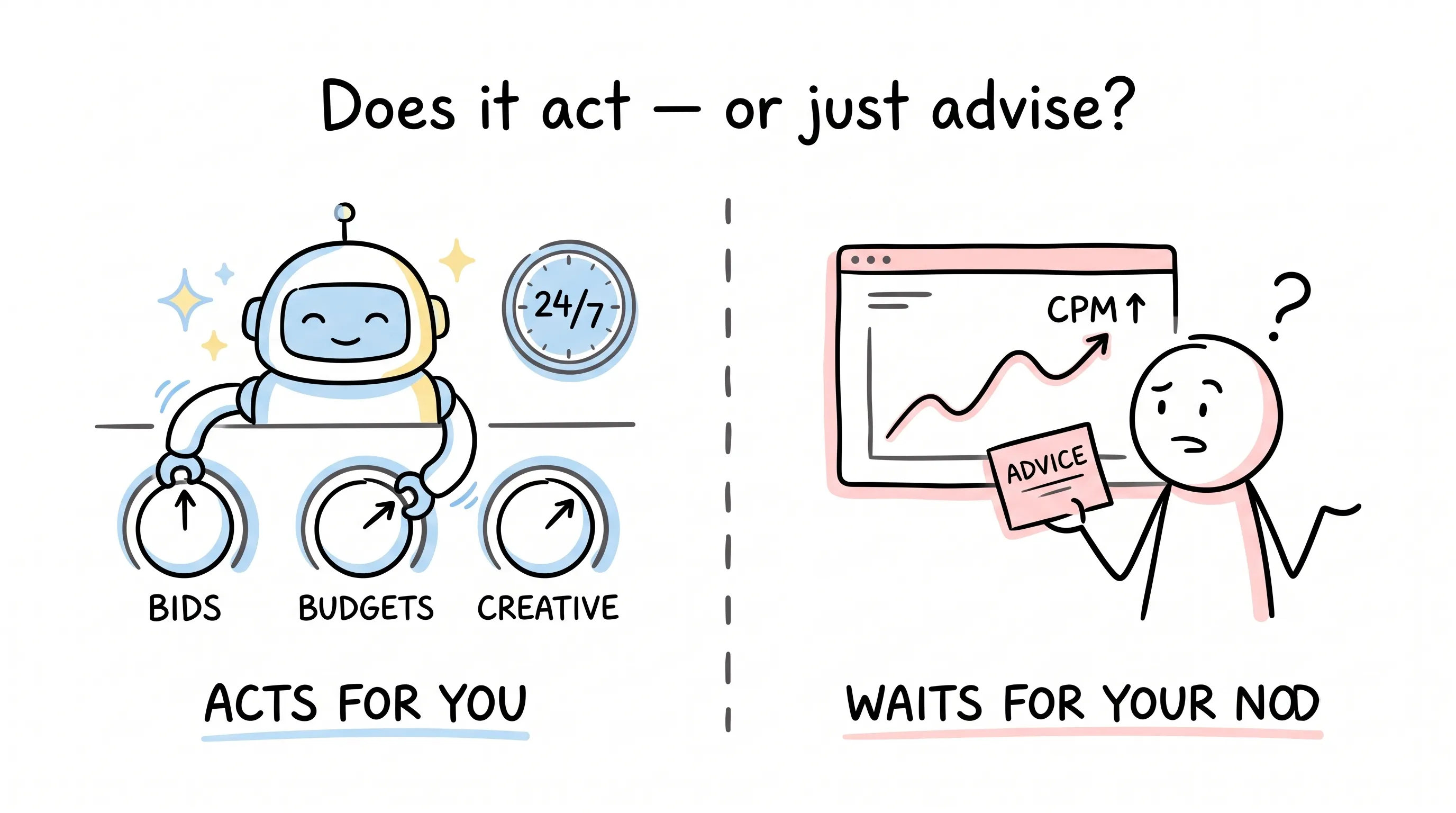
Only one axis really matters: does the tool execute for you, or does it just put recommendations in front of you and wait for your nod?
A tool that can act on its own beats a tool that offers great advice and then sits there waiting.
That was my single biggest takeaway from going through all the mainstream tools this time.
Why Human Reflexes Can't Keep Up Anymore
First, let's be clear about why AI is no longer optional. Three shifts have turned manual ad buying into pure grunt work.
First, creative fatigue.
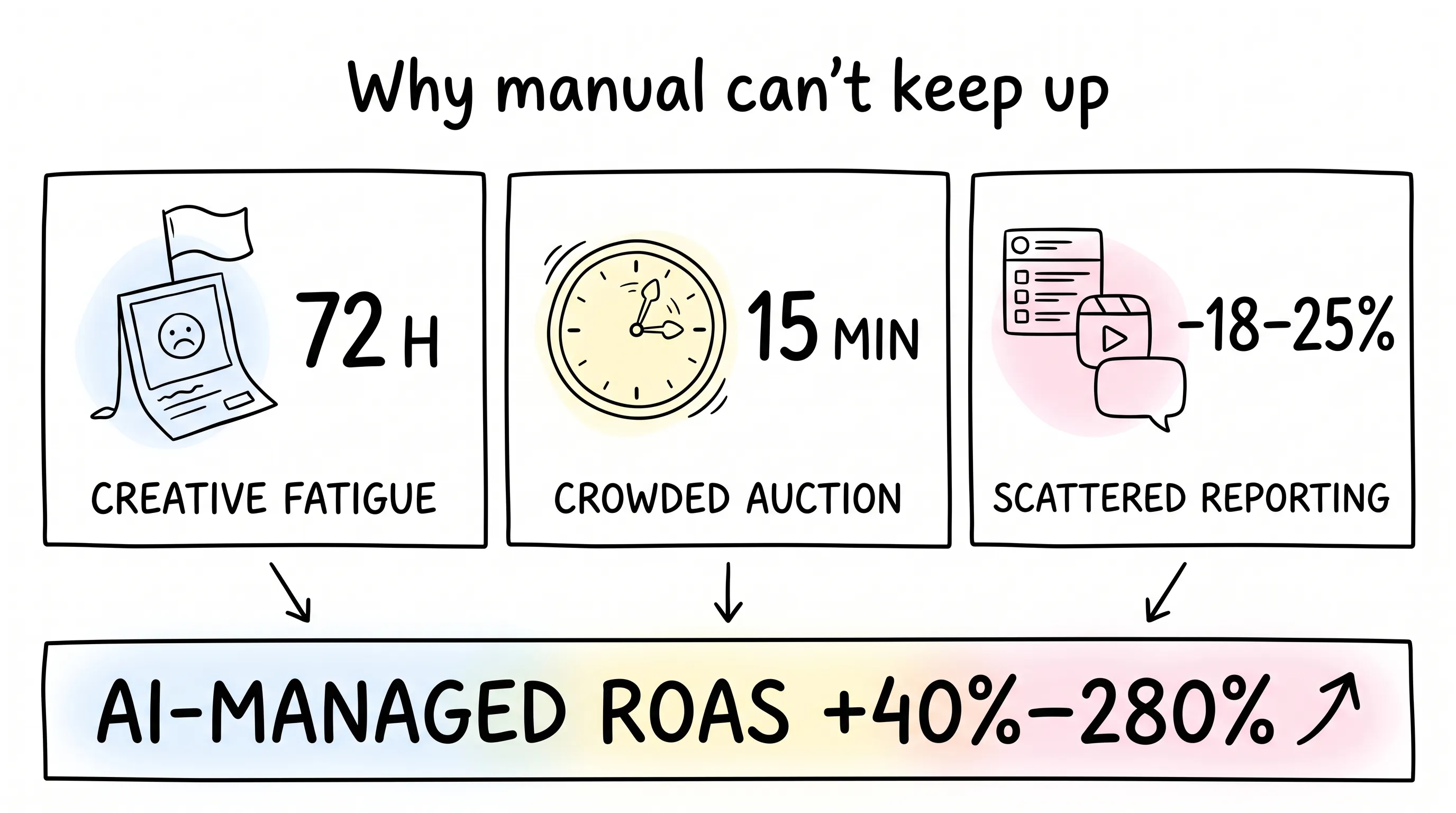
What is creative fatigue? Run the same ad in front of the same people for too long, they get sick of it, stop clicking — and the cost per thousand impressions (CPM) keeps climbing. A single piece of creative used to run for two weeks. Now Meta's algorithm favors busy accounts, and every ad set needs to rotate 15 to 25 creatives a week. Meanwhile, most audiences show fatigue signals within 72 hours.
A human watches the dashboard two or three times a day. By the time you see CPM up 30%, the tuition has been paid.
Second, the auction floor has gotten crowded.
Advantage+ Shopping campaigns, Advantage+ app campaigns, and manual campaigns all compete in the same auction for the same people. You're juggling 4 to 6 campaign types at once. However diligent you are, you check two or three times a day; AI evaluates bids every 15 minutes. Some arbitrage windows close within a few hours — humans simply can't get there in time.
Third, the numbers don't add up.
A customer might first see you in the Facebook Feed, then run into you again on Instagram Reels, and finally click through from Messenger. Facebook, Instagram, Messenger, WhatsApp, Audience Network — five placements, one journey. And Meta's own reporting undercounts these cross-placement conversions by 18% to 25%.
Use media mix modeling and incrementality testing to reconcile the books, and you can claw back some of the ROAS that's been hiding.
Stack those three together and you get this number: Gartner surveyed 1,200 advertisers in 2026, and the ones using AI for ad management ran a return on ad spend (ROAS) 40% to 280% higher than purely manual operations.
So the question today stopped being "should I use AI?" a long time ago.
It's "which one?"
The Most Aggressive Tier: Full Auto
Start with Ryze AI.
It's the only fully autonomous agent in this lineup. It doesn't give you a dashboard; it watches your account 24/7 on its own: adjusts bids when bids need adjusting, moves budgets when budgets need moving, rotates creative when creative needs rotating, narrows audiences when audiences need narrowing. Then it re-measures and keeps going.
If that makes you uneasy, switch on approval mode and it shows you every move before making it. There's a change log too — what it did and why, all on record.
The pricing is interesting: $89 a month, flat. $5,000 in monthly spend, same price. $500,000 in monthly spend, still the same price. It never takes a cut of your spend.
The company's own numbers: 2,000-plus advertisers, more than $500 million in ad spend under management combined, an average ROAS of 3.8x achieved within six weeks. One caution — that's internal data. Listen, but don't take it as a promise. In testing on a real account — an e-commerce account spending $45,000 a month — cost per acquisition (CPA) fell 34% in 21 days.
There's a cost, of course. Full-auto mode spends its first 7 to 14 days in a learning phase, and during that stretch you have to trust it. Also, on fine-grained manual control, it doesn't match the next contender.
Its coverage is broad, too: Meta, Google, several more platforms — even SEO is bundled in. One subscription.
For Those Who Want to Write Their Own Rules: Birch
Birch — formerly Revealbot. New name, same product.
It's the gold standard of rule engines. What's a rule engine? You write the logic yourself: if CPA climbs past $25, and frequency tops 3.0, and click-through rate (CTR) slips under 1.2%, pause that ad set — and fire off a Slack alert to me while you're at it.
Frequency, for the record, is how many times the same people get served the same ad.
A single rule can stack more than 15 conditions, rules can chain into other rules, and the account gets checked every 15 minutes.
Tested with real money: on a lead-gen account spending $30,000 a month, its rules caught 12 ad sets gone off the rails in the first week after launch — in the middle of the night and on weekends, hours when no human could possibly be watching. Bulk building is ferocious too: 8 ad sets and 120 variants, built in 20 minutes.
Pricing starts at $49, the Pro tier is $99, with a 14-day trial.
But you need to be clear about Birch's positioning: it executes your decisions, not its own. You write the rules, and the rule editor takes two or three hours to get comfortable with. It fits teams managing 50-plus campaigns that need strict guardrails.
One thinks for you; the other does what you're thinking. Choosing between them comes down to whether you trust the machine or yourself.
The Creative School Works in Reverse
Everything so far handles the aftermath — after the money is spent. The creative school flips it: before the money is spent, guess which one will win.
The standard-bearer is Lapis. Point it at your website; it learns your brand and generates a stack of creative variants, each carrying a predicted report card: estimated impressions, estimated clicks, estimated CTR. Once you're live, real traffic runs A/B tests to check how sharp its guesses were. It also pairs every ad with a style-matched landing page automatically.
In testing, on a DTC (direct-to-consumer) account spending $12,000 a month, Lapis's variants finished among the top performers in 7 of 9 launches, beating the account's trailing-30-day average CTR.
Now the ugly truths. One: pricing runs on creative credits, and heavy-testing months make ugly invoices. Two: predictions are directional only — the company says so itself; they're priors built on other people's history, not your results. Three: it doesn't touch bids or budgets, so you'll need an execution tool alongside it.
$99 a month comes with 25 credits; the Pro tier is $599. For brands that burn budget testing creative, it hits the mark.
For enterprise-scale creative production, look at Smartly.io.
The big shops spending $500,000-plus a month and needing a thousand-plus creative variants a week — that's who hires it. Master creative goes in; it auto-resizes for each placement, rewrites copy, hooks into product data feeds, and out come batches of localized versions. Predictive budget allocation shifts money in real time along the marginal ROAS curve; in real-world testing, big accounts squeezed out an extra 10% to 18% in incremental ROAS.
Walmart, Uber, and eBay are public clients. TikTok, Snapchat, and Pinterest get managed alongside Meta.
The cost is just as blunt: custom contracts generally start at $2,000 to $5,000 a month, implementation takes 2 to 4 weeks, and a dedicated team rides along the whole way. Under $100,000 in monthly spend, don't bother.
Oh, and one distinction worth making: general-purpose generators like Midjourney and GPT image models operate further upstream. They produce raw material; an ad still needs a hook, a 9:16 layout, a link. Creative tools turn raw material into ads ready for the auction — generators don't.
The Specialists: One Job, Done Brilliantly
Further down sit a batch of tools that do exactly one thing. Unremarkable at first glance — put them in the right spot and they shine.
AdEspresso, owned by Hootsuite, has been at it since 2013, and its signature move is A/B testing. Headlines, images, audiences, placements — multivariate testing broken out cleanly, with the friendliest interface on this entire list and 40-plus tutorials. In testing, its automated optimization paused losing variants two to three days earlier than Meta's built-in campaign budget optimization (CBO), saving about 15% of the budget per test. The weakness is equally clear: by 2026 standards it's aging — no full-auto optimization, no AI-built audiences; the $49 tier caps you at $1,000 in monthly spend, and past $10,000 you're pushed into the $149 tier. Best for beginners and teams that take testing methodology seriously.
Zalster, a small Swedish tool, handles bids and budgets only. Set a target CPA or ROAS and it continuously adjusts bids based on predicted conversion probability, time of day, and audience-segment performance; setup takes 10 minutes. On a SaaS lead-gen account spending $15,000 a month, CPA fell 19% in 30 days. Starts at €49, scaling with spend. Downsides: the bidding logic is a black box, and apart from bidding it manages nothing. Use it as a supporting player, not your lead.
Socioh builds catalog ads for e-commerce. It pulls product images, prices, and reviews from Shopify or WooCommerce; when a product changes, the ads change with it. If a bestseller goes out of stock, it swaps the ad automatically within an hour. The star feature is branded catalog ads: where everyone else's product cards use Meta's default look, it adds your logo, borders, and promo badges. Real-world testing at a clothing store with 500 SKUs showed CTR up 31% and ROAS up 18%. Starts at $99 a month, scaling with catalog size. It's stubbornly single-minded: it only deals in physical e-commerce goods — no bidding, no predictions. If you don't sell physical goods, skip it.
Adzooma is that rare free tool that's genuinely useful. It connects Meta, Google, and Microsoft ads, scans your account, lines up optimization opportunities by estimated impact, and applies them in one click. On a Meta account spending $12,000 a month, it found 8 actionable improvements for free. Paid tiers start at $69, adding rule execution and custom reporting. Naturally, the suggestions are surface-level hygiene: no creative analysis, no audience optimization. Treat it as a free checkup, not your attending physician.
Claude plus MCP is a special case. For $20 a month, wire Claude into your ad account and it pulls data in real time, runs diagnostics, drafts copy, builds reports — load up 30 open-source marketing skills on top and you've hired a paid traffic analyst. In testing, the "wasted spend audit" skill dug $3,200 a month in budget leakage out of a $40,000-a-month account. Leakage neither Lapis nor Birch saw. The "CPA spike diagnosis" skill traced a 40% CPA jump back to one saturated audience segment in 90 seconds.
Impressive!
But the boundary is just as hard: it only analyzes, never acts. Every recommendation has to be executed by you, and you'll need to know how to hook up MCP servers. Twenty dollars hires you the strongest analyst around — but it won't pull the trigger for you.
The Free Baseline: Advantage+
After all these third-party tools, don't forget Meta's own Advantage+.
It's free, lives inside Ads Manager, zero configuration. Official data puts the cost per purchase of Advantage+ Shopping campaigns 32% lower on average than manual campaigns.
In testing, it genuinely holds its own on prospecting. But two traps. First, black box: who it's targeting, why it chose that placement, how it splits budget across creatives — you can't see any of it. For brands with strict exclusion rules or compliance requirements, that's fatal. Second, retargeting is weak; manually built campaigns can leave it trailing by a wide margin.
So treat it as the free baseline and leave it on; then, sized to your spend, stack one of the tools above on top. That's how nearly everyone spending over $10,000 a month runs it.
But There Are Four Checks You Shouldn't Write
Every story has a flip side. Four names still floating around older roundups in 2026 — keep your wallet closed.
Madgicx. Its AI flags "this creative is fatigued," and then you're still the one swapping it out. Insights only, no action. The subscription also scales with spend — performance doesn't go up, but the bill does. The user reviews are even more eye-opening: 1.8 on Trustpilot across 270 reviews, 46% one-star, with complaints concentrated on being charged after the trial ended and refund requests denied. It also only supports Meta — the moment you turn on Google ads, you need to hire another tool. Re-tested in August 2026: it made the list.
Qwaya. Already discontinued. The team pivoted to build the data product Funnel. Yet it still shows up in outdated "Facebook ads tools" roundups, some still listing $149 a month — for a product you can no longer buy. When you see a list recommending it, start doubting the whole list.
Pattern89. Acquired by Shutterstock in 2021, its technology was folded into the acquirer's product line, and the standalone subscription is gone. For pre-launch prediction, Lapis has picked up the baton.
Then there are general AI copywriters like Jasper and Copy.ai. For writing copy, they're excellent. But they can't connect to your ad account, can't read performance data, and certainly won't move a cent of your budget. Buying them as "AI ad tools" is money spent in the wrong place.
Cold Start Is the Exception
One more scenario. Launching a digital product — selling courses, selling template packs — with no historical data in the account and a launch window of just five days.
This is the hardest setup for automation: auto tools need 7 to 14 days of data to find their footing, and your battle is over in five.
What do you do? Dial automation down to the minimum. Target with Advantage+ audience or broad targeting, run 3 to 5 creatives per ad set, pick one conversion event, and let Meta's own delivery system do the learning.
Automate only the two decisions you'd be making anyway: kill, and scale. Write two Birch rules: any ad that has racked up a set number of impressions with CPA over twice target, pause; any ad set that hits target two days in a row, budget up 20%. Underneath it all, lay a floor of Google branded search ads, so when people search your product's name, they land on your page.
Once weekly conversions climb to around 50 and Meta exits its learning phase, full-auto management starts paying off.
How to Choose? Three Questions
Your turn. Three questions — see where you fit.
One: how much do you spend a month? Remember an iron rule: never let tool costs exceed 5% to 10% of monthly ad spend. At $10,000 monthly spend, a $99 tool is 1% — buy without a second thought. At $2,000, that same tool is 5% — think it over. Below $1,000, start free: Advantage+, Adzooma's free tier, or a flat-price tool — but never touch anything that takes a cut of spend.
Two: what's your biggest bottleneck? No time at all — fully automated Ryze AI. Want to predict winners before they're live — Lapis. Need rule-based guardrails — Birch. Creative production can't keep up — Smartly.io or Socioh. Just want someone to run the numbers — Claude plus MCP. Spending under $5,000 — Ryze AI, Adzooma's free tier, or simply Advantage+.
Three: how much control do you want to keep? If you want to write the logic and steer yourself — Birch. If you're ready to let go — Ryze AI. There's a middle road too: a full-auto tool's approval mode, where it proposes and you sign off.
One more thing: the Google and Meta auctions are fighting over the same buyers. Ideally your tool covers both — Ryze AI, Birch, and Adzooma all span the two.
One more easy mistake: treating creative tools and execution tools as competitors. They're usually partners — Lapis handles generation and prediction, Birch handles killing and scaling. Though tools like Ryze AI that bundle rotation and execution into one subscription are the exception.
Finally, a Bucket of Honest Cold Water
People often ask me: which AI tool will push my ROAS highest?
My answer gets more consistent every time: none. No tool can take responsibility for your offer, your creative, your margins, your audience.
Tools are amplifiers. They amplify what's already there.
There's only one honest approach: test with real money for 30 days. The 7-to-14-day learning phase is unavoidable; when the 30 days are up, put ROAS, CPA, and hours saved side by side with your own manual baseline. Whoever moves the numbers, that's the one you keep.
And don't be afraid of it taking your job. What AI takes is the repetitive grind: watching dashboards, adjusting bids, swapping creative, pulling reports. Strategy, offer design, creative direction — still human work. Nearly every team I've seen has redirected their buyers' hours into testing creative and polishing landing pages. That's where compounding happens.
Back to the friend from dinner. After that night's talk, he went home and tried a full-auto tool. Six weeks later he messaged me: 10 hours a week of dashboard-watching had become half an hour, and ROAS climbed from 2.4x to 4.1x.
He said: had I known, I'd have installed it last year.
I said: it's never too late to start. The auction opens a window every 15 minutes anyway, and the wind never stops blowing — whether you catch it is up to you.
Here's wishing you an early escape from dashboard-watching — so your hands are free for the work that actually compounds.
Continue reading
Related articles

Cross-Border Business: Time to Upgrade Your AI Toolbox
A learn article explaining how AI tools help cross-border e-commerce sellers clear five hurdles: language, regulation, logistics, payments, and fraud. It outlines a five-compartment toolbox, a five-step adoption path, and metrics such as conversion rate and CLV, while cautioning against over-reliance on AI.

AI Is Taking Over the Dirty Work of Social Media Marketing, One Task at a Time
This learn article outlines four social media marketing tasks AI can handle — audience analytics, content drafting and design, ad targeting and creative testing, and spam moderation — and cautions that taste, judgment, and data security remain human responsibilities.

AI Is Already This Good — Why Is Your Social Media Marketing Still Pure Manpower?
An overview of 18 AI tools for social media marketing, organized into six categories covering audience research, content creation, scheduling, comment and DM handling, ad management, and visual production, plus notes on personalization, prediction, and emerging trends.