
It's 2026. Before You Pick an AI Marketing Tool, Get One Thing Straight
A 2026 buyer's guide to AI marketing tools, grouping 12 platforms by business type across ecommerce, B2B, and app growth, and explaining how to distinguish AI writing helpers from AI decision layers.
A few days ago, a friend who runs an ecommerce business took me out for coffee — and midway through, he let out a sigh.
He said that last year he onboarded three tools in one go. One for email, one for SMS, plus a dedicated AI writing tool. Add it up and he was spending several thousand dollars a month. The result? Every email still required a manually pulled list, a manually brainstormed subject line, a manually scheduled send time. All that AI, and nothing to show for it.
I told him: you didn't really pick the wrong tools. You just never got clear on what you were actually buying.
It's true — it's 2026, and nearly every marketing tool on the market has AI written on the box. But for the vast majority, someone simply stuck an AI button on an old product. You pay for the button, and you carry home the same 2018-era system.
This year, there is exactly one real dividing line: is the AI helping you write, or deciding for you?
What does it mean for AI to decide for you?
It means the AI itself determines who gets the message, when it goes out, which channel carries it, and which version to use. Four things humans never touch.
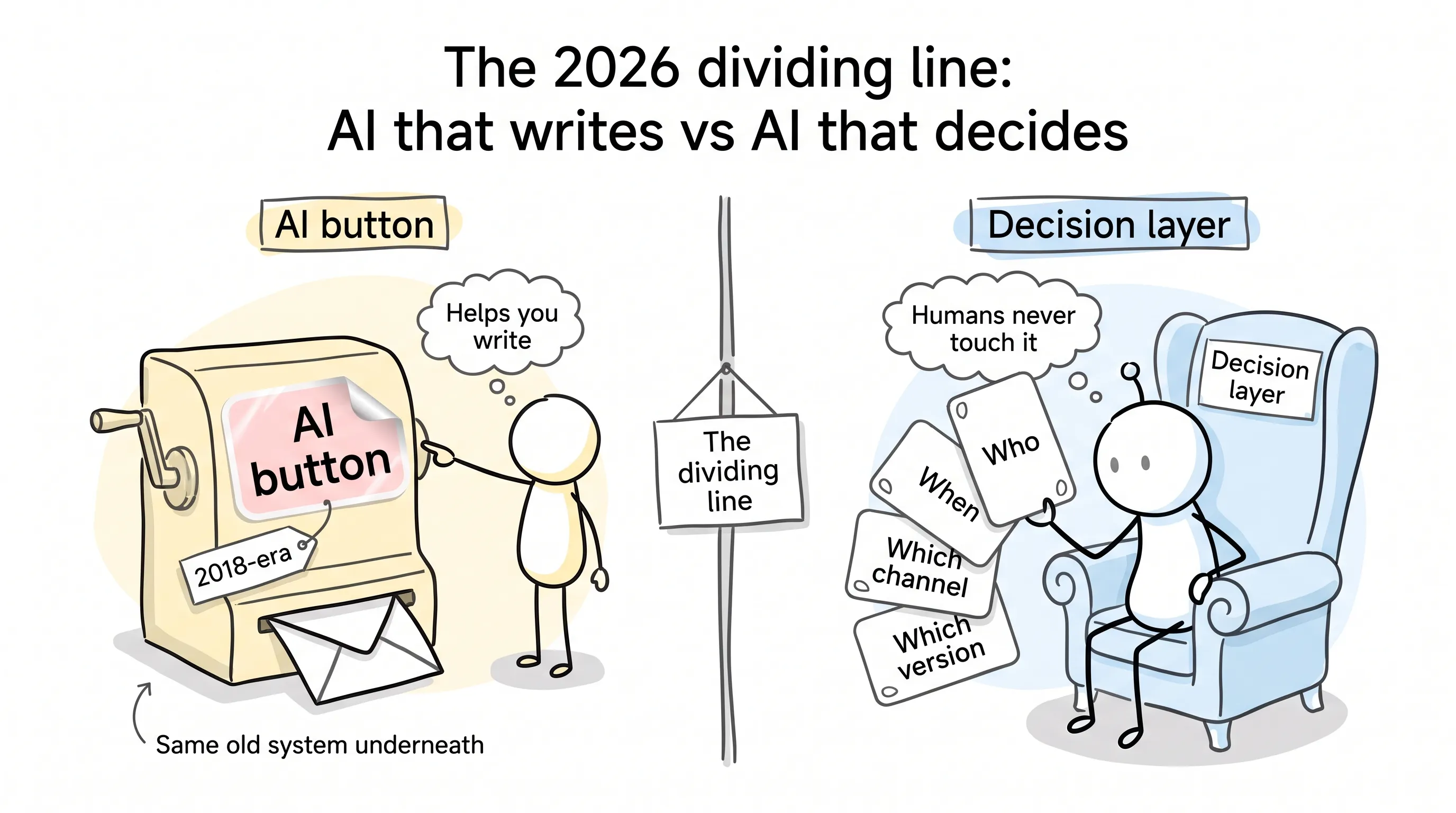
This shift didn't happen gradually. In 2025 alone, generative AI went from a copywriting sidekick to the decision-making core of entire platforms, almost overnight. The quick-reacting platforms tore everything down and rebuilt. The slow ones slapped on a button.
So the hard part in 2026 isn't finding tools. It's telling the real from the fake. Ignore the sales pages — here's my breakdown of the 12 players that matter: HubSpot, Klaviyo, Customer.io, Adobe Marketo Engage, Mailchimp, Iterable, Braze, ActiveCampaign, Brevo, Drift, Jasper, Persado.
Just about every name worth knowing is on this list.
I'll take them one by one. And don't worry about memorizing — I've grouped them into four sets by business type. Whatever your business is, jump straight to that group.
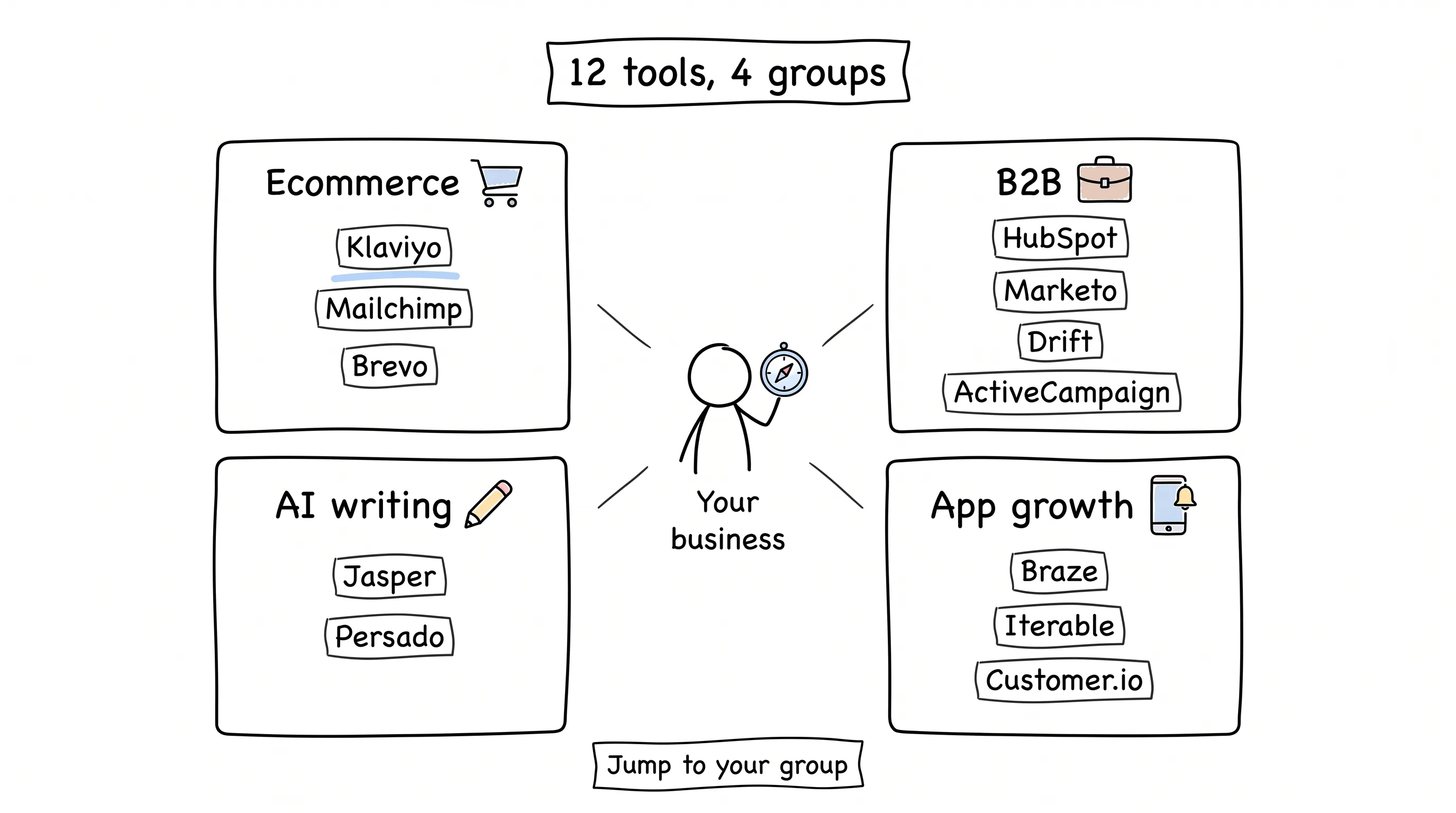
Group One: If You Run Ecommerce, Start with Klaviyo
Is your store on Shopify? Look no further.
Why?
Think about what ecommerce data looks like: order history, browsing records, what a customer last bought, how often they buy. Klaviyo's AI is built on exactly this pile of data. It can predict a customer's lifetime value, predict who is about to churn, even predict roughly which day that person will place their next order.
And what are predictions for?
You feed them straight into your automation flows. Someone about to churn? A win-back email fires automatically. A repeat-purchase date coming up? An SMS gets scheduled ahead of time. For subject lines and body copy, the AI generates several versions in your brand's voice and picks which ones to send.
That is the decision layer. Humans set strategy; machines handle execution. Honestly? It's a hard one to beat.
Now, the money: it's free up to 250 contacts. Mid-size brands generally pay $500 to $5,000 a month. Sounds cheap? Watch out — once your list passes 100,000 contacts, the bill climbs steeply.
Two budget contenders are also in this ring.
One is Mailchimp. Since being acquired by Intuit, it has spent the past two years rebuilding itself and brought in Intuit Assist — the same AI you find in QuickBooks and TurboTax. Give it a single prompt and it can generate an entire campaign. The free tier covers 500 contacts; paid plans start at $13 a month. A fit for solo operators, creators, and small businesses. The catch: deliverability and the granularity of audience segmentation trail the professional platforms by a clear margin.
The other is Brevo, formerly Sendinblue — the most aggressive pricing in the room. Email, SMS, WhatsApp, and CRM all bundled, from $9 a month, with a free tier of 300 emails a day. Its cleverness lies in how it bills: by send volume, not by headcount. A large list you don't mail often? Choose Brevo and save a chunk of change. European companies get a bonus layer: GDPR is territory Brevo already knows inside out.
But if you're in B2B, set all three of these aside for now.
Group Two: For B2B, I Rank Them by Scale
Small team just getting started? Look at HubSpot.
Over the past two years HubSpot did something big: it tore down its entire AI layer and rebuilt it as something called Breeze. Breeze Copilot sits inside every Hub, helping you draft emails, summarize deals, and write blog posts. Crucially, it writes while looking at the data in your CRM — nothing invented from thin air. There's also a set of Breeze Agents that find prospects for you, produce content, triage support tickets, and post to social media.
Expensive? Play with the free tier first. Marketing Hub Starter starts at $20 a month; Professional jumps straight to $890 a month. That's $10,000-plus a year, and it's exactly where many small teams get talked out of the deal.
So why do people keep buying? Because it is genuinely all-in-one. Marketing, sales, and service data live in the same pool — you don't have to stitch ten integration threads together yourself. For companies without a dedicated ops team, that peace of mind is worth money in itself.
The drawbacks, stated plainly: costs climb hard as your contact count grows, and for enterprise-depth ABM (account-based marketing), Marketing Hub hits a ceiling.
For mid-size and large enterprises, the industry standard is still Adobe Marketo Engage.
It now sits inside Adobe Experience Cloud, using Adobe Sensei for predictive audiences, content recommendations, and account scoring. It meshes deeply with Real-Time CDP and connects smoothly with Salesforce and Microsoft Dynamics as well. For complex multi-touch nurturing, scoring models, and account-based plays, it's still the one that can carry the load.
How much? It's all negotiated by contract. For mid-size enterprises, annual contracts start somewhere between $30,000 and $250,000. Yes, you read that right — that's the magnitude.
And two hidden costs on top: implementation is heavy — you'll generally need a partner — and the interface is dated; anyone used to modern tools will frown.
B2B has one more peculiar problem: plenty of people visit your website, but the vast majority are anonymous. Who turns that anonymous traffic into deals? Drift.
Drift pioneered conversational marketing and has now been folded into Salesloft. Its AI agents work out who a site visitor is and whether they qualify — and when the conversation goes well, they book meetings and hand off to sales. Connect Salesloft's email cadences, outbound calling, and revenue forecasting, and the website end and the sales end become one complete assembly line. Pricing is enterprise-grade: from tens of thousands of dollars a year. Selling low deal sizes? Stop looking — this is built for high-ticket B2B.
And teams stuck in the middle? Mailchimp's automation is too thin and HubSpot is pricey. That gap belongs to ActiveCampaign.
Its signature strength is visual automation, with branching logic you can build however you like. In 2024 and 2025 it added AI on top: predictive sending, predictive content, and copy generation. Plans start at $19 a month, with tiers at $59 and $99 above, and CRM and a sales pipeline are built in. Problems exist too: pile up enough automations and the interface gets messy, and its reporting depth doesn't reach enterprise-platform level.
Group Three: Keeping AI's Writing From Going Off Track
The two in this group aren't really running the same kind of business.
Jasper first. It's a content platform that survived the 2023 wave of AI shakeouts — and what kept it alive? It figured out one thing: what enterprises want isn't AI that can write; it's AI that writes like them and stays compliant. So it made brand voice and approved knowledge bases first-class inputs, and every workspace is trained on its own style. From $39 a month. Every piece of content you generate there is backstopped by brand guidelines — something you don't get from using a raw LLM bare.
But it is not a marketing automation platform — don't expect it to send your emails. And once enterprise-quality content is produced, a human still has to be the gatekeeper.
Persado takes a completely different road.
It serves banks, insurers, and telecom carriers — regulated industries: millions of outbound messages every day, every word required to be compliant, every lift required to be computable. It holds a proprietary dataset on language performance: which emotions, which sentence structures, which calls to action produced which results historically — all on the books. So after generating copy, it can rank the copy, run structured tests, and report lifts that are statistically significant.
Companies like these will pay for a 1% lift. When the volume is big enough, 1% is seven figures of revenue. The price tag: six-figure annual contracts in US dollars and a long implementation cycle. Individuals and small teams — don't bother looking.
Group Four: App Growth Is Another World Entirely
Is your product an app? Then the logic changes completely. Your users, inside your product, produce events every single second.
Three players in this group.
Braze — as good as mobile-first gets. Its event stream processing is sub-second; push notifications and in-app messages are native capabilities; Sage AI generates the flows, produces the copy variants, and picks the send times and channels. Food delivery, gaming, streaming, ride-hailing — consumer apps that reach a certain scale almost always end up on it. Annual contracts run six figures in US dollars. But it assumes you have an engineering team that can keep feeding it events from inside your product, nonstop. No engineers? Don't touch it.
Iterable — the brain of cross-channel orchestration. In its flow editor, email, SMS, push, and in-app messages are channels of equal standing; email is not the headliner with the rest thrown in as add-ons. AI Optimization adjusts send time, channel, and content version for each individual user. Popular with finance, media, travel, and lifestyle brands. Mid-size customers pay $50,000 to $200,000 a year — a bit lighter than Braze, but it likewise needs data infrastructure underneath it.
Customer.io — the answer for PLG (product-led growth) companies. What is PLG? It means the product sells itself: every message is triggered by an event inside the product, not by a marketing list. Notion and Linear use it. It has the cleanest event-driven setup of the bunch, engineer-friendly APIs, smooth connections to data sources like Segment and Snowflake, and Copilot can even help you scaffold your workflows. From $100 a month. Marketers without a technical background will find the learning curve steep — it's a precision instrument, not a toy.
That's the rundown. All 12, right here.
Four Questions to Answer Before You Buy
Question one: is your business B2C, B2B, or PLG?
Channels follow the business model, and tools follow the channels. Ecommerce DTC (direct-to-consumer)? Look at Klaviyo first; once your scale and channel complexity exceed its comfort zone, step up to Iterable or Braze. Enterprise B2B? Marketo, HubSpot Enterprise, and Drift often show up as a package. PLG SaaS? You'll circle back to Customer.io or Braze every time.
Question two: how many engineers do you have?
This is the most underestimated question.
Customer.io, Braze, Iterable, and Persado all assume you have engineering capability: you can fire events from your product, connect a CDP (customer data platform), and staff someone to run lifecycle operations. HubSpot, Mailchimp, Brevo, and ActiveCampaign are designed for teams without engineers.
I've seen too many wrecks — here's the whole thing distilled into one sentence: one growth marketer, zero engineers, charging in to buy Braze.
It works the other way too. If you really do have a platform team, don't waste them on Mailchimp.
Question three: is this platform's AI a button or a decision layer?
This year, every player has an AI button. But the ones that put AI into the decision layer can be counted on one hand: Iterable, Braze, Persado, plus HubSpot Breeze and Klaviyo, both getting more complete. Jasper, Copy.ai, and the AI buttons inside Mailchimp and Brevo are content accelerators.
Both kinds are useful. But buy a content accelerator believing it's a decision layer, and disappointment is guaranteed.
Question four: beyond the platform, do you have an orchestration layer?
This is the thing many teams figure out last: marketing platforms are good at what happens inside their own walls and can't handle work that spans tools. Data enrichment, cross-system syncing, letting AI agents read and write everywhere — these rely on an orchestration layer built with n8n, Make, Zapier, or your own code.
What happens if you only pick a platform and never design an orchestration layer?
You buy the right tools and still end up with the wrong system.
One more ballpark for the money: small teams, tens to $1,000 a month; mid-size teams, $1,000 to $10,000; at enterprise level, annual contracts of five to six figures per month are not unusual either.
Finally, How to Verify
Sales pages are all actors. To find out whether a tool truly fits you, run one real campaign inside the trial.
Import 5,000 real contacts, build a three-step branched flow, let the AI layer generate copy for real — then watch four things: deliverability, the accuracy of segmentation, the depth of reporting, and how smoothly the whole setup comes together.
Data doesn't do theater.
Back to my friend from the coffee shop. He has since canceled two of the tools and moved the budget to a platform that genuinely makes decisions. Last month he told me that their win-back emails now decide on their own who they go to — he only reads the report at the end of the month.
One line from him I've kept until now: "We used to be mass-blasting. Now it feels like every customer received a letter written just for them."
I hope the same for you.
Continue reading
Related articles

Cross-Border Business: Time to Upgrade Your AI Toolbox
A learn article explaining how AI tools help cross-border e-commerce sellers clear five hurdles: language, regulation, logistics, payments, and fraud. It outlines a five-compartment toolbox, a five-step adoption path, and metrics such as conversion rate and CLV, while cautioning against over-reliance on AI.

AI Is Taking Over the Dirty Work of Social Media Marketing, One Task at a Time
This learn article outlines four social media marketing tasks AI can handle — audience analytics, content drafting and design, ad targeting and creative testing, and spam moderation — and cautions that taste, judgment, and data security remain human responsibilities.

AI Is Already This Good — Why Is Your Social Media Marketing Still Pure Manpower?
An overview of 18 AI tools for social media marketing, organized into six categories covering audience research, content creation, scheduling, comment and DM handling, ad management, and visual production, plus notes on personalization, prediction, and emerging trends.