
It Knew What You Wanted to Buy Before You Did
An explainer on AI personalization in e-commerce, contrasting predictive recommendations with reactive ones and profiling eight mainstream tools grouped into four camps. It also offers selection criteria on data depth, real-time response, prediction, and privacy, noting limits when markets shift suddenly.
A few nights ago, in the middle of the night, I did something utterly pointless.
On an e-commerce site, I went back and forth over a single macro lens. Checked the specs, compared prices, and in the end didn't buy it. Closed the page. Went to sleep.
At noon the next day, I opened a news app on my phone — one that has nothing to do with that store. Sitting in the ad slot was the very same lens. Next to it, a line of copy: the matching camera bag, 200 off.
I froze for a second.
I had never logged into that store's app. I had never clicked any "agree to personalized recommendations" button. How did it know?
That moment of freeze got me intensely curious about one thing: AI personalization. Over the past few days, I dug through every mainstream personalization tool on the market. The more I looked, the more I felt this was worth talking about with you.
What Is AI Personalization?
So what is AI personalization, exactly?
Plainly put: it lets a machine read your mind for you. It watches every click, every pause, every item added to cart and then abandoned, and it guesses: what does this person want to do next?
If the guess lands, it puts the thing you're most likely to want right in front of you — before you ask.
You might say: product recommendations, nothing new. E-commerce sites have had "you may also like" for a decade.
True. But the "you may also like" of ten years ago and today's are not the same animal.
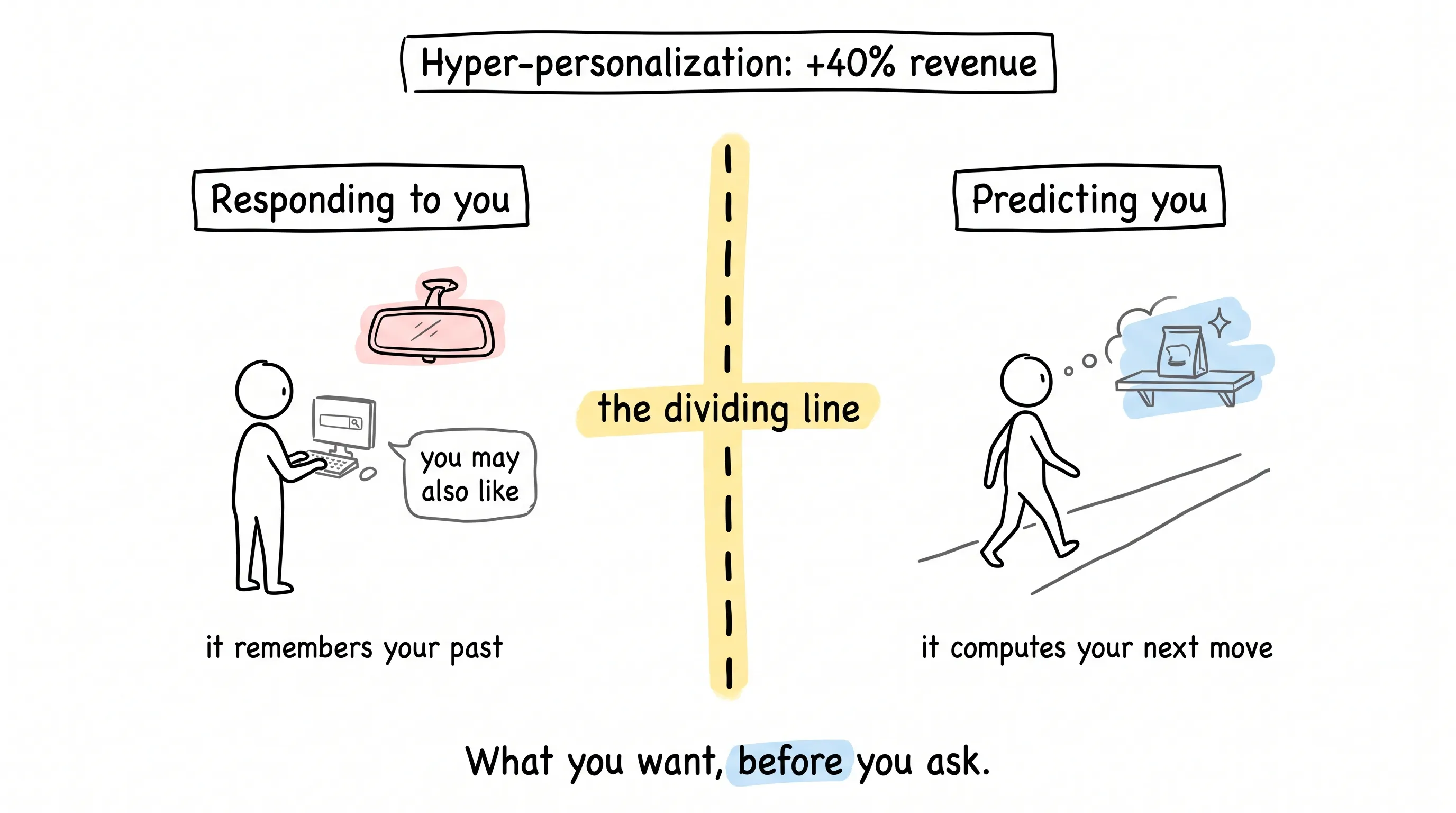
Personalization used to be passive. You searched for something, it remembered, and it pushed it back at you later. It was a cheat sheet — of your past.
Today's personalization is proactive. Before you've even searched, it's ready. It doesn't just look at your past; it computes your next move.
From "responding to you" to "predicting you" — that step is the dividing line between ordinary recommendation and AI personalization.
How much is this worth?
McKinsey has a study: fast-growing companies earn 40% more revenue from "hyper-personalization" than their peers.
What does 40% mean? Two companies, same size, same products, equally good teams. One single thing — doing personalization well — puts one of them miles ahead in hard cash every year. For businesses running single-digit margins, that's a gap that can decide who wins and who loses.
By the way, what is "hyper-personalization"? It means recommending not for a "segment" but for each individual person. Not "30-year-old women may like this face cream," but "you — the cream you looked at three times last night is back in stock."
One word of difference, a world of distance.
Why Does It Guess So Well?
Think about it: how does a machine manage to guess so accurately?
On two things: data, and continuous learning.
Where you clicked on the page, how far you scrolled, which screen you left on, whether you came at midnight or at noon, phone or computer — every behavior is faithfully logged and fed into machine learning models. The models find patterns inside, then adjust in real time: what should this person see, at this very moment?
And it gets more accurate the more it's used. What you do today fine-tunes what it believes about you tomorrow.
Here's an observation of my own. Many people think personalization's value lives in "conversion rate." It goes beyond that. It's one dish, three ways: making it easier for people to buy is conversion; making people feel "this platform gets me" is retention; and not wasting budget on people who were never going to buy is cost.
One dish, three ways. That's the real math of this business.
The Players on the Market, Sorted
OK, theory's done. Now for the tools that do the actual work.
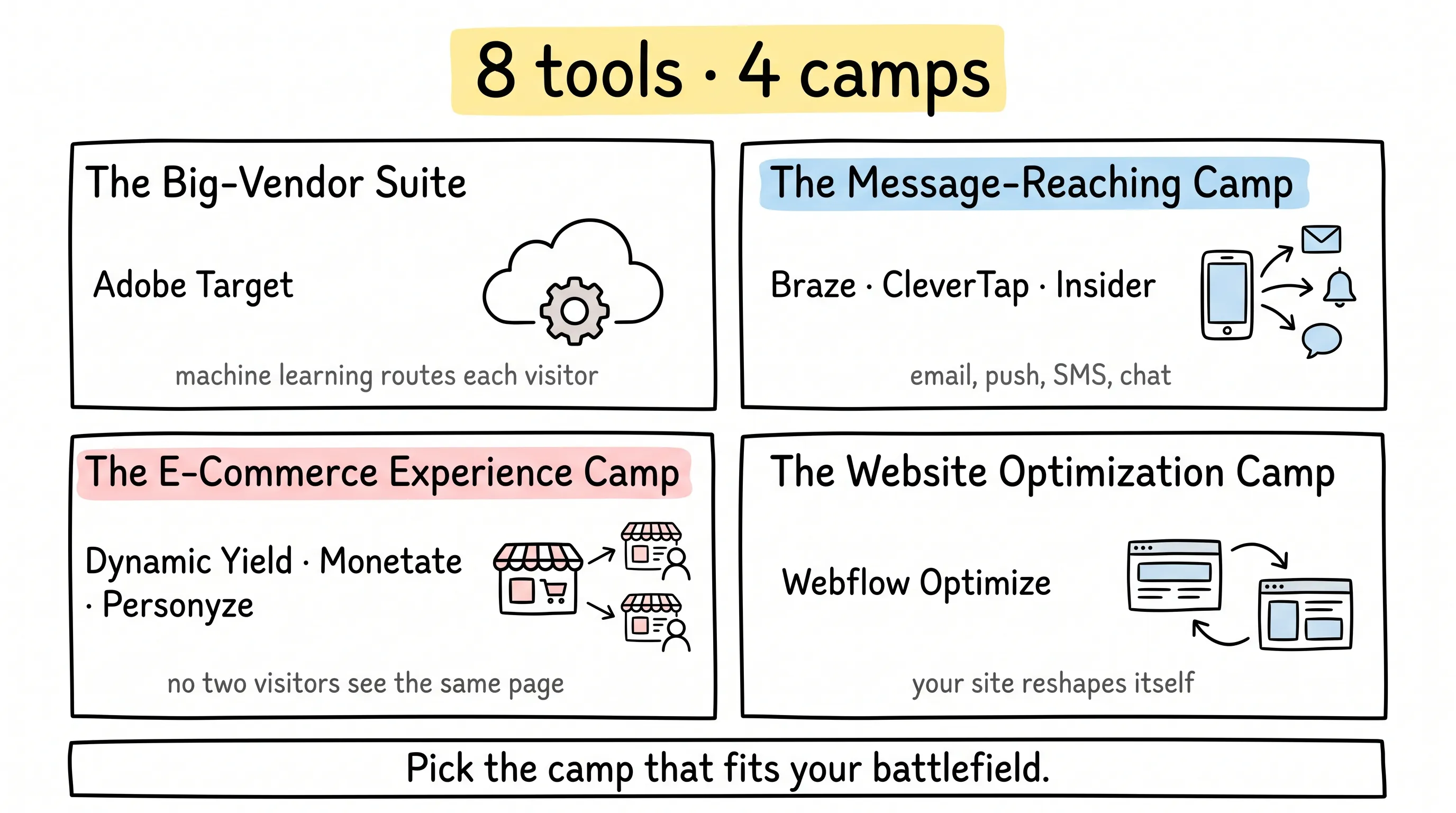
After this round of digging, the mainstream tools come to roughly eight: Adobe Target, Braze, Dynamic Yield, CleverTap, Insider, Monetate, Personyze, Webflow Optimize.
Reading out a list one by one is boring. So I've sorted them by origin and playbook into four camps.
Camp One: The Big-Vendor Suite
The standard-bearer: Adobe Target.
It lives inside Adobe Experience Cloud, and its brain is Adobe's own AI engine, Sensei. Its most famous trick is called Auto-Target: you build ten versions of a page, and it uses machine learning to route each visitor to the version "they're most likely to buy from." Who sees which version is its call — and it gets sharper with every calculation.
It can also link up with Adobe's Real-Time CDP to play "next-step prediction": based on what you just looked at, it swaps out the next screen's recommendations in real time.
When it comes to testing, it's no slouch either. A/B testing and multivariate testing are both solid, drag-and-drop to build, no begging the developers. Hook it into Adobe Analytics and the data views are a joy.
So what do users say? Companies already living inside the Adobe suite generally find it comfortable. But the complaints cluster around two points: first, integrating with anything outside Adobe is complicated; second, customer support — let's not go there.
Pricing is custom-quoted, no free trial. This thing is, at its core, built for long-term residents of the Adobe ecosystem. If you're not a resident, the barrier to entry is steep.
Camp Two: The Message-Reaching Camp
Standard-bearers: Braze, CleverTap, Insider.
This camp's main battlefield isn't your website — it's your phone: email, app push, in-app messages, SMS, even WhatsApp.
Start with Braze. Its strength is "one-to-many, finely targeted reach": based on each user's real-time behavior and predictive signals, it decides who gets what, and when. It has an AI copy assistant that can mass-produce messages in your brand's voice. Its Liquid Logic, paired with Connected Content, also has a great reputation in the industry: one message can split into a thousand versions. A thousand people, each receiving their own flavor of "made just for you."
Pricing is negotiated by usage and company size; there's a 14-day free trial. Complaints: advanced features aren't beginner-friendly, and revenue attribution and last-click analysis (crediting a sale to the final touchpoint) are on the weak side — if you want to know exactly how much money a given message made, you'll have to build another layer yourself.
Next, CleverTap. It works the entire user lifecycle: how to nurture new customers, keep old ones, and reel back the ones who slipped away. Its predictive segmentation is a highlight — the model tells you "this batch of users is at risk of churning" before you act, instead of you remembering after they're already gone. Its experimentation engine is called IntelliNODE, and its copy assistant is Scribe. Pricing starts at $75 a month, with a 30-day free trial — the most generous trial among all eight.
Complaints: again, a learning curve for newcomers. And its customer-journey orchestration is limited in flexibility; very complex paths are awkward to build.
Then there's Insider. This is the most "AI-native" of the bunch. Its flagship is Sirius AI: you describe your goal in plain language, and it generates customer journeys, writes copy, and sets campaign strategy for you. Its on-site search, EUREKA, understands intent: search for "a suitcase that fits a week of clothes" and it won't just throw products with "a week" in the title at you. It has also turned WhatsApp into two-way, conversational commerce — people chat their way into buying. As for when to send and via which channel, it has Send-Time Optimization and next-best-channel prediction to make the call for you.
Custom pricing, no free trial. Complaints: importing custom templates is a hassle, and campaign setup takes some getting used to.
Camp Three: The E-Commerce Experience Camp
Standard-bearers: Dynamic Yield, Monetate, Personyze.
This camp's battlefield is the page itself: homepage, product page, email content — no two visitors see the same thing.
Dynamic Yield has the biggest ambitions. It calls its system Experience OS, meaning: the experience of the entire site is orchestrated by this one "operating system." Its most delightful product is Shopping Muse, a conversational shopping assistant. Tell it "I want a gift for my dad who loves running," and it catches you like a top-floor sales associate in a brick-and-mortar store — chatting and recommending as it goes. It understands natural language and can even recognize products from images. When I saw the demo of this feature, my gut reaction was: this is seriously good.
Architecturally, it's deliberately "tech-stack agnostic" — whatever your foundation is built on, it can plug in. That's a virtue. But in practice, page-by-page integration takes effort, and deep customization requires web development skills. Custom pricing, 14-day trial.
Monetate is an e-commerce veteran. Its engine is called Orchid AI, running machine learning, natural language processing, and large language models together, analyzing behavior and predicting intent in real time. One of its moves shows particular insight into human nature: social proof. For hesitant visitors, it dynamically inserts "only a few left in this color" or "lots of people have bought this recently." Scarcity and herd instinct, all laid on for you.
Custom pricing, no free trial. Complaints: weak on optimizing store pages organized by URL, and deep customization needs technical resources.
Personyze is this camp's all-rounder with the best value. Pricing starts at $250 a month, plus a free starter tier capped at 5,000 page views per month. Its most distinctive trick: "personalize at the moment the email is opened." You blast out an email in the morning; when a recipient opens it at three in the afternoon, the content reassembles itself based on their behavior at that very moment. It sidesteps the lag of "the email went out, then the user changed." The instant I understood this design, I was genuinely impressed.
Its appetite for data is big, too: CRM, CDP, geolocation, weather, purchase history — all fed in to build a unified profile for every visitor. Its visual editor lets you launch a personalization campaign with drag-and-drop. Complaints: the interface is complex, with few guided flows — newcomers get lost easily.
Camp Four: The Website Optimization Camp
Standard-bearer: Webflow Optimize.
It used to be called Intellimize, before Webflow scooped it up. It does one thing above all: your website, reshaping itself for each visitor in real time. First-time visitors see a welcome message; a returning customer who has stared at a product for three days sees the price-drop banner.
It has an AI Content Studio that generates copy, headlines, and calls to action, paired with real-time optimization — "redesigns" no longer need to wait in the dev queue. For anonymous visitors who haven't logged in, its Enhanced Match technology can still guess who they are with pretty good odds. Pricing starts at $14 a month (billed annually), no free trial, but there's a free starter tier to get going. Webflow's own tutorials and community resources are plentiful, so it's not hard to pick up.
Complaints: all told, it may not be cheap for a small company, and its advanced e-commerce capabilities are limited.
Before You Choose, Ask Yourself Four Questions
I won't hand you one of those giant feature-comparison tables. I'll give you four questions to ask yourself before choosing.
Question one: Can it see your users?
Everything in personalization rests on behavioral data. How deep the behavioral tracking goes — clicks, scroll depth, dwell time, cross-device recognition — sets the ceiling for everything downstream. However clever the tool, no data in means nothing out.
Question two: Is it real-time?
A user spends, at most, a few dozen seconds on your page. "Personalization" that runs in overnight batches and updates the next day — once the moment's missed, it's missed. Whether it can react while the user is still standing on the page is the acid test of quality.
Question three: Does it predict?
Looking backward is cheap; guessing the next step is what's valuable. Can the model tell you in advance, "this person is about to churn," "this person will order this week," so you can move before they do? That's the line between reactive and predictive.
Question four: Can it hold the line?
This one's the most overlooked, and the one you can't skip. GDPR, CCPA — the regulations are watching. Consent management, data anonymization, the right to be forgotten: the tool must support these natively, not as an after-the-fact patch job.
Personalization hands out candy; privacy is the minefield. However sweet the candy, cross the line and it all resets to zero.
But, There's Always a Flip Side
All the wizardry of these tools rests on one thing: historical data.
The models learn patterns from "what the user did in the past," then use those patterns to guess "what they'll do next."
In calm waters, this trick is deadly accurate.
But what happens when the market shifts overnight? One viral video changes the consumption habits of an entire category in a single night; one public backlash turns yesterday's preference into today's taboo. What the model has never seen, it cannot predict.
AI can read history. It cannot read sudden shifts. It has only ever seen yesterday.
So my advice: treat AI personalization as a fast, steady "business-as-usual engine," not a crystal ball. Hand it the normal times; keep the judgment calls in a crisis for the human brain. The combination is the complete answer.
Back to That Lens
Back to the lens that made me freeze at the start.
By now I roughly know how it found me. A cross-site ad system recognized my device, passed along the signal that I "looked but didn't buy," and then a real-time bidding system made a decision in milliseconds: put this lens into my feed the next day.
You can call that amazing, or you can call it a little creepy. Honestly, I felt both.
But seen from a business angle, one thing became clear to me: among these eight tools, the gap in raw capability is far smaller than you'd imagine. The essential ingredients, everyone basically has. What truly separates the winners is whether you take "understanding your users" seriously.
The data is there. The models are there. Whether you care enough — that's what decides the game.
May you have that day too: a user glances at your product late at night, and the next day comes back, gladly, to buy.
Continue reading
Related articles

Cross-Border Business: Time to Upgrade Your AI Toolbox
A learn article explaining how AI tools help cross-border e-commerce sellers clear five hurdles: language, regulation, logistics, payments, and fraud. It outlines a five-compartment toolbox, a five-step adoption path, and metrics such as conversion rate and CLV, while cautioning against over-reliance on AI.

AI Is Taking Over the Dirty Work of Social Media Marketing, One Task at a Time
This learn article outlines four social media marketing tasks AI can handle — audience analytics, content drafting and design, ad targeting and creative testing, and spam moderation — and cautions that taste, judgment, and data security remain human responsibilities.

AI Is Already This Good — Why Is Your Social Media Marketing Still Pure Manpower?
An overview of 18 AI tools for social media marketing, organized into six categories covering audience research, content creation, scheduling, comment and DM handling, ad management, and visual production, plus notes on personalization, prediction, and emerging trends.