
Influencer Marketing ROI: How Do You Actually Calculate It?
A bilingual learn article explaining how to measure influencer marketing ROI, covering last-click attribution limits, incremental lift testing, partnership ads, EMV as a baseline, and a four-layer signal stack framework.
A few days ago, I was having dinner with a friend who works in branding, and she told me about a scene.
Their influencer campaigns were posting gorgeous numbers. High likes, comment sections full of "adding this to cart!" But at the quarterly review, the CFO pushed up his glasses and asked one question: We've spent all this money — what exactly did we get back?
The room went silent.
Guess what he asked me? He said, is influencer marketing ROI simply impossible to calculate?
My answer: yes, it can be calculated — and there's a ready-made method for it. Don't be so quick to doubt yourself. What you should doubt is your ruler.
First, the root of the problem: you're holding the wrong ruler
What is last-click attribution? It means when an order comes through, the credit goes to the last ad the customer clicked.
Sounds reasonable, right?
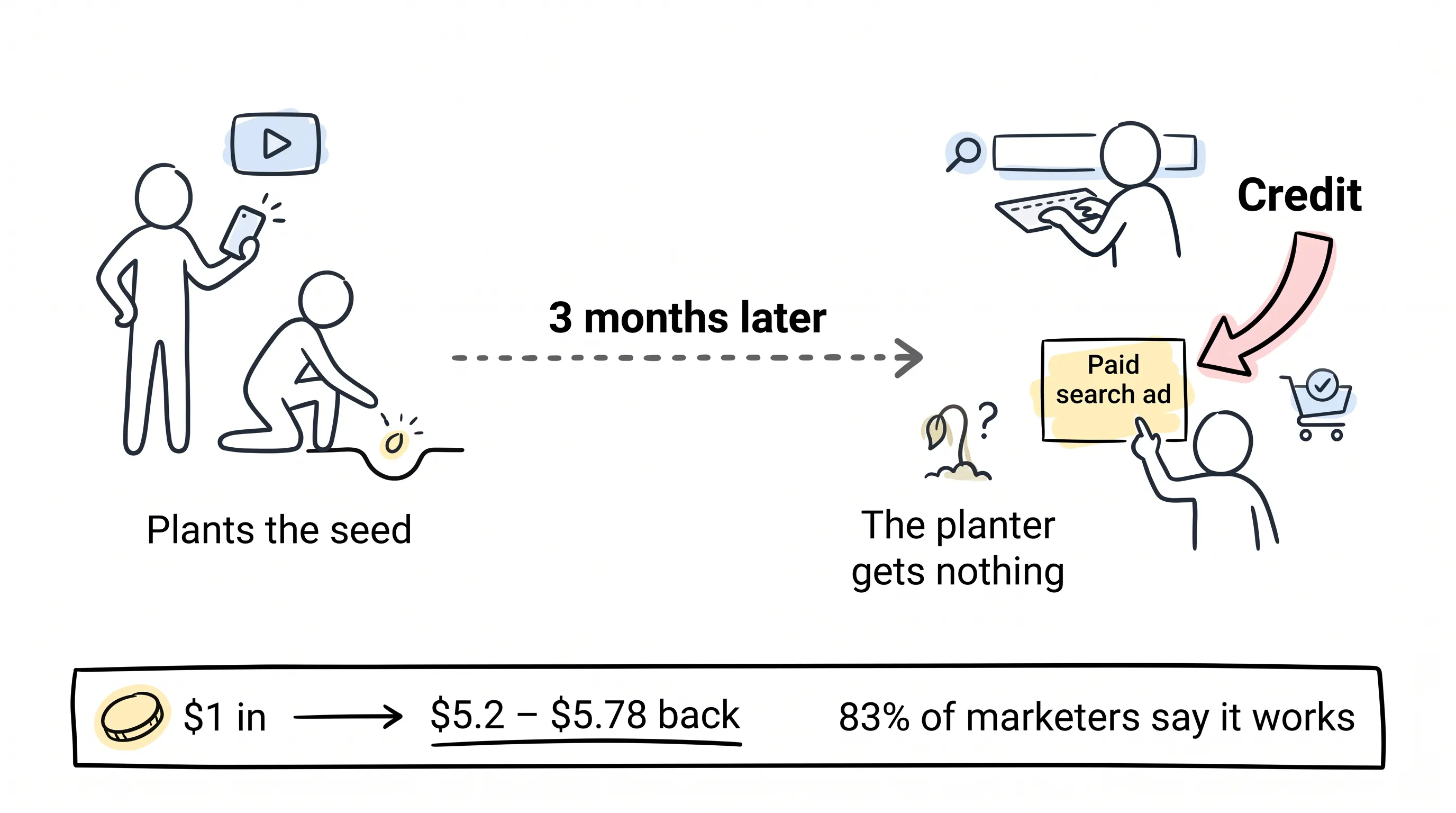
But think about how the desire to buy actually forms. Very likely, an influencer video she scrolled past three months ago planted a seed. Three months later, she searched, clicked a paid search ad, and ordered.
Who does last-click attribution credit? The search engine.
The one who planted the seed harvests nothing.
That's why influencer budgets get cut year after year — not because it isn't doing its job, but because the work it does can't be measured by that ruler. Influencer content plants seeds, and that happens at the very top of the funnel.
Here's the interesting part: the data has been speaking up for influencers all along. Influencer Marketing Hub's benchmark report ran the numbers: for every $1 invested in influencer marketing, brands get back $5.2 to $5.78 on average. And 83% of marketers say it works.
On one side, everyone agrees it works. On the other, the budget can't defend itself. What's missing in between is the right measurement method.
So what do you do? Here are four signals, stacked one layer at a time.
Signal 1: Incremental lift — the only metric that answers the CFO's question
What is incremental lift? (the conversions that come only from people who saw the content — beyond what would have happened anyway)
Very simple: run an experiment. Split your audience into two groups — one that saw the influencer content, one that didn't. Then compare the conversion rates of the two groups.
The extra conversions are what the influencer actually drove. People who would have bought anyway can't be counted as the influencer's credit.
There's a premise behind this: people trust people, not ads. Nielsen's 2012 Global Trust in Advertising report found that 92% of consumers trust recommendations from other people more than a brand's own boasting. Truly good content is, in essence, a personal recommendation amplified ten thousandfold.
So when the CFO asks "was this money well spent," don't fob him off with impressions. Hand him a comparison: one group that saw it, one group that didn't.
Only lift is real lift. It sounds like stating the obvious, but many brands have never run this comparison to this day.
Signal 2: Let the influencer's content run its own ads
This is the play that lets you calculate ROI most directly today. It's called Partnership Ads, also known as allowlisting.
How? Pick the influencer post with the best organic performance, get authorization, and use the influencer's account as the "face" to turn it into a paid ad.
The beauty is that this ad wears a real human face. When users scroll past, what they see isn't a cold brand ad — it's someone they follow. Same budget, engagement on a completely different level — because users have long been immune to ads, but they're not immune to people they trust.
Does anyone vouch for the results? Yes. CreatorIQ's State of Creator Marketing report says 94% of organizations believe influencer content delivers higher ROI than traditional digital ads — and that's up 20 percentage points from the year before.
One piece of content earns organic reach and can also become a measurable ad asset. It's selling the same seed over and over.
Signal 3: EMV isn't a KPI, it's a marking on the ruler
EMV, earned media value. This term has a bad reputation, because it keeps getting trotted out as a headline metric — "We generated $10 million in media value!"
Media value isn't money. Brag like that and finance will tear it apart sooner or later.
But EMV isn't useless. It has a rightful home: the baseline. For example, use it to compare several influencers' organic performance side by side, to decide whom to pick and whom to double down on. It answers "more valuable relative to whom," not "how much money did we make."
Tools aren't good or bad; using them in the wrong place is the problem.
Stack the four signals: the signal stack
You might ask: in actual practice, how do you put this together?
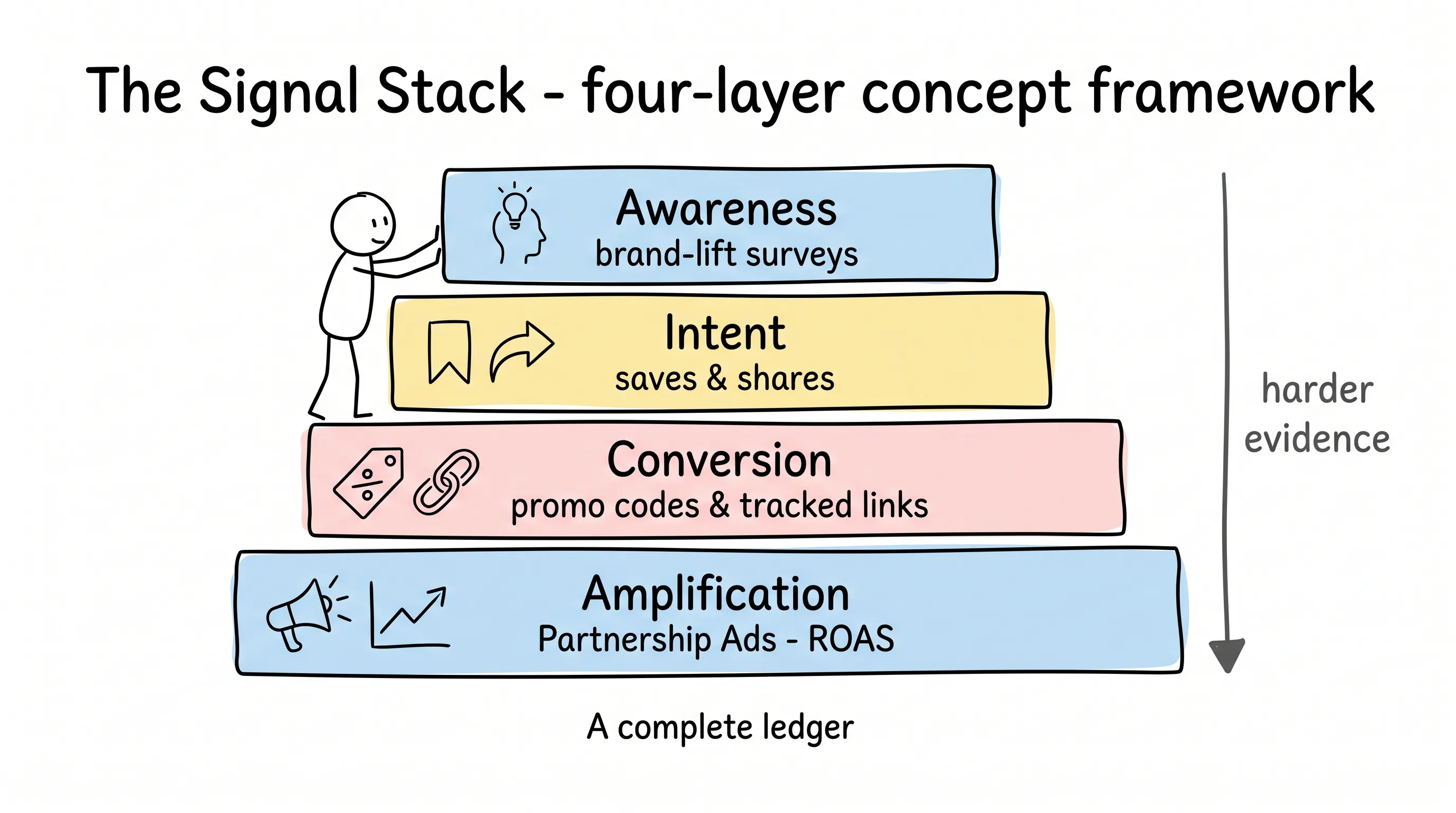
Here's a four-layer framework, called the signal stack. Top to bottom, each layer is harder-edged than the last.
Awareness layer. Use brand-lift surveys to measure how much brand perception differs between audiences who saw the content and audiences who didn't. This layer proves that before a user clicks anything, the brand has already moved into their head.
Intent layer. Look at saves, shares, comments. Sprout Social's 2025 Index report notes that 81% of consumers say social media drives them to impulse-buy. Saves and shares are especially valuable — a casual like is politeness, while a save or a share is a plan to come back and actually buy.
Conversion layer. Issue exclusive promo codes and links with tracking parameters. Who watched the content, who placed the order — every order lines up. This is the cleanest direct attribution.
Amplification layer. Take the best-performing content and run it again through Partnership Ads, calculating ROAS (return on ad spend) directly. This layer turns the signals above into evidence you can scale, and it gives your next budget request real ammunition.
Four layers, each covering its own stretch of the journey. Pieced together, they make a complete ledger.
A few last words
Back to that quiet conference room at the start.
People have been saying "influencer marketing can't be measured" for years. Now you understand: this was never an ability problem — it was a model problem. With the wrong ruler, everything you measure comes out wrong.
Swap in the right ruler, and you won't just hold on to your budget — you'll keep asking for more.
Here's to your next review meeting, where nobody looks down at their phone.
Continue reading
Related articles

Cross-Border Business: Time to Upgrade Your AI Toolbox
A learn article explaining how AI tools help cross-border e-commerce sellers clear five hurdles: language, regulation, logistics, payments, and fraud. It outlines a five-compartment toolbox, a five-step adoption path, and metrics such as conversion rate and CLV, while cautioning against over-reliance on AI.

AI Is Taking Over the Dirty Work of Social Media Marketing, One Task at a Time
This learn article outlines four social media marketing tasks AI can handle — audience analytics, content drafting and design, ad targeting and creative testing, and spam moderation — and cautions that taste, judgment, and data security remain human responsibilities.

AI Is Already This Good — Why Is Your Social Media Marketing Still Pure Manpower?
An overview of 18 AI tools for social media marketing, organized into six categories covering audience research, content creation, scheduling, comment and DM handling, ad management, and visual production, plus notes on personalization, prediction, and emerging trends.