
Influencer Marketing in 2026: Small Creators Are Winning, and Stores Are Moving Inside the Content
An educational overview of 2026 influencer marketing trends: nano and micro creators delivering higher engagement at lower cost, long-term partnerships over one-off placements, AI-assisted creator discovery and measurement, in-content shopping, creator content licensing, and revenue-based attribution metrics.
A while back, an old friend who runs a consumer brand invited me to dinner.
Halfway through the meal, he put down his chopsticks, pulled out his phone, and showed me: the budget for this quarter had just been approved, and he planned to sign a top-tier influencer with ten million followers — one deal, a full quarter.
I said, hold on.
Why?
I walked him through a few sets of numbers. When we were done, he put his phone away.
Those numbers came from a handful of reports I'd been reading closely lately. One of them is the 2026 social media planning guide from Sprout Social. Sprout Social is a company that makes social media management tools, and it sits on years of consumer surveys and influencer marketing research — the data is solid.
Today, I'm going to re-run the math from that dinner for you.
The Money Is Pouring In Faster
What is influencer marketing, exactly?
Put simply: brands pay content creators to recommend products to each creator's own followers. Most of the product recommendation videos and review posts you scroll past are powered by this business.
How big is it? By the end of 2026, the industry is expected to exceed $26 billion.
And the money is still accelerating. In Sprout Social's 2026 planning guide, 83% of marketing leaders plan to increase influencer budgets over the next 6 to 12 months; more than eight in ten of them are shifting that money over from other channels.
Notice that detail: this isn't a bit of extra budget — it's budget being moved.
Moving it means someone else is losing it.
Why cut ads and add influencers? Because trust has changed address. In a Q2 2025 survey, 64% of social media users said that if a brand partners with a creator they like, they're more willing to buy; for Gen Z, that figure is 76%.
Consumers no longer trust ads. But they still trust people.
Small Is Beautiful
When most brands pick influencers, there's a built-in superstition: the bigger the following, the better the results.
That logic is breaking down.
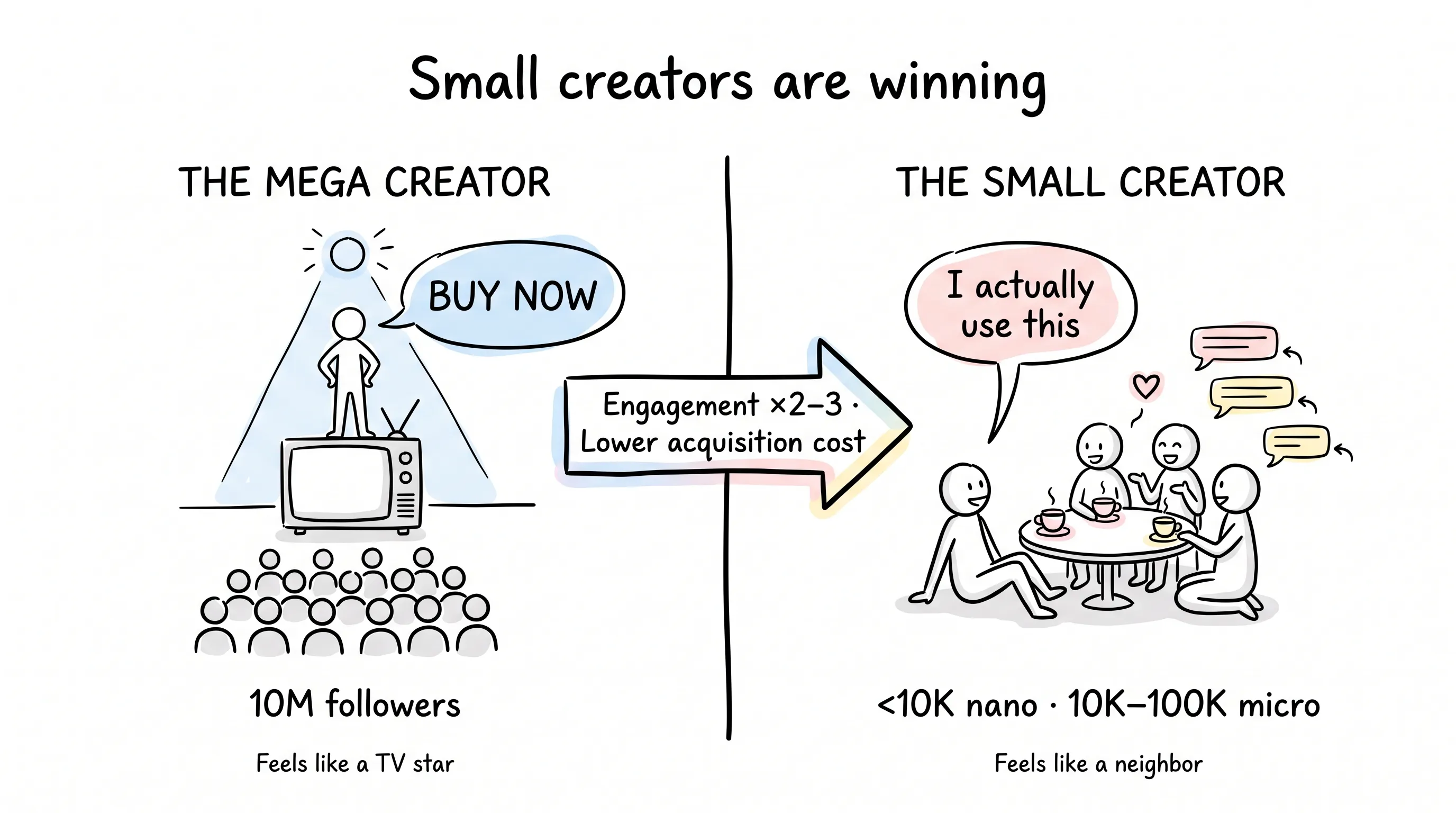
Two terms first. What is a nano-influencer? Someone with fewer than 10,000 followers. What is a micro-influencer? Someone with 10,000 to 100,000.
Sounds modest. Yet these two groups deliver engagement rates two to three times those of mega-creators with millions of followers, at a lower customer acquisition cost.
Why? Think about it. A creator with 10,000 followers replies to practically every comment; their followers treat them like a neighbor, like a knowledgeable friend. Followers look at a ten-million-follower celebrity the way they look at a star on TV.
If a neighbor recommends a toothpaste, you'll probably buy it. When a star on TV recommends toothpaste, you know it's an ad.
So brand budgets are sinking toward the small end of the creator spectrum.
Six Months Beats One Placement
Once you've found the right creator, how do you work with them?
Many brands' approach: buy once, publish once, done.
That's treating a creator as an ad slot.
Think about it: if someone you trust suddenly praises a product out of the blue, you'd raise an eyebrow. But if they've been using it and talking about it for six months, you'll believe they really use it.
One placement buys exposure. Six months buys trust.
In practice, four moves, none complicated:
First, send product for a trial — test people cheaply, and only talk long-term contracts once they've proven reliable. Second, pay base fee plus bonus — a guaranteed base rate, topped up by content volume and conversion performance. Third, for the best performers, sign category exclusivity so competitors can't poach them. Fourth, put the creator's content schedule and your product launch cadence on the same calendar.
And how do creators see it? Sprout Social's influencer marketing report has a number: 71% of creators are willing to offer a discount for multi-period partnerships.
Long-term partnership is a deal where both sides save money.
Authenticity Is the New Passing Grade
Some will say: doesn't long-term collaboration make the content go soft?
Quite the opposite.
In surveys, 47% of consumers say authenticity is what they value most in creator content.
But what counts as authentic is changing. Younger consumers understood how the commerce game works long ago: creators taking sponsored deals is perfectly natural. They don't fuss over whether content has a script; they ask one question: do you actually use it yourself?
What Gen Z wants is evidence that the product lives in the creator's real life.
So brands that do this well now do four things:
Loosen up and let creators speak in their own voice; don't stuff in a corporate-sounding press release. Let the content be a little rough — behind-the-scenes footage holds attention better than a polished blockbuster. Let creators name the product's flaws; reviews that dare to point out downsides make people stop scrolling, and all-praise content gets swiped away. Collect real customers' haul posts and candid shots, and reuse them again and again.
One compliance note: paid partnerships must be disclosed. In the US, the FTC has made this a hard requirement. As we'll see later, even AI-generated virtual influencers have to disclose sponsored deals.
AI Is Taking the Grunt Work
Now let's talk AI. Conclusion first: AI isn't taking creators' jobs — it's taking the grunt work.
Finding creators used to be manual work: scrolling through profile after profile, checking tone, checking numbers, digging up old controversies — a brand manager couldn't screen more than a few dozen a week.
Now, you describe what you need in plain language — say, "find bloggers who make yoga and meditation content with a warm tone" — and AI combs through massive archives in seconds, scores each person's content fit against your brand values, and can even flag risky, controversial content before you sign. Sprout Social's influencer marketing tools ship with exactly this setup.
Why are brands willing to use it? Because the other half of the pain is measurement. Roughly half of marketers admit they can't say whether their influencer spend actually works. When AI runs discovery, matching, and measurement as one chain, creator content finally maps onto business results.
And virtual influencers? Fully AI-generated "people": no scandals, consistent output, on call around the clock — sounds lovely. But they have no life. In categories like fitness, skincare, and food, where the pitch is "I tried this myself," the trust in a real human is something a machine cannot replace. Brands wanting to test the waters, remember one rule: virtual influencers taking sponsored deals must disclose just the same, and are bound by the same regulations.
Your Content Is Your Storefront
This next change is, to me, the one most worth remembering in 2026.
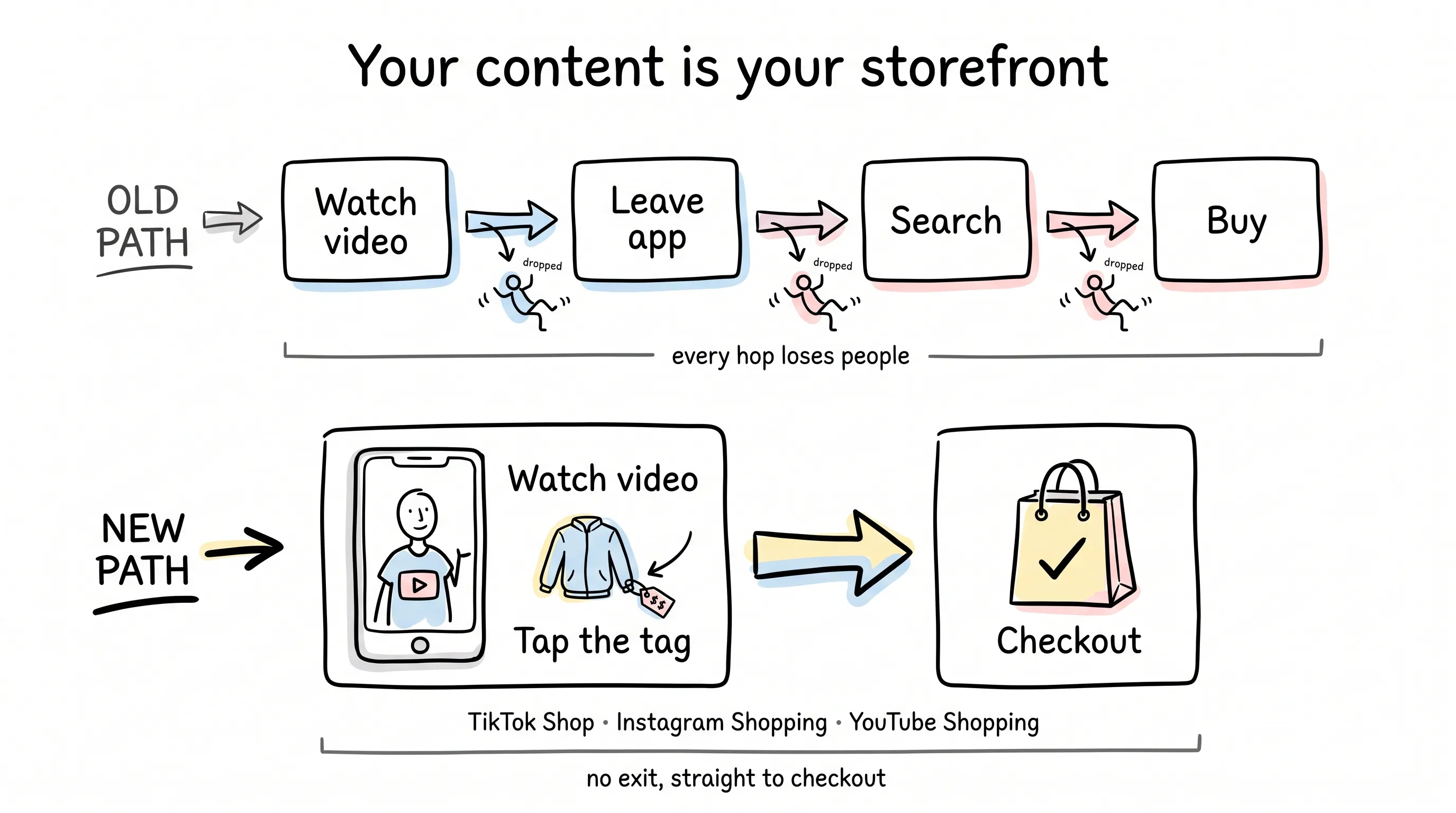
The old creator-commerce path: watch a video, leave the platform, search, find the product, place the order. Every hop loses a wave of people.
Now TikTok Shop, Instagram Shopping, and YouTube Shopping have opened the store inside the content itself. That jacket in the video — tap the tag, no exit, straight to checkout.
Layer on a few more plays: creators go live to demo products on the spot, and once the "gone if you don't buy now" urgency kicks in, the purchase happens right then; creators see in their dashboard, in real time, how many units they've sold and what their commission is — and the more they see, the harder they sell; creators feature curated product collections on their profiles — a landing page in itself.
Shorten the path to the minimum, and conversion rises on its own.
Your content is your storefront. In 2026, that's not a metaphor — it's a fact.
Don't Let Content Live Only One Day
There's another waste most brands haven't noticed.
A creator's hit post finishes its organic run and goes to sleep on their profile, while the ad the brand shot itself is still burning spend — and may not even match that hit's performance.
Sprout Social's data: 90% of marketers say creator content, when put behind paid spend, reaches further than brand-made content; 83% say engagement is better too.
This play has a name — creator content licensing, formerly known as whitelisting: buy the rights to a creator's best content and run it as ad creative.
Three things to do: write usage rights into the contract, and negotiate them before the content goes live — don't wait for it to blow up and patch it after; start with small-spend tests, then scale up only the creatives that convert; use UTM parameters and pixel tracking to keep organic and paid results in separate ledgers, or the ROI will never add up.
B2B Is Joining Too
B2B brands used to think influencer marketing was for consumer players.
Now they're entering too — but with a completely different playbook.
B2B isn't looking for lifestyle bloggers; it's looking for industry analysts, consultants, and vertical-domain LinkedIn voices. Procurement cycles are long, audiences are narrow, and content has to spark insight, not laughs.
There's one selection criterion: a LinkedIn account with just 15,000 followers — all peers, with lively discussion — is worth far more than a generic 50,000-follower business account.
The metrics changed too: forget likes; ask whether a piece of content pushed deals forward faster and lifted lead quality.
Start Running the Numbers
Everything above has to land in a spreadsheet.
Follower counts and view totals are vanity. They tell you how many people saw something, not how many people bought. Influencer budgets are being tied directly to revenue metrics.
Four hard metrics: customer acquisition cost — what it costs to gain one customer through a given creator; conversion rate — how many people clicked the link or used the promo code and actually ordered; customer lifetime value — how much revenue a creator's customers contribute over the long run; plus brand lift studies, to see whether awareness and purchase intent genuinely moved.
How do you keep the full books? Multi-touch attribution: record every touchpoint a customer encounters before buying, not just the last creator post they saw. Track four layers from start to finish: awareness — reach, impressions, brand mentions; interest — site visits, email signups, content saves; conversion — promo codes, affiliate links, pixel tracking; retention — repeat purchases and customer reviews.
Paying creators should shift to a hybrid model too: a base rate for the floor, commission tied to sales, tiered bonuses tied to performance milestones — the higher they climb, the bigger the reward. Nano-influencers can start with product-for-content; the best brand ambassadors get long-term, deeply bound partnerships. Platforms like Sprout Social have built reporting down to the per-post level — which post, which format, which deal structure is working, one glance at the reports tells you.
By the way, surveys show 65% of marketers believe leadership recognizes the value of influencer spend. But confidence is no substitute for an accounting method. Build the attribution model first; launch the next campaign after.
Excel Can't Manage 20 Influencers
One last thing — unglamorous, but potentially fatal: infrastructure.
Managing one creator, Excel is enough. Running 20 campaigns at once, Excel is an accident scene: content approvals slip, payments drag, posts that never passed brand review go live anyway.
Scaling needs at least four things: a creator database holding contracts, contact info, and performance history; a pre-publication content approval workflow; a rights ledger that makes clear which content can be used as ads; and automated payments, so your best creators aren't left waiting for money.
Patience is a consumable. So are creators.
Platforms and Industries Each Have Their Own Temperament
Two more things decide why the same playbook performs wildly differently from place to place.
One is platform. 53% of creators most enjoy making 15-to-30-second short videos — the most sought-after format on both the supply and demand sides. TikTok favors vertical short video and trending audio — good for awareness and e-commerce links. Instagram Reels should stay under 30 seconds to get discovered, and multi-image carousels drive saves and shares. YouTube splits in two: reviews longer than 3 minutes catch high-intent buyers; Shorts handle new-audience reach.
The other is industry. Beauty and fashion audiences want to see products actually worn — tutorials, transformations, makeup routines, honest reviews come first. Food and drink are natural engagement powerhouses — recipes, taste tests, at-home rituals always beat polished brand talk. Fitness only believes people who clearly train — staged content won't survive three videos. Travel should be told as a story: from planning the trip, to landing, to the real experience — the whole arc, told end to end.
Don't copy-paste one video across platforms, and don't force someone else's industry template onto yours. Your audience's buying behavior shapes your playbook.
Closing Thoughts
By the end of that dinner, my friend had changed his mind: no top-tier celebrity. Instead, three vertical creators with around 100,000 followers each, base fee plus commission, a three-month trial first.
Six months later he told me: same budget, more deals closed — and every single order could be traced back to the creator who brought it.
That's the full picture of influencer marketing in 2026: small creators are winning, long-termism is winning, and the ones who run the numbers are winning. AI didn't replace anyone — it pulled everyone out of the grunt work, so creators can do the one thing they're best at: being trusted.
So here's my wish for you: every creator you sign actually uses your product.
Continue reading
Related articles

Cross-Border Business: Time to Upgrade Your AI Toolbox
A learn article explaining how AI tools help cross-border e-commerce sellers clear five hurdles: language, regulation, logistics, payments, and fraud. It outlines a five-compartment toolbox, a five-step adoption path, and metrics such as conversion rate and CLV, while cautioning against over-reliance on AI.

AI Is Taking Over the Dirty Work of Social Media Marketing, One Task at a Time
This learn article outlines four social media marketing tasks AI can handle — audience analytics, content drafting and design, ad targeting and creative testing, and spam moderation — and cautions that taste, judgment, and data security remain human responsibilities.

AI Is Already This Good — Why Is Your Social Media Marketing Still Pure Manpower?
An overview of 18 AI tools for social media marketing, organized into six categories covering audience research, content creation, scheduling, comment and DM handling, ad management, and visual production, plus notes on personalization, prediction, and emerging trends.