
Influencer Marketing Burns $4.8 Billion a Year, and AI Has Finally Had Enough
An analysis of influencer marketing fraud and how AI-based creator vetting, predictive analytics, and compliance practices are being applied, including tool options and rollout steps.
A while back, a friend of mine who works in consumer goods took me out to dinner. Over the meal, he vented: last year he'd spent more than two million RMB on influencer campaigns. When he reviewed the results, the reported impressions looked beautiful — but the comment sections were buzzing in a way that felt off.
"Look at these comments," he said, handing me his phone. "Same handful of phrases over and over, just swap the avatar and keep praising."
I stared at the screen for a long moment and laughed. That's bots, plain and simple.
The worst part, he said, was what a third-party audit turned up: more than a third of that influencer's followers were fake.
Dinner left a knot in my stomach. When I got home, I sat down and ran the numbers on the entire influencer marketing industry, from top to bottom. The more I crunched, the more I felt this was worth telling you about.
Because the change is happening at the industry's foundations.
First, Let's Run the Numbers
How big is influencer marketing now?
You probably have no feel for the number. Globally, the market hit $32.55 billion in 2025 and is projected to blow past $40 billion in 2026. The US alone pours in $9.3 billion a year. And 86% of US marketers plan to work with influencers this year, up from roughly 75% in 2022.
A business riding the wave, right?
But. Think about it: while the industry sprints, what's leaking out the other side?
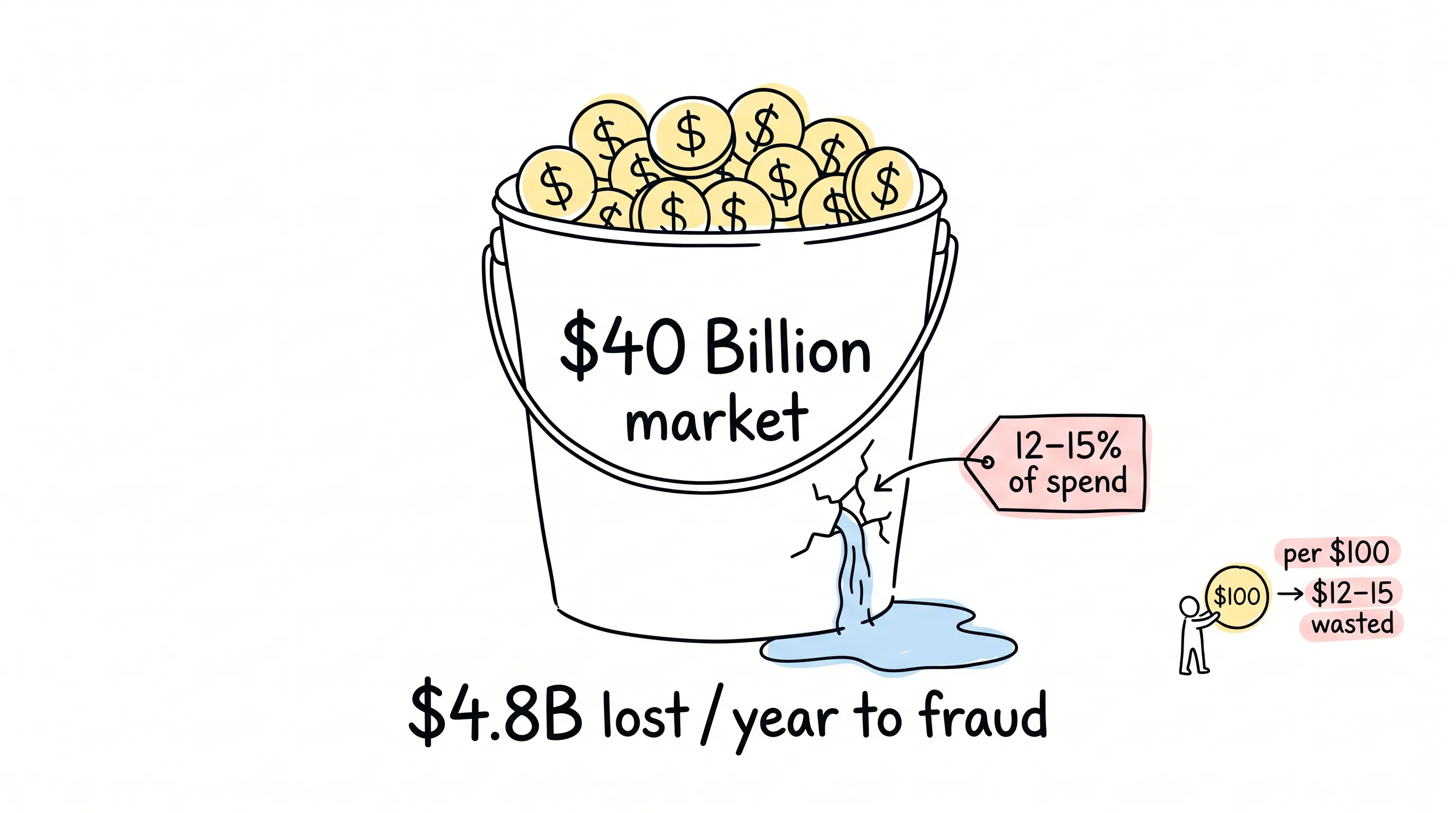
The industry's own data stings. Influencer Marketing Hub, Statista, the World Federation of Advertisers — the very organizations that keep reporting good news for this industry — are also recording another set of numbers: roughly $4.8 billion lost to engagement fraud every year, 12% to 15% of the total pot. A third of Instagram influencers have fake followers exceeding a third of their audience. And in the mid-to-upper tier — accounts with 100,000 to 500,000 followers — the fraud rate approaches half.
What does that mean? For every $100 you spend, about $12 to $15 goes straight into a fraudster's pocket.
An average mid-sized campaign wastes about $128,000. The World Federation of Advertisers surveyed 1,400 senior marketers across 28 countries: 81% had run into influencer fraud in the past year. For the projects that got burned, the gap between expected reach and actual reach averaged 37%.
That's not a marketing budget. That's tuition. And you pay it every year, in a class that never ends.
That's why, in 2026, AI in influencer marketing is no longer a nice-to-have toy. It's the deadbolt you install before you open for business.
What Does "Vetting People Through Their Content" Mean?
So how does AI guard the door?
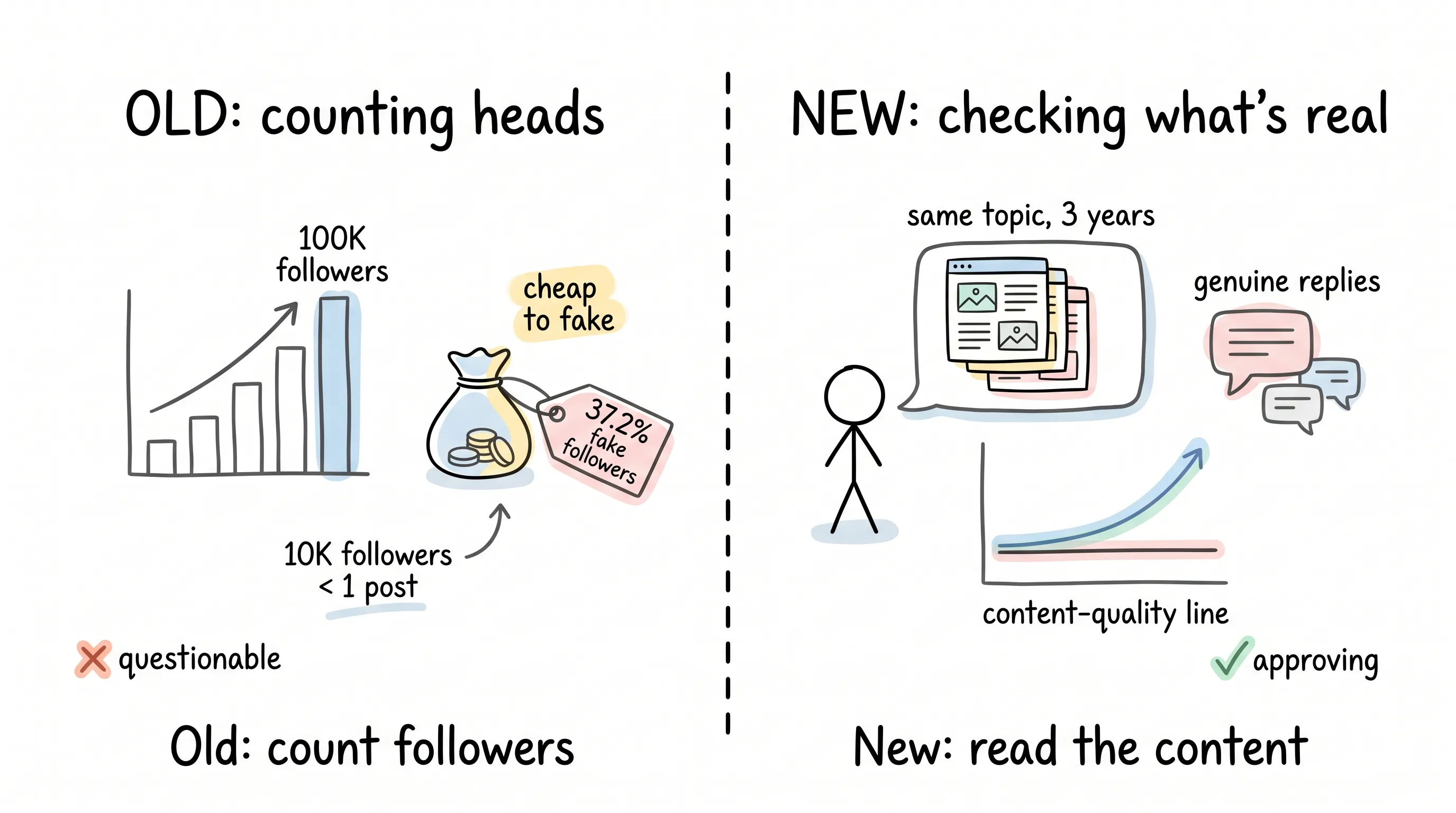
The traditional vetting method: look at follower counts, look at engagement rates. Sounds reasonable. The problem is that these two numbers are precisely the easiest to fake.
How much does it cost to buy 10,000 followers? Less than paying someone to write a single sponsored post.
SociaVault scanned 100,000 Instagram and TikTok creator accounts in 2025 and found that 37.2% of followers showed signs of being fake. In other words, tap open any decent-looking account at random, and one in three of those followers was bought.
So the new approach skips the "vanity metrics" entirely and looks at the content itself.
AI reads what a creator actually publishes: Is their voice consistent? Do they stay on topic? Does the comment-section interaction sound like real humans talking? Someone who genuinely knows skincare has spent three years talking about nothing but ingredients and skin feel. Someone who fakes expertise once the check clears was talking personal finance last month, gaming this month, and suddenly starts raving about a face cream next month.
In other words, the old question was "how many followers does this person have?" The new question is "what does this person actually know — and does their audience genuinely care?"
From counting heads to checking what's real. That's the most fundamental shift in this round of change, as I see it.
Video analysis can push one step further. An account goes quiet for three months, then likes suddenly spike. The comment sections read like copy-paste. The follower growth curve shows a steep climb completely disconnected from content quality. To the human eye these traces look "kind of weird"; AI flags them in red.
The problem surfaces before the contract is signed. Tuition for that deal: saved.
ROI You Can See, and the Invisible Hand
Fraud defense is only the defensive half. Where AI gets really valuable is offense.
What is predictive analytics?
Here's an example. You have a budget in hand and 500 creators in front of you. Who do you pick? In the past, it came down to your business-development person's eyeballs and gut feel. Now, a model digs through historical data from thousands of campaigns — a creator's past track record, audience profile, content format, posting times — throws it all in, and hands you a projection: what this deal is likely to become.
The industry's current average return: $5.78 earned per $1 spent. Top campaigns reach $11 to $18. And 63% of marketers have already plugged AI into some stage of their influencer workflow.
Beyond the numbers, one trend deserves special mention: when it comes to conversion-focused campaigns, 73% of brands would rather pick micro-influencers with 10,000 to 100,000 followers than big names. Why? Micro-influencers' engagement rates are roughly triple those of mega influencers, at a fraction of the price.
Ten real followers beat ten thousand fake spectators. People have finally learned to do this math.
Unilever's AI-powered campaign for Dove took this playbook to the ceiling: AI generated the visual assets, AI mined micro-influencers, AI orchestrated the rollout rhythm — and the campaign landed 3.5 billion impressions, with 52% of buyers being first-time Dove customers.
My God. Half their new customers.
During the campaign itself, AI kept watch in real time. When a content format starts scaling faster or a time slot starts outperforming, the system suggests shifting money from the slow lanes to the fast ones. The campaign went from "spray and pray" to something you can steer mid-flight.
For friends in B2B, here's a bonus: B2B campaigns run long cycles with messy attribution, and the worst fate is not being able to explain where the money went. Predictive models can calculate which creators actually move the sales pipeline, not just the like count. When you report to the CFO, you finally have numbers to show.
By the way, this playbook is expanding outward. Creator content is feeding the answer layer of AI search engines like ChatGPT and Perplexity. That hooks the creator business into GEO (Generative Engine Optimization — making your brand show up in AI-generated answers). Your influencer content may determine whether an AI mentions your brand when it answers a user's question.
Robots as Influencers — Do You Buy It?
Now for the spicy topic.
AI-generated virtual personas can already publish content, reply to comments, and appear on camera, virtually indistinguishable from an algorithm. Virtual influencers like Lil Miquela, Imma, and Shudu have millions of followers, and Calvin Klein, Prada, and BMW have all booked them for ads. Gartner's research says virtual personas cost about 30% less than comparable real humans, with no discount in brand buzz.
Thirty percent cheaper, and no talent scandals to manage. Sounds perfect?
But.
Consumers still don't trust virtual personas. Especially in trust-intensive categories — beauty, health, food, finance — users want to see a real person, with real flaws, who has actually used the face cream. No algorithm, however perfect, can top "it pills a little on me, but it's really hydrating."
So the realistic playbook I see: virtual personas for testing and brainstorming — simulating copy scenarios to see which messaging might hit; real humans front and center for the actual campaign.
AI behind the scenes, humans on stage. That division of labor won't flip anytime soon.
Where's the Red Line?
One thing is harder than any technology: regulation.
In August 2024, the US Federal Trade Commission (FTC) finalized its rule: fake reviews, fabricated testimonials, and purchased social proof are all banned. Earlier, the 2023 update to the Endorsement Guides made it explicit: if an endorsement is substantially generated by AI or deeply AI-assisted, it must be clearly disclosed. Meta, TikTok, and YouTube have all rolled out platform-level AI content labels.
At the operational level, it boils down to one sentence: if you use AI in an influencer program, you must document it, disclose it, and write it into the contract. If you violate it, the brand and the agency that executed the program get fined together. AI compliance has gone from "legal's elective course" to the same tier as crisis PR.
A few gray areas remain where nobody has clear answers yet. When AI analyzes a creator's content to produce insights, whose data is it? When AI participates in creation, how does credit work? The answers to these questions are still unwritten — legal and PR teams need to sit down together and get the uncomfortable conversations out of the way first.
My advice is simple. Transparency is the only principle that's never wrong. Disclose exactly as much as AI contributed — to creator selection, content creation, user interaction. Put it where users can actually see it. A disclosure buried in a bio is no disclosure at all.
Last rule: a human must stay in the loop. AI can scan ten thousand documents in a second, but it doesn't understand what your brand must never say, which topics are untouchable, which jokes are landmines in this culture. Before every AI recommendation ships, a human should be saying "go" or "no go."
Where to Start
The tools are no longer scarce. CreatorIQ, Tagger, Upfluence, Modash, Aspire, Traackr, Meltwater Klear — the layer of creator intelligence and execution workflow is getting crowded. And TikTok Symphony and Meta's native AI suites hand you the capabilities at the platform level.
So the hard part of tool selection is no longer "is there a tool," but "which tool plugs into your existing attribution stack, CRM, and campaign infrastructure."
As for rollout, my view is three steps.
Start with vetting and fraud defense. Why? Because the return is the most direct — dodging one fake creator can save enough to pay a year's worth of tooling. This step shows results fast, and it builds the team's confidence.
Then bring in predictive analytics, so creator selection and scheduling come with numbers attached.
Finally, as the team gets comfortable, move into AI-assisted creation and real-time optimization. AI proposes topics, drafts copy, brainstorms video concepts; humans finalize and perform. Batch, repetitive decisions — repricing, shifting budgets, swapping creatives — run automatically on AI; strategic calls you're unsure about escalate to humans.
Don't get greedy at the start. Pilot with a small slice of campaigns and run them head-to-head with the traditional approach. The numbers will speak for themselves.
Back to That Dinner
Writing to this point, I remember how that dinner with my friend ended.
He asked me: so tell me — is our industry being saved by AI, or destroyed by it?
I said: neither. AI is just laying bare what's always been in this industry, out in the sunlight. Fake followers were always there; waste was always there. They used to hide behind pretty data reports. Now they can't hide anymore.
The bigger the pot, the more sludge it can hold — and the harder the moment of reckoning hits.
In a $40 billion industry, 15% is leaking. Whoever plugs the leak first is the one whose every dollar actually lands on a real person. And once trust is proven with data, it travels along every campaign, all the way back to the brand.
An industry that has always carried its budget like a bad-debt provision is learning to spend the money on real people.
As for you — if you're still picking influencers by follower count, one reminder: you're counting heads, and they're counting your budget.
Continue reading
Related articles

Cross-Border Business: Time to Upgrade Your AI Toolbox
A learn article explaining how AI tools help cross-border e-commerce sellers clear five hurdles: language, regulation, logistics, payments, and fraud. It outlines a five-compartment toolbox, a five-step adoption path, and metrics such as conversion rate and CLV, while cautioning against over-reliance on AI.

AI Is Taking Over the Dirty Work of Social Media Marketing, One Task at a Time
This learn article outlines four social media marketing tasks AI can handle — audience analytics, content drafting and design, ad targeting and creative testing, and spam moderation — and cautions that taste, judgment, and data security remain human responsibilities.

AI Is Already This Good — Why Is Your Social Media Marketing Still Pure Manpower?
An overview of 18 AI tools for social media marketing, organized into six categories covering audience research, content creation, scheduling, comment and DM handling, ad management, and visual production, plus notes on personalization, prediction, and emerging trends.