
In the AI Era, Other People Get to Tell Your Brand Story
A learn article explaining AEO and how AI answers draw mostly on third-party sources, citing an AirOps study of 21,311 brand mentions in which 85% came from third-party sites. It outlines six steps to keep brand messaging consistent across owned and third-party web content.
A few days ago, in a group chat for marketers, I came across a set of numbers and stared at them for a long time.
In 2025, a company called AirOps studied 21,311 brand mentions. By "brand mentions," I mean those moments when an AI tool, in the middle of answering a question, happens to name a brand.
And the result?
85% of those mentions came from third-party websites. The share coming from what brands say on their own official sites is small enough to be almost negligible.
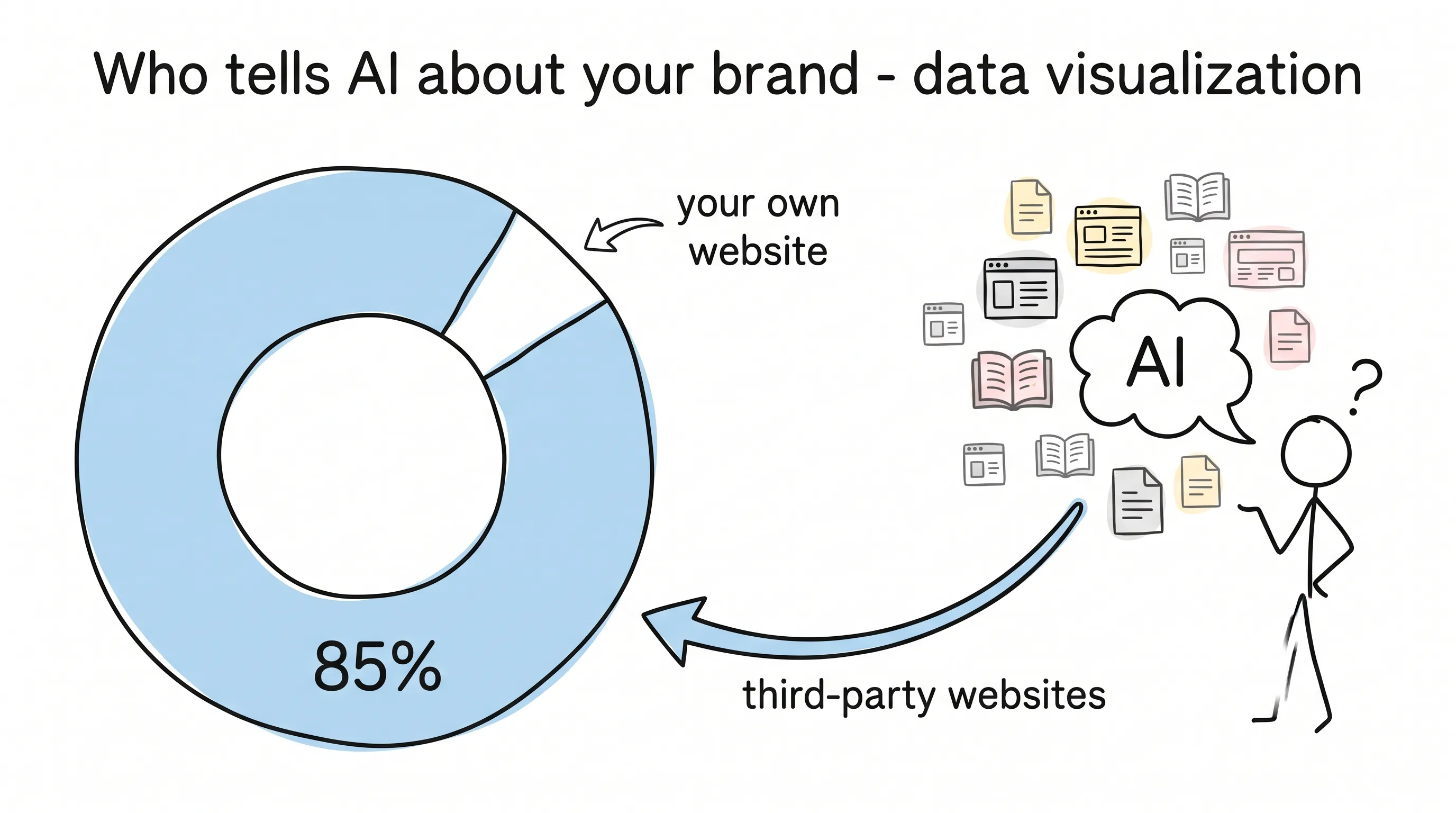
My first reaction was: whoa. Which means how AI introduces you depends mostly on what other people say about you.
This deserves a proper conversation.
What Is AEO?
AEO — Answer Engine Optimization.
In plain language: we used to do SEO, serving search engines. A user typed a query, got ten blue links, and whoever ranked near the top won.
Now? Plenty of people don't click links anymore. They ask an AI directly: which brand is reliable? What does this company actually do?
The AI hands them an answer.
Whether your brand is in that answer or not — that's exactly what AEO worries about.
So how does an AI decide whether to mention you?
That brings us to a key mechanism: AI also goes online to look things up. The technique has a name — RAG, retrieval-augmented generation. It sounds arcane, but stripped down, it means this: before answering you, the AI first searches the web the way you would, grabs the latest material it finds, and stitches it into an answer.
What it finds largely determines how it talks about you.
So the question becomes: when AI looks things up, who is doing the talking?
The answer is that set of numbers from the opening: mostly, third parties.
AI's Memory Is Assembled, Piece by Piece
What is a knowledge graph?
Think of it as AI's "memory" of an industry. Your company, in that memory, is an "entity." Everything AI knows about you is collected from across the web: your official site, media coverage, forum discussions, the exact wording people use when introducing you...
If the accounts in those places are all over the map, AI can't assemble a clear picture of "you."
And if it can't assemble that picture, what happens?
It doesn't mention you.
If the knowledge graph can't find you, AI's answers can't find your brand.
Flip that around, though: as long as your story is clear, consistent, and rooted deep enough across the web, the knowledge graph is something you can influence.
Where to start? I'll break it into six moves.
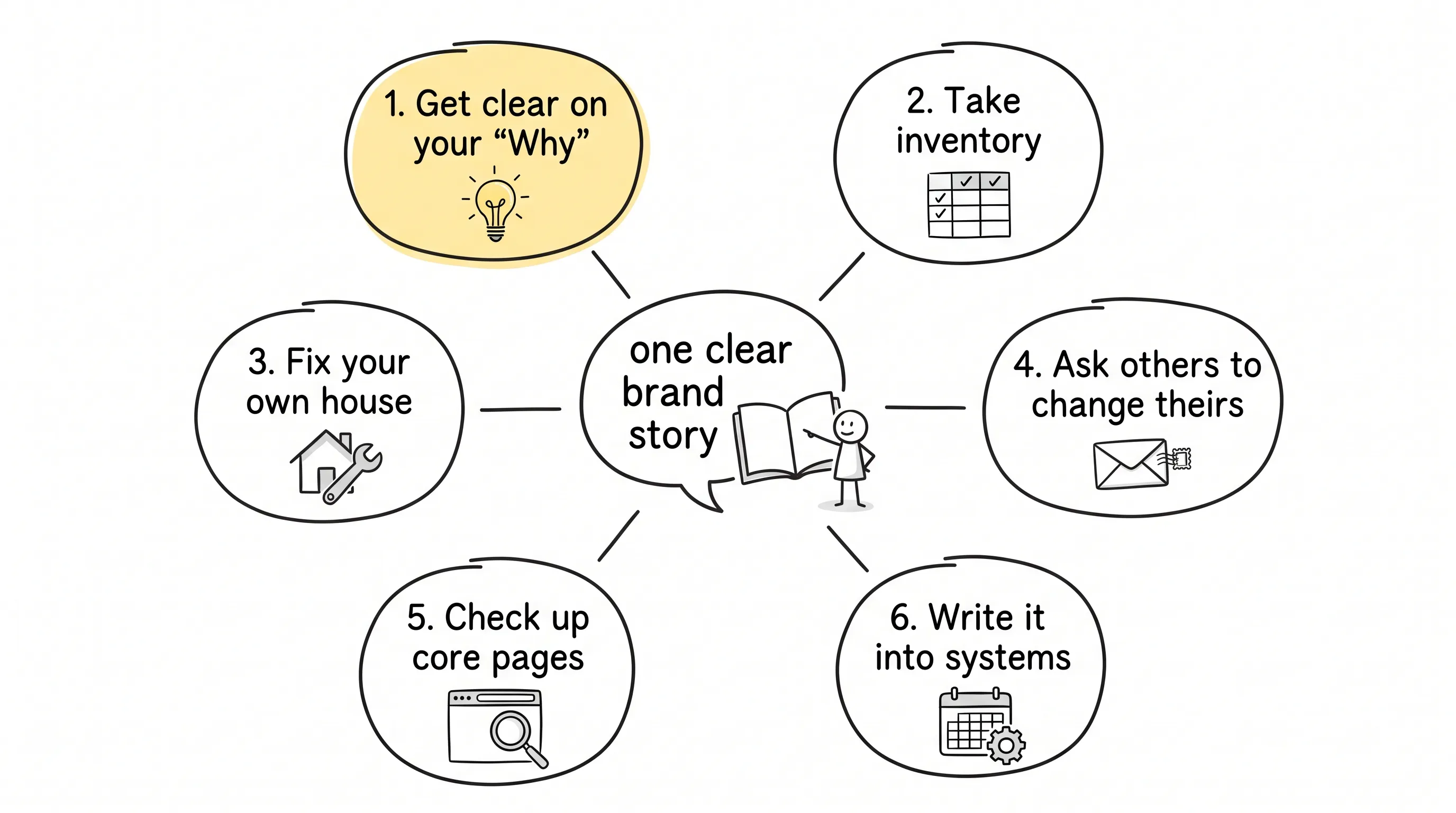
Move One: Get Clear on Your "Why"
Many brand stories start with "the year our company was founded."
Wrong.
A brand story isn't a company résumé, and it isn't the elevator pitch a salesperson rattles off. The question it has to answer is: why should customers care about you?
What do you actually do? Why do you do it? Who do you help, and with what problem?
Until those three questions are settled, don't rush into ads or events. Because when you're unclear, every campaign muddies the brand a little more.
Once you're clear, compress it into a single paragraph and put it into every one of your self-introductions. That's the foundation for everything that follows.
Move Two: Take Inventory
Then, run an audit.
Every piece of content you've ever published, every customer touchpoint, everywhere on the web you're mentioned — pull it all out into a table.
A finished inventory pays off at least twice.
First, you find out where you've "gone silent," or where people describe you harshly.
Second, the surprise usually hides in the by-products: as you work through the list, new communities and new audiences you've never touched pop up, and you get a clear view of where your competitors hang out.
Move Three: Fix Your Own House First
With the table in hand, start where you have the final say.
Website copy, sales scripts, PR templates, email templates, the introduction deck you send out — swap all of them to the new story.
Of course, this won't always go smoothly inside the company.
Think about it: sales always has a "secret pitch deck" in hand, untouched for three years, that they're perfectly comfortable using. Ask them to change it, and they'll give you eight hundred reasons.
But this hurdle has to be crossed. If the story isn't unified, you walk out the door as two different versions.
Move Four: Ask Others to Change Theirs
Once your own house is in order, go find the third parties.
For the media that covered you and the industry sites that published your introductions — send an email, politely ask them to update their wording.
Most editors are willing to make the change. Fresh information is good for their sites too. Even for a very old article, asking for a small update usually isn't hard.
As for that guy in the forum who casually chatted about you? You can't control him. But there's no harm in asking.
Don't underestimate these edits. In AEO terms, you're correcting the "entity wording" that belongs to you inside the knowledge graph.
Here's a particularly good example.
SparkToro's founder, Rand Fishkin, ran an experiment in 2025. His team put the same sentence into every bio and every company description: "makers of fine audience research software."
Then he went and asked the major AI tools: what does SparkToro do?
The AI handed that exact sentence right back. It even slipped the phrase in while answering other questions.
The same sentence, appearing in every self-introduction across the web — and AI took it as fact.
Powerful.
Move Five: Give Your Core Pages Regular Checkups
Next step, back to the old trade: SEO.
Your core traffic pages — update what needs updating, and while you're at it, add AEO-friendly elements like FAQs and key-point summaries. The higher a page ranks in traditional search, the more likely RAG retrieval picks it up.
One caveat: the update has to be a "substantive update." Add new data, flesh out details, or restructure outright so the information is fuller. A lazy date-bump — search engines can tell.
Treat it like servicing a car. It's not a one-time job; it comes due every so often.
How often? Here's the math:
News and trend-chasing content needs a refresh every 30 to 60 days. Product pages and comparison reviews, every 30 to 90 days. Evergreen educational content can go six months to a year.
One more thing: those evergreen beginner explainers have already lost a big chunk of their traffic to AI chat. Keep updating them, but don't over-invest there.
Move Six: Write the Story into the Company's Systems
The last step is also the easiest to miss.
Pull out your content calendar and run it against the brand story again. Topics that don't fit, cut; the questions your users are asking right now, add.
What are fan-out queries? The user asks one question, and the AI splits it into eight smaller ones and researches each in turn. Your content should be positioned to catch those smaller questions.
Don't forget the employee handbook and recruiting materials — unify them under the same story too. Because your employees, now and in the future, will talk about the company on third-party platforms. The real company in their eyes and the story you tell externally had better be the same story.
Otherwise? You say one thing publicly, your employees say another on forums. And AI hears both.
Finally, One Layer Deeper
LLMs run on consensus. They treat the most-cited account as the authoritative one.
What does that mean?
If your competitor's story is airtight while yours is scattered in pieces — who will AI remember?
So once the audit is done and the copy updated, don't bury the results in some forgotten corner of the company drive and let them slowly rot. Knead the brand story into the content calendar, into every call to action, into every audience persona.
Back to the numbers from the opening: 85% of mentions come from third parties.
You can't control what other people say about you. But you can make "what people say about you" grounded in something solid: plant one clear story into every corner of the web.
Every AI answer is a vote. You can't vote for yourself — but you can get more people to speak for you.
May your brand move into AI's memory soon.
Continue reading
Related articles

Cross-Border Business: Time to Upgrade Your AI Toolbox
A learn article explaining how AI tools help cross-border e-commerce sellers clear five hurdles: language, regulation, logistics, payments, and fraud. It outlines a five-compartment toolbox, a five-step adoption path, and metrics such as conversion rate and CLV, while cautioning against over-reliance on AI.

AI Is Taking Over the Dirty Work of Social Media Marketing, One Task at a Time
This learn article outlines four social media marketing tasks AI can handle — audience analytics, content drafting and design, ad targeting and creative testing, and spam moderation — and cautions that taste, judgment, and data security remain human responsibilities.

AI Is Already This Good — Why Is Your Social Media Marketing Still Pure Manpower?
An overview of 18 AI tools for social media marketing, organized into six categories covering audience research, content creation, scheduling, comment and DM handling, ad management, and visual production, plus notes on personalization, prediction, and emerging trends.