
In the AI Era, a Crisis Doesn't Pass — It Gets Remembered
An analysis of the November 2025 Campbell's crisis case arguing that AI assistants now retell negative coverage and shape brand first impressions, so companies should build search content assets and monitor their representation in AI answers before a crisis occurs.
Lately I've been turning one thing over in my head: the day your brand gets hit with negative news, the first one to tell the story to the public may no longer be a news outlet.
It's AI.
The thought comes from a firestorm in November 2025. At the center of it: Campbell's, the canned-soup company.
Let me walk you through what happened.
An audio recording, allegedly of an executive, began making the rounds online. The lawsuit alleges that the executive called the company's own soup "highly processed food for poor people," said the products used "bioengineered meat," and made disparaging remarks about employees. The employee believed to have recorded the remarks was then fired by the company — and filed a lawsuit.
Think about it: on one side, an executive who seemingly wrote off the company's own products as food for poor people; on the other, the employee who made the recording getting fired. Pick either one on its own, and you have a topic primed to explode.
Sure enough, it exploded.
What Did This Cost?
The marketing firm Terakeet later combed through the data from this firestorm. Two numbers made my stomach drop when I saw them.
One: negative news sentiment surged to 70%.
The other: the stock fell 7.3%, wiping $684 million off the company's market capitalization.
And it didn't stop there. Search for Campbell's, or for any of its products, and nearly every slot on Google's front page — the news results, People Also Ask, AI Overviews — was filled with versions of this story from every angle.
What does that mean? It means that even someone trying to form an objective picture of the company afterward would see nothing but this crisis on their first screen of results.
Brand impressions built up over years, wiped out overnight.
On the consumer side, calls to boycott Campbell's began to build. And the employee who made the recording, then got fired and went to court — in job seekers' eyes, that becomes another layer of the story: Is this company's culture any good? When something goes wrong, do executives answer for it? Could you actually feel at ease working there?
Those impressions will have a very real effect on whom the company can hire — and keep.
What Did AI Actually Do Here?
Reading this far, you might think: isn't this just an ordinary PR crisis, one that simply spread faster?
No. The real variable is AI.
What do I mean by AI's negative bias?
Put simply: in this content ecosystem, sensational and controversial material is naturally the most eye-catching. Once something gains traction, social media and news sites repost and cite each other, and the content rolls up into a snowball. Meanwhile, AI systems stand nearby, gulping all of it down, then retelling it to the next person who asks.
During this firestorm, searches for "3D-printed meat" spiked, as countless people asked: is what Campbell's uses even real meat?
Surely, you'd think, this is where AI steps in to set the record straight?
It didn't.
Instead, it pulled a phrase straight from Campbell's own website: "mechanically separated chicken." The phrase originally described the company's own ingredient process; AI plucked it out, jammed it into fragmented contexts, and recited it to everyone who asked.
The more it retold, the worse it got.
AI has no obligation to clarify the truth for you. Its only job is to repeat what it has read.
Honestly, sit with that detail for a second: the words the brand wrote about itself became the knife turned against it.
Statements Help — But They're Not Enough
Campbell's response was the standard set of moves: issue a formal statement, publish a press release on its website, reaffirm that its ingredients are the real thing.
Those moves worked. They reinjected facts into the discussion, and early signals showed AI already beginning to cite the clarifications.
But on their own, they're not enough.
Why?
Because once a controversy spreads across news, social media, and search, it settles into the data layer — the layer AI learns from.
What's the data layer? It's the evidence AI speaks from. AI has no eyes of its own; whatever it reads, it believes, and whatever it believes, it repeats. Once the water in the pool is dirty, every cup you scoop out of it is dirty too.
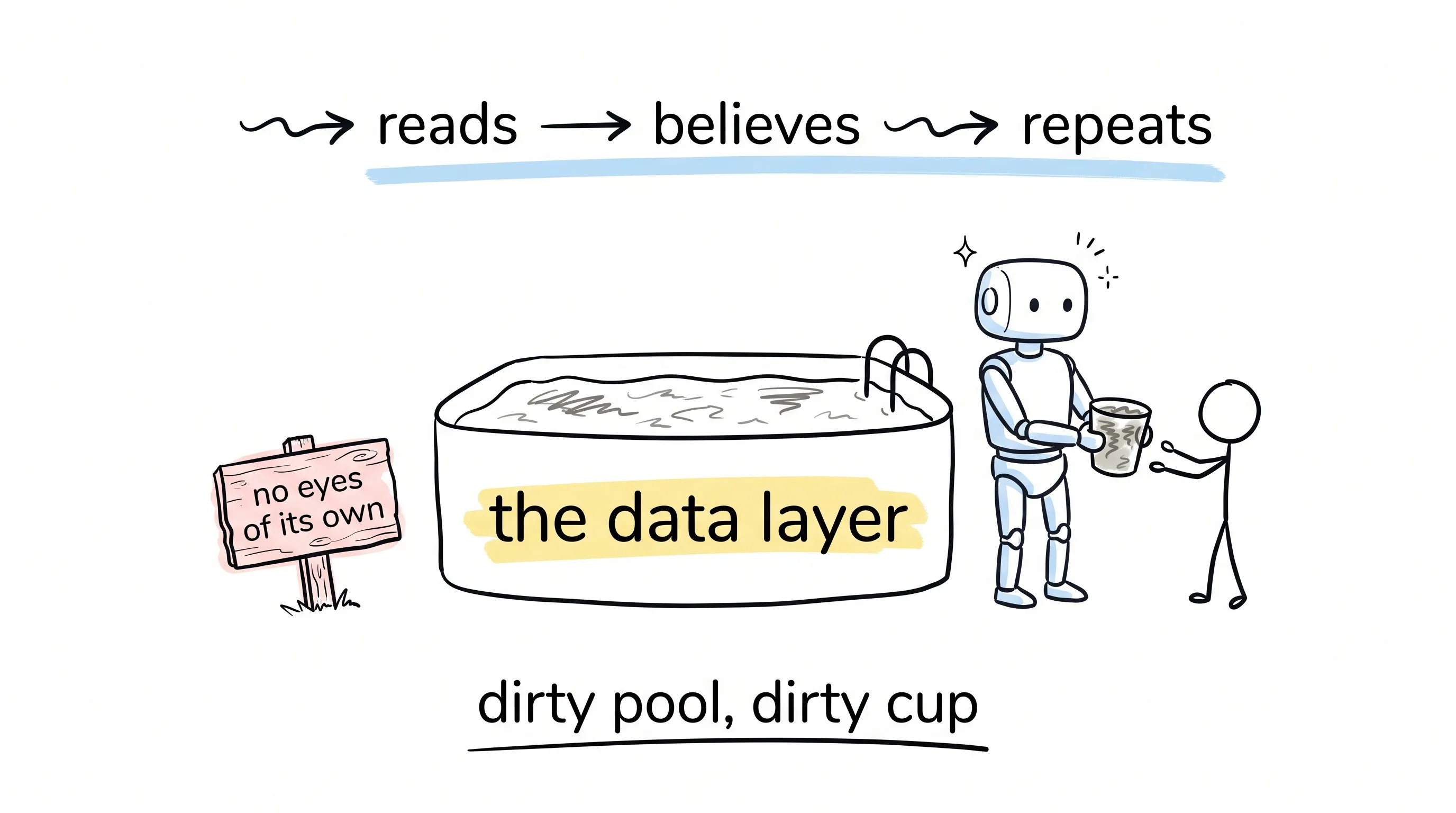
Trying to clean it up afterward is like picking pebbles out of mixed concrete.
The Best PR Happens Before the Crisis
So the place where effort is truly worth spending is when the waters are calm.
Campbell's ideal posture would have been to build out its search real estate before anything went wrong: publish authoritative, fact-clarifying content assets in advance, so that the front page of search stays occupied, long term, by controllable, credible content the company owns.
That way, when the day of scrutiny arrives, negative content finds it hard to squeeze onto the front page; and when the news cycle moves on, the negative finds it hard to hang around.
This approach is like building a firewall around yourself. A firewall can't block every risk. But it decides how loud your voice is when a crisis hits — and how long the echo lasts after it passes.
There's also a daily assignment: keep an eye on what your brand looks like inside ChatGPT, Gemini, and Perplexity.
More and more people treat an AI assistant as their first stop for getting to know a brand. AI-generated summaries are becoming many people's "first impression" of a brand.
Whether that impression is accurate is no longer something the PR department can manage with a single statement. It has to be tended the way you tend your website or your flagship store — checked daily, nurtured daily.
Back to the Question We Started With
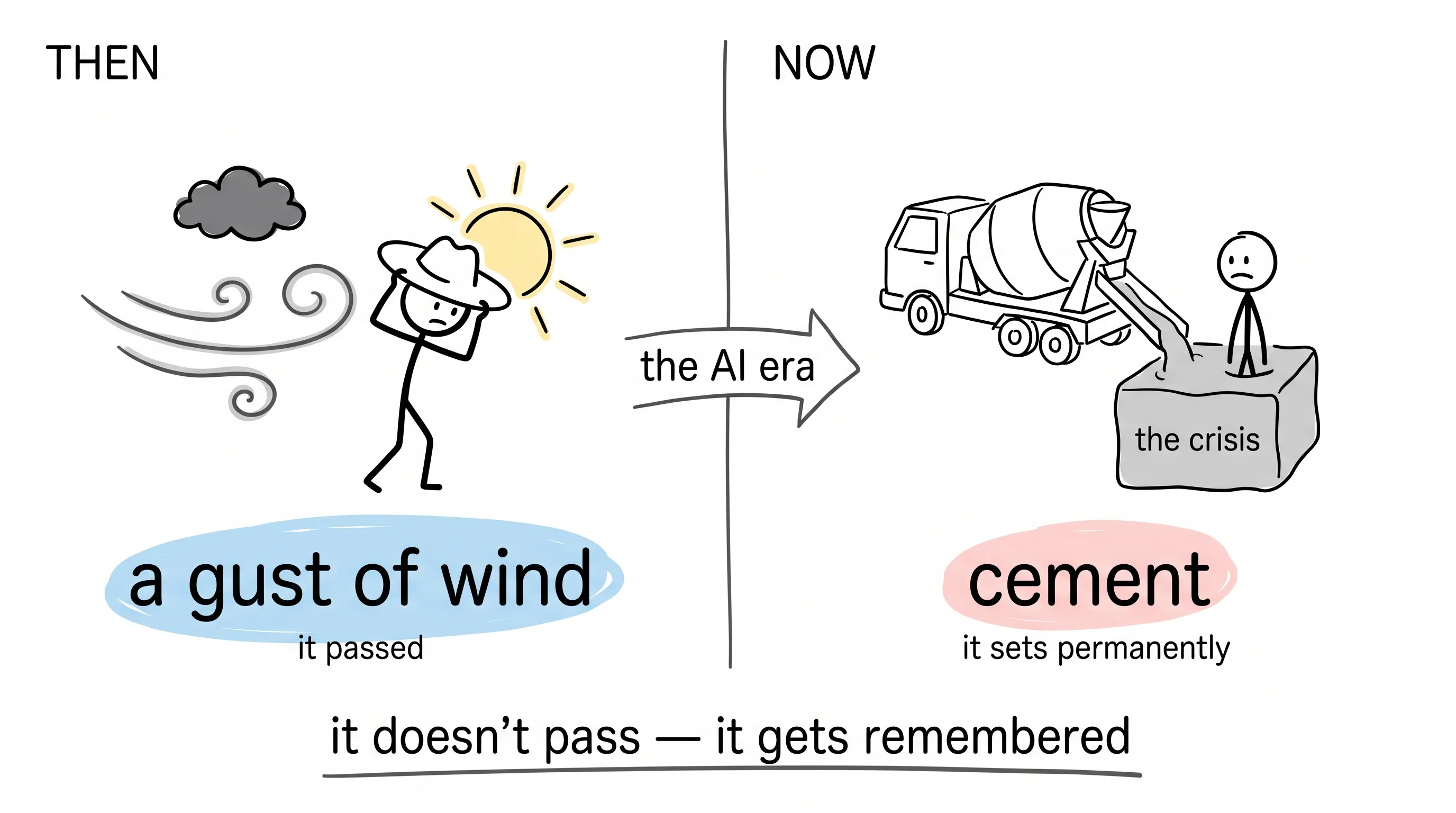
Crises used to be like a gust of wind. While it blew, the sky went dark; once it passed, everyone picked up and moved on.
Crises now are like cement. One stir, one pour into the foundation, and it sets permanently.
Reputation has moved from "fix it after it breaks" to "cultivate it before it happens." Your search real estate, your reputation inside AI — both demand upfront investment and daily care.
So stop asking "will AI get skewed by this story?"
Ask yourself instead: starting today, are you continuously shaping what AI puts out?
That's my take. It may not be right.
And I hope you never have to use this playbook.
Continue reading
Related articles

Cross-Border Business: Time to Upgrade Your AI Toolbox
A learn article explaining how AI tools help cross-border e-commerce sellers clear five hurdles: language, regulation, logistics, payments, and fraud. It outlines a five-compartment toolbox, a five-step adoption path, and metrics such as conversion rate and CLV, while cautioning against over-reliance on AI.

AI Is Taking Over the Dirty Work of Social Media Marketing, One Task at a Time
This learn article outlines four social media marketing tasks AI can handle — audience analytics, content drafting and design, ad targeting and creative testing, and spam moderation — and cautions that taste, judgment, and data security remain human responsibilities.

AI Is Already This Good — Why Is Your Social Media Marketing Still Pure Manpower?
An overview of 18 AI tools for social media marketing, organized into six categories covering audience research, content creation, scheduling, comment and DM handling, ad management, and visual production, plus notes on personalization, prediction, and emerging trends.